

Someone in your service area just asked ChatGPT, “What’s the best moving company for a family relocating from Austin to Denver?” The AI responded with five names. Your company, with 15 years of experience, an A+ BBB rating, and hundreds of five-star reviews, didn’t make the list.
The issue isn’t your service record. It’s that AI doesn’t recognize your authority.
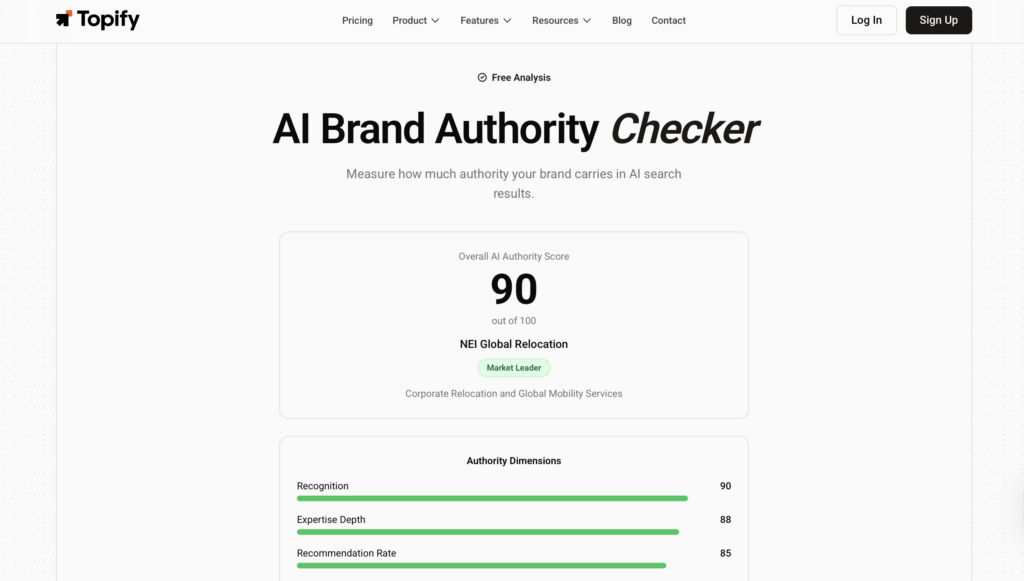
There’s a way to see exactly where the disconnect is. Topify‘s Brand Authority Checker scores how AI models perceive your relocation brand’s credibility, broken down into four dimensions that directly affect whether you get recommended.
✅ Free ⚡ Results in 60 seconds 🔒 No signup required
AI Brand Authority Checker
What Brand Authority Actually Means for a Moving Company
AI doesn’t recommend movers the way Google ranks them. There’s no keyword bidding, no ad spend that buys you a top position. AI models evaluate brands on authority signals: how well-known you are in your category, how deeply AI understands your services, how often it recommends you over alternatives, and how much third-party validation it can find.
For relocation companies, these signals carry outsized weight. People are handing their entire household to a company they found through a prompt. AI treats that trust threshold seriously.
The Four Scores That Decide If AI Trusts Your Relocation Brand
Each score from the Brand Authority Checker maps to a specific problem movers face in AI search.
| Metric | What It Measures | What It Means for Relocation Brands |
|---|---|---|
| Recognition (0-100) | How often AI identifies your brand in the moving category | Below 40: AI doesn’t associate you with relocation services in your region |
| Expertise Depth (0-100) | How well AI understands your service capabilities | Below 50: AI may not know you handle cross-country moves or corporate relocation |
| Recommendation Rate (0-100) | How often AI recommends you vs. alternatives | Below 30: you’re losing booked jobs to companies AI prefers |
| Trust Signals (0-100) | External validation AI detects (reviews, media, citations) | Below 40: AI can’t find enough third-party evidence to vouch for your reliability |
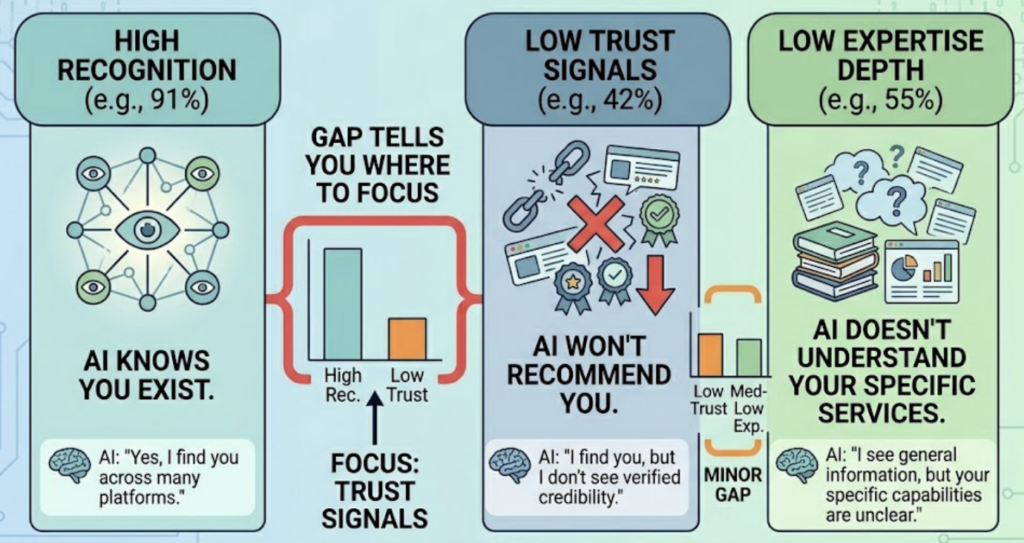
A relocation company with a Recognition score of 80 but a Trust Signals score of 25 has a specific, fixable problem: AI knows who you are, but doesn’t trust you enough to recommend you. That gap typically means your reviews, media mentions, or directory listings aren’t structured in ways AI can access.
Three Scenarios Where Movers Discover They’re Invisible
Scenario 1: Strong local reputation, zero AI presence. A mover with 500+ Google reviews and a 4.8 rating runs the check and finds a Recognition score of 18. The AI simply doesn’t connect their brand to the relocation category. The likely cause: thin website content, no structured data, and minimal presence on platforms AI crawls beyond Google.
Scenario 2: AI recommends you for the wrong service. A full-service corporate relocation firm discovers their Expertise Depth score is 35. When they test prompts like “best corporate relocation companies,” AI describes them as a local residential mover. The AI’s understanding of their capabilities is outdated or incomplete.
Scenario 3: Competitor gets recommended despite lower ratings. A company with 4.9 stars notices a competitor with 4.2 stars consistently appears in AI answers. The Brand Authority Checker reveals the competitor’s Trust Signals score is 30 points higher, driven by mentions on Reddit, industry publications, and structured review data across multiple platforms.
How to Run Your Brand Authority Check
Go to Brand Authority Checker, enter your moving company’s brand name or domain, and get your four-dimensional authority breakdown in under 60 seconds. No signup, no credit card.
Look at each score individually first. Then compare them against each other. The gap between your highest and lowest score tells you exactly where to focus. A high Recognition but low Trust Signals score means AI knows you exist but won’t recommend you. A high Trust Signals but low Expertise Depth means AI trusts you in general but doesn’t understand your specific services.
Relocation Buyers Ask AI First. Here’s What They’re Typing.
The prompts people type into AI platforms reveal what drives their moving decisions. These aren’t broad searches like “movers near me.” They’re specific, intent-heavy questions that force AI to make a recommendation.
| AI Prompt Example | Platform | Search Intent | What It Reveals |
|---|---|---|---|
| “Best moving company for a family move from Chicago to Phoenix” | ChatGPT | Long-distance purchase decision | Whether AI recommends you for specific routes |
| “Most reliable movers for fragile and antique items” | Perplexity | Specialty service trust verification | Whether AI understands your specialty capabilities |
| “Compare corporate relocation companies for 200 employees” | Gemini | Enterprise vendor evaluation | Where you rank in B2B relocation comparisons |
| “Affordable local movers in [city] with good reviews” | ChatGPT | Budget-conscious local decision | Whether your brand appears in price-sensitive queries |
| “Is [your brand] licensed and insured for interstate moves?” | Perplexity | Trust and compliance verification | How accurately AI describes your credentials |
Here’s the thing: each of these prompts can return a completely different set of recommended companies. Research on local business AI recommendations found that ChatGPT and Perplexity recommend almost entirely different businesses for the same query. Your brand might appear on one platform and be completely absent on the other.
That gap is invisible unless you measure it.
AI Recommendations Favor National Chains. Local Movers Are Fighting an Uphill Battle.
National relocation brands dominate AI search results for a structural reason: they have larger digital footprints. More media coverage, more platform listings, more structured data, more Reddit threads, more everything that AI models use to build authority profiles.
A regional mover serving three states with a flawless service record competes against national chains that have thousands of indexed pages, press releases in major outlets, and reviews spread across every platform AI crawls. The playing field isn’t level, and the Brand Authority Checker’s Recognition score makes this gap visible in hard numbers.
This doesn’t mean local movers can’t win. It means they need to know the score before building a strategy. AI models weight review signals heavily: companies recommended by ChatGPT average 4.3 stars, while Perplexity recommendations average 4.1 stars. Brands below those thresholds get filtered out entirely.
The action path for local and regional movers is specific:
- Run the Brand Authority Checker to see your baseline Recognition and Trust Signals scores
- Identify which dimensions are weakest (often Trust Signals for local companies)
- Build structured content and review distribution strategies that target the specific signals AI looks for
A local mover with a Recognition score of 20 isn’t permanently invisible. That score tells you exactly how far the gap is and where to start closing it.
Your Brand Authority Changes by City. Are You Checking Every Service Area?
Unlike SaaS or e-commerce, relocation is hyper-local. A moving company serving the Dallas-Fort Worth metro, Houston, and San Antonio will have a different AI authority profile in each market. AI might recommend you in Dallas but have no idea you exist in San Antonio.
This is because AI builds location-specific context from different signal clusters. Your Google Business Profile in one city, your Yelp reviews in another, your BBB listing in a third. If your digital presence is uneven across service areas, your AI visibility will be uneven too.
The practical implication: a single brand authority check isn’t enough for multi-market movers. You need to test how AI perceives your brand in each service region. A company scoring 65 in its headquarters city might score 15 in a market it expanded into last year.
| Service Area Factor | Why It Affects AI Authority | What to Check |
|---|---|---|
| Local review volume | AI weights location-specific reviews for local queries | Review count and rating per city on Google, Yelp, BBB |
| Local content pages | AI needs city-specific content to associate your brand with an area | Whether you have dedicated service pages per market |
| Local directory listings | Consistent NAP data helps AI verify your presence | Accuracy across 20+ directories per service area |
| Local media mentions | Regional press strengthens location-specific authority | Whether local outlets have covered your company |
This matters more as AI search behavior shifts toward longer, more specific queries. Ten-word queries trigger AI Overviews more than five times as often as single-word searches. “Best moving company in San Antonio for a three-bedroom house” is a real prompt that demands location-specific authority.
One Snapshot Tells You Where You Stand. Continuous Tracking Keeps You There.
Your Brand Authority Checker results show you today’s picture. But AI models update their training data, adjust ranking signals, and shift recommendations on a rolling basis. A score of 72 today could drop to 50 next quarter if a competitor builds stronger signals in your market, or if AI reweights the sources it trusts.
Topify‘s platform picks up where the free tool leaves off. The Comprehensive GEO Analytics dashboard tracks your authority, sentiment, and visibility scores continuously across ChatGPT, Perplexity, Gemini, and Google AI Overviews. For relocation companies operating in multiple cities, this means monitoring brand authority per market without running manual checks every week.
Here’s how the free check compares to the full platform:
| Capability | Free Brand Authority Checker | Topify Platform |
|---|---|---|
| Check frequency | One-time snapshot | Continuous daily/weekly monitoring |
| AI platforms covered | Aggregated score | Per-platform breakdown (ChatGPT, Perplexity, Gemini, AI Overviews) |
| Historical trends | None | Full trend history with alerts |
| Competitor tracking | Not included | Real-time competitor benchmarking |
| Multi-market monitoring | Manual per-city checks | Automated per-market tracking |
| Action recommendations | General direction | Specific, prioritized optimization steps |
Every plan starts with a 7-day free trial, no credit card required. The Starter plan begins at $99/month.
Conclusion
AI is becoming the first filter for relocation decisions. Corporate HR managers, families planning cross-country moves, and individuals comparing local movers are all asking AI platforms for recommendations before they visit a single website. If your brand authority scores are low, you’re not in the conversation.
Start with the Brand Authority Checker to get your baseline. Run it for your brand name, then test it against the specific service areas you cover. The scores will tell you exactly where AI trusts you and where it doesn’t.
While you’re assessing your brand authority, a few other free checks can round out the picture. Topify‘s GEO Score Checker evaluates whether AI crawlers can actually access your site. The AI Visibility Report shows how often your brand gets mentioned across major AI platforms. And the Competitor Analysis tool reveals who AI considers your direct competitors in the relocation space.
FAQ
Is the Brand Authority Checker free? Do I need to create an account?
Yes, it’s completely free with no account required. Enter your brand name or domain and get your authority scores in about 60 seconds.
What’s the difference between the free tool and the Topify platform?
The free Brand Authority Checker gives you a one-time snapshot of your four authority scores. The Topify platform adds continuous monitoring, historical trend tracking, per-platform breakdowns, competitor benchmarking, and actionable optimization recommendations.
How often should a relocation company check its AI visibility?
At minimum, once per quarter. AI models update frequently, and your authority scores can shift based on new reviews, competitor activity, or changes in how AI weights its sources. Multi-market movers should check each service area separately.
My moving company has great Google reviews but low AI authority. Why?
AI doesn’t only pull from Google. It aggregates signals from Yelp, BBB, Reddit, industry publications, directory listings, and your own website’s structured data. A strong Google profile with weak presence elsewhere creates a gap that AI notices. The Brand Authority Checker’s Trust Signals score reveals exactly how much third-party validation AI can find.

