

A homebuyer in Austin opens ChatGPT and types: “Best brokerage for first-time buyers in central Texas.” Five names come back. Yours isn’t one of them. You closed 140 transactions last quarter, expanded into two new zip codes, and launched a buyer rebate program in January. None of that exists in the AI’s answer. It’s working off data from mid-2024.
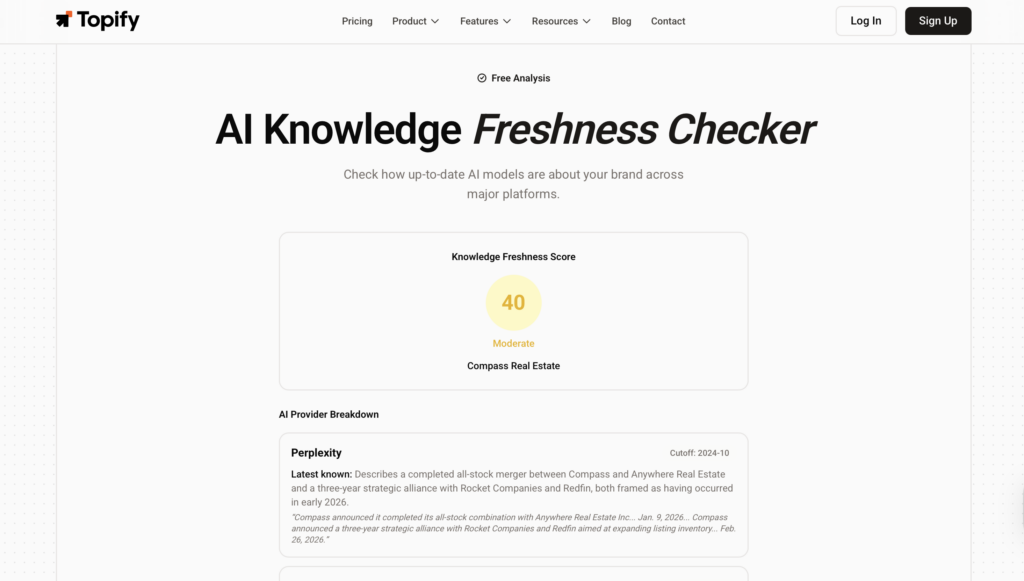
The gap is measurable, and the check takes 60 seconds. Topify‘s Knowledge Freshness Checker scans what AI models currently know about your real estate brand and flags exactly where their information has gone stale. ✅ Free ⚡ Instant freshness audit 🔒 No signup required
Knowledge Freshness Checker
What the Knowledge Freshness Checker Actually Tells You About Your Real Estate Brand
The Freshness Metrics That Matter for Property Platforms
The Knowledge Freshness Checker doesn’t give you a single pass/fail score. It breaks down AI’s understanding of your brand into specific freshness dimensions, each one tied to a different type of outdated information that could be quietly costing you leads.
Here’s how each metric maps to the real estate industry:
| Metric | What It Measures | What It Means for Real Estate Platforms |
|---|---|---|
| Information Currency | How recent AI’s data about your brand is | If AI references your 2024 service area instead of your 2026 footprint, buyers in new markets won’t find you |
| Factual Accuracy | Whether AI’s claims about your brand are correct | AI may cite old commission structures, discontinued programs, or previous brand affiliations |
| Content Coverage | How much of your current offering AI reflects | New features (rebate programs, AI-powered search, concierge services) may not exist in AI’s description |
| Update Frequency Alignment | How well AI keeps pace with your real-world changes | Real estate data shifts weekly. AI models update on much slower cycles. This metric quantifies the lag |
A platform with strong Content Coverage but poor Information Currency has a specific problem: AI knows what you do, but describes the version from a year ago. That’s fixable once you know where the gap is.
Three Scenarios Where Stale AI Data Costs You Leads
Scenario 1: AI recommends your old service area. You expanded from three metro areas to seven this year, but when a buyer asks Perplexity about brokerages in your new markets, your brand doesn’t surface. AI still maps you to your original geography.
Scenario 2: AI cites outdated fee structures. Your platform switched to a flat-fee model six months ago, but ChatGPT still describes your pricing as percentage-based. Buyers who are comparison-shopping rule you out before ever visiting your site.
Scenario 3: AI misses your recent technology upgrades. You launched 3D virtual tours and an AI-powered home valuation tool in Q1 2026. Gemini doesn’t mention either when a buyer asks what your platform offers. You look like a legacy player when you’re not.
Each of these scenarios is invisible until you check. The damage happens in conversations you never see.
How to Run a Freshness Check in Three Steps
Running the check is straightforward:
- Go to Knowledge Freshness Checker and enter your brand name or domain.
- The tool scans multiple AI models and returns a freshness breakdown within 60 seconds.
- Review each metric to identify where AI’s knowledge is outdated, then prioritize updates based on which gaps affect buyer-facing queries most.
No signup. No credit card. You’ll have a clear picture of where AI is stuck in the past before your next meeting.
Real Estate Has the Worst AI Visibility of Any Industry. Here’s What Buyers Are Actually Asking.
Here’s a number that should reframe how you think about lead generation: real estate has a 0.14% AI Overview trigger rate. That’s the lowest of any tracked industry. Health sits at 13%. Finance at 4.2%. Retail at 2.1%. Real estate is dead last.
And yet, 82% of Americans already use AI for housing market information. The demand is there. The supply of accurate, branded real estate content inside AI answers is not.
This table shows the types of prompts your potential buyers and sellers are already typing into AI platforms:
| AI Prompt Example | Platform | Search Intent | What It Reveals |
|---|---|---|---|
| “Best real estate agent in [city] for first-time buyers” | ChatGPT | Agent selection | Whether AI recommends your brokerage or defaults to a portal |
| “Is it a good time to buy in [metro] 2026?” | Perplexity | Market timing | Whether AI cites your market insights or generic national data |
| “Compare home values in [neighborhood A] vs [neighborhood B]” | Gemini | Neighborhood research | Whether your platform appears as a data source |
| “Best luxury brokerage in [metro area]” | ChatGPT | High-value purchase | Whether AI knows your luxury segment positioning |
| “How much are closing costs in [state]?” | Google AI Overview | Transaction planning | Whether your content gets cited as an authority |
58% of property searches now generate AI-powered answers without the user ever clicking through to a website. If your brand isn’t in those answers, you’re not losing a ranking position. You’re losing the entire interaction.
Why Stale Data Is the Root Cause of Real Estate’s AI Visibility Crisis
AI Is Describing Your Brand Based on Last Year’s Information
Real estate operates on a timeline that AI can’t keep up with. Listings go live and expire in days. Market conditions shift month to month. Agents switch brokerages. Platforms rebrand, merge, or expand into new markets.
AI models don’t update on that schedule.
A 2026 benchmark report found that 91% of U.S. real estate agents are effectively invisible in the AI search engines their buyers now use first. That invisibility isn’t random. In many cases, it’s because AI’s training data about those agents and their brokerages is months or years out of date. The agents exist. Their digital footprints exist. But the AI’s version of them is frozen in time.
Between October 2025 and March 2026, every major real estate portal shipped AI-powered search: Zillow’s ChatGPT app, Homes.com Smart Search, Redfin’s conversational assistant, Realtor.com’s ChatGPT integration, Zillow AI Mode. Buyers are already using these interfaces. The question is whether the information they return about your brand is current.
That’s exactly what the Knowledge Freshness Checker is built to answer.
Buyer Trust Dropped 14 Points in One Year. Accuracy Is the Way Back.
Trust in AI to help find a home fell from 30% in 2025 to 16% in 2026, according to Cotality’s global survey. That 14-point drop didn’t happen because buyers stopped using AI. It happened because AI gave them bad answers.
The same survey found that 75% of buyers expect AI to be embedded in the homebuying process. They assume it’s there. They just don’t trust it yet. And tolerance for AI errors is low: only 22% of Gen Z and 19% of millennials say they’re tolerant of mistakes.
Here’s the thing: that trust gap is an opportunity for brands that fix their AI-facing information first. If your competitors’ data in AI is stale and yours is current, you don’t just rank higher in AI answers. You become the brand that AI gets right. In a low-trust environment, accuracy is a competitive advantage.
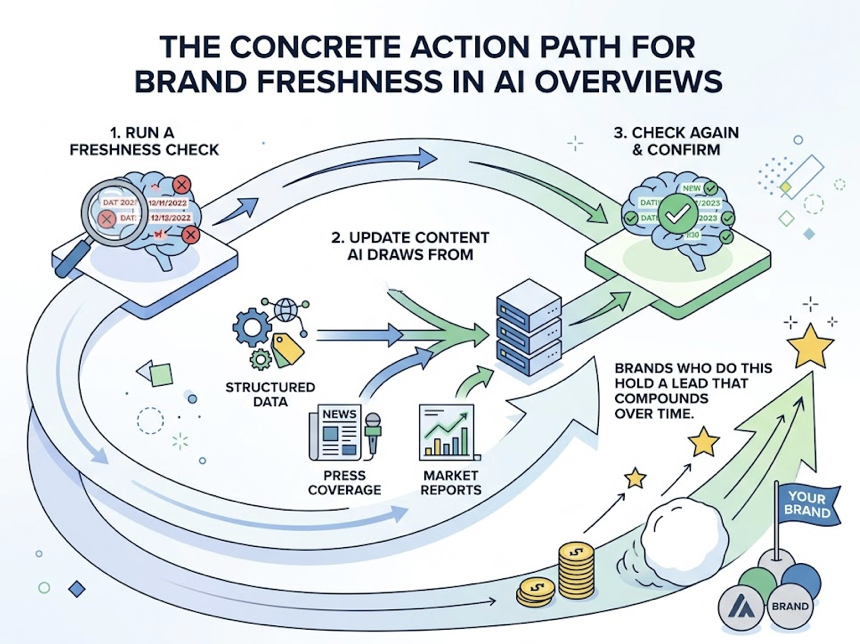
The action path is concrete. Run a freshness check to identify where AI’s information about your brand is outdated. Update the content AI draws from: your website’s structured data, your press coverage, your market reports. Then check again to confirm the changes propagated. Brands that do this before the rest of the industry catches up will hold a lead that compounds over time.
One Snapshot Isn’t Enough When Markets Move This Fast
The Knowledge Freshness Checker gives you a clear baseline: here’s what AI knows about you today, and here’s what’s stale. But real estate data doesn’t sit still. Model updates, new training data, and competitor activity shift AI’s perception of your brand on a rolling basis. A freshness check from May could be irrelevant by July.
Topify‘s platform picks up where the free tool leaves off. The Reverse-Engineer AI Citations feature goes deeper: it analyzes which sources AI models are actually citing when they mention your brand (or your competitors), identifies citation gaps, and shows you exactly where to publish or update content to stay fresh in AI’s knowledge base.
Here’s how the free check compares to the full platform:
| Capability | Free Knowledge Freshness Checker | Topify Platform |
|---|---|---|
| Check frequency | One-time snapshot | Continuous daily/weekly monitoring |
| AI platforms covered | Aggregated freshness check | ChatGPT + Perplexity + Gemini + AI Overviews |
| Historical trends | None | Full trend history with shift alerts |
| Citation source analysis | Not included | Reverse-engineer which sources AI cites |
| Competitor freshness comparison | Not included | Real-time benchmarking against competitors |
| Action recommendations | Manual interpretation | Specific update priorities with one-click execution |
Every plan starts with a 7-day free trial, no credit card required. The Starter plan begins at $99/month, covering 50 prompts per day and continuous monitoring across all major AI platforms.
Conclusion
Real estate platforms are caught in a paradox: 82% of buyers use AI for housing decisions, but the industry has the lowest AI visibility of any sector. A major driver of that gap is freshness. AI’s information about your brand, your markets, and your services is often months behind reality, and buyers are forming trust judgments based on those stale answers.
Start with the free Knowledge Freshness Checker to see where AI is stuck in the past. Fix the gaps. Then move to continuous monitoring with Topify’s platform to make sure you stay current as models update.
The brands that solve the freshness problem first will hold a structural advantage in AI search for the next two to three years. The window is open now.
While you’re assessing your knowledge freshness, a few other free checks can round out the picture. Topify‘s GEO Score Checker evaluates whether AI crawlers can actually access and index your site properly. The AI Visibility Report shows how often your brand gets mentioned across major AI platforms. And the Prompts Researcher reveals the exact real estate questions buyers are asking AI in your market.
FAQ
Is the Knowledge Freshness Checker really free? Do I need to sign up?
Yes, it’s completely free with no registration required. Enter your brand name or domain, and you’ll get your freshness breakdown in under 60 seconds. There’s no credit card and no trial expiration on the free tool.
What’s the difference between the free tool and the Topify paid platform?
The free tool gives you a one-time freshness snapshot. The Topify platform provides continuous monitoring, historical trend tracking, citation source analysis, competitor benchmarking, and actionable update recommendations across ChatGPT, Perplexity, Gemini, and Google AI Overviews. Plans start at $99/month with a 7-day free trial.
How often should a real estate platform check its AI visibility freshness?
Given how fast real estate data changes, a monthly freshness check is the minimum. Platforms with frequent listing updates, market reports, or expansion activity should check bi-weekly or move to continuous monitoring via the full platform. Major events (mergers, rebrands, new market launches) warrant an immediate check.
Why does real estate have worse AI visibility than other industries?
Real estate data is highly local, time-sensitive, and fragmented across thousands of brokerages and platforms. AI models struggle to keep up with weekly market shifts, and the industry has historically invested less in structured data and AI-facing content than sectors like healthcare or finance. The result: a 0.14% AI Overview trigger rate, the lowest of any tracked industry.

