

Families Ask AI for Care Recommendations. Is Your Community in the Answer?
A daughter types into ChatGPT at 11 p.m.: “Best assisted living near Portland for a parent with early-stage dementia.” Five communities come back. Yours, with 95% occupancy and a 30-year track record, isn’t one of them. The problem isn’t your care quality. It’s that AI doesn’t recognize your authority.
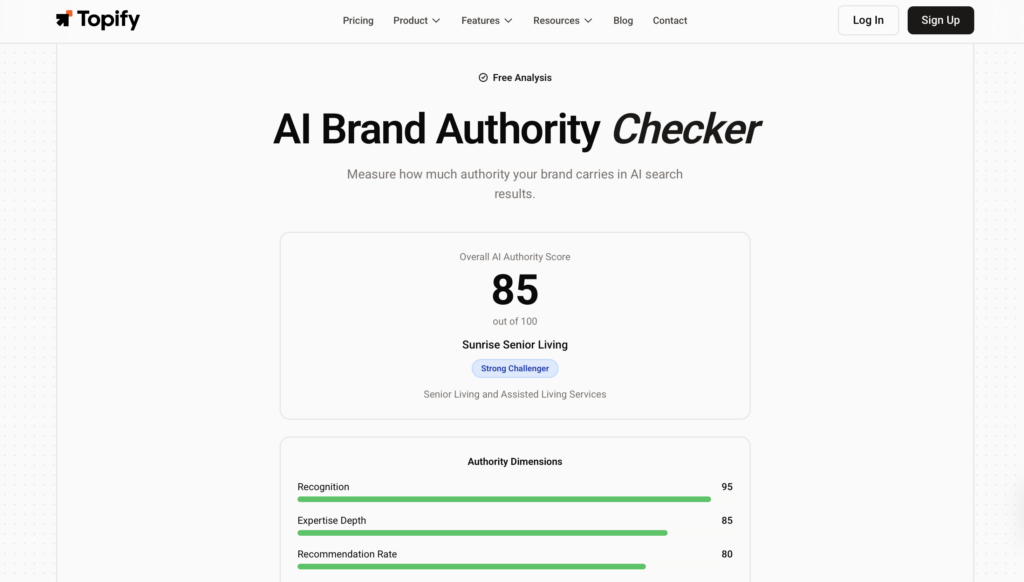
There’s a way to find out exactly where the gap is. Topify‘s Brand Authority Checker scores how AI models perceive your community’s trustworthiness, broken down into four dimensions that directly influence whether you get recommended.
✅ Free ⚡ Results in 60 seconds 🔒 No signup required
AI Brand Authority Checker
What the Brand Authority Checker Reveals About Your Community
The Four Scores That Decide If AI Trusts Your Assisted Living Brand
The Brand Authority Checker evaluates your community across four distinct dimensions. Each one maps to a specific way AI models decide whether to include you in a recommendation.
Here’s what they measure and what they mean for assisted living operators:
| Metric | What It Measures | What It Means for Assisted Living |
|---|---|---|
| Recognition Score | How often AI identifies your brand by name | Low score = AI doesn’t know your community exists in your metro area |
| Expertise Depth | How well AI understands your services and specializations | Low score = AI may describe you as “general senior living” instead of highlighting your memory care program or rehab services |
| Recommendation Rate | How frequently AI recommends you when families ask | Low rate = families touring competitors before they ever hear your name |
| Trust Signals | External validation AI detects (reviews, citations, media) | Weak signals = AI treats your community as unverified, even with decades of operations |
Don’t assume a strong local reputation translates to a strong AI authority profile. AI models weigh structured data, indexed reviews, and third-party citations. A community with 200 recent Google reviews and a well-structured FAQ page can outrank a 30-year operator with thin online signals.
Three Scenarios Every Assisted Living Operator Should Check For
Scenario 1: High occupancy, low AI recognition. Your community runs at 90%+ occupancy through referral networks and hospital discharge partnerships. But when you run the Brand Authority Checker, your Recognition Score is below 40. AI simply doesn’t know you exist because your referral-driven model never required strong digital authority signals.
Scenario 2: Outdated service descriptions in AI answers. You expanded your memory care wing and added a rehab program last year. But AI still describes your community based on a two-year-old profile. Your Expertise Depth score reflects what AI thinks you offer, not what you actually offer. Families get the wrong picture before they ever call.
Scenario 3: Strong reviews, weak recommendation rate. Your Google rating is 4.6 stars. But your Recommendation Rate is still low. The issue: your reviews sit on one platform, and AI models pull trust signals from multiple sources. A single-channel review strategy doesn’t translate to broad AI authority.
How to Run Your Community Through the Checker in 60 Seconds
The process takes three steps:
- Go to the Brand Authority Checker and enter your community’s brand name.
- Review the four-dimensional authority breakdown. Note which scores fall below 50, since those are the dimensions where AI is most likely to skip your community.
- Compare your scores against the category benchmarks the tool provides. If your Recognition Score is high but your Recommendation Rate is low, AI knows you exist but doesn’t trust you enough to suggest you.
No account needed. No credit card. You’ll have a clear read on your AI authority profile in under a minute.
The AI Prompts That Decide Where Families Tour First
Families researching assisted living don’t search the way they used to. Instead of typing “assisted living near me” into Google, they’re asking conversational questions to ChatGPT, Perplexity, and Google’s AI Overviews. And the answers they get shape which communities make the shortlist before a single phone call happens.
Here are the prompts driving real decisions in this category:
| AI Prompt Example | Platform | Search Intent | What It Reveals About Your Brand |
|---|---|---|---|
| “Best assisted living for dementia near [city]” | ChatGPT | Care-specific recommendation | Whether AI links your community to specialized memory care |
| “Is $7,000/month for assisted living worth it?” | Perplexity | Cost-value evaluation | How AI frames your pricing: justified or expensive |
| “Assisted living vs. home care for aging parent” | Google AI Overview | Care model comparison | Whether your community appears as a recommended alternative |
| “Which assisted living facilities have the best reviews in [area]?” | ChatGPT | Trust verification | Whether AI sees enough review signals to include you |
| “Signs my parent needs assisted living” | Perplexity | Early-stage research | Whether your content appears as an educational authority |
| “Assisted living with physical therapy programs” | Gemini | Service-specific search | Whether AI understands the depth of your service offerings |
Aline’s 2026 Senior Living Benchmark Report found that older adults initiated more than half of senior living research in 2025. These aren’t just adult children searching on behalf of parents. Seniors themselves are asking AI for guidance. If your community isn’t in the AI answer for the prompts above, you’re invisible to both generations of decision-makers.
What the Data Says About AI Authority and Assisted Living
Strong Local Reputations Don’t Guarantee AI Visibility
Here’s the thing: assisted living communities built on referral networks, hospital partnerships, and local physician relationships often have the weakest AI authority profiles. That’s because AI doesn’t measure reputation the way families and referral partners do.
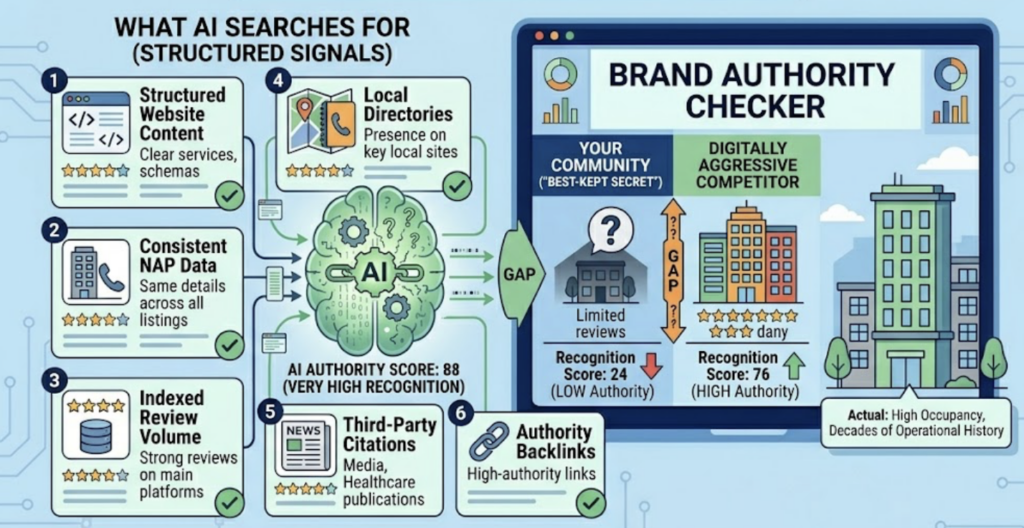
AI models look for structured content on your website, consistent NAP (name, address, phone) data across directories, review volume on indexed platforms, and third-party citations in media or healthcare publications. A community that’s “the best-kept secret in town” is, to AI, literally a secret. The Brand Authority Checker makes this gap visible. You might discover that your Recognition Score is a fraction of what a newer, digitally aggressive competitor scores, despite your community having twice the occupancy and ten times the operational history.
Industry data shows that AI tools actively scan public sentiment, review volume, and recency to assess credibility. Communities with steady, timely review responses and strong local reputation signals are more likely to appear in AI-generated recommendations. If you rely on word-of-mouth alone, AI has nothing to scan.
Crisis-Driven Research Leaves Zero Room for Discovery
Assisted living decisions often happen under pressure. A parent falls. A cognitive assessment comes back concerning. A hospital discharge coordinator says, “You need to find a community this week.”
In that moment, the adult child opens ChatGPT and asks for recommendations. They don’t browse 15 websites. They don’t call 10 communities. They trust the AI’s top three to five answers and start scheduling tours.
Assisted living inquiry-to-move-in conversion rates dropped 10% in 2025, even as independent living conversions jumped 16.7%. One explanation: the families reaching assisted living communities through traditional channels are less pre-qualified than they used to be, because the most motivated families are now following AI recommendations first. If your authority score is low, you’re not on that crisis shortlist. And in this category, there are no second chances.
Rising Rates Make the Cost-Value Story AI Tells About You Even More Critical
Assisted living asking rates rose 5.9% year-over-year in 2025, with some operators pushing 8-10% increases in 2026. When a family asks AI “Is assisted living worth $7,000 a month?”, the answer depends on how AI perceives your community’s expertise and trust profile.
A high authority score means AI frames your rate as a reflection of quality care, specialized programming, and clinical depth. A low authority score means AI either ignores your community entirely or, worse, positions it as one of the “expensive options” without the context that justifies the price. In a market where rates are climbing and families are cost-conscious, the narrative AI builds around your brand directly affects whether a $7,000 inquiry converts into a $7,000 move-in.
One Snapshot Isn’t Enough: Tracking Authority Over Time
The Brand Authority Checker gives you a clear baseline. But AI search results shift as models update, new content gets indexed, and competitor signals change. A score you check today could look different in 30 days.
Topify‘s Comprehensive GEO Analytics platform picks up where the free tool leaves off. It continuously tracks your community’s visibility, authority trends, and sentiment across ChatGPT, Perplexity, Gemini, and Google AI Overviews, all from a single dashboard. For assisted living operators, that means seeing how your authority scores shift after you publish new content, respond to reviews, or update your service pages.
| Capability | Free Brand Authority Checker | Topify Platform |
|---|---|---|
| Check frequency | One-time snapshot | Continuous daily/weekly monitoring |
| AI platforms covered | Single check | ChatGPT + Perplexity + Gemini + AI Overviews |
| Historical trends | No | Full trend history with alerts |
| Competitor tracking | No | Real-time competitor benchmarking |
| Actionable next steps | Manual interpretation | One-click GEO optimization recommendations |
| Team collaboration | No | Shared dashboards for marketing + admissions teams |
Topify’s platform starts at $99/month with a 7-day free trial and no credit card required. For communities spending thousands on referral partnerships and traditional marketing, adding AI visibility tracking to the mix is a small line item with outsized impact. You can start a free trial and see your full authority trend data within minutes.
Conclusion
Assisted living is a trust-first category, and AI is now the first place families go to decide which communities deserve that trust. If your authority profile is weak, you don’t get considered. It’s that simple.
Start with the Brand Authority Checker to see how AI perceives your community right now. Use the four-score breakdown to identify which dimensions need work. Then, if you need continuous tracking as your content strategy evolves, Topify’s platform keeps you in the loop across every major AI search provider.
Other free tools worth running alongside the Brand Authority Checker:
Your AI authority profile is only one piece of the puzzle. The GEO Score Checker evaluates whether AI crawlers can access your site’s content properly, a common issue for communities using older CMS platforms. The AI Visibility Reportshows how often your brand gets mentioned across major AI platforms, giving you a frequency baseline. And the Brand Sentiment Checker reveals how AI describes your community’s strengths and weaknesses, so you can see whether the narrative matches reality.
FAQ
Is the Brand Authority Checker free? Do I need to create an account?
Yes, it’s completely free with no signup required. Enter your community’s brand name and get your four-dimensional authority score in about 60 seconds.
What’s the difference between the free tool and Topify’s paid platform?
The free Brand Authority Checker provides a one-time snapshot of your AI authority profile. Topify’s platform adds continuous monitoring, historical trend tracking, competitor benchmarking, and optimization recommendations across multiple AI search providers. Plans start at $99/month with a 7-day free trial.
How often should an assisted living community check its AI visibility?
At minimum, after any major change: new service launches, website redesigns, review campaigns, or media coverage. For communities actively investing in content and SEO, monthly checks with the free tool or continuous monitoring through the platform give the most actionable data.
My community has great reviews on Google. Why would my AI authority score be low?
AI models pull trust signals from multiple platforms and sources, not just Google. If your reviews are concentrated on a single platform, your overall authority profile can still be thin. AI also weighs content structure, media citations, and directory consistency. A high Google rating is a good foundation, but it’s not the whole picture.

