

Your brand might rank on page one of Google. But when someone asks ChatGPT to recommend a tool in your category, you’re not there. That’s not a content problem. It’s a visibility problem in a system most teams haven’t started measuring yet.
AI search optimization is the practice of making your brand visible, citable, and trustworthy to AI systems. It operates by a different set of rules than traditional SEO, and the gap between teams who understand that and teams who don’t is widening fast.
AI Search and Traditional SEO Are Not the Same Game
Traditional SEO is about ranking. You optimize for crawlability, keyword density, and backlinks. The output is a position on a results page.
AI search doesn’t work that way. When a user asks ChatGPT or Perplexity a question, the model doesn’t return a ranked list. It synthesizes an answer and, in doing so, decides which sources to cite and which brands to mention. That decision isn’t about ranking. It’s about perceived authority, semantic clarity, and cross-platform trust signals.
The practical implication: two brands with identical Google rankings can have completely different AI visibility outcomes. The one that shows up in AI answers isn’t necessarily the one with more backlinks. It’s the one the model “trusts” as a source.
That’s a different optimization problem.
So, What Is AI Search Optimization?
AI search optimization (also referred to as Generative Engine Optimization, or GEO, and Answer Engine Optimization, or AEO) is the process of making a brand visible and citable across AI-driven search platforms including ChatGPT, Gemini, Perplexity, and Google AI Overviews.
Unlike traditional SEO, which targets keyword rankings, AI search optimization targets the model’s citation decision. The goal is to be the brand that gets mentioned when a user asks an AI system a question relevant to your category.
Here’s a useful way to frame the shift:
| Traditional SEO | AI Search Optimization | |
|---|---|---|
| Core goal | High SERP ranking | Inclusion as a cited source in AI answers |
| Interface | Lists of links | Synthesized natural-language answers |
| What models analyze | Keyword density, backlinks | Semantic clarity, entity authority, factual accuracy |
| Key metrics | CTR, organic traffic | Brand mention rate, citation rate, sentiment score |
The underlying mechanism matters here. AI systems use retrieval-augmented generation (RAG) to find relevant sources before generating an answer. They don’t rank pages. They assess which sources best answer the query with accuracy, clarity, and authority. That’s the process you’re optimizing for.
The 5 Signals That Actually Drive AI Citations
Most teams assume that good SEO automatically translates to AI visibility. It often doesn’t. The signals LLMs use to select sources are related to, but distinct from, traditional ranking factors.
Answerability. Models favor content that front-loads answers. If the most important information sits in the first 30% of your content, it’s significantly more likely to be retrieved. Structured Q&A sections, direct definitions, and clean paragraph openings all improve answerability.
Entity authority. AI systems cross-validate brands by checking whether they appear consistently across high-authority domains, such as industry publications, news sites, forums like Reddit, and review platforms like G2 or Trustpilot. A brand mentioned once on Forbes carries less weight than a brand mentioned consistently across 20 relevant sources.
Semantic structure. Clean HTML, heading hierarchies, and schema markup help models parse and extract facts accurately. Structural clarity isn’t just a UX consideration; it’s a retrieval consideration.
Freshness. LLMs exhibit a recency bias. Content that’s regularly updated, or that reflects real-time developments, is more likely to be retrieved than static pages that haven’t changed in two years.
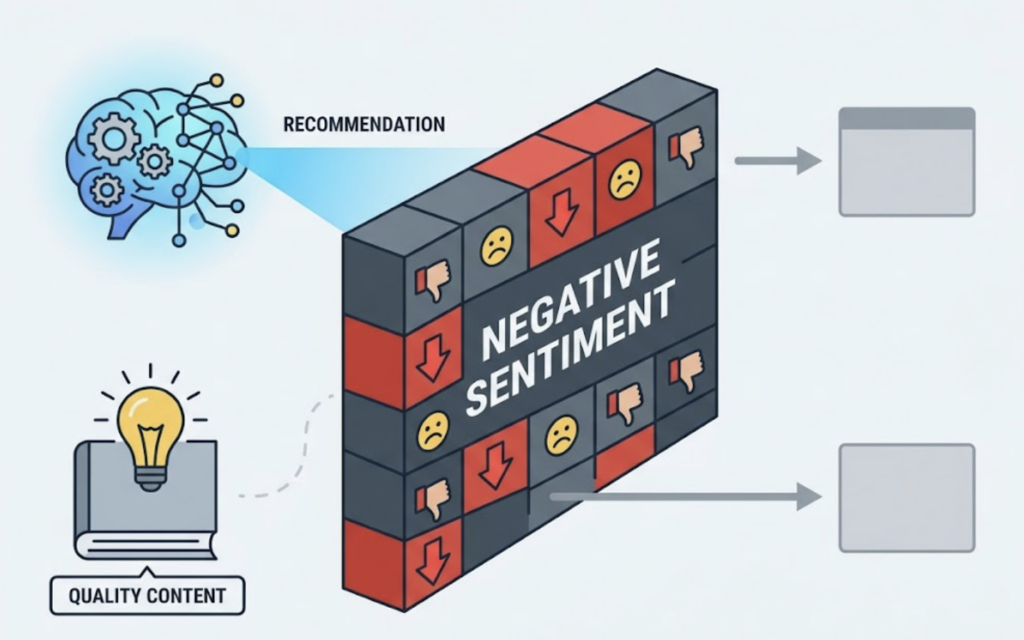
Sentiment. Negative sentiment in reviews or forum discussions can suppress AI recommendations regardless of content quality. If the prevailing signal around your brand is negative, the model may simply avoid citing you even when your content is technically authoritative.
How to Measure AI Search Optimization
This is where most teams have a blind spot. They’re running AI search optimization without any measurement infrastructure. When visibility shifts, they don’t know if it’s because of an algorithm update, a competitor’s content push, or something they did themselves.
Effective AI search intelligence requires a distinct set of KPIs:
AI visibility rate: The percentage of relevant prompts where your brand is explicitly mentioned or cited by the AI. This is your baseline metric.
Citation rate: How often the AI provides a direct link to your domain as a source. Higher citation rate generally correlates with higher answerability and entity authority.
Share of voice (SOV): Your brand’s presence relative to competitors within the same AI response. SOV tells you not just whether you’re visible, but how visible you are compared to the alternatives.
Sentiment score: An automated analysis of how the AI describes your brand. Positive sentiment isn’t just good PR; it’s a functional prerequisite for being recommended.
Position tracking: Where your brand appears in a multi-source AI response. First mention carries more weight than a footnote.
Conversion visibility rate (CVR): The estimated likelihood that an AI mention drives a user toward a brand interaction. This connects AI visibility to revenue potential.
Platforms like Topify are built specifically for this measurement layer. Topify tracks all seven of these metrics across ChatGPT, Gemini, Perplexity, and other major AI platforms, giving teams a structured dashboard instead of manual spot-checking. The Basic plan starts at $99/month and includes tracking for 100 prompts, 9,000 AI answer analyses, and four projects.
Without this kind of AI search analytics infrastructure, you’re running optimization in the dark.
A Practical 6-Step Strategy for AI Search Optimization
Building an AI search optimization strategy doesn’t require starting from scratch. Most of the infrastructure is already there. The work is in adapting it.
Step 1: Identify your target AI prompts. The prompts your audience types into ChatGPT are often different from the keywords they search on Google. Start by mapping the questions your potential customers are asking AI systems about your category. Focus on “best [category] for [use case]” and “what is [problem] and how do I solve it” patterns. These are the high-intent prompts where AI citations directly influence purchase decisions.
Step 2: Audit your baseline AI visibility. Before optimizing anything, run a baseline audit. Test your brand’s current appearance across ChatGPT, Gemini, and Perplexity using your target prompts. Document which prompts trigger a mention, what sentiment the mentions carry, and where you appear relative to competitors. This baseline is the foundation of everything that comes after.
Topify’s Visibility Tracking automates this across platforms, running 9,000+ AI answer analyses per month on the Basic plan so you’re not doing it manually.
Step 3: Optimize source authority. Digital PR is one of the highest-leverage activities in AI search optimization. Being mentioned on “kingmaker” domains, such as industry publications, high-DR news sites, and category-specific forums, is a primary driver of LLM discovery. A single placement on a well-regarded industry site does more for your AI visibility than a dozen low-authority backlinks.
Step 4: Restructure content for answerability. Audit your existing content and refactor it. Add direct Q&A sections, clean up paragraph openings so the main point comes first, use FAQ schema, and eliminate filler. Every paragraph should either answer a question or establish a fact. Content that wanders doesn’t get cited.
Step 5: Manage entity consistency. Your brand information, including your name, product descriptions, mission statement, and key differentiators, should read consistently across your website, social profiles, and third-party directories. AI systems cross-reference multiple sources. Inconsistency between sources reduces the confidence the model has in your brand as a reliable entity.
Step 6: Monitor, iterate, and track changes. AI model updates shift citation patterns. Competitor content activity affects your share of voice. A prompt that surfaces your brand today may not surface it three months from now if your content hasn’t been refreshed or a competitor has outpaced your authority.
Treat AI search intelligence as a live dashboard, not a quarterly report. Topify’s competitor monitoring tracks competitor positioning in real time, so you know when a rival’s AI visibility is climbing before it shows up in your own metrics.
Common Mistakes That Suppress AI Visibility
Most teams who are “doing AI search optimization” are making at least one of these mistakes.
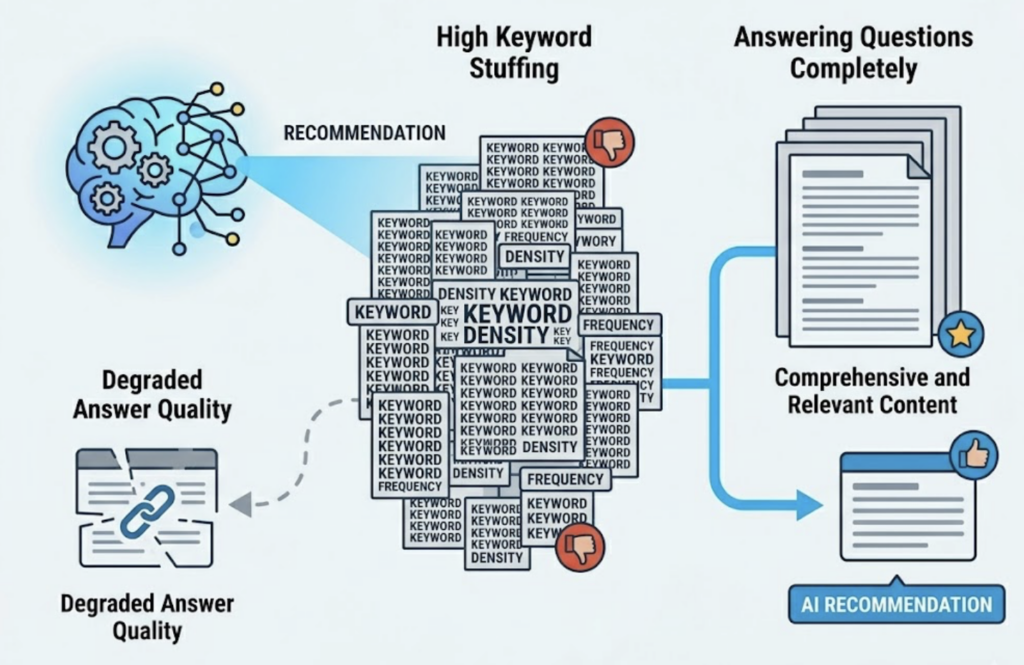
Optimizing for keywords instead of intent. AI models prioritize semantic relevance, not keyword frequency. Keyword stuffing doesn’t improve AI citations. In some cases, it actively degrades answer quality and makes a source less likely to be retrieved. Focus on answering questions completely, not on hitting keyword density targets.
Treating AI search as a zero-click problem. Some teams deprioritize AI visibility because it doesn’t generate direct referral traffic. That framing misses the point. AI search is a brand-building channel. A user who hears your brand name three times in AI responses before they ever visit your site is not a cold lead.
Applying legacy tactics to a new system. Mass-produced, low-quality content, thin pages, and templated structures are precisely what LLMs are trained to filter out. The tactics that gamed Google in 2012 don’t translate.
Running optimization without measurement. This is the most common mistake. Without an AEO-specific tracking system, you can’t distinguish the impact of a content update from the impact of a model update. You’re optimizing blind.
AI Search Optimization Checklist
Use this checklist before, during, and after any AI search optimization effort:
Foundation
- [ ] Target AI prompts identified and documented
- [ ] Baseline visibility audit completed across ChatGPT, Gemini, and Perplexity
- [ ] Competitor AI visibility benchmarked
Content
- [ ] Key content pages refactored with front-loaded answers
- [ ] FAQ sections and Q&A schema added to relevant pages
- [ ] Paragraph openings lead with the main point
- [ ] Content updated within the last 90 days
Authority
- [ ] Brand mentioned consistently on at least 3 high-authority external domains
- [ ] Entity information consistent across website, social, and directories
- [ ] Sentiment on public review platforms monitored and addressed
Measurement
- [ ] AI visibility rate tracked per prompt
- [ ] Citation rate and sentiment score monitored
- [ ] Competitor share of voice tracked
- [ ] CVR (Conversion Visibility Rate) established as a target metric
Iteration
- [ ] Visibility changes logged with timestamps
- [ ] Content refreshes scheduled quarterly at minimum
- [ ] AI platform model updates monitored for citation pattern shifts
Conclusion
AI search optimization isn’t a future consideration. It’s a present gap. Brands that are ranking well on Google but invisible in AI answers are already losing discovery to competitors who’ve started treating AI visibility as a structured, measurable growth channel.
The core shift is this: from ranking for keywords to being cited as a trusted source. The strategy, the metrics, and the tools are all different. But the underlying logic is familiar. Authority, relevance, and consistency still win. They just play out on a different surface.
Topify gives teams the infrastructure to track, measure, and optimize AI brand visibility across every major platform. If you’re starting from zero, the baseline audit is the first step. Everything else follows from knowing what you’re actually working with.
FAQ
What is AI search optimization?
AI search optimization (also called GEO or AEO) is the process of making your brand visible and citable in AI-generated answers across platforms like ChatGPT, Gemini, and Perplexity. It focuses on being included as a trusted source in AI responses rather than ranking in traditional search results.
How does AI search optimization work?
AI systems use retrieval-augmented generation (RAG) to find relevant sources before generating an answer. They assess source authority, content structure, semantic clarity, and cross-platform consistency. Optimizing for these signals increases the likelihood that your brand is cited in relevant AI answers.
How do I measure AI search optimization?
Key metrics include AI visibility rate (how often your brand appears in relevant AI answers), citation rate, sentiment score, share of voice relative to competitors, and conversion visibility rate. Platforms like Topify provide dashboards for tracking all of these across multiple AI engines.
What are the best tools for AI search optimization?
Topify is an AI search optimization platform that tracks brand visibility across ChatGPT, Gemini, Perplexity, and other major AI engines. It covers seven core metrics including visibility, sentiment, position, and CVR. Plans start at $99/month for 100 prompts and 9,000 AI answer analyses. For a broader list of free GEO tools, see the GEO free tools reference.
What are examples of AI search optimization in practice?
A SaaS company auditing which prompts surface their brand in ChatGPT. A marketing team running digital PR to get mentioned on high-authority industry sites. An in-house SEO team restructuring blog posts to front-load answers. A brand tracking competitor share of voice across Perplexity after a product launch. These are all AI search optimization in practice.
What is the difference between AI SEO and traditional SEO?
Traditional SEO targets keyword rankings on search engine results pages. AI SEO (or GEO/AEO) targets inclusion as a cited source in AI-generated answers. The signals, metrics, and content strategies differ significantly, though they share some foundational principles around authority and relevance.
How much does AI search optimization cost?
Costs vary. DIY approaches using free tools can get you started at no cost. Dedicated platforms like Topify start at $99/month for self-serve tracking. Full-service GEO optimization programs that include content production and strategy execution start at $3,999/month.

