

Your Google Analytics dashboard looks fine. Sessions are steady, organic traffic is holding. But somewhere right now, a potential customer is asking ChatGPT which CRM to use, and your brand isn’t in the answer.
That’s the blind spot nobody’s talking about.
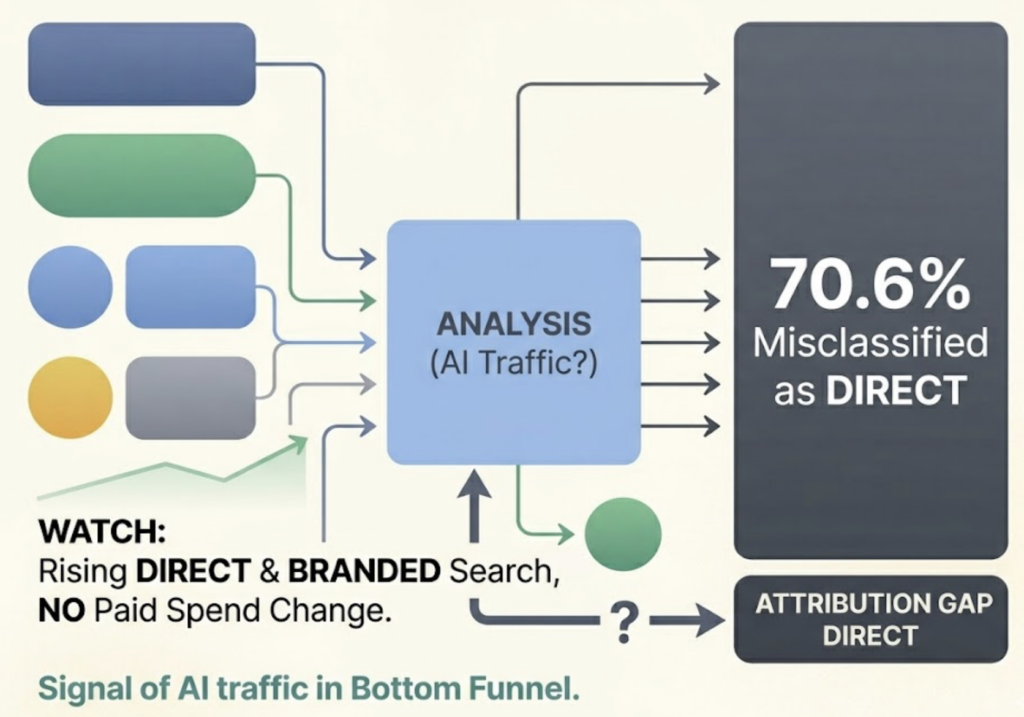
Traditional analytics are built on one assumption: that a user triggers a search, clicks a link, and lands on your site. But when AI answers a question, the user often never clicks anything. They read the response, form an opinion about which brand to trust, and either act on it directly or come back later via a branded search. By the time they reach your site, GA4 has already misattributed the credit to “Direct.”
The measurement gap is real. And it’s getting bigger.
This article breaks down the 7 metrics that actually capture what’s happening in the AI answer layer, what each one means, and how to read the numbers when you have them.
Your Dashboard Is Missing the Whole Conversation
When GPTBot or Google’s AIO crawler fetches your content, it doesn’t execute JavaScript. It reads the text, pulls what it needs, and leaves. No session recorded. No visit logged.
That’s the core problem. AI platforms operate on an “Agent-to-Infrastructure” model, while GA4 is built for a “Human-to-Browser” world. The two architectures don’t overlap. Your content can directly influence a buyer’s decision without producing a single trackable event.
The numbers make this hard to ignore. When an AI Overview appears in Google results, organic CTR drops by roughly 61%, falling from 1.76% to 0.61%. On mobile, zero-click searches now account for 77% of all queries. The most valuable impression your brand can earn now lives inside an AI response, and your current dashboard can’t see it.
What “AI Search Visibility” Actually Measures
AI Search Visibility isn’t one number. It’s a multidimensional read on how your brand appears in AI-generated answers, covering frequency, position, tone, and citation source, all at once.
Unlike traditional rankings, which are deterministic (rank #1, everyone sees you #1), AI visibility is probabilistic. The same prompt can produce different responses across different sessions, platforms, and times of day. That means visibility has to be measured statistically, across hundreds of standardized prompts, not spot-checked once.
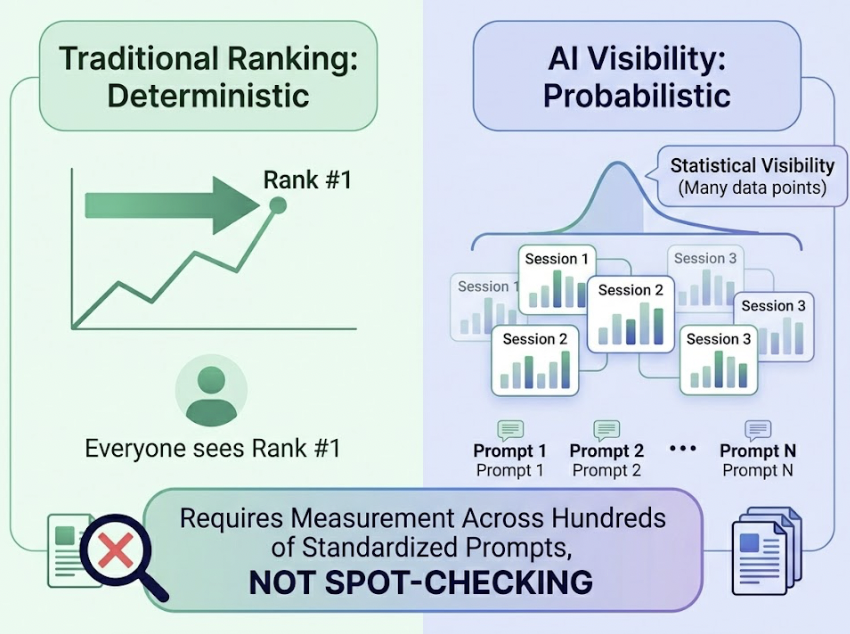
Think of it less like a scoreboard and more like a reputation graph that updates daily.
Here are the 7 metrics that make up that graph.
Metric #1: Visibility Rate Tells You If the AI Knows You Exist
The Visibility Rate (also called Share of Model or Inclusion Rate) answers the most basic question: across all the prompts your target audience is using, what percentage of the time does your brand show up at all?
The formula is simple: divide the number of AI responses mentioning your brand by the total prompts tested, then multiply by 100.
For most brands checking for the first time, the score lands between 10% and 30%. Here’s how to read that number:
| Visibility Rate | What It Means |
|---|---|
| 0–10% | The AI has no meaningful representation of your brand |
| 10–30% | Recognized but not trusted as a primary answer |
| 30–60% | Known player, often framed as an “alternative” |
| 60–80% | Consistently in the consideration set |
| 80%+ | Default answer for the category |
The Princeton GEO study found that specific content structuring tactics can increase AI visibility by 115.1% for brands that previously ranked around position #5 in traditional results. Visibility Rate isn’t fixed by domain authority alone. It’s driven by how “extractable” your content is for the model’s retrieval process.
Metric #2: Position Decides How the AI Frames You
Being mentioned isn’t enough if you’re mentioned last.
AI answers follow an inverted pyramid of trust. The brand named first, or listed as #1, gets framed as the definitive choice. Brands that appear later get framed as alternatives. That framing shapes user decisions before they’ve visited a single website.
The Response Position Index (RPI) quantifies this with a weighted score:
| Position | Score | What It Signals |
|---|---|---|
| First mention (#1) | 100 | Default industry leader |
| Top 3 (#2–#3) | 70–80 | Core competitive set |
| Mid/late mention | 40–65 | Known alternative |
| Footnote or late list | 10–30 | Low recall, low selection |
| Not mentioned | 0 | Invisible for that context |
There’s a strong negative correlation (Spearman -0.46) between a brand’s overall visibility score and its likelihood of ranking outside the Top 3. Brands that consistently hold Top-3 positions typically cover 22% more subtopics and related entities than those that don’t. The AI rewards contextual completeness, not just direct relevance.
Metric #3: Sentiment Score Tells You What the AI Actually Thinks
You can have a high Visibility Rate and still be losing business if the AI is consistently describing your brand with caveats.
The Sentiment Score rates AI tone on a 0–100 scale, from explicitly negative (0–20) to enthusiastically positive (81–100). The threshold that matters most is 80%. Above 80%, models are significantly more likely to recommend your brand in response to subjective queries like “What’s the best tool for X?” Below 60%, the AI may be mentioning you while simultaneously warning against you.
Here’s the risk scenario worth watching: high visibility combined with low sentiment. That combination means the AI is scaling negative perception, not just reporting it. If authoritative third-party sources such as Reddit threads or industry reviews consistently describe your brand as “expensive” or “hard to onboard,” those associations get absorbed into the model’s outputs. The AI doesn’t form opinions on its own. It reflects the narrative already present in its training data.
That’s called Narrative Bias, and it’s hard to fix without a deliberate earned-media strategy.
Metric #4: Citation Share Shows Whether the AI Trusts Your Sources
AI platforms like Perplexity, Google AIO, and Gemini don’t just generate answers. They ground them in citations. Citation Share measures which domains get referenced to support those answers, and how often yours is one of them.
The data here is uncomfortable for most marketing teams: third-party sources are cited 6.5 times more often than brand-owned pages. Earned media accounts for roughly 48% of citations. Your own blog comes in at around 23%.
| Source Type | Citation Share | Role in AI Answers |
|---|---|---|
| Earned media (news, PR) | 48% | Authority signal for recommendations |
| Owned content (blog, site) | 23% | Factual verification (pricing, features) |
| Forums (Reddit, Quora) | 11% | Social proof and user-experience context |
| Review platforms (G2, Yelp) | 11% | Sentiment and comparison logic |
A specific diagnostic to look for: a high Visibility Rate combined with low citation of your own domain. That means the AI is using your ideas and data but attributing them to others. The Princeton GEO study found that adding structured citations and statistics directly to content improves citation odds by up to 40%. JSON-LD schema (FAQ, HowTo, Product) helps make pages machine-readable enough to be sourced directly.
Metric #5: AI Search Volume Surfaces Demand Your Keyword Tools Miss
Traditional SEO keyword tools measure search volume based on short queries averaging 3.4 words. The average ChatGPT prompt runs 23 to 60 words. That’s a different category of intent entirely.
AI Search Volume measures the actual volume of conversational queries being directed at AI platforms around your category, product, or specific use case. The scale of this demand is significant:
- ChatGPT handles 1B+ queries per day and drives 77% of AI-driven website referral traffic
- Google AIO appears in 13–30% of all searches, reaching 2B+ monthly users
- Perplexity processes 780M monthly queries and doubled both users and revenue through 2025
If a specific “how-to” prompt in your category is generating high volume on ChatGPT but sending zero traffic to your site, you’ve found a content gap that traditional keyword research would never have flagged. AI Search Volume tells you where the demand actually lives, not just where it used to live.
Metric #6: Competitor Mention Rate Shows You Where Your Market Share Ends
AI answers are often a zero-sum format. If the model limits its response to the “Top 3” options, being #4 means you don’t exist for that query.
The Competitor Mention Rate (CMR) tracks how often rivals appear in the same prompt universe where you’re competing. Two calculations matter here:
Share of Voice (SOV): Your mentions ÷ total brand mentions for the category × 100. This gives you your proportional ownership of the category’s AI answer space.
Displacement: Instances where a competitor has replaced your brand in a prompt you previously won. This is where CMR becomes a real-time competitive intelligence tool.
If a competitor’s G2 Leader badge starts appearing in 50% of your target prompts while your own reviews are ignored, CMR surfaces that signal early enough to act on it. The goal isn’t just to track your own score; it’s to understand who’s gaining ground and why.
Metric #7: CVR Shows Whether AI Visibility Converts
This is the metric that closes the loop between AI visibility and actual business outcomes.
The Conversion Visibility Rate (CVR) estimates the likelihood that an AI recommendation drives a user toward a transactional action. And the performance gap between AI-referred users and traditional organic visitors is substantial:
| Source | Conversion Rate | vs. Google Organic |
|---|---|---|
| Claude | 16.8% | ~6x higher |
| ChatGPT | 14.2–15.9% | ~5x higher |
| Perplexity | 10.5–12.4% | ~4x higher |
| Google Organic | 1.76–2.8% | Baseline |
The reason is simple: by the time an AI recommends your brand, it has already done the comparison work the user would otherwise do themselves. The user arrives pre-qualified.
The catch is attribution. Up to 70.6% of AI-referred traffic is misclassified as “Direct” in GA4. The practical signal to watch for: a rising direct and branded search volume with no corresponding change in paid spend. That pattern, especially when your AI visibility score is climbing, is the evidence that the answer layer is driving the bottom of your funnel.
Moving From Knowing to Actually Measuring
Understanding these 7 metrics is straightforward. Extracting them consistently is not.
AI responses are non-deterministic. A single prompt run once gives you a data point of one. To get statistically valid numbers, you need hundreds of prompt variations fired across multiple platforms, tracked over time, on a schedule.
That’s where manual testing breaks down. Checking ChatGPT once a week in a browser tells you approximately nothing about your actual visibility rate.
Topify automates the query fan-out process, running standardized prompt sets across ChatGPT, Gemini, and Perplexity simultaneously and tracking all 7 metrics in one dashboard. A typical workflow looks like this: an audit phase where 500 category-relevant prompts are fired; a diagnostic phase where the platform flags that your Visibility Rate is 40% but Sentiment is 55 because an old Reddit thread is being heavily cited; and an action phase where the team updates their earned-media presence and monitors Sentiment Lift over the following 30 days.
That’s the difference between a one-time optimization and a live reputation graph.
Conclusion
AI search visibility isn’t coming. It’s already determining who gets seen, who gets trusted, and who gets the conversion. The users consulting ChatGPT before making a purchase decision aren’t waiting for marketers to catch up.
The 7 metrics here, Visibility Rate, Position, Sentiment, Citation Share, AI Search Volume, Competitor Mention Rate, and CVR, give you a complete read on how your brand exists in the answer layer. Start by establishing your baseline. Identify where you’re invisible, where your sentiment is working against you, and which competitors are gaining ground in prompt universes you should be owning.
Measure first. Then optimize.
FAQ
How can I improve my AI search visibility if my current score is low?
Focus on three levers: freshness, structure, and authority. Update high-value pages every 7–14 days to stay current with AI crawlers. Use clear H2/H3 headings and structured lists that models can extract cleanly. And invest in earned-media placements on the third-party sources AI trusts most, including Wikipedia, Reddit, and major industry outlets. These don’t just improve your Citation Share; they improve your Sentiment Score over time as the narrative in your training data shifts.
What’s a realistic Visibility Rate benchmark for a B2B brand?
For an established player in a competitive category, 35–45% is generally considered strong. AI platforms tend to surface multi-perspective answers, so it’s uncommon for a single brand to dominate above 60% of a prompt universe. Scores above 80% typically only occur for branded queries or highly niche technical topics. If you’re coming in under 20%, the priority is entity authority: getting consistently mentioned across authoritative third-party platforms before optimizing your own content.
If my brand ranks #1 on Google, does that guarantee a top ChatGPT recommendation?
No. Only about 56% of ChatGPT’s citations correlate with Google’s top 10 results. A page can rank #1 organically and receive zero AI citations if the content is poorly structured for extraction. AI models prioritize information density and citable facts over the backlink profiles that drive traditional rankings. GEO and SEO optimize for different things, and a strong performance in one doesn’t automatically transfer to the other.

