
A growth analyst adds a newly observed rival to the monthly competitor report. The brand’s share falls immediately, although its recorded appearances haven’t changed. Leadership asks what went wrong with the campaign, and the analyst has to explain that the comparison group changed before the market necessarily did.
AI search competitor analysis needs a stable view for measuring established rivals and an open view for discovering new ones. Both are useful, but they answer different questions. Keeping them separate makes it possible to notice emerging competition without rewriting the meaning of the historical trend. The first step is to define who belongs in each view and when an observation qualifies as comparable evidence.
Fix the Cohort for AI Search Competitor Analysis
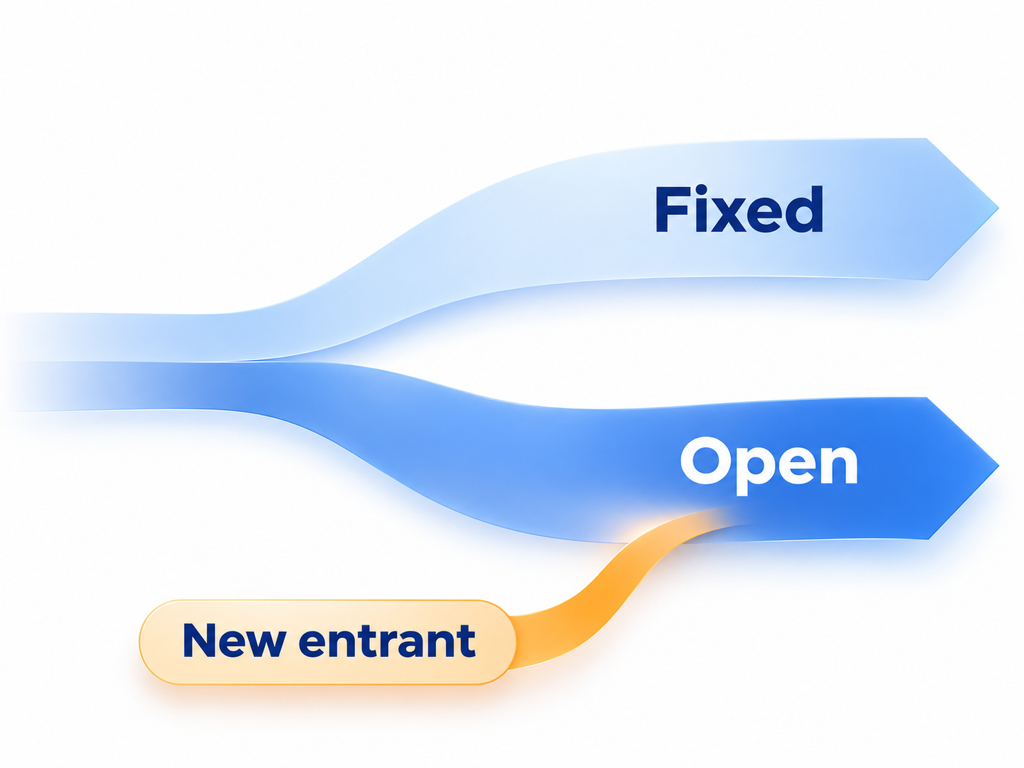
A fixed cohort is a named set of competitors used for a comparable reporting period. An open cohort includes additional entities discovered during monitoring. The fixed view asks how the brand performs against the same reference group; the open view asks what the currently observed competitive set looks like.
Write the membership rule before calculating shares. Record the entities, role requirements, relevant buyer tasks, and effective period. A publisher or marketplace should not enter a direct-product cohort unless it competes for the decision being measured.
Keep discovery active outside that fixed comparison. A stable cohort shouldn’t become a reason to ignore new names. The analytical design is to preserve comparability while maintaining a separate queue for candidate competitors.
This dual-view method is a reporting recommendation, not a claim that every platform implements the same cohort system. It works only when the team preserves underlying observations and clearly labels the denominator used in each result.
Record When a New Rival Was First Observed
First observed is a statement about your evidence, not the competitor’s market history. A brand may have existed for years before it appeared in a monitored answer. Avoid calling the observation a launch or market entry unless independent evidence establishes that event.
Record the answer, prompt, platform, collection time, entity, and role. Add the coverage conditions that could explain why the brand wasn’t seen earlier. A new topic in the prompt set can expose an established rival without indicating a new competitive surge.
Use a discovery status such as candidate, verified relevant, or rejected. Verification should establish that the entity competes for the buyer task and that the appearance is correctly identified. It needn’t imply that the rival is already a material business threat.
Retain the original observation even if the entity is later excluded. A short rejection reason, such as “publisher used as evidence,” helps prevent the same false candidate from repeatedly entering the review queue.
Separate the observation date from the decision date. The team may notice a candidate on Monday and approve it for open-cohort reporting on Thursday. Those timestamps describe different steps and should not be silently substituted for each other.

Calculate Fixed and Open Cohort Shares
Define the counting unit before calculating either share. The following example counts brand appearances once per eligible answer, allowing more than one brand per answer. The denominator is the total of those appearances within the chosen cohort, not the total number of users or market purchases.
Imagine a hypothetical period with forty appearances for your brand and sixty across the other fixed-cohort rivals. Your fixed-cohort share is forty percent. If an additional candidate contributes twenty appearances to the open cohort, your open-cohort share is forty divided by one hundred twenty, or about 33.3 percent.
Nothing in that calculation requires your brand to lose an appearance. The difference comes from the broader denominator. This is an illustrative arithmetic example, not a measured result or a forecast of competitive performance.
| Observed change | Fixed-cohort interpretation | Open-cohort interpretation | Appropriate conclusion |
|---|---|---|---|
| New relevant entity is added | Membership remains unchanged | Denominator may expand | Report discovery separately |
| Existing rival gains appearances | Comparable competitive movement | Movement may also be visible | Inspect prompts and answer evidence |
| Collection fails for part of the period | Coverage is incomplete | Coverage is incomplete | Avoid treating missing runs as absence |
| Entity changes role in an answer | Apply the stated role rule | Review classification | Preserve the original occurrence |
Also report answer-level visibility where useful: answers mentioning your brand divided by eligible collected answers. That is a different metric from share of appearances across a cohort. Clear names prevent the two percentages from being mistaken for each other.
Require Comparable Evidence Before Escalation
Decide what merits investigation before a striking result appears. Relevant conditions might include repeated appearances on important buyer tasks, consistent entity identification, and a commercial role that matches the cohort. These are proposed review criteria, not universal thresholds.
Consider the consequence of the observed change. A new rival appearing on one low-priority informational question may deserve a note. Repeated appearances on a decision central to your product category may deserve an evidence review sooner.
Inspect the answer rather than escalating from a name alone. Determine what the rival was recommended for, which qualifications were attached, and what sources supported the claim. An appearance with a limiting condition can have a different meaning from an unqualified recommendation.
Avoid choosing a repeat count after seeing the result. Document the initial review rule and any later change. This reduces selective reporting while allowing the process to adapt when the team learns that its original criteria were unhelpful.
A discovered name is a research lead, not a completed competitive diagnosis.
Report Exits and Missing Evidence Transparently
A rival that doesn’t appear in the next collection hasn’t necessarily left the market. It may be absent from the sampled answers, affected by changed coverage, or simply not observed in that period. Use language that matches the evidence.
Keep collection status separate from competitive status. A failed or missing run cannot support the same absence conclusion as a successfully collected answer that contains no relevant mention. Preserve both states in the denominator policy.
When an entity is removed from the open view, record why. A role correction, business closure, and deliberate reporting-scope change have different meanings. Historical observations should remain available with the classification applicable to the report.
For fixed-cohort changes, start a new comparable period or provide an explicit bridge calculation. Don’t quietly replace past membership and then present the rewritten series as though the original benchmark had never changed.
The related AI Citations vs. Brand Mentions: Not the Same is useful context for defining the event being counted. Cohort membership is an additional rule layered on top of that observation unit.
Use Topify Discovery Without Rewriting the Past
Topify describes emerging-brand discovery and query-level comparisons on its Dynamic Competitor Benchmarking page. Start with your brand, known rivals, and the buyer tasks being monitored. Review a newly surfaced name as a candidate, preserve the original answer context, and decide whether its commercial role qualifies it for the open view.
Use the observations to maintain a stable reference report alongside a discovery report in your analysis sheet. The output should show the brand’s comparable movement, any new candidates, and the evidence supporting escalation. The fixed/open cohort calculations proposed here are an analyst-managed method; the public product description doesn’t establish a native dual-cohort implementation or justify backfilling unobserved historical appearances for newly discovered competitors.
Bring the two views together in the narrative. Explain whether a share changed because established rivals gained appearances, because the comparison group expanded, or because coverage was incomplete. More than one explanation can apply, and the report should preserve that possibility.
Conclusion
A fair competitive trend needs a stable reference group and an explicit counting rule. Keep that view intact while allowing a separate discovery process to surface new entities. Record when each candidate was observed, verify its role, and distinguish a wider denominator from an actual loss of brand appearances.
Start with one reporting period and use competitor discovery and query comparisons to build the evidence queue. Calculate fixed and open shares separately, disclose missing collection, and preserve membership decisions. The next leadership review can then explain what changed in the observed competition and what changed in the measurement, without confusing either with a proven shift in market share.
FAQ
Is a first appearance automatically an emerging threat?
No. Verify identity, commercial relevance, and context first. First observed describes your monitoring evidence, not necessarily a recent launch or meaningful market change.
Why can share fall when my appearances stay constant?
A larger comparison denominator can reduce share. Report fixed and open cohort results separately so added competitors don’t look like an unexplained decline.
Should a new rival be inserted into historical reports?
Don’t invent earlier observations. If historical evidence exists and is reclassified, label the revised analysis separately and retain the original reporting basis.
How often should fixed membership change?
Choose a review cadence suited to the business decision. Record effective dates and provide a bridge when membership changes, rather than silently rewriting the comparison group.