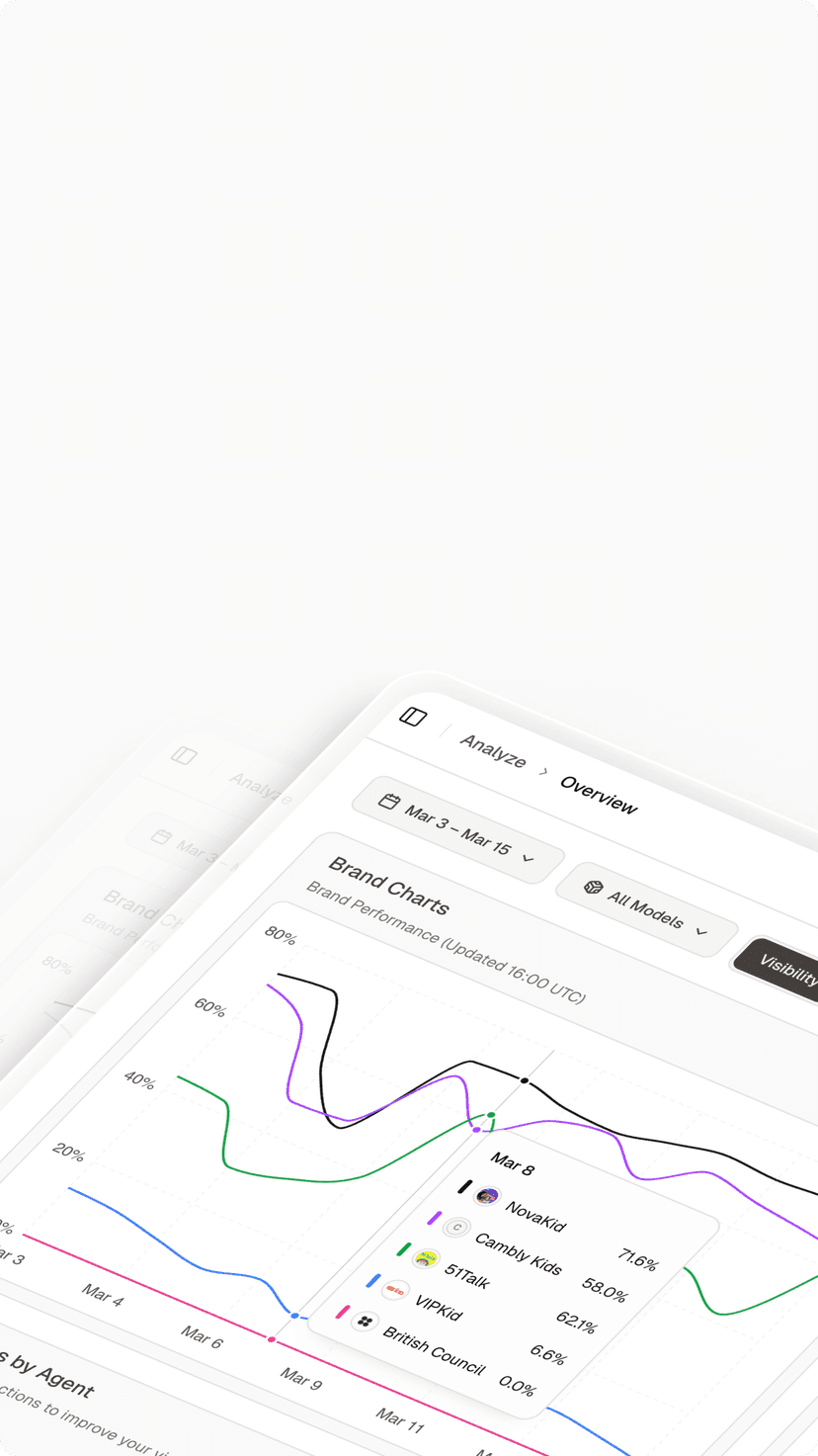
A competitive intelligence researcher exports an answer report and finds software companies, review sites, and marketplace operators in the same list. The chart makes a publication look like the category leader, even though the answer recommends a product sold by a different company. The team is about to assign a product positioning task to what is actually a source coverage problem.
AI search competitor analysis needs a role attached to each observation. An entity can sell a product, publish evidence, distribute another vendor’s offer, or perform several of those jobs at once. Classifying its role in the specific answer makes the comparison useful and directs the next action to the right team.
Define Roles in AI Search Competitor Analysis
Start with the relationship expressed in the answer. A recommended product is a candidate for the buyer’s task. A cited publisher supplies evidence or context. A marketplace may distribute the product without being its manufacturer, and a platform provider may supply infrastructure without competing for the same purchase.
These are working analytical categories, not permanent labels for a company. Their purpose is to prevent unlike observations from being compared as though they describe the same competitive event.
Google describes supporting links in AI search experiences. A supporting source and a recommended commercial option can be related, but they are different units. Seeing a publisher’s domain doesn’t establish that the publisher was recommended as the product to buy.
Write the role definition before reviewing a large export. Include examples and a clear unknown state. That makes disagreements easier to resolve and limits the tendency to classify every familiar commercial domain as a direct rival.
Classify the Mention in Its Local Context
Read the sentence around the entity and inspect the relevant link. Ask what the user is being invited to do: evaluate a product, buy from a seller, read a comparison, or verify a fact. The local relationship is more informative than a company category alone.
Record the answer identifier, entity, exact excerpt, role, and supporting URL. Preserve the original name separately from any normalized entity identifier. Identity resolution can help avoid duplicates, but it doesn’t decide the role performed in this occurrence.
Consider a hypothetical business that sells a tool and publishes an annual category report. A recommendation of its tool and a citation to its report should remain two distinguishable observations. They can share an entity identifier while supporting different analyses.
Don’t infer endorsement from proximity. A source listed next to a recommendation may support one fact, provide general context, or discuss alternatives. Where the relationship is unclear, retain the excerpt and mark the role uncertain instead of forcing a competitive conclusion.
Keep a reviewer note for difficult cases. A short explanation such as “linked as pricing evidence for another product” is more useful than a bare label that cannot be audited later.

Keep Source Share Apart From Recommendation Share
Define the observation unit and denominator for each report. Source share might use cited links or answers containing a source. Recommendation share might use recommended candidates or answers containing a qualified recommendation. Those choices produce different numbers and need explicit names.
For an illustrative example, imagine an answer recommending two products and citing three publishers. Counting all five entities as competitors would combine evidence suppliers with buying options. The resulting percentage would change if the answer added a citation, even when the commercial shortlist stayed identical.
Choose a counting policy before aggregating. If a brand is named repeatedly in one answer, decide whether the report counts occurrences or answer-level presence. If a publisher supplies several links, decide whether the source report counts URLs, domains, or answer coverage.
| Role in the answer | Useful observation unit | Suitable comparison | Likely action owner |
|---|---|---|---|
| Recommended product | Candidate or answer-level presence | Other relevant products | Product marketing |
| Evidence publisher | Cited URL, domain, or answer coverage | Other evidence sources | Content or communications |
| Marketplace or seller | Offer or channel occurrence | Comparable distribution channels | Ecommerce or partnerships |
| Infrastructure provider | Stated technical relationship | Relevant providers for that task | Product or technical team |
| Unclear role | Unresolved observation | Excluded from role-specific totals | Research reviewer |
This is a suggested reporting design, not a claim that one denominator suits every business. The important requirement is comparability within each report and a clear explanation of what a percentage actually counts.
A source can influence the answer without competing for the sale.
Handle Marketplaces and Hybrid Businesses
Allow multiple roles when the evidence supports them. A marketplace may be recommended as a shopping destination, cited for a product specification, and listed as one seller among several. Those occurrences should not be collapsed into one universal classification.
Store roles at the observation level, then derive the company-level view. This avoids a common reporting shortcut where an entity’s first classification determines every future appearance. New contexts can legitimately produce different roles.
Use separate fields for the product owner and distribution channel when the distinction matters. A manufacturer gaining product visibility doesn’t establish that its preferred store received the recommendation. Likewise, a retailer’s presence doesn’t prove ownership of the recommended product.
Preserve unresolved relationships rather than guessing from a brand’s homepage. The answer may use an ambiguous abbreviation or link to an unexpected destination. Verify enough context to classify the occurrence, and keep uncertainty visible when that context is unavailable.
The same approach supports fair competitor comparisons. Include a marketplace as a rival only for the decision where it competes, such as choosing a purchasing destination. In a manufacturer comparison, its role may instead belong in the channel or source layer.

Compare Like Roles Before Choosing an Action
Choose the next action from the role-specific gap. A rival product recommended for the buyer’s task may justify a feature or positioning investigation. A publisher repeatedly cited for a disputed fact may justify reviewing the evidence it provides.
A source gap doesn’t automatically require more product pages. The useful evidence may belong in documentation, an independently verifiable specification, or a clear explanation of a limitation. Publishing another generic comparison can leave the actual information problem unresolved.
Similarly, a marketplace gap may require channel data review rather than a brand awareness campaign. Inspect the offer or seller relationship before deciding which team owns the issue. The same visible name can point to different work depending on its role.
Use AI Citations vs. Brand Mentions: Not the Same as related context for keeping signals distinct. The operational extension here is to attach the role and action to each occurrence, rather than stopping at two broad metric categories.
Review a small set of ambiguous examples together before scaling the classification. If reviewers disagree, refine the role definition or preserve a mixed state. A clean-looking report is less valuable than a classification that another analyst can explain and reproduce.
Use Topify to Connect Rival and Source Reviews
Topify describes recommended-brand comparisons through Dynamic Competitor Benchmarking. Its AI Search Analytics page also describes cited domains and URLs. Begin with the relevant brand, buyer prompts, and observed answers, then review the candidate and source records as separate evidence streams rather than placing every visible entity in one league table.
Add the role labels in an analyst-managed review sheet, preserving the excerpt and URL behind each decision. The output should distinguish product competition, source coverage, and channel relationships so the business can assign the appropriate follow-up. The public product descriptions don’t establish automatic occurrence-level role classification for every hybrid business, so don’t assume that a normalized company name has already resolved the analytical relationship.
A useful final report can remain compact: one product comparison, one source coverage view, and a queue of ambiguous roles. Connect them with shared answer identifiers so a reviewer can inspect the same result from either direction.
Conclusion
A competitive report should compare entities that perform comparable jobs in the buyer’s decision. Attach a role to the occurrence, keep recommendation and source denominators separate, and allow hybrid businesses to occupy different roles in different contexts. Preserve unknown cases instead of forcing them into a misleading ranking.
Start with one important answer and use competitor benchmarking context alongside a direct review of its sources. Identify the recommended product, the evidence publisher, and any distribution channel before assigning work. That turns a mixed list of names into specific decisions for product marketing, content, communications, or partnerships, each supported by the relationship actually observed.
FAQ
Does a cited publication count as a competitor?
Only when it competes for the decision being measured. A publication used as evidence usually belongs in a source report, not automatically in a product recommendation ranking.
Can one business have multiple roles?
Yes. Classify each occurrence in context. A company can publish evidence, sell a product, and distribute other products without every mention representing the same competitive relationship.
Why keep recommendation share and source share separate?
They use different observation units and answer different questions. Combining them can change a commercial share simply because the answer contains more evidence links.
How should unclear roles be reported?
Preserve the excerpt and link, mark the role unresolved, and exclude it from role-specific conclusions until reviewed. Unknown is preferable to an unsupported classification.