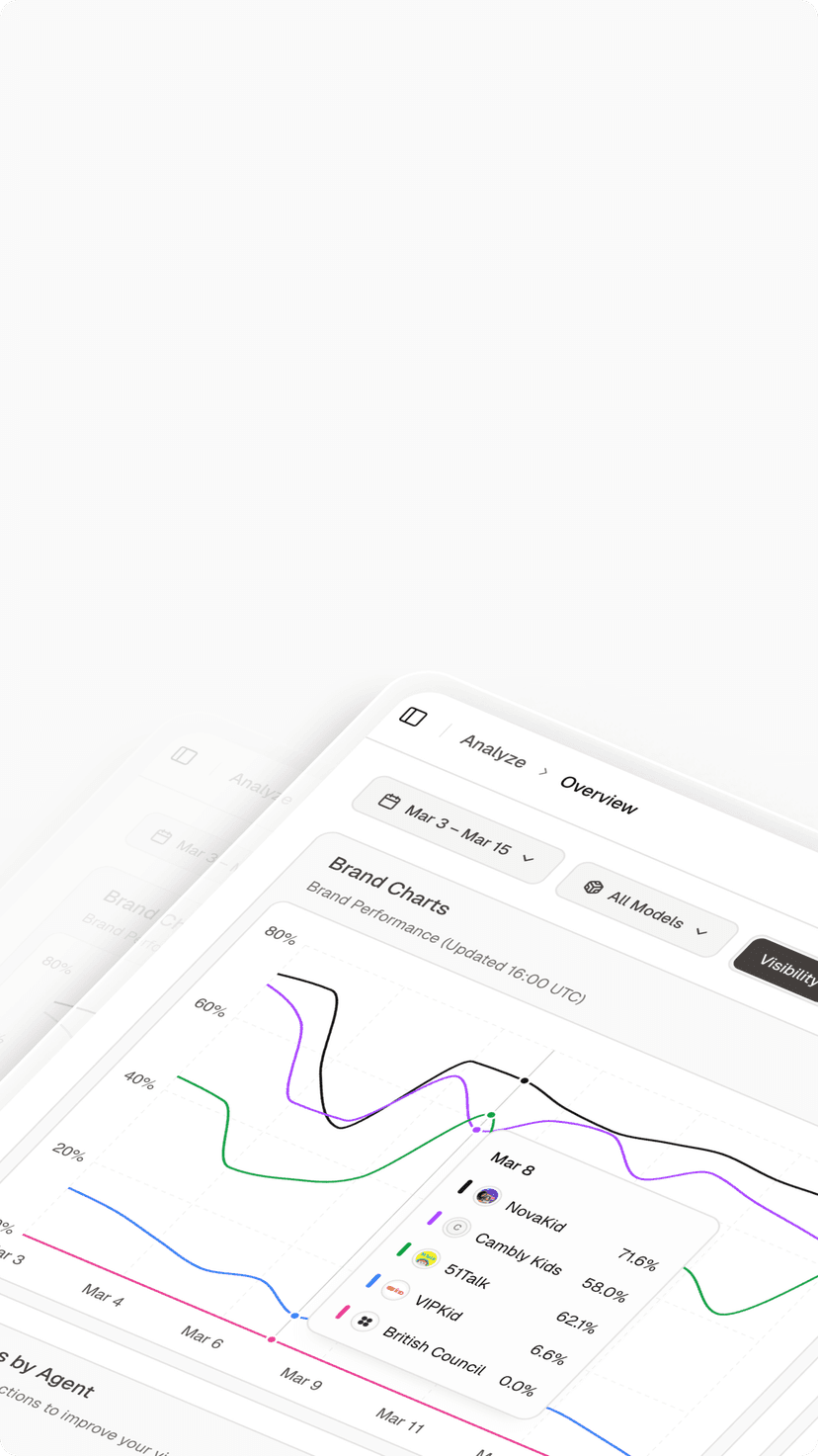

Defining the AI Visibility Platform: The Command Center for GEO
An AI visibility platform is a specialized software ecosystem designed to monitor, analyze, and optimize a brand’s presence within the generative search landscape. It serves as the bridge between your content production and the “Retrieval” layers of modern AI engines.
Beyond Traditional Search Crawling
Traditional SEO tools function by scraping Search Engine Results Pages (SERPs). They tell you where your URL ranks in a list of links. However, an AI visibility platform must account for Synthesis. When an AI generates a response, it doesn’t just display a link; it integrates facts about your brand into a narrative. A visibility platform tracks:
Brand Salience: Is your brand mentioned as a leader in its category?
Fact Accuracy: Are the prices, features, and leadership details the AI provides correct?
Citation Share: Is your domain being credited as the primary source
Competitor Proximity: Which competitors are being recommended alongside (or instead of) your brand?
The Role of Topify in 2025 Marketing
Topify acts as the diagnostic engine for Generative Engine Optimization (GEO). By quantifying how models perceive your brand’s authority, Topify allows marketing teams to move from SEO to GEO with mathematical certainty, ensuring that brand signals are consistent across every conversational prompt.
How Tracking Works: The Methodology of Synthetic Probing
The most persistent question regarding AI visibility platforms is: “How do you track mentions if the model’s weights are proprietary?” The answer lies in the Science of Observation—treating the LLM as a behavioral system rather than a searchable database.
Large-Scale Prompt Matrixing
Since we cannot look “inside” the neural network, we must saturate it with stimuli. An AI visibility platform generates a Prompt Matrix—a massive library of thousands of variations of the same user intent.
Example: For a cloud security brand, the platform doesn’t just track “best firewall.” It tracks prompts like: “What is the most secure firewall for a fintech firm using AWS in 2025?” or “Which firewall has the best SOC2 compliance rating for small banks?”
Probabilistic Statistical Modeling
Because LLMs are stochastic (randomized to an extent), a single answer is not a data point. Topify runs these prompt matrices thousands of times across different geographic nodes and user personas. By analyzing the results at scale, the platform calculates an AI Share of Voice (SOV). If your brand is recommended in 85% of simulations, your visibility is “Robust.” If it is only 5%, you have an “Invisibility Gap.”
The Retrieval Interception Layer: Tracking via RAG
While some tracking is behavioral, other methods focus on the Retrieval-Augmented Generation (RAG) pipeline. This is the process where AI engines like Perplexity or SearchGPT pull real-time data from the web.
Monitoring the Citation Trail
When an AI engine provides a link to a source, it is a signal of “Highest Trust.” An AI visibility platform monitors these citation trails to see which specific content fragments are being ingested.
The Discovery: By seeing which URLs are “Retrieved,” Topify identifies the specific pages on your site that the AI’s “Retriever” finds most authoritative.
The Strategy: This allows brands to prioritize their optimization efforts on the pages that are already showing “Citation Potential.”
Information Density Audits
AI retrievers prioritize content with high Information Density. Platforms like Topify score your content against the “winning” citations of your competitors. If a competitor is cited more frequently, the platform analyzes their fact-to-word ratio, technical structure, and entity clarity to provide you with a roadmap for AEO strategies.
Measuring Sentiment and Narrative Integrity
Visibility is not just about being “present”; it is about being “preferred.” One of the most critical functions of an AI visibility platform is tracking Brand Sentiment.
Detecting Sentiment Bias
LLMs are trained on massive datasets that include social media discussions, reviews, and news articles. These training sets create a “Sentiment Weights” for every brand.
The Tracking: Topify uses Natural Language Processing (NLP) to detect if the AI describes your brand as “expensive,” “reliable,” “legacy,” or “innovative.”
The Risk: If the AI consistently associates your brand with negative sentiment, it acts as a silent repellent to high-intent users.
Hallucination Monitoring
If an AI assistant provides incorrect pricing or attributes a competitor’s feature to your brand, that is a hallucination. A visibility platform alerts your team to these inaccuracies in real-time. To fix these, brands must engage in Truth Engineering, which involves mastering entity SEO for AI visibility to synchronize their brand signals across the web.
Comparison: AI Visibility Platforms vs. Traditional SEO Tools
The gap between legacy tracking and modern visibility platforms is a gap between “Clicks” and “Conversions.”
Feature
Traditional SEO (e.g., Ahrefs)
AI Visibility Platform (Topify)
Operational Logic
Static Index Scraping
Dynamic Behavioral Probing
Primary Metric
Keyword Rank (Position 1-100)
AI Share of Voice (SOV %)
Unit of Success
URL & Click-Through Rate
Entity Citation & Recommendation
Retrieval Check
Google Crawler (Googlebot)
RAG Attribution & LLM Synthesis
Trust Source
Backlink Authority
Fact Density & Entity Sync
Outcome Focus
Traffic Volume
Brand Authority & Influence
For a deeper look at the tools available, see our guide on how to compare AI search optimization tools.
Real-World Application: Bridging the “Invisibility Gap”
To understand the strategic value of an AI visibility platform, let’s look at a case involving an enterprise B2B SaaS company specializing in HR tech.
The Problem
The company ranked #1 on Google for “payroll automation software.” However, when users asked ChatGPT, “What is the most compliant payroll software for mid-sized European firms?”, the AI recommended three smaller competitors and ignored the brand entirely.
The Topify Audit
Using Topify, the brand ran a 1,000-prompt probe. The analysis revealed that while their domain authority was high, their content was too “marketing-heavy.” The AI retrievers were prioritizing competitors who used “Fact-Dense” technical tables and clear SOC2 compliance data points.
The Result
By refactoring their high-intent pages and synchronizing their founder data across the Knowledge Graph, the brand increased its AI Share of Voice from 4% to 32% in four months. This shift in visibility directly led to a 20% increase in high-quality demo requests, proving the impact of how to rank in AI Overviews.
Strategic Outlook: Agentic Discovery and M2M Tracking
As we move toward 2026, the landscape will evolve from “Search Engines” to AI Agents. These agents will autonomously browse, compare, and recommend products to human users.
Optimizing for the “Machine Handshake”
In this world, visibility tracking will focus on Machine-to-Machine (M2M) Signals. This includes tracking how easily an AI agent can verify your brand’s technical specifications, pricing, and compliance without human intervention.
Topify’s Readiness: We are already developing “Agentic Visibility Scores” to help brands ensure their APIs and documentation are optimized for autonomous discovery. This represents the future of search engine optimization.
Frequently Asked Questions (FAQ)
Do I need a separate visibility platform for ChatGPT and Perplexity?
No. Advanced platforms like Topify provide a unified dashboard that tracks visibility across all major LLMs (ChatGPT, Gemini, Perplexity, Claude). Because each model has different retrieval biases, the platform helps you identify which specific content updates will move the needle for each specific engine.
Why does my brand rank on Page 1 but get ignored by Gemini?
Gemini uses a hybrid retrieval model. While traditional SEO authority matters, if your brand signals are inconsistent across the Knowledge Graph (e.g., your LinkedIn says one thing, your Wikipedia another), Gemini may perceive your brand as a “Trust Risk” and choose a more synchronized competitor.
Can a visibility platform help me fix AI “hallucinations” about my brand?
Yes. Hallucinations usually occur when an AI encounters conflicting or outdated data during the retrieval phase. By identifying the “source of friction”—such as an old press release or a forgotten technical blog—Topify helps you synchronize your signals to “force” the AI toward the truth.
How often should I audit my AI Share of Voice?
LLMs are updated and fine-tuned constantly. A competitor’s update or a model’s fine-tuning can displace your citation overnight. We recommend a continuous monitoring cycle with weekly SOV reports to ensure your brand reputation remains stable in a volatile conversational environment.
Conclusion: Taking Control of the Answer Box
The transition from “ranking links” to “securing citations” is the most significant competitive shift in modern marketing. In an era where AI handles the synthesis of information, brands can no longer afford to be a “Black Box” to the model.
An AI visibility platform provides the technical eyes and ears needed to navigate this new terrain. By leveraging synthetic probing, citation analysis, and sentiment monitoring through Topify, brands can move from being an “Invisible Entity” to becoming the definitive, cited answer that users trust.