A visibility report can show more citations while the answers themselves become less useful. A buyer sees a linked claim about compatibility, pricing, or availability, opens the source, and cannot find the stated condition. The link creates an impression of verification even when the page supports only part of the sentence.
AI citation share measures source presence within a defined pool. It does not establish that every linked statement is accurate. A separate claim-support audit connects the answer’s wording to the actual source passage, checks important qualifiers, and assigns a clear next action when the evidence is incomplete or contradictory.
AI Citation Share Cannot Certify Claim Accuracy
Keep visibility measurement and factual verification separate. Microsoft’s Citation Share documentation concerns displayed citations attributed to a site within a grounding-query context. The presence of a link does not tell you how faithfully the answer represents its destination.
Research also treats citation quality as a distinct evaluation problem. The ALCE paper evaluates generated answers through separate dimensions that include correctness and citation quality. Its historical model results should not be reused as current error rates, but the distinction remains useful for designing an audit.
Two common mismatches require different responses. A page may support the product feature but omit the regional condition asserted in the answer. Another page may explicitly contradict the stated feature. Combining both situations into a single inaccurate-answer count can hide whether the team needs additional evidence, a correction, or simply more careful reporting.
Begin with high-consequence buyer claims rather than attempting to review every sentence. Claims about eligibility, contractual conditions, compatibility, and current availability may warrant closer inspection than a broad descriptive introduction. Define the audit scope before seeing which sources make your brand look favorable.
A source link is the beginning of verification.
Define the Claim and Capture Its Answer Context
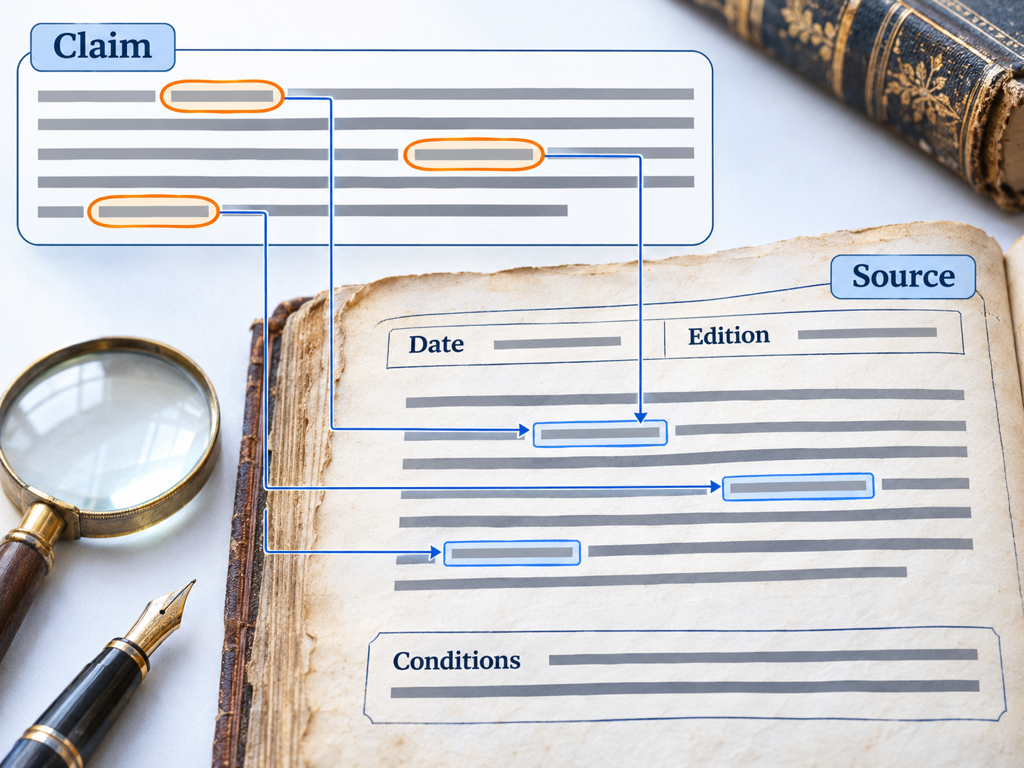
Treat the audit unit as a testable assertion with its qualifiers intact. “The platform integrates with the CRM” differs from “The entry plan integrates with the CRM in every region.” Splitting a compound sentence may be necessary when different sources support its different parts.
Capture the full answer, the visible citation marker, the destination URL, and the observation date. Keep the original user question where authorized, along with relevant market, language, platform, and product identity. An isolated quotation can remove conditions that change the meaning of the claim.
Record the answer’s temporal frame. A statement about last year’s product does not necessarily conflict with a current specification, while a present-tense claim may rely on a page that has not been updated. Preserve both dates rather than assigning the source’s current status to the historical observation.
The research on fine-grained grounded citations examines supporting quotations as a way to improve verification. For an editorial audit, the practical lesson is to retain the passage that supports your label. A reviewer needs more than a URL and a confident conclusion.
Choose a stable claim identifier before annotation. If one answer repeats the same assertion twice, keep the occurrences linked so reviewers can distinguish repeated presentation from two independent pieces of evidence. Do not let formatting inflate the number of factual claims reviewed.
Match Each Claim to the Actual Source Passage
Open the cited destination and locate the relevant text. Read the surrounding paragraph, headings, footnotes, and applicable conditions before assigning a label. A search snippet or a highlighted phrase can omit the restriction that makes the source materially different from the answer.
Use a short rubric and preserve uncertainty. The following is a practical manual-review scheme, not an official platform score or a certified fact-checking standard.
| Review label | Evidence requirement | Next action |
|---|---|---|
| Supported | The passage supports the assertion and its material qualifiers | Preserve the passage and observation context |
| Partially supported | Some material elements are supported; others remain unestablished | Split the claim or identify missing evidence |
| Contradicted | The inspected source states something materially incompatible | Escalate the specific conflict for review |
| Unverifiable | The source or relevant passage cannot be inspected adequately | Keep uncertainty visible and seek another source |
Do not treat the absence of a statement as a contradiction. A feature page that never discusses a particular integration cannot establish that the integration is unavailable. It also cannot support an affirmative claim that the integration exists.
Handle multiple citations carefully. Sometimes two passages jointly support a compound statement. Preserve that relationship explicitly and check whether the combined evidence supplies all necessary conditions. A group of loosely related links is not automatically stronger than one directly relevant passage.
Keep the first label provisional when the source is difficult to interpret. A technical term may refer to a product edition, legacy feature, or partner component. Flag the ambiguity rather than replacing a careful reading with a label that merely fits the report’s desired narrative.
An inaccessible source leaves the claim unresolved.
Check Dates, Qualifiers, and Product Identity
Review qualifiers before evaluating the headline statement. Region, plan, user role, release status, deployment type, and product version can determine whether an otherwise accurate claim applies to the buyer’s situation. Copy them into the audit record instead of relying on the reviewer to remember them.
Consider a clearly hypothetical example. An answer says that a software service includes an integration on its entry plan. The cited page confirms the integration exists, but its plan table restricts access to an enterprise edition. The source supports the feature’s existence and contradicts the claimed plan availability.
Another hypothetical answer describes a product as available worldwide. Its source says the rollout is limited to selected countries. This is not a minor wording issue when the user’s decision depends on local availability. The correction should preserve the geographic condition, not merely add another link.
Verify entity identity when names overlap. A company, product family, individual model, and reseller offer can share similar wording while referring to different things. Record the exact entity and edition before comparing claims across pages.
Prefer an appropriate primary source when it resolves the issue. Official documentation can establish current specifications, while independent testing may be needed for a performance claim. The right source depends on the assertion; a vendor page should not automatically overrule credible external evidence about an observed limitation.
Use Independent Review for Disputed Labels
Have a second person inspect consequential or disputed records before the team reports an error as confirmed. Give that reviewer the answer, source passage, and labeling rules. Where practical, ask for an independent initial label before revealing the first reviewer’s conclusion.
Track disagreements by type. Reviewers may disagree about what the answer asserts, which product it names, what the source means, or whether a qualifier is material. Those disagreements suggest different fixes to the rubric and should not be reduced to a single reviewer-performance score.
Use adjudication to document the reason for the final label. Preserve the original labels and the evidence used to resolve them. A later product update should not erase what the reviewers could establish at the time of the observation.
Separate public-source corrections from monitoring notes. The team may need to correct its own outdated documentation, request a change to an external page, or simply record that an answer misrepresented an accurate source. None guarantees that the next AI answer will change, so schedule a comparable recheck.
A useful audit output includes the claim, support label, material limitation, source owner, proposed action, and review date. The purpose is to help someone resolve a buyer-relevant uncertainty, not to collect an impressive number of red flags.

Use Topify Sources to Prioritize Manual Verification
Topify can help focus the review queue on sources that appear in the answers your team monitors. Its AI citation analysis describes URL and domain tracking, platform differences, and citation gaps. Use those signals to identify the product claims and destinations that deserve manual attention, rather than beginning with an arbitrary list of pages.
The next step is an evidence ledger outside the visibility percentage. Inspect the selected answer, preserve the cited passage, assign a provisional support label, and send material conflicts for independent review. Your output should distinguish increased source presence from improved claim accuracy; the citation-share benchmarking guide provides related context for keeping metric definitions clear. Source tracking does not itself certify that a passage entails every adjacent statement, and a manual sample cannot establish the accuracy of all answers on an engine. Report the reviewed scope and use the findings to prioritize specific documentation or verification work.
Conclusion
AI citation share can show that your sources appear more often without showing whether the linked answers accurately represent them. A claim-support audit closes part of that gap by comparing the actual assertion with the actual passage, including dates, editions, and conditions that change a buyer’s decision.
Start with a small set of consequential claims. Preserve full answer context, use a consistent rubric, and keep partially supported statements separate from contradictions and inaccessible sources. Use Topify’s citation analysis to identify relevant destinations, then make the manual review accountable through passages, reviewers, and a documented next action. The goal is a defensible explanation of what the evidence supports, followed by a comparable recheck after the relevant correction or clarification.
FAQ
Does a citation prove that an AI claim is correct?
No. A citation identifies a source link. Verification requires checking whether the source supports the assertion and all material qualifiers.
What is the difference between partial support and contradiction?
Partial support leaves part of the claim unestablished. Contradiction means the inspected source states something materially incompatible with the claim.
How should inaccessible sources be classified?
Mark them unverifiable within the audit scope. Do not infer accuracy or inaccuracy from an access failure alone.
Can a higher citation share coexist with inaccurate answers?
Yes. Relative source presence and faithful representation are separate outcomes. Report them through separate measurements and an explicit review sample.