A prompt quality analyst reviews a normalized question set and finds that “without annual billing” became “annual billing.” The cleaner wording now represents the opposite purchase requirement. Questions with similar product terms have been grouped together, while the exclusion that could change the shortlist has disappeared.
A prompt research tool needs a meaning check before those questions enter monitoring. Negative wording can exclude a feature, deny a claim, or qualify only one part of a sentence. The practical decision is which proposition the negative expression affects, whether a rewrite preserves that scope, and whether the resulting answer satisfies the buyer’s constraint rather than merely mentioning the brand.
Mark Negation Before Normalizing a Prompt Research Tool Export
Identify the negative cue and the expression it governs before editing. Words such as “not,” “without,” and “never” can alter a buyer’s requirements, but their presence alone does not tell you the full meaning. The reviewer needs to state what is excluded or denied.
For a synthetic buyer question, “Find reporting tools without per-seat fees” excludes a pricing basis. “Find reporting tools that are not free” sets a different condition. A normalization rule that drops small words can make these questions look simpler while destroying the distinction the research needs.
The October 2026 NegCue research studies multiple forms of negation rather than treating every cue as equivalent. Its results concern the models, training, and benchmarks examined in that paper. Use it as a reason to inspect meaning carefully, not as a failure-rate estimate for a current commercial answer product.
Preserve the original question beside every edited version. Add a plain-language statement of the constraint and the reason for the rewrite. That record lets another reviewer decide whether normalization improved clarity or changed the research task.
Distinguish an Exclusion From a Negative Opinion
Classify what the negative statement does. A buyer excluding a billing model is specifying eligibility, not necessarily expressing dislike for a brand. An answer saying a product does not support a feature is making a capability claim, which may be neutral in tone even when it disqualifies the product.
Use a proposed meaning review rather than forcing every negative sentence into a sentiment label. The following examples are synthetic and illustrate distinct interpretation tasks.
| Question or statement | What is negated or excluded | Review task | Unsafe simplification |
|---|---|---|---|
| Tools without per-seat fees | A pricing basis | Preserve the cost constraint | Treat as general negative sentiment |
| Do not recommend tools requiring annual billing | A candidate eligibility condition | Check every recommended option | Remove “do not” during normalization |
| The tool is not difficult to configure | A difficulty claim | Review the qualified meaning | Treat as equivalent to universally easy |
| Not every plan includes exports | A universal coverage claim | Determine which plans qualify | Rewrite as no plans include exports |
| Which option no longer supports this integration? | Current support relative to an earlier state | Verify the time-dependent premise | Convert to a timeless compatibility question |
Make the affected entity explicit. A sentence can deny a claim about one plan while leaving another plan unaddressed. Assigning the negation to the entire brand can turn a limited statement into an overbroad conclusion.
Keep time conditions visible too. “No longer” raises a historical comparison that “does not” may not establish. A source confirming current absence does not automatically prove previous support or the date of a change.
Negative wording is a meaning problem before it is a sentiment label.
Create Minimal Contrast Pairs With Explicit Scope
Build contrast pairs that change one logical condition at a time. Preserve the buyer, product category, task, and remaining requirements so the difference remains interpretable. Label whether the pair is intended to preserve meaning or deliberately test a changed requirement.
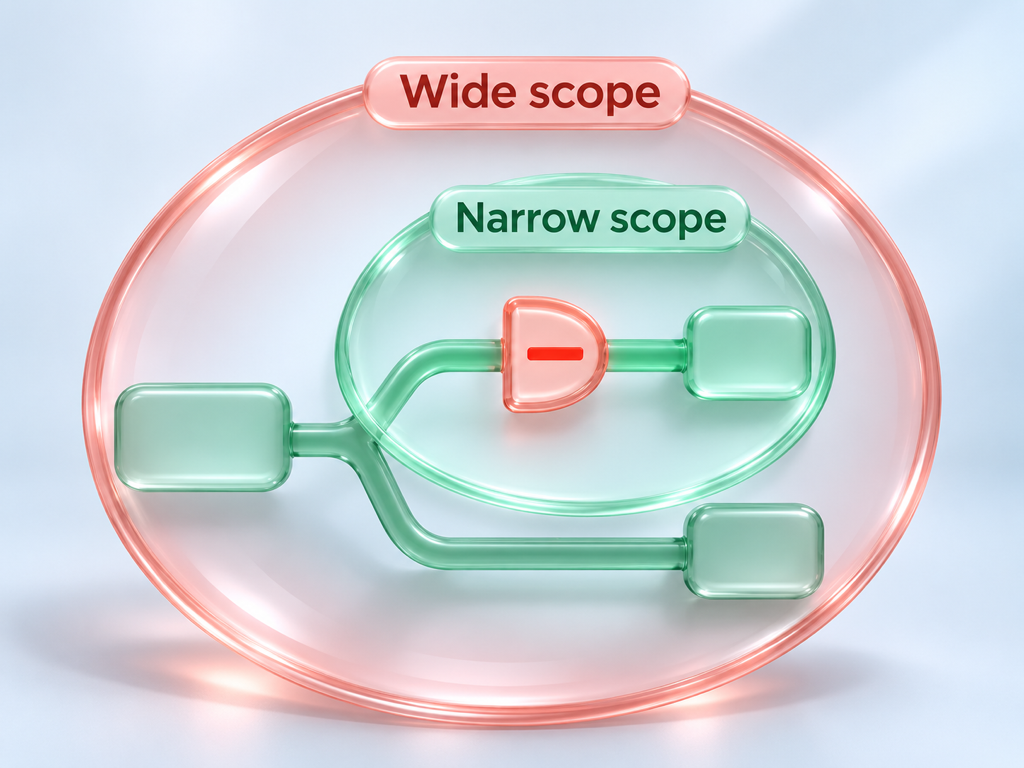
The ScoNe research uses controlled examples to investigate the scope of negation. Its benchmark design supports a methodological distinction: inserting a negative cue and understanding what it affects are separate tasks. Do not transfer its historical model results directly to current consumer search behavior.
A synthetic equivalent pair might express the same exclusion in two clear forms, with a reviewer checking the intended meaning first. A deliberately non-equivalent pair might compare “no plans require annual billing” with “not every plan requires annual billing.” The latter allows some plans to require it; the former does not.
Record the expected relationship before inspecting answers. If the pair is equivalent, a difference may warrant investigation of wording dependence. If the pair changes the requirement, different recommendations may be appropriate. Without that label, a team can mistake correct sensitivity to a changed condition for inconsistent behavior.
Do not run an expanding set of live tests simply because the examples are easy to generate. Define the approved questions, collection plan, and intended decision first. The quality review can be completed on synthetic fixtures before any paid monitoring is activated.
Review Meaning Before Merging Similar Questions
Check logical compatibility before grouping questions that share vocabulary. Two questions can name the same category and feature while asking for opposite eligibility conditions. A similarity score cannot substitute for a review of the buyer decision those sentences express.
Use a short merge checklist: same task, same eligible candidates, same required evidence, and compatible scope. Where any of these differ, preserve a separate question or an explicit subgroup. The purpose is to retain a meaningful testing unit rather than produce the smallest possible number of clusters.
Flag rewrites that change quantifiers or exceptions. Words such as “all,” “some,” “only,” and “unless” can interact with negative phrasing in ways that change which options are allowed. A reviewer should restate the permitted and excluded cases in ordinary language before approving the merge.
Use a counterexample to challenge an equivalence claim. For “not every plan requires annual billing,” imagine a product with one monthly plan and one annual-only plan. If a proposed rewrite excludes that product entirely, the rewrite may have changed the original condition.
Keep unresolved questions in a review queue. Ambiguity is sometimes present in the original buyer language, and a clean rewrite cannot reveal what an unknown person intended. Preserve the ambiguity or seek clarification rather than inventing a precise constraint.
Score Constraint Satisfaction Separately From Brand Presence
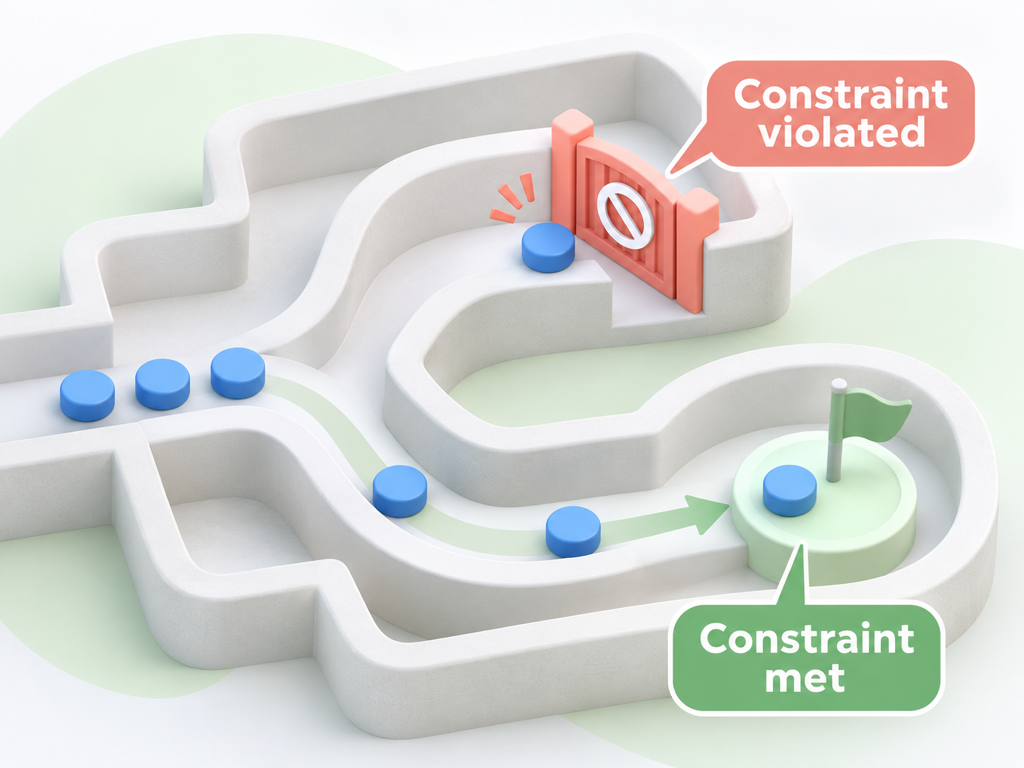
A brand mention does not show that a recommendation met the exclusion. The answer may name the brand while recommending a plan that violates the stated condition, or mention it only to explain why it is unsuitable. These outcomes need separate review labels.
Use a proposed answer record containing brand presence, recommendation role, stated qualification, constraint satisfaction, and evidence status. This record is an analyst framework, not a description of a monitoring vendor’s internal metrics. Keep unknown support separate from a verified violation.
Inspect the recommended configuration rather than the brand in the abstract. A product may offer several plans with different billing or integration conditions. The relevant question is whether the answer selected a qualifying option and supplied evidence for the condition the buyer actually stated.
A synthetic result can illustrate the boundary without inventing performance numbers. An answer that says “Vendor A is popular, but its listed plan requires annual billing” contains a brand mention and a disqualifying condition. Counting it as a successful recommendation would lose the purpose of the question.
An exclusion survives the review only when the scoring checks it.
Keep Approved Wording Stable in Ongoing Monitoring
Topify can help surface candidate questions for a defined brand and category. Its prompt discovery describes identifying buyer questions and visibility gaps, giving analysts a starting set to inspect. Review the negative expressions and their scope before selecting which candidates represent the decision you want to monitor.
Retain the raw candidate, approved wording, constraint statement, contrast-pair purpose, and human review decision separately unless the actual workflow has been verified to preserve those fields. Discovery does not guarantee logical equivalence after normalization, and observed brand presence does not establish constraint satisfaction. Use the reviewed set only within a separately authorized collection plan, and keep any later wording change visible as a revision. The output should help decide which product evidence or answer qualification needs attention, with unresolved interpretations still available for inspection.
A related framework for buyer intent and constraints helps organize the wider decision. The narrower negation review protects the logical meaning within that framework rather than replacing the entire intent analysis.
Define a maintenance check for imports and bulk edits. Compare original and approved wording after each transformation, and send changes to negative cues or scope-bearing expressions for human review. A small semantic check can prevent a long reporting series from measuring a question nobody intended to ask.
Conclusion
Negation should survive every step from discovery to monitoring. Identify the cue, state its scope, preserve the original question, and label whether contrast pairs preserve or deliberately change meaning. Review logical compatibility before merging questions, and score constraint satisfaction separately from brand presence. A cleaner sentence is useful only when it still represents the buyer’s decision.
Begin with a small set of questions containing exclusions, exceptions, or time-dependent negative claims. Ask a second reviewer to restate the eligible cases and challenge each proposed rewrite with a counterexample. Use prompt discovery as the candidate source, followed by explicit approval of the wording and collection plan. The result should be a stable research question whose logic remains visible when a recommendation is evaluated.
FAQ
Why can removing not change a prompt cluster?
It can reverse or broaden the eligibility condition. Shared category terms do not make two questions equivalent when their exclusions differ.
Is negative wording always negative sentiment?
No. It can express a neutral requirement, a capability limit, an exception, or a historical change. Review meaning and sentiment separately.
Can a positive rewrite preserve the same exclusion?
Sometimes, but equivalence requires checking. Confirm that the rewrite permits and excludes the same cases rather than assuming that a more fluent sentence means the same thing.
Does a brand mention mean the answer met the constraint?
No. The answer may disqualify the brand or recommend an unsuitable configuration. Check the role, qualification, and supporting evidence separately.