A storefront team can make every color feel like a separate product or let shoppers change the selection inside one page. Both experiences can work, but the search implementation becomes fragile when the URL, canonical rules, structured data, and feed assume different architectures. The result is often a correct-looking interface with an unreliable arrival state.
Product variant structured data needs an architecture decision before a template decision. Your team must decide how a specific option is addressed, which page represents shared information, and what happens when someone follows a copied link without a prior session. Choosing by developer convenience alone leaves these questions unresolved until a campaign, feed review, or customer complaint exposes them.
Product variant structured data follows the URL architecture
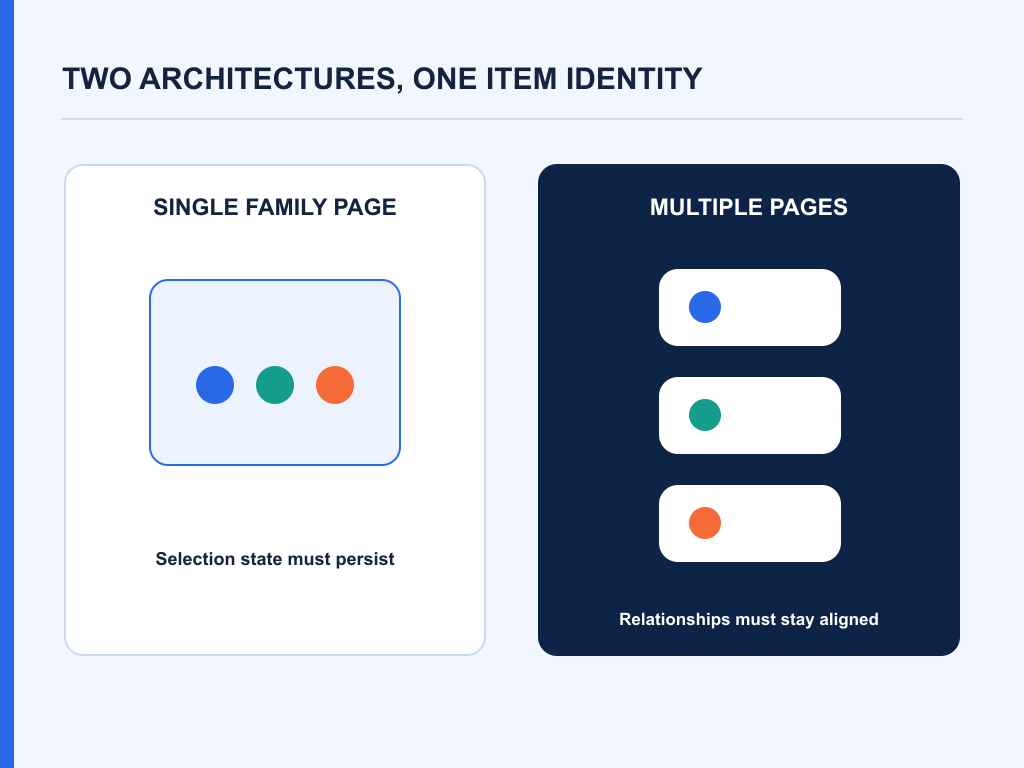
Google’s variant documentation includes single-page and multi-page implementations. These are different ways to express relationships, not a ranking contest between architectures. Choose the model that reflects how your storefront actually serves the family.
A single-page experience may keep shared information together while changing the selected option. A multi-page experience can give distinct variants more dedicated content and destinations. Either arrangement needs unambiguous item identity and a reproducible selection.
Sketch the request before writing markup. Mark the URL a shopper clicks, the initial item returned, the item visible after rendering, and the destination recorded in feeds. Differences between these four states are more informative than the number of page templates in the CMS.
A single-page family simplifies shared content but needs state discipline
One family page can reduce repetition in descriptions, care instructions, and comparison content. It can also keep reviews and option exploration in one customer journey. Those advantages disappear when choosing an option changes facts without updating the associated state consistently.
List every field that must move together when the selection changes. Price, availability, image, SKU, delivery information, and the item submitted to the cart are common candidates. A partial update can leave a buyer looking at one configuration while the order action refers to another.
Treat a copied link as an acceptance test. Open it in a logged-out browser, then repeat on mobile and with the browser language changed. The selected configuration should remain recognizable without a stored preference or an invisible session variable.
Do not confuse a family landing page with a generic category page. The family page should still give a buyer enough information to understand the product and its actual choices. A thin wrapper around a selector offers little useful evidence for search or customer decisions.
Multiple pages create editorial freedom and maintenance obligations
Separate pages can help when variants require genuinely different images, compatibility explanations, or specifications. The extra space is valuable only when the team can maintain those differences. Copying identical text across many URLs creates inventory to maintain without necessarily adding information.
Consider an illustrative equipment family with region-specific electrical connections. A dedicated page may explain the plug, voltage range, certification, and local supply arrangement. Another color of the same casing may need only a selectable variant, not a separate editorial project.
Use the following decision table during architecture review. The entries are implementation trade-offs, not platform ranking claims. Weight them according to your catalog complexity and maintenance capacity.
| Decision criterion | Single family page | Multiple variant pages |
|---|---|---|
| Shared explanatory content | Usually centralized | Needs a defined shared-content source |
| Material variant differences | Must remain visible after selection | Can receive dedicated explanation |
| Direct arrival at an option | Requires reliable URL state | Requires stable variant destinations |
| Catalog updates | Fewer page surfaces | More surfaces need synchronization |
| QA burden | Selection transitions | Cross-page consistency and relationships |
| Team ownership | Often one template owner | May require catalog and locale coordination |
Record why the choice was made. A future redesign should not inherit an architecture whose original assumptions no longer hold. Review the decision when a family gains new fulfillment, compatibility, or regional distinctions.
Canonicalization and item identity solve different problems
Canonicalization helps search systems select a representative URL among duplicates. It does not decide which item a customer is buying. Google’s canonicalization explanation describes that representative-page role.
Do not automatically give every selectable option an independent indexing objective. Conversely, do not collapse useful dedicated pages without examining their content and architecture. The correct configuration depends on how closely the pages overlap and how the platform represents variants.
For parameter-driven variants, consult Google’s ecommerce URL recommendations. They recommend consistent persistent URLs and describe canonical treatment for optional variant parameters. Keep links, sitemaps, and canonical declarations consistent with the design you choose.
An indexing preference cannot repair a broken selection.
Document URL transformations at the CDN and application layers. A redirect that removes a commercial parameter may destroy the variant state while leaving a perfectly functional family page. Test the response chain, not just the final HTTP success code.
Test architecture with difficult arrivals
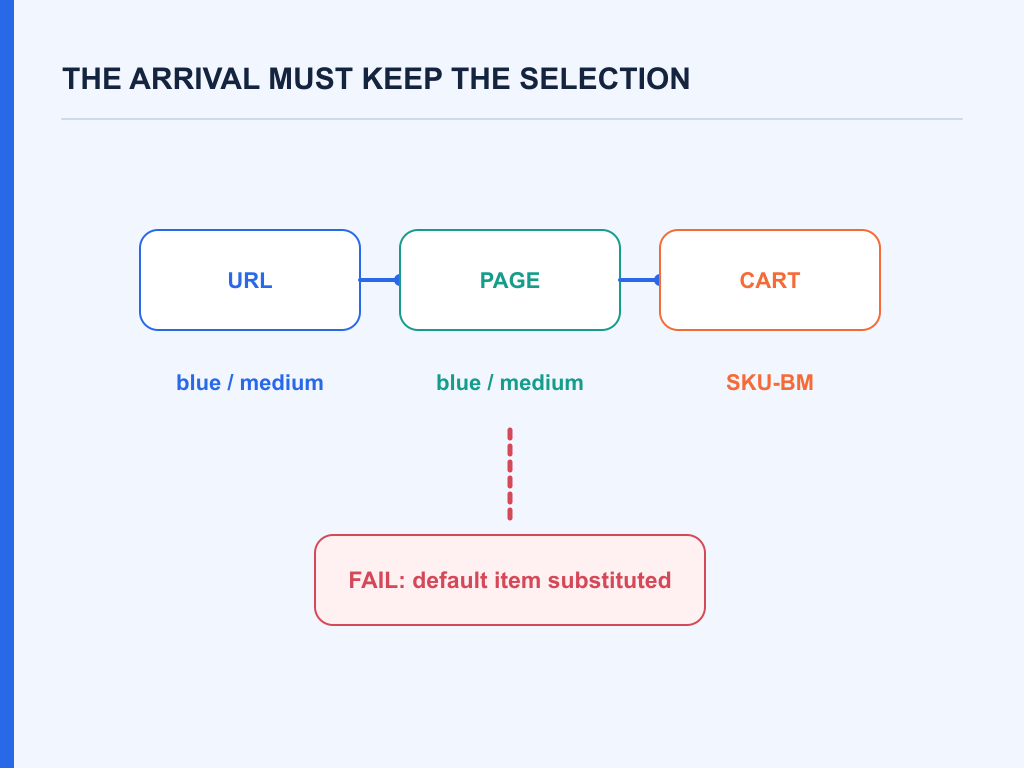
Build a test matrix that includes a sold-out selection, a differently priced selection, and an option with different media. Add a mobile visit, a copied link, and a visit after a cache purge. These cases reveal assumptions that a default desktop session can conceal.
Check both the initial HTML and rendered state. The first may expose an outdated default while the second appears correct after client code runs. Also test the option selected by an external feed rather than only by the storefront’s own navigation.
Retain evidence for each stage: requested URL, redirect chain, selected item identifier, visible facts, extracted markup, and cart identifier. A screenshot alone can prove the appearance but cannot fully prove the underlying item mapping. Keep screenshots and machine-readable records together.
Set a rollback condition before rollout. A lost parameter, wrong offer, or cart mismatch should stop expansion to additional families. A delayed monitoring signal should not be the first release gate for a defect that a deterministic test can detect.
Add an ownership rule for discontinued variants. Decide whether the destination should retain useful out-of-stock information, redirect to an appropriate successor, or return an unavailable state. A blanket redirect to the family may be reasonable in some cases, but it should not silently imply that the old item remains purchasable.
Monitor whether the chosen destination helps buying answers
Once the architecture is stable, evaluate it against real buying decisions. Compare prompts that ask for the family with prompts that require a specific attribute. Record the cited destination and whether it leads to an appropriate option.
Topify can help organize the answer-observation side of this work. Supply a stable set of product and comparison questions, then review visibility, answer position, and source URLs through AI search analytics. The useful output is a list of commercially important questions whose cited destination or description needs investigation. Pair each observation with the relevant family or variant URL and your architecture decision record.
This does not make the monitoring tool a canonicalization validator, and changes in citations do not prove that one URL design caused an improvement. Keep technical tests and observed answers separate in the report. The related ChatGPT vs Google AI Shopping Visibility: What Makes Products Discoverable explains why cross-platform discovery requires more than one representation. Use the monitoring result to select the next investigation, rather than to declare a universally superior architecture.
Conclusion
The best variant URL architecture is the one that represents the catalog clearly and survives a fresh customer arrival. A single page can centralize shared information; multiple pages can explain meaningful differences. Both require stable item identities, consistent commercial facts, and deliberate canonical handling.
Before choosing, draw the URL-to-item journey for a difficult product family and test it without existing session state. Deploy the smallest coherent version, preserve the evidence, and compare customer and crawler-facing outcomes. Topify’s AI search analytics can then show which product questions cite useful destinations and which deserve closer examination. Make the architecture decision from catalog requirements and testable behavior, then use answer observations to refine priorities over time.
FAQ
Does every product variant need its own page?
No. Google documents both single-page and multi-page approaches. The storefront still needs a reliable way to address the intended selection.
Are URL fragments sufficient for variant discovery?
Do not rely on fragments to distinguish indexable product content. Use the path or parameter conventions appropriate to your storefront and current guidance.
Is a canonical URL the same as a SKU URL?
No. A canonical declaration expresses a representative-page preference; a SKU identifies an item. They can be related without serving the same purpose.
What is the most useful architecture test?
Open a specific option in a fresh session and verify its identity, visible offer, markup, and cart item all agree.