A catalog manager sees one jacket in the merchandising system, six color choices on the website, and several dozen stock records in the warehouse. Search systems need to understand how those records relate without attaching the cheapest price, an unavailable size, and an unrelated image to the same item. A valid markup test cannot tell you whether that commercial identity is correct.
Product variant structured data starts with that identity decision. The family explains what the options share; the purchasable item explains what a customer can actually order. Getting the boundary right makes implementation, release testing, and answer-level monitoring substantially easier. The first task is to decide which facts belong to the family and which must stay attached to a specific selection.
Product variant structured data needs two identity levels
Google documents a ProductGroup model with variesBy, hasVariant, and productGroupID. The group connects related products, while individual Product records describe the variants. This relationship can express a family without pretending that every member has the same commercial state.
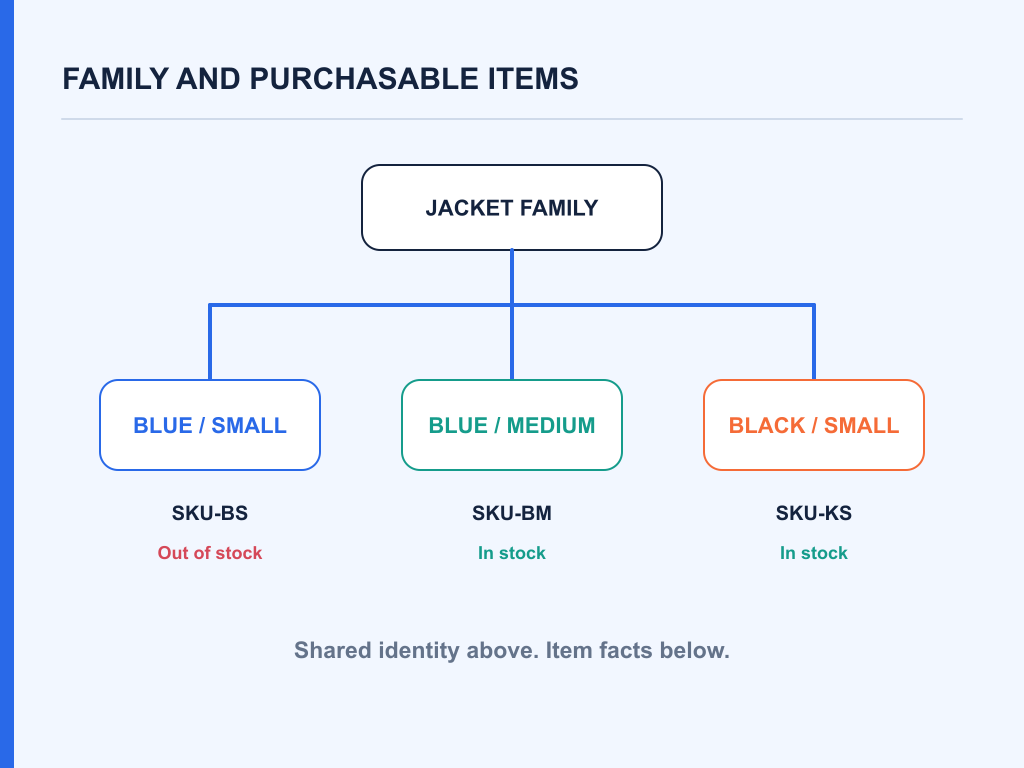
Start with a catalog example rather than a schema generator. A jacket family may share a brand, material description, and care instructions, while each color-and-size combination has its own SKU, image, availability, and offer. A sold-out small blue jacket must remain distinguishable from an available medium blue jacket.
The family is not the inventory unit.
Write down the identity keys used by the product information system, storefront, warehouse, and feeds. Each key should have an owner and a documented mapping. When a storefront manufactures identifiers differently from the feed exporter, debugging quickly becomes a reconciliation project rather than a markup project.
Put shared facts on the group only when they are actually shared
The group is useful for properties that remain true across its members. Shared brand information is an obvious example; a supposedly shared image or description needs more scrutiny. A photograph of one color may misrepresent the remaining variants even when the camera angle is consistent.
Treat inheritance as a claim about the catalog. When one edition changes materials, dimensions, compatibility, or included accessories, confirm whether it still belongs to the same commercial family. A convenient merchandising collection does not automatically establish that every property can be inherited.
Use a small field register to make the decision explicit. The register can live beside the catalog transformation code and should identify which team approves changes. This makes it easier to prevent a later merchandising edit from silently changing the meaning of every child record.
| Field | Recommended ownership decision | Failure to test |
|---|---|---|
| Group identifier | Stable family record | Unrelated items grouped together |
| SKU or other item identity | Specific purchasable variant | Several selections collapse into one item |
| Brand | Shared only where consistent | A licensed sub-brand disappears |
| Image | Accurate for the represented selection | Color differs from the landing page |
| Price and availability | Offer for the selected item | Cheapest or stocked sibling is substituted |
| Compatibility | Most specific verified level | A buyer receives an unsuitable version |
Do not populate uncertain fields with marketing assumptions. An empty compatibility claim creates work for the team; an inaccurate compatibility claim creates work for the customer. Record the missing evidence and fix the underlying product record.
Keep the variant and its offer together
A Product describes the item; an Offer describes the commercial proposition attached to it. Google distinguishes merchant listings from product snippets: the former concern pages where customers can buy from the merchant, while the latter also cover product-related pages without direct purchase.
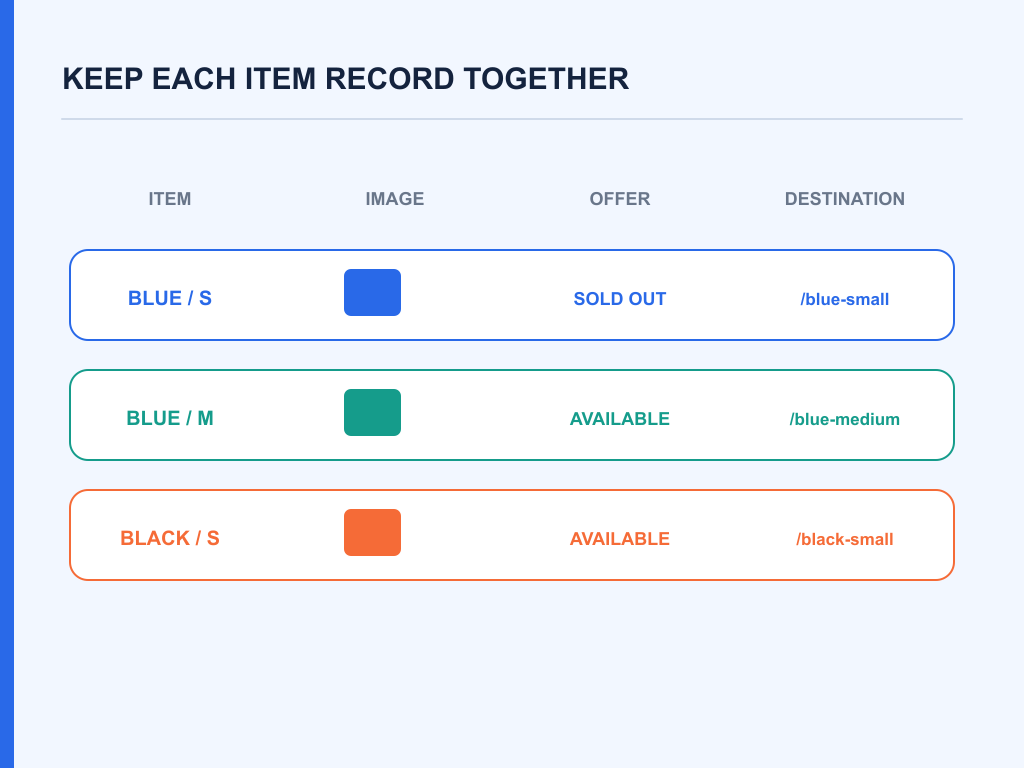
For implementation, keep a clear item-to-offer association. A record should not inherit another variant’s price merely because it belongs to the same group. The customer-facing selection, structured representation, and feed entry should refer to the same purchasable item at the time of inspection.
Consider an illustrative notebook sold with two memory configurations. The brand and chassis may be shared, but the larger-memory option can have a different price, shipping date, and product identifier. If the page initially displays the smaller configuration while markup describes the larger one, syntactic validity does not resolve the contradiction.
Document whether stock status refers to online purchase, store pickup, preorder, or a future delivery commitment. The record should describe the actual route offered to the customer. Do not use a generic available state to mask a restricted or uncertain fulfillment arrangement.
Make the landing URL preserve the selection
An item URL should open the intended selection in a fresh session. Test it without cookies, with a different browser locale, and on a narrow screen. A URL that restores the right state only for the person who copied it is unreliable as a discovery destination.
Google’s ecommerce URL guidance describes paths and query parameters for variant identification. It also warns against relying on fragments to distinguish indexable content. Choose a consistent scheme that the storefront can serve directly.
Keep identity separate from tracking. Campaign parameters may be appended to a stable item URL, but they should not become the only way to reproduce a color or size. Define which parameters choose commercial state and which only record attribution.
Test the entire transition: initial response, rendered selection, image, price, stock message, and cart addition. An add-to-cart action can still submit a default SKU after the interface appears to show the requested variant. That is a commerce defect even before it becomes a search problem.
Validate meaning before increasing coverage
Begin with a representative family rather than a full-catalog deployment. Include a sold-out option, a differently priced option, and an option with a distinct image. These cases expose inheritance errors that a uniform family can hide.
Run the Rich Results Test for supported markup checks, then inspect the production response and the rendered page. Keep the evidence attached to a timestamp and release version. A successful staging test does not establish that the CDN, theme, and live feed all received the same update.
Create acceptance criteria that a catalog operator can understand. For example, the selected item’s identity, offer, and image must agree across the destination and exported record. Define how a failed criterion blocks release and who may approve a documented exception.
Coverage is useful only after identity is trustworthy.
Avoid interpreting eligibility as an outcome guarantee. Google states that its AI features do not require special AI-specific structured data. Product markup has documented search uses, but it should not be sold internally as a guaranteed recommendation mechanism for every answer engine.
Observe product answers after the catalog is coherent
Once technical checks pass, create a separate observation plan. Ask questions that depend on the attributes most likely to be confused: a particular size, a compatible configuration, a material, or a price constraint. Save the response and cited URL instead of recording only whether the brand appeared.
Topify can support that observation layer. Start with a fixed set of buying questions and relevant competitors, then use AI search analytics to examine brand visibility, positions, and cited sources. Review whether the answer describes the correct item family and whether its destination preserves the required variant. This can help prioritize a page or source investigation when commercially important attributes are omitted or mixed together.
Keep the product record and release log beside the monitoring results. Topify does not replace schema validation, warehouse inventory, or a checkout test, and a missing mention cannot prove a variant-data error caused the omission. The related ChatGPT Product Feed Optimization: The Fields That Improve Discovery, Accuracy, and Trust provides a complementary feed perspective. Use both workflows to distinguish a representation defect from a retrieval or recommendation outcome.
Before widening the prompt set, agree on the remediation owner for each observed defect. Catalog identity belongs with product data, a broken destination belongs with storefront engineering, and an unsupported claim belongs with the source owner. This prevents the content team from trying to repair an operational problem by publishing more copy.
Conclusion
Product variant structured data works best when the catalog already knows the difference between a family and a purchasable selection. Start with stable identities, place shared facts carefully, and keep variant-specific images and offers attached to the correct item. Then verify that a fresh visit and cart action preserve that selection.
Choose one varied product family for a pilot, document its field ownership, and retain a production test record before expanding coverage. After deployment, use Topify’s AI search analytics to observe whether buying answers describe and cite the intended products. Technical validity and answer visibility answer different questions; the combination gives your team a more useful investigation path when a customer-facing result is wrong.
FAQ
What is product variant structured data?
It describes relationships between a product family and its individual variants. Google’s supported model uses ProductGroup and Product records with properties that express the variation.
Should every variant share the same price?
Only when that price is correct for each represented offer. Do not copy a family minimum into an item whose actual purchase price differs.
Can a variant URL use a query parameter?
Yes. The destination must reliably select the intended variant, and canonical handling should follow the chosen architecture and current platform guidance.
Does valid markup guarantee an AI recommendation?
No. Markup validation checks representation and eligibility requirements, not every retrieval or recommendation decision.