A promotion goes live at midnight, but the feed exporter, page cache, product markup, and cart service do not all update together. A shopper can arrive at the right family and still see a price from the wrong configuration. A successful schema test from the previous afternoon offers little protection against that operational failure.
An audit of product variant structured data should therefore test the release as a sequence of commercial states. It must establish which selection is represented, which price is active, and whether stock and imagery remain aligned as the promotion starts and ends. The objective is a repeatable release decision, supported by evidence that another operator can reproduce.
Product variant structured data audits start with risky cases
Audit selection should follow failure risk rather than catalog order. Include families with different prices, many option combinations, low-stock items, scheduled promotions, and region-specific fulfillment. A small deliberately difficult sample can expose a template defect that affects a large part of the catalog.
Keep a second sample for coverage after the difficult cases pass. The first asks whether the implementation can fail in predictable ways; the second asks how widely the correct implementation has reached. Combining these purposes in one completion percentage can hide a serious defect behind many easy passes.
Record each case with its item ID, family ID, destination URL, country, currency, expected selection, and inspection time. These fields establish the commercial context before any tool parses the page. Without them, two testers can report different results while unknowingly inspecting different offers.
Compare the same item across every commercial surface
Use the product system as the approved record of intent, then reconcile the exported and customer-facing representations. Google documents price mismatch problems between submitted product data and landing pages. That makes timing and surface consistency a concrete release concern.
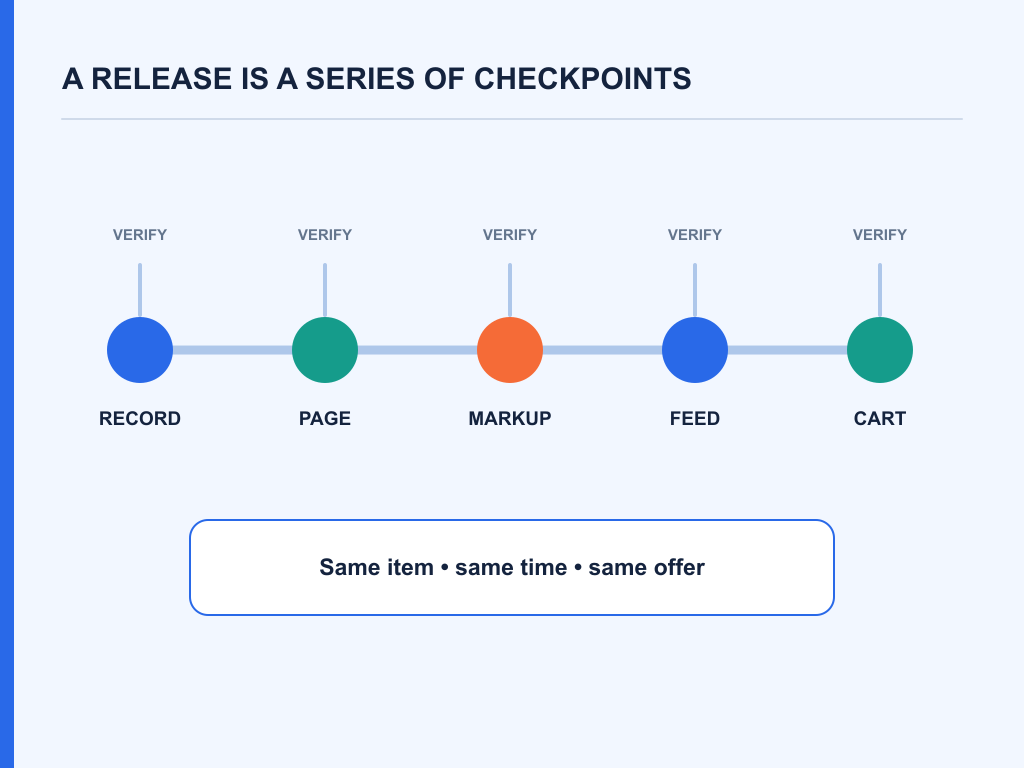
Compare initial HTML, rendered page, structured data, feed row, and cart selection. Record the same item at the same commercial moment. An apparent disagreement may otherwise be caused by a legitimate price change between two inspections.
| Test | Evidence to retain | Release decision |
|---|---|---|
| Variant identity | Item ID, selected options, group relationship | Block when the wrong item is represented |
| Active price | Amount, currency, promotion interval | Block when published surfaces disagree |
| Availability | Stock message and purchasable state | Block misleading availability |
| Primary image | Selected option and image URL | Repair a mismatched color or model |
| Destination state | Fresh-session arrival and redirects | Block lost selections |
| Cart handoff | Submitted item and final cart identity | Block substitution of the default option |
Label the table a test register rather than a platform performance score. It tells the team whether the catalog release is coherent, not how often a search engine will recommend an item. This keeps a controllable implementation task separate from an uncertain discovery outcome.
Test the beginning and end of the promotion
A scheduled sale has at least three important states: before activation, during the offer, and after expiration. Add boundary cases for timezone handling and cache invalidation. A campaign that ends correctly in one region can still remain active on another delivery surface.
Use explicit timestamps in the test record. Keep the intended commercial timezone beside the system’s stored representation and the observed page time. Avoid informal notes such as midnight or tomorrow when operators work across regions.
Google’s landing-page requirements cover consistency of currency, availability, and related buying information for its merchant experiences. Apply the relevant requirements to the actual destination being promoted, including the exact variant and fulfillment limitations.
An illustrative test might activate a discount for one size while keeping sibling variants at their ordinary prices. Confirm the group page does not present the discount as universal. Then confirm the discounted item returns to its approved offer after expiration.
Do not let a sale badge stand in for the price record. The customer should be able to determine the actual amount for the chosen item. A visually prominent promotion with an ambiguous final price creates uncertainty even when the underlying JSON is valid.
Triage identity errors before cosmetic warnings
Separate blockers from improvements. Wrong item identity, incorrect currency, lost selection, and cart substitution deserve immediate attention. An optional property warning may be worth fixing without carrying the same commercial consequence.
Google’s merchant listing documentation distinguishes required and recommended properties. Use those requirements alongside your own customer-risk criteria. A property can be optional for a search enhancement yet important to your own buying experience.
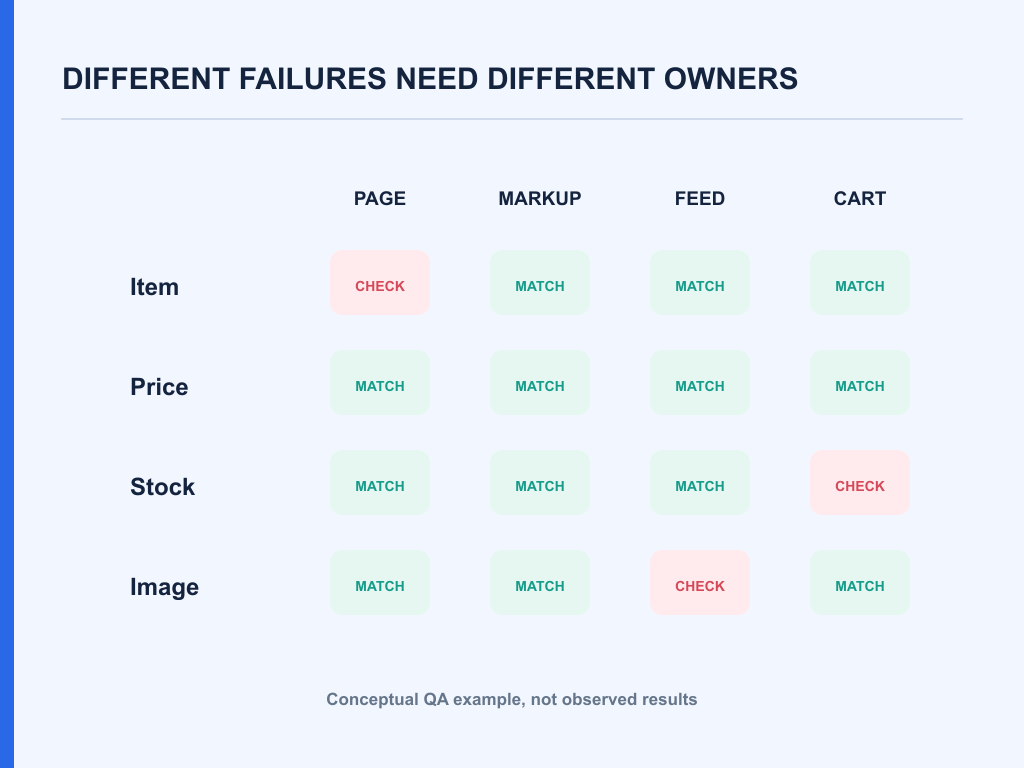
Assign each failure to the layer that produced it. A stale feed should not automatically create a theme-engineering ticket, and a JavaScript selection bug should not be sent to the catalog copywriter. Attach a minimal reproduction and the expected result to every issue.
Identity failures come first.
Keep rejected test records, not just the eventual passing result. They show which failure modes the team understood and help a later regression investigation. A release log that contains only green checkmarks loses this operational memory.
Build a rollback that preserves useful product information
A rollback should restore a coherent known state across affected surfaces. Reverting only the markup can leave the page and feed in disagreement. Name the systems involved, the order of rollback, and the person authorized to make the decision.
Keep the rollback scoped to the affected family or transformation when possible. A template-wide revert may be necessary, but it should not be the default response to a single bad source record. Distinguish data defects from renderer defects before broadening the intervention.
Test cache behavior during rehearsal. Record whether the platform invalidates page HTML, API responses, image selections, and exported feeds on the same event. When their refresh intervals differ, document the expected delay and define how customers will see a consistent offer during it.
Google describes automatic item updates that can reconcile some price, availability, and condition mismatches. Treat such features as platform assistance, not a substitute for publishing accurate source data. Your own release gate should remain accountable for the facts you send.
After recovery, repeat the failing case and one adjacent sibling. This checks whether the fix corrected the intended mapping without breaking another option. Expanding to the full regression suite makes sense when the change touched shared transformation code.
Use AI answers to prioritize the next audit cycle
Deterministic release checks should happen before discovery monitoring. Once the commercial state is coherent, ask whether generated buying answers still mix up versions, prices, or availability. Save the response, date, prompt, cited source, and required item attribute.
Topify can organize the ongoing observation workflow. Enter product-family and attribute-specific questions, then use AI search analytics to inspect mentions, positions, and cited URLs. Group observations by the commercial decision being tested, such as finding a compatible version or comparing a discounted item with alternatives. The output can identify high-priority destinations for the next technical audit rather than merely counting brand appearances.
Monitoring cannot confirm the inventory service’s current state or establish that one markup change caused an answer to improve. Pair observed responses with your release register and source timestamps. The existing ChatGPT Product Feed Optimization: The Fields That Improve Discovery, Accuracy, and Trust offers related guidance on keeping the feed representation coherent. Together, these records help the team decide whether the next action belongs in product data, storefront code, or source clarification.
Conclusion
A pre-sale audit should establish that the right item, offer, image, and availability survive the complete arrival-to-cart journey. Start with difficult families, inspect the same commercial state across surfaces, and rehearse activation and expiration boundaries. Keep explicit blockers and a rollback that restores consistency across the affected systems.
For the next promotion, choose a risk-based pilot set and require a timestamped evidence record before approval. After launch, use Topify’s AI search analytics to observe whether important buying answers describe the catalog accurately. Answer monitoring can reveal where to investigate next, while the release tests determine whether the information your team publishes is internally coherent and safe to expand.
FAQ
When should variant markup be audited?
Audit before major catalog releases, promotion boundaries, template changes, and feed transformations. Keep a smaller regression check for routine updates.
Is a valid Rich Results Test enough?
No. It does not prove that the visible selection, feed, inventory, and cart all represent the same item.
Which errors should block a sale release?
Wrong item identity, misleading prices or availability, lost selection, and cart substitution are strong candidates. Set the actual criteria before testing.
Can AI monitoring replace release QA?
No. It observes generated answers and cited sources. It cannot replace deterministic checks of the live commerce systems.