A customer reads a generous storewide return promise, opens a product marked final sale, and asks an assistant which rule applies. The answer depends on scope, not on which sentence sounds more confident. A merchant can publish individually plausible policy statements that become misleading when the relationship between them is missing.
A merchant return policy needs a clear default, an explicit exception model, and a reliable way to resolve the policy for a particular item and market. Structured data can represent part of that information, but the business must first decide what the information means. Begin with a policy map that customer support, commerce operations, and engineering can all use without interpreting contradictory fragments.
A merchant return policy needs a scope model
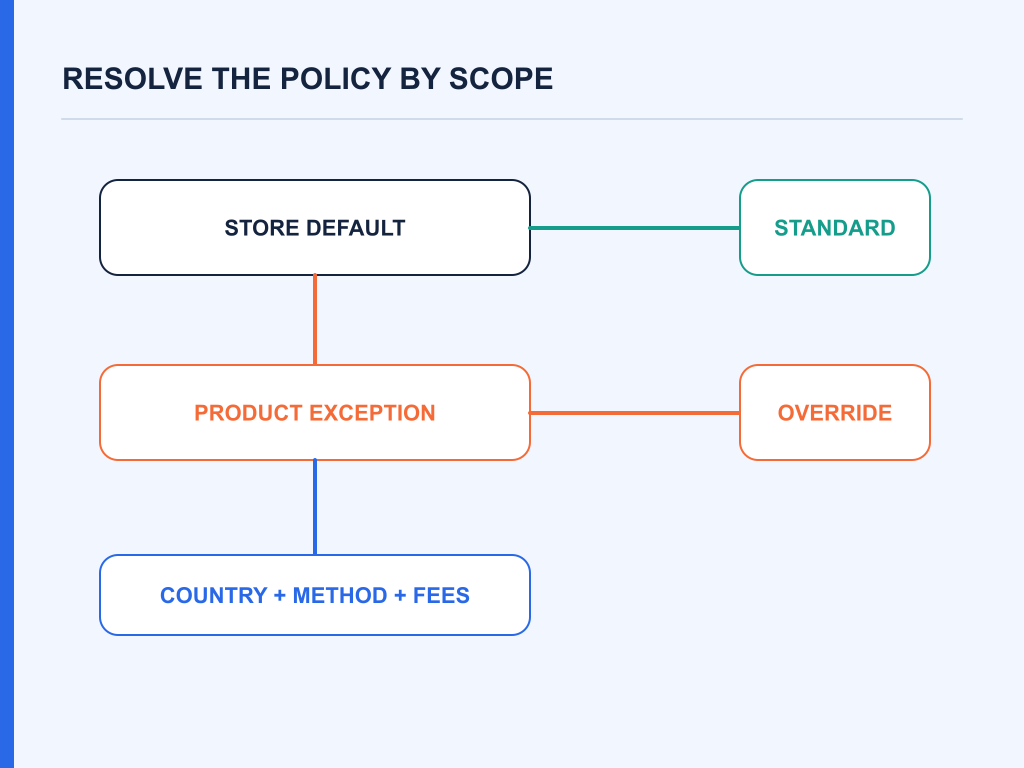
Separate the business-wide promise from rules applying only to a product, category, destination, or purchase interval. A policy may be correct at one scope and wrong at another. The task is to identify the applicable rule before presenting it as a customer entitlement.
Google’s MerchantReturnPolicy documentation supports a standard business policy under Organization and product-specific overrides under Offer. The product-level representation supports a narrower set of properties, so do not assume every organization-level detail can be copied into an offer unchanged.
Create a policy identifier and a readable explanation for every rule. Record the applicable products, countries, conditions, effective dates, and owner. A phrase such as special return terms is not a sufficient exception because neither a tester nor a customer can resolve it reliably.
The default must have a defined boundary.
Publish a useful default before adding exceptions
A standard policy should answer the common customer decision: whether the purchase can be returned, within what window, through which route, and with what cost. Link to the full policy from product and support surfaces where the decision arises. Keep the explanation readable independently of markup.
Do not reduce the default to a single number. A return window without its starting event can be ambiguous, and a free-return statement may omit condition or location restrictions. Ask support staff to identify the recurring questions that the current policy fails to resolve.
Translate the approved business rule into the properties supported by the platform. Keep details that cannot be represented clearly available in the visible policy. The inability to encode a nuance does not justify removing it from the customer explanation.
Version the policy when its substance changes. Preserve the previous version and the date it governed purchases so support can answer questions about earlier orders. This record is also useful when an external answer cites a superseded page or cached statement.
Product exceptions should be explicit and narrow
An exception should identify exactly what it changes and leave the rest of the policy understandable. For example, an illustrative personalized item might have a different ordinary return rule from a standard stocked item. The actual language and obligations need approval from the business’s qualified policy owner.
Avoid treating an exception label as customer-facing evidence. A feed label can route the correct policy internally, but a shopper still needs the applicable terms on the destination. Internal naming conventions are implementation aids, not an explanation of the purchase.
Google documents return policy labels in its product data specification. Its invalid-label troubleshooting guidance explains that an unresolved policy label can result in the default being applied. That is a practical reason to validate the mapping rather than merely confirm that a label field is populated.
Test products with no exception, one exception, and an unexpected or retired label. Define the intended behavior for each state. A missing configuration should create an actionable error in the publishing workflow, not quietly become an unreviewed commercial promise.
Resolve country, method, and fees together
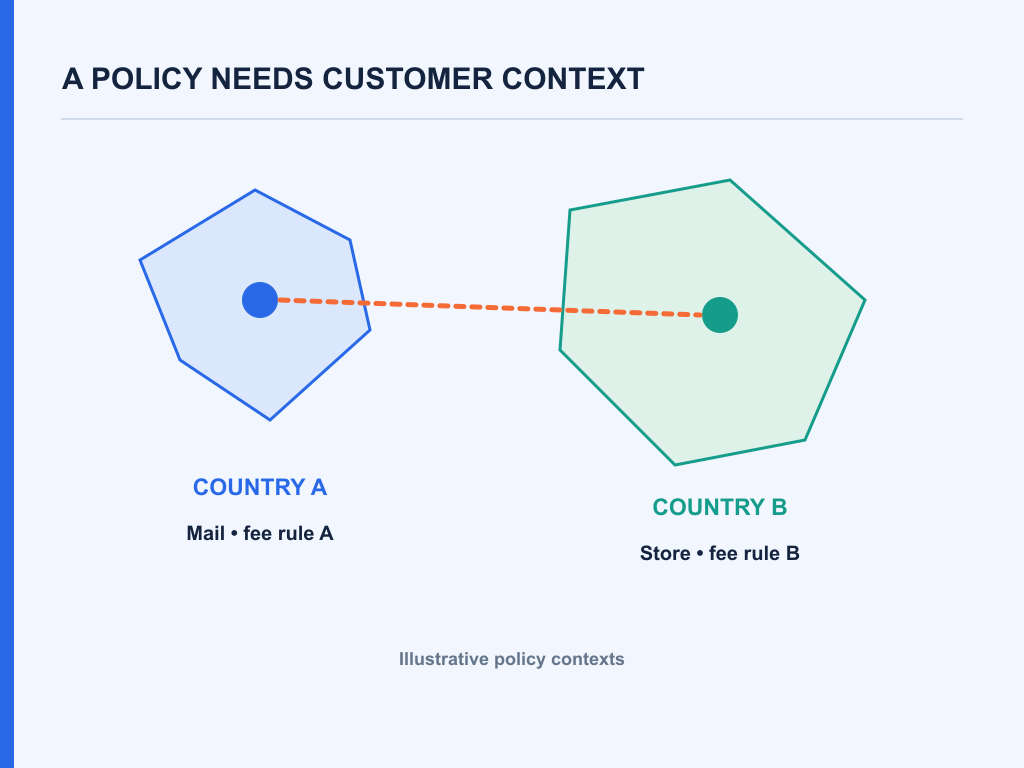
A policy is useful only in the customer’s context. A supported return method may differ by country, while the party responsible for postage can differ from the party collecting an administrative fee. Keep these concepts separate in the underlying record.
Use a policy-resolution table to check representative cases. The values below describe questions to answer, not recommended commercial terms. Replace them with the business’s approved facts before implementation.
| Context | Rule to resolve | Evidence to inspect |
|---|---|---|
| Ordinary item in the main market | Standard window and method | Default policy and product destination |
| Item carrying an exception label | Override and unchanged conditions | Label mapping and visible exception |
| Cross-border purchase | Applicable country and return route | Local policy and fulfillment instructions |
| Store return instead of postal return | Accepted method and restrictions | Store participation and policy text |
| Customer-remorse return | Fees and responsibility | Approved fee rule and customer explanation |
| Earlier order after policy revision | Version applicable to that order | Effective dates and archived policy |
Check the language of every policy summary as well as the data fields. A short product badge can contradict a detailed support page even when both were written by well-informed teams. Assign one owner to approve the summary after the policy record changes.
Validate the resolved promise on the live destination
Run structured-data checks, but include a human-readable resolution test. Give a tester an item, destination country, and order context, then ask them to state the applicable policy from the page. A correct technical record is insufficient when the customer cannot find or interpret it.
Inspect the initial response, rendered product page, policy page, merchant configuration, and any exported feed. Keep the timestamp and selected item alongside the evidence. A policy changed between two inspections can create an apparent mismatch that is actually a versioning problem.
Define release blockers around misleading promises. An incorrect free-return statement, wrong exception, broken policy link, or conflicting country rule should be addressed before broad deployment. Optional enhancement warnings can have a different priority while still entering the backlog.
Also test unavailable states. A policy page that requires login, returns an error in one market, or redirects to a generic help center does not provide dependable public evidence. Verify the destination from a fresh session in the markets that matter.
Policy clarity should survive a copied link.
Observe how buying answers describe the policy
After the policy record and public pages agree, create a set of policy-sensitive buying questions. Include returns as an explicit constraint rather than always asking a generic best-product question. Record the answer’s factual statement and source, not just whether the brand was recommended.
Topify can provide a repeatable observation workflow. Enter a stable panel of shopping and comparison questions, then inspect brand mentions, cited sources, and answer positions through AI search analytics. Review the cases in which policy conditions are missing, an old rule is repeated, or a competitor receives a clearer explanation. The output should be an investigation queue linked to actual policy records and affected markets.
The platform cannot determine the contractual entitlement for an individual customer or replace the merchant’s approved policy. A response change also does not establish that a markup edit caused it. The related AI Prompt Gap Analysis: Find the Evidence Competitors Supply and You Do Not is useful for deciding whether the gap is missing evidence, conflicting evidence, or a different recommendation outcome. Route each issue to the policy or publishing owner who can resolve it.
Conclusion
A merchant return policy becomes dependable when the team can resolve a specific item’s rule for a specific customer context. Establish the default, name the exceptions, and keep countries, methods, fees, and effective dates connected. Then make the resolved promise readable on the live destination as well as in its structured representation.
Start with a small policy matrix covering standard items, exceptions, and cross-border cases. Assign ownership, retain policy versions, and block misleading claims before release. Use Topify’s AI search analytics afterward to observe whether buying answers reproduce the current terms accurately. This connects policy operations with discovery measurement while keeping the approved business rule as the source of truth.
FAQ
Where should the standard merchant return policy be represented?
Google supports a business-level policy under Organization. Product-specific exceptions can be represented under Offer using the supported subset of properties.
Should an exception replace the entire public policy?
It should clearly state the applicable change and its scope. Customers still need a complete explanation of the conditions that govern their purchase.
Can a feed label replace visible return terms?
No. The label helps map records internally; the customer-facing destination should explain the applicable policy.
Does return-policy markup guarantee accurate AI answers?
No. It is one representation of policy information. Observe actual answers and trace errors to their sources before choosing a corrective action.