A citation analyst prepares a weekly report and uses a page’s updated date as the moment an answer adopted a new fact. The timeline looks precise, but the stored record contains only a page label and the time someone reviewed a response. The team is about to make a claim about retrieval that neither timestamp establishes.
LLM citation tracking becomes easier to defend when every date has a stated meaning and source. Publication, modification, the event discussed, answer collection, and human review can happen at different times. The practical decision is which clock supports the question being asked, how much precision it contains, and which parts of the timeline must remain unknown.
Define the Clocks in LLM Citation Tracking
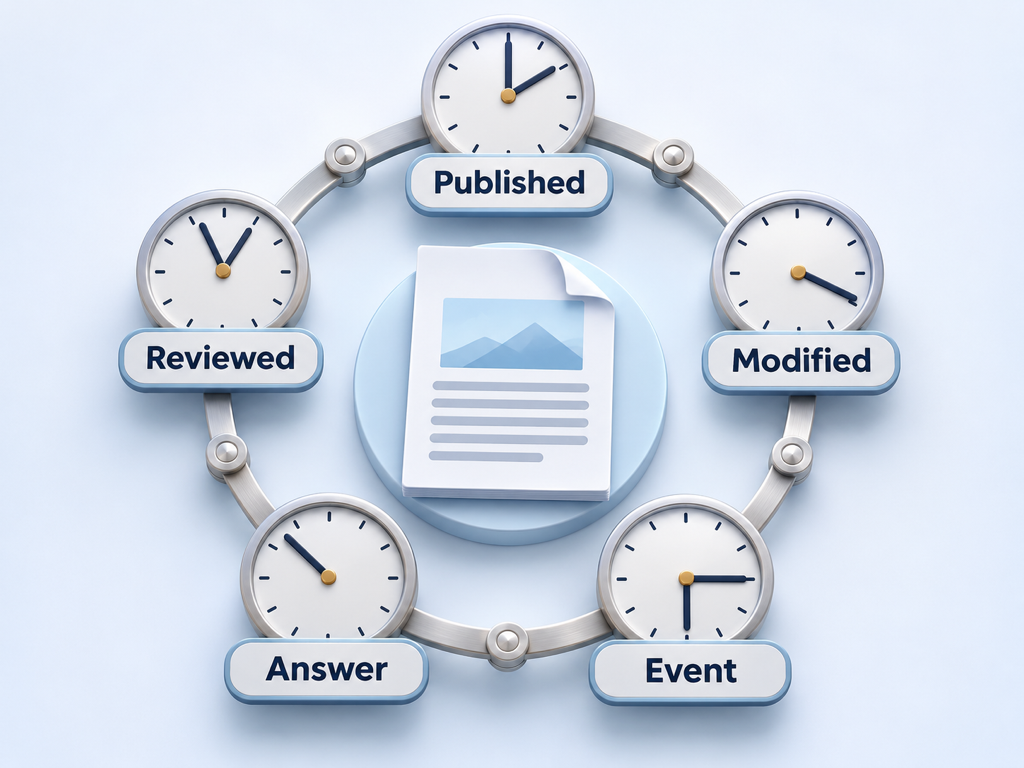
Use separate fields for separate events. A source publication date describes when the publisher says a document appeared. A modification date describes a later change to that document, while an event date refers to something discussed within it. An answer observation time records when your system captured a response; a review time records when a person checked it.
None of these fields should silently stand in for internal retrieval time. A visible citation establishes that a particular link appeared in the captured answer. It does not necessarily expose the model’s complete information path, the exact retrieval moment, or the version of every passage consulted.
Build a date dictionary before creating a freshness metric. For each field, state the event, evidence source, precision, time zone when known, and treatment of missing values. This lets another analyst understand why two seemingly similar dates cannot be exchanged.
Choose the clock from the business question. A review of an expired offer concerns the offer’s validity period. A report on when your monitoring first observed a citation concerns collection records. A question about document publication concerns publisher evidence. Those decisions can share a timeline without sharing one authoritative date.
Record Where Every Source Date Came From
Capture provenance alongside the date value. A visible byline, structured metadata, a search-result label, and a reviewer inference are different evidence types. Storing only the chosen date discards the distinction a future investigation may need most.
Google explains that a byline date is an estimate informed by multiple signals. That is a useful reason to preserve the observed date label and its origin rather than treating one search display as an exact publisher timestamp. The same documentation distinguishes published and modified date information.
The following is a proposed analyst record, not a vendor data schema:
| Date field | Example evidence source | Precision to preserve | Claim it can support |
|---|---|---|---|
| Source publication | Publisher’s visible publication label | Date or timestamp as shown | What the publisher states about publication |
| Source modification | Updated label or structured field | Observed precision and zone | What the source states about modification |
| Fact period | The cited sentence, table, or offer terms | Period or validity interval | When the particular claim applies |
| Answer observed | Collection record | Actual captured timestamp | When this answer was observed |
| Human reviewed | Review record | Actual review timestamp | When evidence was checked by a person |
Retain conflicting observations instead of resolving them invisibly. A page can display one date in its byline and another in structured metadata. Store both values with their evidence locations, then explain which one you used for a particular decision and why.
Keep inference out of raw fields. A reviewer may reasonably suspect that a source predates its current URL, but that interpretation belongs in a note with supporting evidence. It should not overwrite the publication date as though the publisher had supplied it.
Preserve Time Zones and Unknown Values
Preserve the precision the source actually provides. A page labeled November 12 contains a calendar date, not a verified instant at midnight in your reporting time zone. Converting that label into a precise UTC timestamp creates information that was never observed.
Store the raw string and a normalized interpretation separately. The normalized representation can identify a date-only value, a timestamp with an offset, an interval, or an unknown value. Keeping the raw label makes later corrections possible when the parser or interpretation changes.
Use a synthetic example to test the workflow. One source shows a date only, another shows a time with an explicit offset, and an answer capture has its own system timestamp. Verify that sorting the records does not imply a definite order between events whose precision is insufficient to establish it.
Choose display behavior for uncertain order. A report can show date-only events in a calendar band rather than aligning them to an invented second. A reviewer should be able to see where the timeline contains exact observations and where it contains a range or unresolved ordering.
Unknown time is a valid observation state.
Check the Claim Date Against the Page Date
A new page date does not prove that every claim on the page is current. A publisher might update navigation, add a section, or revise a different table while leaving the cited fact unchanged. Evaluate the claim’s own period and conditions before using the page date as a freshness signal.
Consider a synthetic source updated in November that still contains a benchmark collected in May. The document may be recently maintained, while the benchmark remains evidence about the earlier sample. Reporting the benchmark as November data changes the meaning even though the source URL and update label are accurate.
Record the relevant passage or table location beside its period. For an offer, preserve the validity interval and any explicit expiration condition. For a research result, preserve the sample period or experiment version when stated. If no claim-level period is available, label it unknown rather than borrowing the page date.
Separate “recently published” from “applicable now” in the review outcome. An old definition may still answer a stable technical question, while a newly republished price can already be out of date. The review should follow the decision the evidence must support, not a universal age threshold.
Keep the remediation specific. A date ambiguity may call for a narrower statement or further source verification. It does not automatically justify declaring the entire source stale or claiming that an answer used obsolete internal knowledge.
Report Date Conflicts Without Rewriting Observations
Use a conflict record when dates disagree. Include each observed value, its source, the collection time, and the interpretation under review. That record should explain the disagreement without erasing the evidence that produced it.
Separate correction of a parsing error from a new observation. Fixing an offset incorrectly read by your parser changes the interpretation of an existing record. Visiting a page later and finding a revised update label creates a new source observation. Preserve the distinction so a historical chart does not appear to have changed on its own.
Require a reason when an analyst chooses a display date. The reason might be a clearly labeled publisher timestamp, a claim-specific validity period, or a decision to leave the value unresolved. An undocumented “best date” field makes future reconciliation depend on memory.
Show the uncertainty in the report’s language. “Observed in an answer collected on November 20” is a narrower, defensible statement than “retrieved on November 20” when no retrieval event was captured. A precise verb often prevents more confusion than an additional chart annotation.
The timeline should retain the evidence, including its gaps.

Use Citation Trends With Explicit Date Limits
Topify can support the answer-observation side of this workflow. Start with a defined brand, relevant questions, and the source URLs that matter to the investigation. Its AI citation analysis describes tracking cited domains and URLs across observed answers, helping an analyst decide which recurring sources deserve a date-provenance review.
Keep publisher dates and claim periods in a separate evidence record unless the actual available workflow has been verified to preserve them. A citation trend can help prioritize an investigation, but it cannot establish an undisclosed internal retrieval time or prove that a page’s latest revision supplied a particular answer. Connect the sampled citation to its collection conditions, then record the human review of the source independently. That separation preserves the value of monitoring while keeping the date interpretation inspectable.
The distinction between a source citation and a brand mention also matters when constructing the timeline. A brand appearing in an answer does not provide the same source-date evidence as a visible link to a specific page.
Finish each review with a sentence that states the supported event. For example, a report can establish when a citation was first observed within the retained sample and which publisher date was visible during review. It should also state when earlier observations or exact source-version evidence were unavailable.
Conclusion
Citation dates should describe the events they actually represent. Keep source publication, modification, fact validity, answer observation, and human review separate. Preserve raw labels, offsets, precision, and conflicts, and do not convert a date-only value into an invented instant. A current page label also needs a claim-level check before it supports a freshness conclusion.
Begin with one citation that influenced a business decision. Build the date dictionary, trace every displayed date to its evidence, and rewrite any timeline claim that implies an unobserved retrieval event. Use citation-source monitoring to prioritize subsequent reviews while retaining the independent date record. The result should explain what happened, when it was observed, and which parts of the sequence remain unresolved.
FAQ
Is a page update date the model retrieval time?
No. A publisher’s modification label and an internal retrieval event describe different things. Do not substitute one for the other without direct evidence.
Which date should a citation report use?
Use the date that matches the question. Citation observation, document publication, and claim validity should have separate fields rather than competing for one timestamp.
How should date-only values be stored?
Preserve them as date-only values with the raw label and provenance. Do not invent a time or time zone that the source did not provide.
Does a fresh page date prove fresh facts?
No. Check the cited passage’s own period and conditions. A recent document revision may leave an older fact unchanged.