

Your rankings are fine. Your traffic isn’t.
Position one still shows your domain. Google Search Console confirms your impressions are stable. But organic sessions are down 30%, and the pipeline has gone quiet. The culprit isn’t a penalty or an algorithm update you missed. It’s the synthesized answer sitting above your blue link, answering the user’s question before they ever consider clicking.
That gap between ranking and traffic is widening fast, and the KPIs you’re using can’t explain it.
Organic CTR Is Down. Your Rankings Aren’t Broken.
The numbers from mid-2025 are hard to argue with. For informational queries where an AI Overview is present, organic click-through rates have dropped from a baseline of 1.76% to 0.61%, a collapse of over 65%. Position one listings, which historically captured the most clicks, have seen a 34.5% drop in CTR when AI Overviews appear above them. Some studies put that number closer to 79% for the top organic result.
The mechanism is partly visual. AI Overviews push traditional results down by an average of 1,562 to 1,630 pixels, moving them below the fold before a user even starts reading. But the bigger issue is cognitive: the answer is already there. Global zero-click rates have reached approximately 60%, with mobile searches ending without a click 77.2% of the time.
Blaming this on bad content or weak rankings is the wrong diagnosis. It’s a structural shift in how search works.
What AEO Actually Measures (and Why It’s Different)
Legacy SEO treated the search engine as a librarian pointing users toward relevant pages. AEO exists because that model no longer describes what Google, ChatGPT, or Perplexity actually do. These systems function as analysts: they read the pages, synthesize an answer, and deliver it directly.
The result is a broken funnel. Awareness and consideration are now happening inside the search interface, without an external click. A user asking “Which email tool is best for a 50-person SaaS team?” gets a synthesized recommendation, evaluates the options presented, and often makes a decision, all without visiting a single website.
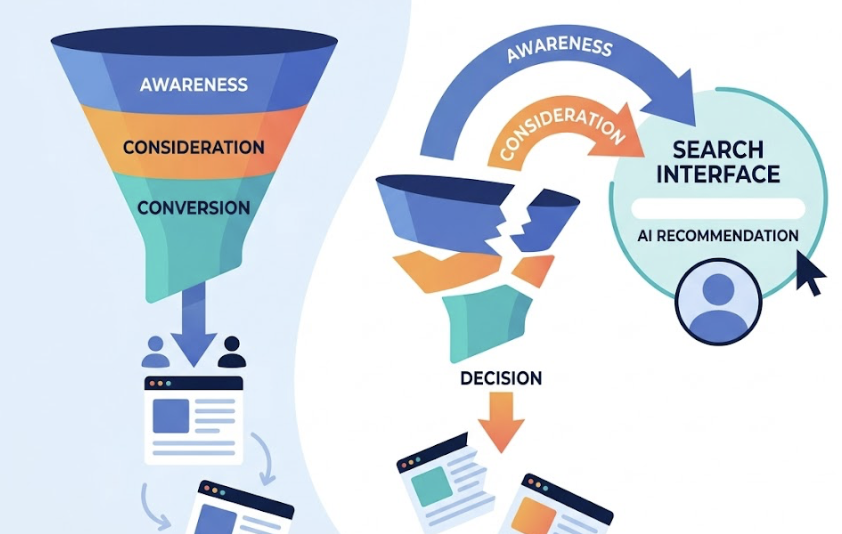
That’s what the research calls Retrieval-Augmented Generation (RAG): the AI retrieves content blocks and weighs them based on “information gain,” the degree to which a source provides structured, unique, factual data that others don’t. Your content either gets extracted to form the answer, or it doesn’t.
The median enterprise B2B brand is cited in only 3% of the AI Overviews for which it is relevant. That’s the visibility gap most dashboards still can’t see.
The 6 KPIs for AEO That Actually Matter
These aren’t replacements for every traditional metric. They’re the indicators that tell you what’s happening in the layer of search where clicks are no longer the primary outcome.
1. AI Visibility Rate
This is the primary health indicator for AEO. It measures the percentage of relevant, high-intent prompts where your brand appears in the synthesized AI response. The formula is simple: divide the number of queries where your brand is mentioned by the total tested category prompts, then multiply by 100.
A low visibility rate means the AI doesn’t associate your brand with the core problems your product solves. That’s a content and positioning issue, not an SEO technical issue.
2. Brand Position Index
Being mentioned isn’t enough if you’re buried in an “others to consider” footnote. The Brand Position Index measures where your brand appears within recommendation lists or comparisons. High-performing brands aim to be the first-named entity in 30% or more of relevant responses. The difference between being listed first and third in an AI answer is roughly equivalent to the difference between ranking first and fifth on a traditional SERP.
3. Sentiment Score
AI engines don’t just cite brands. They characterize them. The Sentiment Score quantifies the tone used to describe your brand, typically on a scale from -100 to +100. There’s a meaningful difference between “Brand X is a CRM provider” (neutral) and “Brand X is widely recommended for its onboarding and support” (positive). Tracking this also catches AI hallucinations early, before they influence thousands of users.
4. Citation Source Share
Here’s a number worth sitting with: 82 to 85% of AI citations currently come from third-party platforms, not brand-owned domains. Reddit threads, G2 reviews, and industry publications are often driving your AI presence more than your own content. Citation Source Share tracks which domains are influencing how AI describes your brand. That shapes where you invest in digital PR.
5. Prompt Coverage and Semantic Breadth
Most teams track 10 to 20 branded queries. That’s not enough. The majority of high-value discovery happens through unbranded, category-level prompts: “best security software for small businesses,” “which analytics tool works with Shopify,” “what CRM does a 20-person team need.”
Prompt Coverage measures how many distinct user intents your brand appears in. A narrow prompt pool produces a flattering visibility rate and a misleading picture of actual reach. A meaningful AEO baseline requires 25 to 100 context-rich prompts, expanding to thousands for enterprise-level tracking across ChatGPT, Perplexity, and Gemini.
6. Conversion Visibility Rate (CVR)
Traditional AI referral traffic often shows up as “Direct” in GA4 because UTM parameters get stripped. The Conversion Visibility Rate estimates the probability that an AI response is driving user interaction. The underlying data point here is significant: AI-referred visitors convert at a rate 4.4 times higher than organic search visitors, because the AI has already handled the research phase of their journey.
That means your AI visibility is generating pipeline you’re not measuring, and likely not attributing.
The Prompts You’re Not Tracking Are Costing You Visibility
This is where most AEO strategies fall short before they even start.
Branded prompts (queries containing your brand name) behave like navigational searches. They tend to produce high sentiment scores, but they don’t reach new customers. The real entrance for net-new discovery is the unbranded, category-level prompt: someone who doesn’t know your brand yet, asking an AI for a solution to a problem you solve.
There are three practical ways to expand your prompt pool. Semantic mapping builds a matrix crossing product features with user personas and funnel stages. Community intelligence mines Reddit, Quora, and industry forums for the natural language questions users ask before a purchase decision. Sales and support mining extracts recurring themes from discovery calls and support tickets, which are often the exact questions AI systems are answering for prospects who haven’t contacted you yet.
Manual methods work up to a point. Topify’s High-Value Prompt Discovery automates this by continuously surfacing new high-volume prompts across ChatGPT, Gemini, and Perplexity as AI recommendation patterns shift. That matters because 70% of AI Overview content changes within 90 days. Static prompt pools go stale fast.
How to Build Your AEO Reporting Dashboard
The reporting structure needs to match the audience, not just the data.
For execution teams tracking weekly, the focus is on week-over-week shifts in visibility rate, new competitor recommendations entering the AI results, and changes in citation source patterns. This cadence allows content teams to respond to emerging gaps before they compound.
For marketing managers reviewing monthly, the relevant metrics are Sentiment Score trends, Position Index changes, and competitor share of voice in AI responses. This level answers whether campaigns are actually shifting how AI characterizes the brand.
For CMOs and VPs reviewing quarterly, the focus shifts to category role (are you positioned as a leader, challenger, or afterthought in AI answers?), AI referral CVR, and the correlation between AI visibility and branded search volume. This is the layer that justifies AEO investment and informs budget allocation.
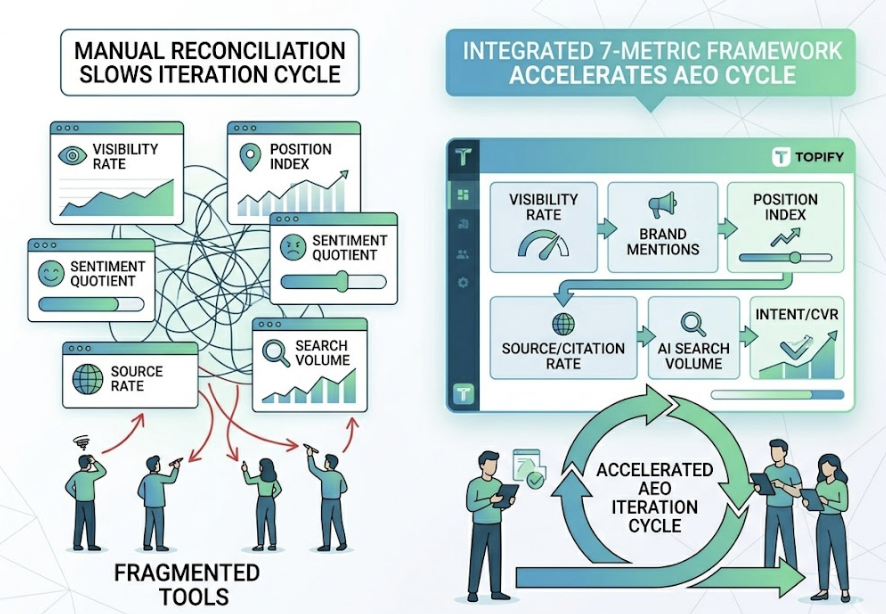
Topify’s 7-metric framework integrates all of this into a unified dashboard: visibility rate, brand mentions, position index, sentiment quotient, source/citation rate, AI search volume, and intent/CVR. That’s relevant because fragmented tools force teams to manually reconcile data from five different sources, which slows down the iteration cycle that AEO requires.
Short-Term: Run SEO and AEO KPIs in Parallel
Don’t drop organic metrics cold. During the transition, the right approach is a dual-track system: continue monitoring organic search sessions alongside AI visibility and citation rate. This prevents a specific blind spot where stable rankings can mask a collapsing pipeline caused by AI displacement.
The metrics to run in parallel:
| Traditional SEO KPI | AEO Equivalent |
|---|---|
| Organic CTR | AI Visibility Rate |
| Average Position | Brand Position Index |
| Branded Search Volume | Sentiment Score + Brand Mentions |
| Backlink Domain Count | Citation Source Share |
| Keyword Ranking Coverage | Prompt Coverage |
| Organic Conversions | Conversion Visibility Rate (CVR) |
The crossover point varies by category. In cybersecurity, where AI Overviews appear in roughly 60% of relevant queries, the AEO metrics are already more predictive. In real estate, where that figure is closer to 4.5%, traditional metrics still carry more weight.
What Good Looks Like: AEO Benchmarks by Stage
Performance in AEO is relative to your category and current maturity, not an absolute number.
Foundation stage (visibility below 20%): The brand is largely absent from synthesized answers. The priority is “atomic answers”: adding 30 to 60 word direct summaries at the top of high-performing pages and implementing FAQ and structured schema. The goal is to become extractable before trying to become primary.
Growth stage (visibility 20 to 50%): The brand is entering the conversation but typically ranked second or third. The shift here is toward “information gain”: adding proprietary data, original research, and expert quotes that AI models favor for primary citation. Third-party platforms like G2 and industry publications need active management because they’re likely driving more of your AI presence than your owned content.
Leadership stage (visibility above 50%): The brand is the first-choice recommendation in its category. The focus becomes narrative defense: monitoring for sentiment drift and ensuring AI models don’t retrain on competitor content or outdated positioning.
Industry variance matters here. Health and finance categories show the highest AI Overview prevalence (48.75% and 25.79% respectively), meaning those brands face the steepest zero-click challenge, but also the highest trust transfer when they earn a citation. B2B SaaS sits near 50% prevalence with a median of just 3% of brands receiving consistent citations, which represents both the problem and the opportunity.
Conclusion
Organic CTR isn’t dead. It still matters for transactional and deep-research queries where users need to verify complex decisions. But for informational and early-stage research queries, it’s become a lagging indicator that hides more than it reveals.
The brands building durable positions in 2026 are the ones treating AI visibility as a measurable channel with its own KPI structure, not a side effect of SEO. Start with AI Visibility Rate and Conversion Visibility Rate. These two metrics are the easiest to establish a baseline on, and they’re the ones that will tell you whether your brand exists in the layer of search where your next customer is making decisions.
FAQ
What are KPIs for AEO?
Key Performance Indicators for Answer Engine Optimization include AI Visibility Rate (percentage of relevant prompts where the brand appears), Brand Position Index (rank within AI recommendation lists), Sentiment Score (tone of AI characterization), Citation Source Share (which domains drive AI mentions of your brand), Prompt Coverage (breadth of user intents captured), and Conversion Visibility Rate (estimated conversion probability per AI response).
How is AEO different from SEO measurement?
SEO measurement centers on page-level rankings and the volume of clicks driven from a results page. AEO measurement focuses on entity-level inclusion within a synthesized answer, tracking the brand’s role in the response rather than the traffic it generates.
Can I still use organic CTR as a KPI?
Yes, for transactional and lower-funnel queries. For informational and early-stage research queries, CTR has become a misleading indicator because zero-click rates now exceed 60% globally, with mobile at 77.2%. Use it in parallel with AEO metrics during the transition rather than as a standalone measure of search performance.
How many prompts should I track for AEO?
A meaningful baseline requires 25 to 100 context-rich prompts representing your target personas and journey stages. Enterprise-level tracking typically expands to thousands of prompts to account for variation across ChatGPT, Perplexity, Gemini, and platform-specific behavior.
What tools can help track AEO KPIs?
Specialized platforms like Topify are built specifically for this: tracking brand mentions, citations, sentiment, and position across major LLMs in a unified dashboard. Traditional SEO platforms like Ahrefs and SEMrush are beginning to integrate some of these metrics, but their AI visibility coverage remains limited compared to purpose-built AEO tools.

