

You’ve got Ahrefs running, SEMrush open in another tab, and GSC pulling data in the background. You’re tracking hundreds of keywords. But here’s the thing: none of those tools tell you if your brand shows up when someone asks ChatGPT for a recommendation.
That’s not a gap you can afford to ignore. AI sessions now account for 56% of traditional search volume, and when an AI Overview appears at the top of Google, organic click-through rates drop by 61%. The traffic is moving. The question is whether your keyword research tools are moving with it.
This list covers five tools that each solve a different part of the problem, and how to use them together.
Most Keyword Research Tools Were Designed for a Search Engine That’s Losing Ground
Traditional tools like Ahrefs and SEMrush were built on a “Keyword → Volume → Rank” logic. That logic works well when users click on blue links. It breaks down when users get their answers directly from an AI.
Zero-click searches already account for 65% of all Google searches in the U.S., projected to exceed 70% by end of 2026. AI Overviews now appear for roughly 20.5% of keywords, up from 6.5% in January 2025. And conversational queries have changed shape entirely: the average AI prompt in 2026 is 23 words long, compared to the 1-3 word head terms traditional tools were built to handle.
This doesn’t mean Ahrefs and SEMrush are obsolete. It means they’re now one layer of a stack, not the whole stack.
Quick Comparison: 5 Tools at a Glance
| Tool | Best For | Channels Covered | Starting Price | Biggest Time-Saver |
|---|---|---|---|---|
| Topify | GEO + AEO keyword research | ChatGPT, Gemini, Perplexity, DeepSeek + more | $99/mo | Automated AI prompt discovery |
| Ahrefs | Traditional SEO + backlink analysis | Google (+ Brand Radar add-on for AI) | $129/mo | Competitor gap analysis |
| SEMrush | Multi-channel marketing teams | Google, PPC, local, + AI Toolkit add-on | $139.95/mo | Personalized keyword difficulty |
| Google Search Console | Ground-truth Google data | Google only | Free | Zero-click intent discovery |
| AlsoAsked | Question cluster mapping for AEO | Google PAA | $12/mo | 3-level intent tree in 30 seconds |
#1 Topify: The Keyword Research Tool Built for AI Search
Every tool on this list tracks where your content ranks. Topify tracks something different: whether your brand gets cited when someone asks an AI a question.
That’s the gap most keyword research workflows still can’t see.
High-Value Prompt Discovery as the New Keyword Research
Topify’s prompt discovery engine continuously surfaces high-volume AI prompts relevant to your brand across ChatGPT, Gemini, Perplexity, DeepSeek, and other major platforms. Think of it as keyword research, except the “search engine” is a large language model and the “keyword” is a 23-word conversational question.
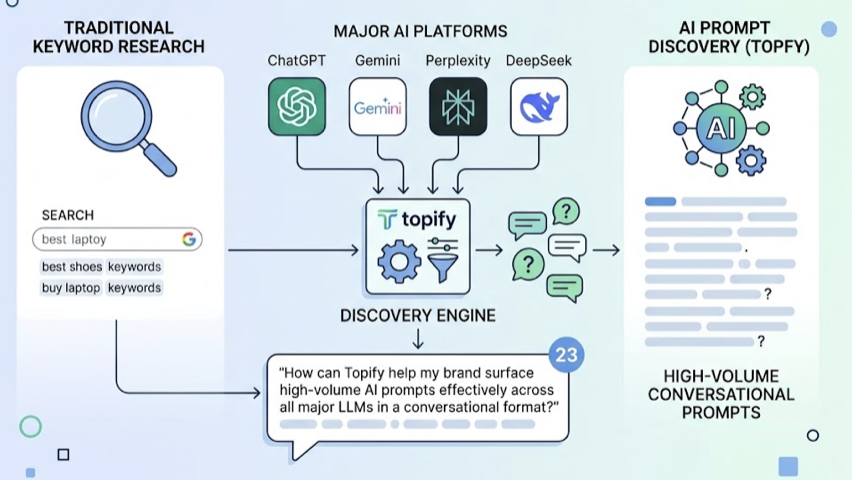
The tool’s AI Volume Analytics shows you how many users are asking specific questions across LLM platforms, not just what they’re typing into Google. This is the forward-looking metric that traditional tools don’t have.
Source Analysis: Reverse-Engineering Why AI Recommends Competitors
One of Topify’s most actionable features is Source Analysis. It identifies exactly which third-party domains AI platforms cite when answering brand-related questions. If your competitor is being cited and you’re not, Source Analysis shows you which authoritative sources you’re missing, so your content strategy can target those specific citation gaps.
This is GEO in practice: not optimizing for Google’s crawler, but optimizing for how AI synthesizes information into a trusted response.
What You Actually Track
Topify measures seven metrics: visibility, sentiment (scored 0-100), position, AI volume, brand mentions, intent, and CVR. That last one matters more than it sounds. AI-referred traffic converts at up to 23x the rate of traditional organic traffic. Volume is down. Value is up. Topify tracks both.
Pricing: Basic at $99/mo covers 100 prompts across 4 platforms. Pro at $199/mo scales to 250 prompts with API access and advanced citation gap analysis. Enterprise starts at $499/mo for custom prompt sets and team workflows.
Best for: SEO and marketing teams expanding from traditional Google SEO into GEO and AEO. Also strong for agencies managing multiple client brands across AI platforms.
#2 Ahrefs: Still the Infrastructure Standard
Ahrefs hasn’t been replaced. Its keyword database covers 28.7 billion terms, and its backlink index remains the deepest in the industry. For building topical authority and identifying competitor content gaps, it’s still the most reliable option at scale.
The feature that matters most in 2026 is Click Data. Unlike raw volume, click data tells you how many of those searches actually result in a visit to any website. A keyword with 10,000 monthly searches might only drive 2,000 clicks once AI Overviews are factored in. Knowing this upfront keeps your team from investing in terms that no longer drive traffic.
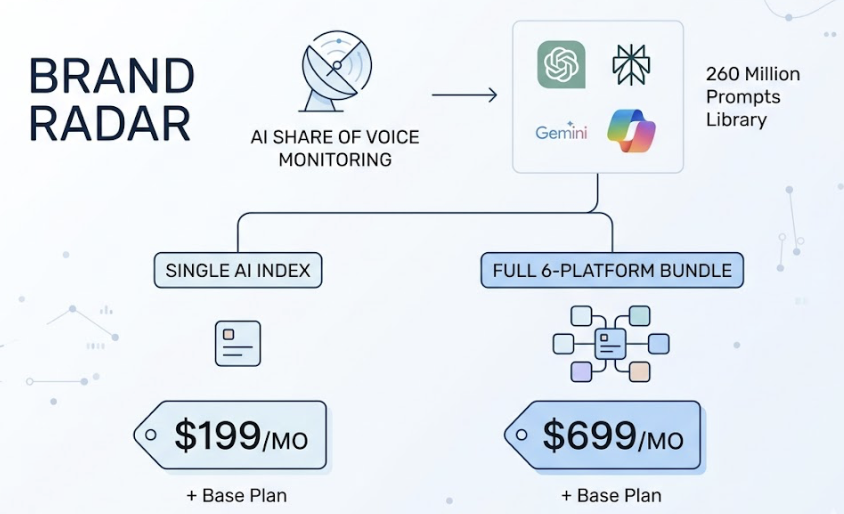
For AI coverage, Ahrefs offers Brand Radar as an add-on. It uses a library of 260 million prompts to monitor share of voice across ChatGPT, Perplexity, Gemini, and Microsoft Copilot. It’s powerful, but priced accordingly: $199/mo for a single AI index, or $699/mo for the full 6-platform bundle, on top of the base plan.
Best for: Technical SEOs, link-building specialists, and teams where traditional organic search still drives the majority of revenue.
#3 SEMrush: Best When Your Team Manages More Than Just SEO
SEMrush made a smart bet on workflow integration. Its value isn’t any single feature; it’s that keyword research, PPC, content planning, and competitor tracking all live in one dashboard. For marketing teams that can’t afford to context-switch between five different tools, that matters.
The standout 2025 update is Personal Keyword Difficulty (PKD%), which scores keyword difficulty against your specific domain’s authority rather than a generic benchmark. If your domain isn’t strong enough to rank for a given term, PKD% flags it early. That’s hours of saved research time per week.
SEMrush also leans hard into Topical Authority, helping teams build the pillar-and-cluster content structures that LLMs favor. E-E-A-T signals aren’t just for Google anymore; AI engines consistently cite domains that demonstrate depth on a subject.
AI coverage comes via the AI SEO Toolkit ($99/mo add-on), which provides daily rank-style monitoring for ChatGPT and Google AI Mode presence.
Best for: Large in-house marketing teams running SEO, PPC, and content under one roof. Less ideal for specialists who just need deep keyword or backlink data.
#4 Google Search Console: Free, Direct, and More Useful Than Most People Realize
GSC doesn’t get enough credit as an AEO research tool. Here’s why it should.
Filter your queries for high impressions and zero clicks. Those are your most important targets. They’re terms where Google (or an AI Overview) is already answering the user’s question without sending them anywhere. These zero-click terms are exactly what AEO content should address: structured, concise answers that make your content the source AI extracts from, rather than a destination users click to.
One important nuance for 2026: GSC now counts impressions from AI Overviews and traditional organic results separately. If your page is cited in an AIO and ranks on page one, you get two impressions per search. CTR appears to drop. That’s not a failure; that’s double visibility. The metric to watch is actual clicks, not CTR alone.
GSC won’t give you competitor data, and it won’t tell you what’s happening outside Google. But it gives you clean ground truth for your own Google performance, which is the foundation everything else builds on.
Best for: Every team, as a starting point. Works especially well when piped into AlsoAsked or Topify as a research seed.
#5 AlsoAsked: The Fastest Way to Map Question-Based Keywords
AlsoAsked is built around a single insight: Google’s People Also Ask feature reveals how users actually think about a topic, not just what they type first.
When someone expands a PAA result, Google dynamically generates more related questions. AlsoAsked automates this process three levels deep, surfacing 150+ questions for a single query and organizing them into a visual intent tree. PAA visibility grew 34.7% in the U.S. between 2024 and 2025, which makes this data source increasingly valuable for structuring content.
For AEO, this is directly actionable. Each branch of the intent tree maps to a specific H2 or H3 in your content. Answer the question concisely and structurally in the first 40-60 words of that section, and you’re building content that’s optimized for extraction, whether into a featured snippet, a PAA box, or an AI Overview summary.
The Bulk Search feature handles up to 1,000 keywords at once, useful for ecommerce teams mapping intent across large product catalogs.
Pricing: Free tier (3 searches/day), Basic at $12/mo, Lite at $23/mo, Pro at $47/mo with API access.
Best for: Content strategists and AEO planners who need to map question intent quickly. Not a standalone tool; pairs best with Ahrefs or SEMrush for volume validation.
How to Do AEO With These 5 Tools: A 3-Step Workflow
These tools work better together than in isolation. Here’s the workflow that covers traditional SEO, GEO, and AEO in one pass.
Step 1: Map the Conversational Ecosystem
Start with AlsoAsked to build question clusters around your target topic. Then pull zero-click queries from Google Search Console: these are the questions your audience is already asking, where Google is answering them before they ever reach your site. Together, these two sources give you the full picture of what your audience wants to know.
Step 2: Validate Volume and Topical Difficulty
Run your question list through Ahrefs or SEMrush. Ahrefs’ Click Data tells you which questions still drive traffic incentives. SEMrush’s PKD% filters out terms where you don’t have a realistic shot. Use the Content Gap feature to find questions where competitors are capturing featured snippets that you should be targeting instead.
Step 3: Track AI Prompt Visibility
This is where Topify closes the loop. Upload your priority topics and track whether your brand is being cited in AI responses across ChatGPT, Perplexity, Gemini, and others. If you’re not cited, Source Analysis identifies the authoritative sources you’re missing. If you are cited, Visibility Tracking and Sentiment Scoring show how your brand is being framed. Neither step is possible in any other tool on this list.
Track it. Optimize it. Done.
Conclusion
The keyword research stack of 2026 isn’t one tool; it’s a layered system where each tool handles a different layer of discovery. AlsoAsked maps the questions. Ahrefs and SEMrush validate the opportunity. GSC grounds you in real Google data. And Topify tracks the layer that none of the others can reach: what happens when your audience skips Google entirely and asks an AI instead.
Research suggests that 76% of AI Overview citations still pull from pages ranking in Google’s top 10, which means traditional SEO is still the price of entry for AI visibility. But entry isn’t enough anymore. The brands that consistently get cited in AI answers are the ones treating AI search as a separate discipline, with its own research tools and its own success metrics.
The five tools above cover both disciplines. Use them together.
FAQ
What’s the difference between GEO tools and traditional keyword research tools?
Traditional tools focus on “Keyword → Rank” using Google’s index and backlink authority. GEO tools like Topify focus on “Prompt → Citation,” tracking whether your brand appears in conversational AI responses across platforms like ChatGPT and Perplexity. They’re measuring completely different things.
How do I do AEO keyword research?
Start with AlsoAsked to map question clusters, then cross-reference with GSC’s zero-click queries to find where AI or Google is already answering without sending traffic. Structure your content to provide direct, extractable answers in the first 40-60 words of each section. Then use Topify or SEMrush’s AI Toolkit to track whether those answers are being pulled into AI Overviews.
Do I still need Ahrefs or SEMrush if I use Topify?
Yes. Topify handles the AI citation layer; Ahrefs and SEMrush handle the infrastructure layer, including technical audits, backlink analysis, and traditional rank tracking. Since the majority of AI Overview citations still pull from pages that rank well in traditional Google results, traditional SEO remains foundational.
What are the best GEO tools for small teams?
Google Search Console (free) + AlsoAsked Basic ($12/mo) + Topify Basic ($99/mo) gives a capable starting stack for intent research and AI visibility tracking. Adding SEMrush Pro ($139.95/mo) makes sense once the team needs deeper competitive and technical analysis.

