

Search “best keyword research tools” and you’ll find dozens of platforms all claiming to help you find the right terms. The problem is that most of them are answering the wrong question. They’ll tell you a keyword gets 40,000 monthly Google searches. They won’t tell you how many times that same intent is satisfied inside a ChatGPT session or a Perplexity research thread, with zero clicks and zero referrer data showing up in your analytics.
That’s the gap most keyword stacks still can’t see.
In 2026, the SEO specialists getting the clearest picture of their search presence aren’t just using better traditional tools. They’re using a different kind of tool entirely for a different layer of discovery.
What Changed in Keyword Research Between 2024 and 2026
Gartner projected a 25% decline in traditional search volume by 2026. That number has largely materialized. Users increasingly turn to AI-native platforms for research-intensive and evaluative tasks because the result is immediate, synthesized, and conversational.
ChatGPT now handles over 2 billion queries daily. Organic click-through rates for Google’s top positions have dropped 61% when AI Overviews appear. And 70.6% of AI-driven referral traffic arrives without referrer headers, meaning it shows up as “direct” in GA4 and disappears from your attribution model entirely.
The consequence isn’t just lost traffic. It’s lost measurement.
High organic rankings no longer guarantee visibility if your brand is omitted from the AI-generated summary occupying the top thousand pixels of the screen. The primary KPI has shifted: from keyword ranking to what researchers now call “Share of Model,” the percentage of relevant AI responses in which your brand appears as a recommended answer.
Traditional keyword tools weren’t built for this. They remain essential for building the foundational authority that AI crawlers rely on, but they don’t see into the “dark AI” layer where buying decisions increasingly get made.
The 2026 Keyword Research Toolkit at a Glance
The keyword research stack in 2026 runs on two distinct layers: the Foundation Layer (traditional SEO) and the AI Discovery Layer (GEO/AEO). Effective strategy requires both. Here’s how the leading platforms compare across the dimensions that matter most this year.
| Platform | Primary Layer | GEO/AEO Support | Starting Price | Ideal For | Standout Feature |
|---|---|---|---|---|---|
| Topify | AI Discovery | Comprehensive (7-metric) | $99/mo | SaaS, Multi-platform teams | AI Volume Analytics + One-Click Execution |
| Ahrefs | Foundation | Moderate (Brand Radar add-on) | $129/mo | Agencies, Technical Analysts | 243M+ prompt database, backlink precision |
| SEMrush | Foundation + Marketing | Moderate (AI Toolkit add-on) | $139.95/mo | Enterprise, All-in-one teams | 25.5B keyword database, intent classification |
| Moz Pro | Foundation | Basic (intent metrics) | $99/mo | SMBs, Beginners | Domain Authority scoring, Priority Score |
| Google Keyword Planner | Search Baseline | None | Free | PPC, Initial Research | Direct Google source data |
The table above makes the tradeoff visible: traditional tools are strong where AI tools are blind, and vice versa. The platforms that cover both worlds fully don’t exist yet as a single product. That’s why the 2026 stack is a combination play.
#1 Topify: Where Keyword Research Meets GEO
Topify doesn’t replace your keyword tool. It covers the part your keyword tool can’t reach.
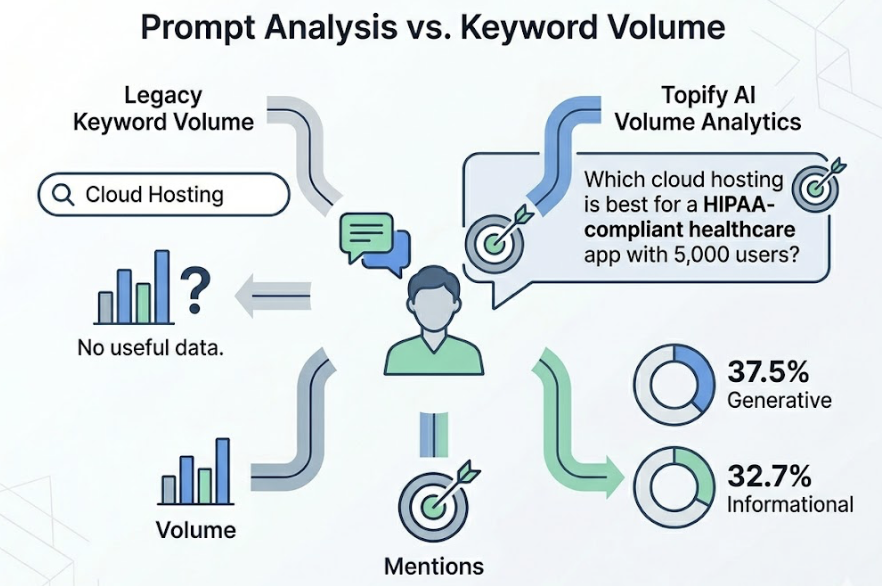
The core distinction is the shift from keywords to prompts. Legacy tools report search volume for “cloud hosting.” Topify’s AI Volume Analytics identifies the specific conversational queries people are asking inside ChatGPT, such as “Which cloud hosting is best for a HIPAA-compliant healthcare app with 5,000 users?” Analysis of over 50 million prompts shows that 37.5% are generative and 32.7% are informational. These are the prompt categories where traditional volume metrics tell you nothing useful.
That’s where Topify starts.
Seven metrics, one visibility picture. Topify tracks brand performance across ChatGPT, Gemini, Perplexity, and DeepSeek through seven core indicators that redefine what “search performance” means in 2026:
- Visibility Score: How often your brand appears across a defined prompt set. Appearing in 30% of relevant AI answers often delivers more pipeline impact than a #1 Google ranking with zero clicks.
- Sentiment Quotient (0-100): Whether AI engines describe your brand positively, neutrally, or negatively. This matters because AI referral traffic converts at an average of 14.2%, roughly five times higher than Google organic. The quality of what AI says about you directly affects conversion.
- Relative Positioning: Where your brand appears in a list of recommendations. Being mentioned first in a Perplexity summary confers a “first-mover” authority that compounding brand recognition builds on over time.
- AI Search Volume: The estimated frequency of specific prompt triggers across major LLMs. This is the GEO equivalent of keyword search volume.
- Mention Density: Your brand’s absolute frequency across varied prompts, indicating topical authority within the model’s knowledge graph.
- Intent Alignment: Whether AI engines are framing your brand in evaluative, recommendatory, or educational contexts.
- Attributed CVR: The estimated conversion rate of traffic originating from AI citations.
Source Analysis: reverse-engineering what AI trusts. The hardest question in modern search is “To be recommended by AI, where do I need to appear?” Only 14% of URLs cited in Google’s AI Mode appear in the top 10 traditional search results. Ranking doesn’t predict citation.
Topify’s Source Analysis identifies the specific Reddit threads, niche publications, and industry blogs that AI platforms are currently pulling from. This turns Digital PR and community engagement from a guesswork activity into a prioritized, measurable effort.
Execution, not just data. Most monitoring tools stop at the dashboard. When Topify detects a citation gap or a visibility drop, its AI agent proposes specific content variants or schema updates deployable with one click. No manual workflow required.
Topify’s Basic Plan starts at $99/month, covering 100 prompts and up to 9,000 AI answer analyses monthly. The Pro Plan ($199/month) extends to 250 prompts and 22,500 analyses, with advanced competitor benchmarking. For teams managing multiple clients or brands, Enterprise plans start at $499/month.
The Traditional Heavy Hitters, Ranked by What They Can’t Do in 2026
These tools remain core to any foundation-layer strategy. Their limitations in AI search aren’t reasons to abandon them. They’re reasons to understand what role they play.
#2 Ahrefs. Still the industry leader for backlink data purity and technical site auditing. The Brand Radar feature indexes 243 million real-world prompts and monitors visibility across 6+ AI platforms including YouTube and Reddit. Its Parent Topic clustering is particularly useful for identifying content that can simultaneously rank in Google and serve as citation material for LLMs. The trade-off: full access to AI index data requires add-ons that can push total subscription costs past $600/month for agencies.
#3 SEMrush. The most comprehensive multi-channel suite available. Its 25.5 billion keyword database and intent classification are the strongest in the traditional layer. The Unified SEO + AI Visibility dashboard is effective for teams that need to consolidate legacy rankings and generative presence into a single report. The limitation: AI features are often gated behind paid add-ons at $99/user, and teams that only need focused AI monitoring often pay for functionality they don’t use.
#4 Moz Pro. Moz has maintained relevance by focusing on the “Neighborhood of Trust” through Domain Authority and Page Authority metrics, which AI models still use to evaluate source credibility. The Priority Score system is particularly strong for SMBs: it weights keyword potential by DA, CTR, and difficulty to surface niches where smaller sites can realistically compete. Deep multi-LLM prompt tracking is not available.
#5 Google Keyword Planner. Not a comprehensive SEO tool, but irreplaceable for one thing: validating ground-truth Google search demand. It’s the only platform with direct access to Google’s source data. Seasonal trend forecasting and organic competition metrics remain accurate and free. For AI search, it offers nothing.
What AEO Actually Means for Keyword Strategy in 2026
AEO (Answer Engine Optimization) has moved from a tactical experiment to a strategic requirement. With 69% of Google searches now ending without a click, the primary objective of content is no longer to be visited. It’s to be extracted.
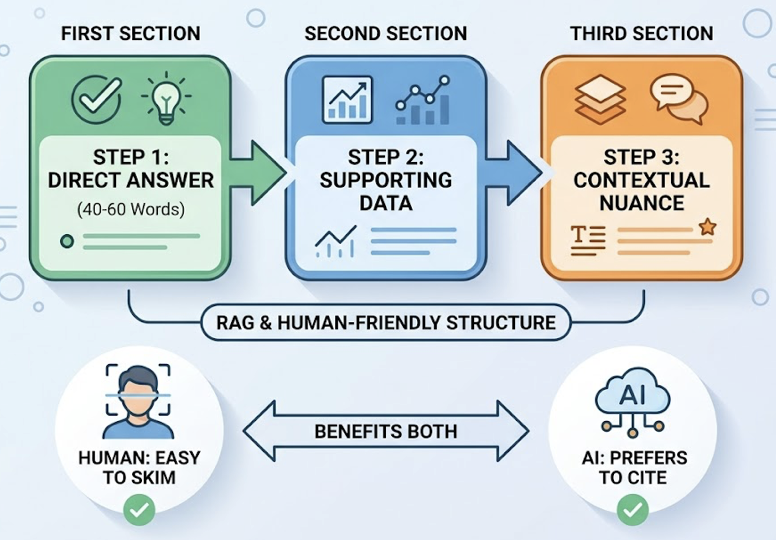
AI models use Retrieval-Augmented Generation (RAG) to synthesize answers. This process favors content that leads with a direct answer in 40-60 words, followed by supporting data, and ends with contextual nuance. The structure that humans find easy to skim turns out to be exactly what AI systems prefer to cite.
Here’s how to do AEO in 2026, in three concrete steps:
Step 1: Identify high-value AI prompts. Move beyond keyword lists. Use Topify’s AI Volume Analytics to find the conversational prompts triggering AI summaries in your category, both for your brand and your competitors. These prompts are the GEO equivalent of seed keywords.
Step 2: Optimize content for modular extraction. AI systems parse content by section, not by page. Each H2 or H3 heading must function as a standalone unit: a complete thought that can be independently cited without surrounding context.
Step 3: Monitor and influence your Neighborhoods of Trust. In 2026, 85% of brand mentions in AI search originate on third-party pages. Your domain authority matters, but it doesn’t determine what AI says about you. Topify’s Source Analysis shows exactly which external domains AI platforms are citing in your category so you can prioritize earned media accordingly.
The business case is concrete. NerdWallet reported a 35% revenue increase in 2024 despite a 20% traffic decline, demonstrating that being cited as the trusted authority captures higher-intent users at the decision stage, regardless of organic click volume.
GEO vs. SEO Keywords: The Divergence of Search Intent
The same term means different things depending on the discovery engine.
Search “project management software” on Google and the intent is navigational. The user knows what they want and is heading somewhere. Ask ChatGPT the same query and the interaction shifts to “Which tool do you recommend for a 15-person remote team with a $200/month budget?” That’s a completely different intent signal, with explicit constraints, a specific context, and a direct invitation for a recommendation.
This is the core difference between SEO keyword strategy and GEO keyword strategy:
| Dimension | Traditional SEO Keyword | GEO/AEO Prompt |
|---|---|---|
| User Phrasing | Short fragments (“project management software”) | Conversational with constraints (“best PM tool for remote team, under $200/mo”) |
| Intent Signal | Low, inferred from query | High, explicitly stated |
| Content Goal | Rank on page one | Become the recommended solution for specific scenarios |
| Primary Metric | Volume and Difficulty | Visibility Score and Citation Rate |
GEO tools like Topify make the “prompt space” a trackable and optimizable channel. Rather than guessing which prompts AI engines associate with your brand, you see exactly how often you appear, in what context, with what sentiment, and against which competitors. That’s Share of Model tracking. And in 2026, it’s replacing keyword ranking as the north star for brands where AI-driven discovery contributes meaningfully to revenue.
How to Build a 2026 Keyword Stack That Covers Both Worlds
No single tool provides 360-degree visibility in 2026. The high-performing teams have settled on a three-layer configuration:
Layer 1: Foundation (Traditional SEO). Ahrefs or SEMrush for keyword research, backlink analysis, and technical auditing. This layer builds the authority that makes AI engines consider you a credible source.
Layer 2: AI Discovery (GEO/AEO). Topify for prompt monitoring, visibility tracking, source analysis, and one-click execution. This layer tells you what’s happening in the AI search layer that Layer 1 can’t see.
Layer 3: Validation (Free). Google Keyword Planner for ground-truth Google volume. Google Search Console for owned-site performance data.
The budget allocation most teams are landing on: 60-70% of resources to the foundation layer, 20-30% to AI discovery optimization.
If your traffic is still 80%+ from Google Search, Ahrefs or SEMrush remains the priority. If your goal is to enter the AI recommendation loop for high-intent research queries, Topify’s prompt-level monitoring and execution layer is where the leverage is. If you’re on a constrained budget, start with Topify’s Basic Plan at $99/month to validate the AI search opportunity before scaling up.
These aren’t competing investments. They’re complementary layers covering different parts of how your audience actually finds you.
Conclusion
Keyword research isn’t obsolete in 2026. It’s bifurcated. The brands maintaining strong visibility have built stacks that cover both the Google layer they’ve always optimized for and the AI conversation layer where the highest-converting discovery is increasingly happening.
Traditional tools like Ahrefs and SEMrush remain the foundation of any credible search strategy. But they were built for a world where search engines matched text to links. That world is still real. It’s just no longer the whole picture.
Topify fills the part of the picture legacy tools can’t render: what AI says about your brand, who it recommends instead, and what content and sources you’d need to influence to change that. Get started with Topify to see where your brand stands in AI search today.
FAQ
Q: What’s the difference between SEO keyword tools and GEO tools?
A: Traditional SEO tools measure keyword rankings, search volume, and backlinks within search engines like Google. GEO (Generative Engine Optimization) tools track brand visibility, sentiment, and citation rates inside AI platforms like ChatGPT and Perplexity. The data is fundamentally different: SEO tools report positions on a list, while GEO tools report how often and how favorably AI engines recommend your brand in response to conversational queries.
Q: How do you do AEO in 2026?
A: AEO (Answer Engine Optimization) centers on three steps. First, use a tool like Topify’s AI Volume Analytics to identify the high-value conversational prompts triggering AI summaries in your category. Second, restructure content with answer-first blocks under each heading, written as standalone units that AI systems can extract without surrounding context. Third, monitor and build presence on the third-party sources (Reddit, niche publications, media) that AI platforms cite most frequently in your category. The goal is extraction probability, not just ranking position.
Q: Can Topify replace Ahrefs or SEMrush?
A: No, and it’s not designed to. Topify is a specialized layer for AI search optimization. It complements traditional tools by providing visibility into the AI discovery layer that Ahrefs and SEMrush can’t track. The foundational authority those tools help you build is still what makes AI engines consider your brand a credible source. The two layers work together.
Q: Which keyword research tool is best for AI search optimization?
A: For most teams, Topify provides the strongest combination of prompt discovery, multi-platform visibility tracking, and execution capability. It covers ChatGPT, Gemini, Perplexity, and DeepSeek with seven core metrics and a one-click content deployment layer. For teams that already have Ahrefs, the Brand Radar add-on is a useful research starting point, though it functions as a research tool rather than a full execution platform.

