


You can now produce a 1,500-word blog post in under three minutes. That’s not a claim from a product demo. It’s the operational reality for content teams that adopted AI writing tools in 2024.
And yet, most of those teams are still asking the same question: why isn’t the traffic coming?
The answer has less to do with writing speed and more to do with what happens after the content is published. AI blog generators changed how fast you can create. They didn’t change how AI search engines decide what to recommend.
An AI Blog Generator Writes. It Doesn’t Think for You.
An AI blog generator is a software tool built on Large Language Models (LLMs). It takes a prompt or keyword as input and produces a draft by predicting the most statistically likely sequence of words based on its training data. It doesn’t research. It doesn’t verify. It doesn’t know what your brand actually stands for.
The quality of the output is shaped by two variables: the temperature setting (which controls creativity vs. factual accuracy) and the quality of the input prompt. A low temperature produces reliable, structured text suited for documentation. A high temperature produces creative phrasing with a higher risk of hallucination — where the model generates plausible-sounding information that is factually wrong.
That’s the gap most teams underestimate. You can get 10 drafts in an hour. You still need a human to decide which ones are worth publishing.
Where the Speed Gains Are Real
The efficiency data is hard to argue with. Organizations using AI content tools report production speeds up to 400% fasterand per-article costs reduced by approximately 50%. The average productivity gain across teams is around 40%, and 78% of organizations have now integrated AI into their content workflows.
For specific use cases, AI blog generators deliver clear value:
- Long-tail keyword coverage: AI can generate dozens of topically related articles that a small team couldn’t produce manually
- Content scaffolding: Outlines, headers, and first drafts that human writers refine rather than build from scratch
- Repurposing: Turning transcripts, reports, or internal docs into structured blog posts
The efficiency case is real. The strategic case is more complicated.
The Part Where Human Writers Still Win
Here’s the thing: Google and AI search engines are moving in the same direction. Both increasingly reward “Experience” — content that reflects genuine first-hand knowledge, proprietary data, and expert perspective.
Google’s E-E-A-T framework (Experience, Expertise, Authoritativeness, Trustworthiness) has become significantly more demanding since 2025. Content that simply aggregates existing information without adding real insight is flagged as “lowest quality” by both human evaluators and algorithmic filters. “Scaled content abuse” — publishing hundreds of AI-generated pages that add no unique value — can trigger manual actions and de-indexing.
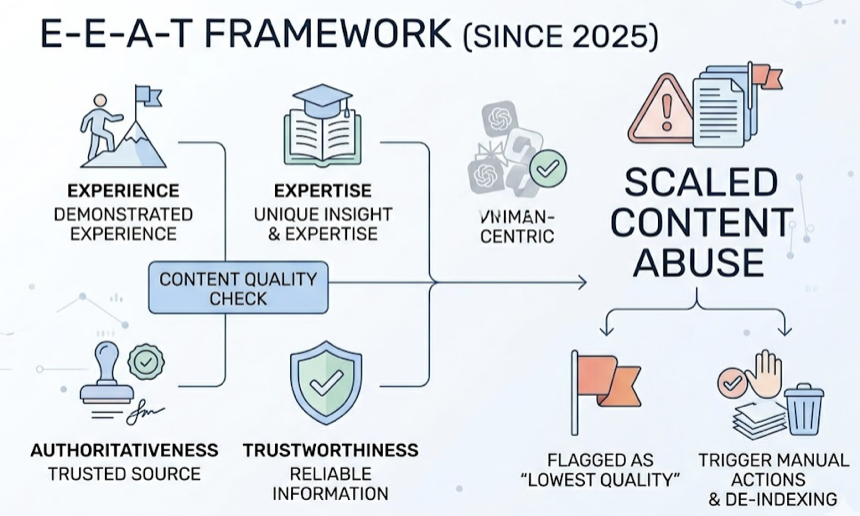
AI can draft. It can’t replace the researcher who spent three months in the field, the analyst who found the anomaly in the dataset, or the practitioner who has a counter-intuitive take because they’ve actually done the work.
The practical model that holds up: AI handles volume and structure. Humans supply the layer of experience that drives both rankings and trust.
You Can’t Skip Keyword Research, Even with AI
An AI blog generator is only as useful as the strategic direction you give it. The “garbage in, garbage out” principle applies directly here: if you feed the tool the wrong keywords, you get well-written content that no one finds.
The bigger problem is that traditional keyword research tools are increasingly insufficient. Research shows these tools miss approximately 88% of the queries that AI systems generate when answering user questions. This happens because of a process called “Query Fan-Out”: when someone asks ChatGPT or Perplexity a question, the system doesn’t look up that exact phrase. It fires 5 to 11 parallel sub-queries targeting different angles simultaneously.
A search for “best project management software for agencies” might trigger sub-queries about pricing tiers, integration with invoicing tools, onboarding time, and case studies by industry. Your content needs to satisfy those hidden sub-queries — not just the primary keyword.
The implication: content strategy built around traditional search volume metrics will consistently underperform in AI search. The Total Addressable Search Surface accessible through AI is 10 to 16 times larger than what traditional tools can see.
Writing for AI Search Is Different. AEO Changes the Goal.
Traditional SEO aims for page rankings. Answer Engine Optimization (AEO) aims for citations in AI-generated responses. These are not the same thing, and optimizing for one doesn’t guarantee the other.
The numbers make this concrete: 68% of pages cited in AI Overviews are not in the top 10 organic results for the primary keyword. Ranking well on Google is no longer sufficient to win visibility in AI answers.
AI platforms cite content based on “Chunk-Level Relevance”: they extract specific passages that directly answer a narrow question. A 3,000-word guide that buries the answer in paragraph 14 will be skipped in favor of a shorter piece that states the answer in the first two sentences.
This means content architecture changes fundamentally for AEO:
| Dimension | Traditional SEO | AEO |
|---|---|---|
| Primary goal | Page rankings, click-through | Citations in AI responses |
| Success metric | Keyword position, CTR | Answer inclusion rate |
| Content structure | Long-form, topic clusters | Fragment-ready, BLUF structure |
| Retrieval mode | Index + keyword matching | Retrieval-Augmented Generation |
Freshness matters more than most teams realize. 85% of AI Overview citations come from content published within the last 24 months, and 76% of ChatGPT’s most-cited pages were updated within the last 30 days. In fast-moving categories, content can lose significant citation share within 90 days.
The “Bottom Line Up Front” (BLUF) method is the most reliable structural approach: every key section opens with a 1-3 sentence summary that states the answer clearly. The supporting detail follows. AI engines pull the opening; humans read the rest.
One More Gap: No AI Blog Generator Tracks What Happens Next
You publish the article. Now what?
A standard AI blog generator has no visibility into whether your content is being cited by ChatGPT, whether a competitor just displaced your brand in Perplexity’s recommendations, or whether AI is describing your pricing incorrectly. Research shows 67% of AI citations can be “dead” or uncontrollable — and hallucinations about a brand’s features or pricing can damage reputation before a user ever reaches the website.
This is the visibility blind spot that separates a content production tool from a content growth system.
Topify‘s AI Agent is built for the part that comes after writing. It continuously monitors how your brand appears across ChatGPT, Gemini, Perplexity, and other major AI platforms. It surfaces the high-value prompts your content isn’t winning. It audits which domains competitors are getting citations from, revealing the topical authority gaps in your own library.
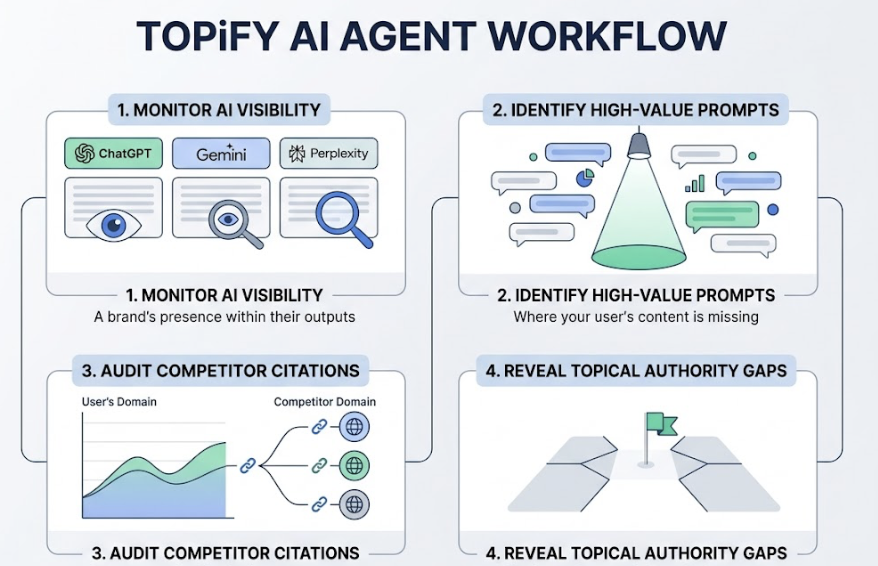
The underlying data supports why this matters: brand mentions correlate with AI search visibility at 0.664, compared to 0.218 for traditional backlinks. That’s a three-to-one advantage for brand presence over link-building in the AI search era. Topify tracks that presence quantitatively — visibility, sentiment, position, citation frequency — across every major AI platform.
The workflow it enables:
- Discover high-value AI prompts your brand should be winning
- Track how your content performs in real AI responses, not estimated rankings
- Analyze which sources AI platforms cite in your category
- Execute optimization strategies with one-click deployment — no manual workflows
That’s the gap between a generator and an agent. A generator fills pages. An agent drives growth.
Conclusion
AI blog generators are efficiency tools. They solve the “how fast can we produce” problem. They don’t solve the “will AI recommend this” problem.
The real question for any content team in 2026 isn’t whether AI can write your next article. It’s whether your content will be cited when someone asks ChatGPT or Perplexity for a recommendation in your category. That requires a different kind of strategy: structured content, precise keyword research that accounts for AI query fan-out, AEO-optimized architecture, and ongoing visibility monitoring.
Writing faster is the easy part. Getting recommended is the work.
If you’re ready to move from content production to AI search visibility, Topify is built for that shift.
FAQ
Can AI-generated blog posts rank on Google? Yes, with conditions. Google’s policy is quality-focused, not origin-focused. AI content can rank if it’s genuinely helpful, accurate, and demonstrates real expertise. Content that mass-produces pages without adding unique insight — what Google calls “scaled content abuse” — risks de-indexing.
What’s the difference between an AI blog generator and an AI agent? An AI blog generator takes a prompt and produces a draft. An AI agent like Topify operates in a feedback loop: it monitors how content performs in AI search environments, identifies visibility gaps, surfaces new opportunities, and executes optimization strategies autonomously.
How does AEO differ from traditional SEO? SEO targets page rankings in search result lists. AEO targets citation in AI-generated answers. The success metric shifts from keyword position to “answer inclusion rate” — how often your content is cited when AI engines answer relevant queries. Structure, freshness, and entity clarity drive AEO performance more than backlinks.
Is AI content good enough to replace a content team? For volume and structure: often yes. For original research, expert perspective, and the “Experience” layer that both Google and AI engines increasingly require: no. The teams seeing the best results use AI for production efficiency and humans for the strategic and experiential layer that drives authority.
Read More

