

Your SEO team just spent three days building a keyword list. Clean data, solid volume numbers, competitive difficulty scores. The content calendar is set.
Then someone types a question into ChatGPT, and your brand doesn’t appear once.
That’s not a content problem. That’s a research problem. The keywords you found were never the ones people use when they talk to AI.
Manual Keyword Research Has a Blind Spot Nobody Talks About
Traditional tools like Google Search Console, Ahrefs, and Semrush were built to track one thing: what people type into a Google search bar. Short phrases. Fragmented queries. “Best CRM.” “Project management software.” Keywords designed for a list of blue links.
AI search doesn’t work that way.
Users interacting with ChatGPT, Perplexity, or Gemini don’t type keywords. They ask questions. The average AI-driven query runs 7.2 words, compared to 4.0 words for a traditional Google search. More importantly, the intent is completely different: instead of browsing options, users are asking for a synthesized answer to a specific problem.
The result? Content teams optimize for phrases that rank on Google but never trigger a mention in any AI-generated response. And with Google’s AI Overviews now appearing in roughly 55% of searches, organic CTR on those queries has dropped 34.5%. The traffic that manual keyword research was built to capture is shrinking fast.
That’s the structural failure at the center of the manual approach.
Way 1: AI Keyword Research Captures Prompts, Not Just Phrases
Manual tools capture “what people search.” AI keyword research captures “what people actually ask.”
That distinction changes everything for Answer Engine Optimization (AEO). A manual tool surfaces “best project management software” with 40K monthly searches. AI keyword research surfaces prompts like “what project management tool should a 10-person remote team use if they need Slack integration and automated lead scoring.”
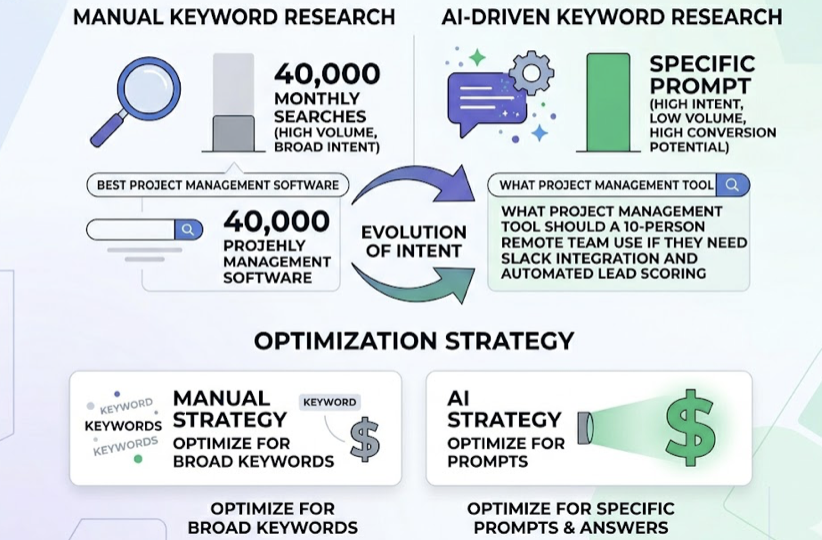
These aren’t the same user. They’re not even in the same stage of decision-making.
AI systems use Retrieval-Augmented Generation (RAG) to find content that can be directly extracted into a synthesized answer. To appear in that answer, your content needs to match the full conversational structure of the prompt. Optimizing for a 4-word phrase won’t get you there.
The Princeton GEO study found that adding statistics and direct-answer formatting can boost AI visibility by up to 40%. That kind of optimization only makes sense once you know the actual prompts you’re targeting.
Way 2: It Covers Platforms Manual Tools Can’t See
Here’s a number that should change how you think about keyword strategy: only 11% of domains are cited by both ChatGPT and Perplexity for the same query. 71% of all cited sources appear on exactly one platform.
Visibility isn’t universal. It’s platform-specific.
Manual keyword research is anchored to Google’s database. But if you’re trying to appear in AI-generated answers across ChatGPT, Gemini, Perplexity, and DeepSeek, you’re flying blind without platform-specific data. ChatGPT heavily favors Wikipedia (47.9% citation share) and editorial sites. Perplexity leans toward Reddit (46.7%) and niche forums. Google AI Overviews prioritize YouTube content and structured data.
This is why GEO (Generative Engine Optimization) requires multi-platform keyword intelligence. A single-platform approach doesn’t account for where your actual audience is finding answers.
A “Search Everywhere” strategy starts with knowing what each platform rewards, and that’s not something any manual Google-centric tool can tell you.
Way 3: Real-Time Discovery vs. Stale Databases
Legacy keyword tools typically update monthly or quarterly. By the time a trending query appears in Ahrefs, AI platforms have already crawled and indexed the authoritative early sources. The citation loop is essentially closed before you even see the opportunity.
AI-driven research tools process real-time SERP data and monitor emerging prompt patterns continuously. In fast-moving categories like SaaS, fintech, or AI tools themselves, the window between a prompt trending and a brand capturing that visibility can be hours, not weeks.
The time-to-action gap is significant. Manual keyword research takes 8 to 16 hours. AI-powered research takes under 15 minutes. Content strategy development drops from 5 to 10 days to under an hour.
That’s not a marginal improvement. That’s a different operating model.
AI keyword research also enables predictive discovery: brands can identify emerging topics two to four months before they peak in traditional search volume. By the time a keyword appears in a manual tool, someone else has already built the citation authority.
Way 4: It Tells You Why a Keyword Matters for AEO
Traditional tools give you two numbers: Volume and Difficulty. Both measure the same thing: potential for clicks.
That model breaks down when 93% of interactions in Google’s AI Mode result in zero clicks. High volume doesn’t mean high AI visibility. High difficulty doesn’t predict whether a competitor is dominating that prompt in ChatGPT’s answer.
AI keyword research introduces influence-oriented metrics. The core one is AI Visibility Percentage: how often your brand appears in AI answers across your tracked prompts. Instead of knowing “we rank #3 for this keyword,” you know “we appear in 34% of AI answers for this intent cluster, and our main competitor appears in 61%.”
That’s a gap you can actually act on.
Sentiment analysis adds another layer. AI tools don’t just mention your brand; they describe it. Monitoring how ChatGPT or Perplexity characterizes your product, compared to competitors, is qualitative competitive intelligence that manual research can’t produce at scale.
Way 5: Competitive Intelligence Reveals the 91% Most Brands Ignore
Manual competitive research looks at what competitors publish: their pages, their rankings, their backlinks. But in the GEO era, that’s only 9% of the picture.
Research shows that 91% of brand mentions in AI-generated responses come from third-party sources. A competitor’s own website accounts for less than one-tenth of their AI visibility. The rest comes from Reddit threads, G2 reviews, comparison articles, industry blogs, and forum discussions.
Web-wide brand mentions correlate with AI citation at r=0.664. Backlink volume correlates at r=0.100. That means brand mentions are more than six times more predictive of AI visibility than the backlinks manual SEO has been optimizing for years.
AI keyword research exposes where competitors are building this third-party presence. Which directories mention them. Which communities discuss them. Which comparison tables consistently surface their name. That intelligence is the foundation of a GEO strategy that actually moves the needle.
Way 6: Volume That Reflects Actual AI Search Behavior
Google’s Keyword Planner measures demand for Google searches. It has no correlation with prompt volume in AI environments.
AI Volume Analytics tracks the actual frequency of specific intent-based prompts within AI search tools. And the downstream data makes a strong case for why this matters more than Google volume.
Traffic from AI platforms converts at roughly 14.6%, compared to 1.7% for traditional SEO. AI visitors have already used the tool to research and narrow their options before clicking through. They’re buyers, not browsers. That’s a 4.4x conversion uplift compared to standard search traffic.
Optimizing for AI prompt volume doesn’t just improve visibility. It improves the quality of every visitor who reaches you.
For brands building content strategy, using AI volume data to prioritize topics is more accurate than using Google volume for the same purpose. The audiences have different behaviors, different intents, and different conversion profiles.
Way 7: It Connects Keyword Discovery Directly to Execution
Traditional workflow: find keywords, write briefs, hand off to content, publish, wait months for rankings. Every step is a manual handoff. Every handoff introduces delay and misalignment.
AI keyword research platforms close that loop.
Topify, the AI search optimization platform built by founding researchers from OpenAI and Google SEO practitioners, is built specifically for this workflow. It surfaces high-value prompts where your brand is missing from AI answers, then gives you the data to act immediately — no tool-switching, no manual audits.
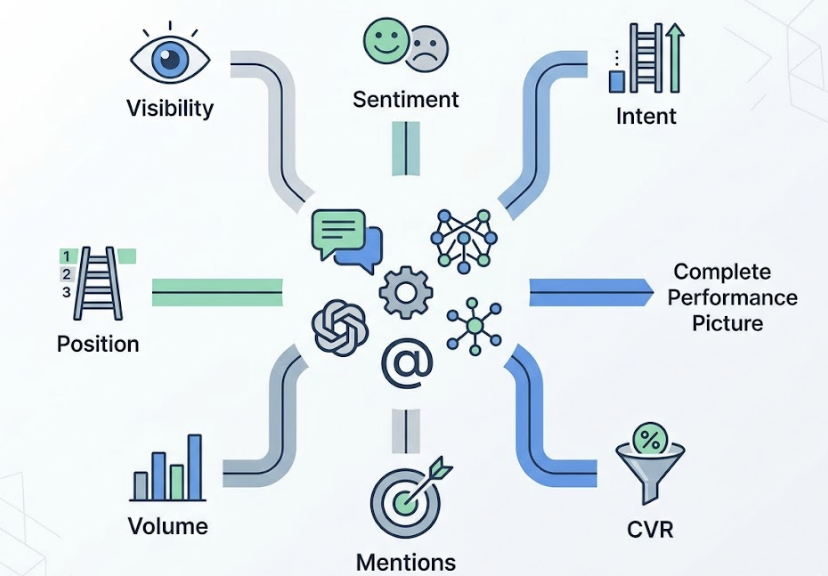
The platform tracks seven core metrics across ChatGPT, Gemini, Perplexity, and other major AI engines: Visibility, Sentiment, Position, Volume, Mentions, Intent, and CVR. Together, they give you a complete picture of where you stand in the citation economy and what’s driving your competitors’ performance.
Topify’s One-Click Execution model means you can go from discovering a prompt gap to deploying a GEO content strategy without rebuilding a workflow from scratch. For teams managing multiple brands or clients, that operational efficiency compounds quickly.
Plans start at $99/month, with a 30-day trial on the Basic tier covering 100 prompts and 9,000 AI answer analyses across ChatGPT, Perplexity, and AI Overviews.
Where This Is All Heading
By 2028, market analysts project AI platforms will send more qualified traffic than traditional search engines. Over 40% of all searches already run through AI tools. The “traffic flip” isn’t hypothetical.
The brands that will win aren’t the ones with the most backlinks. They’re the ones that understood early that the prompt box replaced the search bar, and adjusted their research methods accordingly.
Manual keyword research made sense when the goal was a top-three position on a SERP. That goal is increasingly irrelevant. The new goal is citation authority in AI-generated answers, and you can’t build that with tools designed for a different era.
Conclusion
The gap between manual keyword research and AI keyword research isn’t closing. It’s widening.
Manual tools miss 7.2-word conversational prompts. They can’t see across platforms where 71% of citations are platform-exclusive. They update too slowly to capture emerging AI search patterns. They measure clicks in a zero-click environment. They ignore the 91% of brand visibility that lives on third-party sites.
AI keyword research addresses all seven of these gaps. For SEO teams, content strategists, and GEO practitioners, the transition from keywords to prompts isn’t optional. It’s the prerequisite for remaining visible in the search environments your audience actually uses.
FAQ
What’s the difference between AI keyword research and traditional SEO keyword research?
Traditional keyword research identifies short phrases people type into Google, optimized for SERP rankings. AI keyword research captures full conversational prompts used in ChatGPT, Perplexity, and Gemini, optimized for citation frequency in AI-generated answers. The two approaches serve different channels and require different tools.
How do I start doing AEO keyword research?
Start by auditing your current AI visibility: which prompts are returning answers in your category, and which of those answers include your brand? Map the intent clusters behind those prompts, then restructure your content to lead with direct answers, supported by statistics and structured data. Tools like Topify automate the discovery and monitoring steps.
What are the best AI keyword research tools for GEO?
The most effective GEO tools provide cross-platform coverage (not just Google), real-time prompt discovery, sentiment tracking, and third-party source analysis. Topify’s platform covers all of these, tracking brand performance across ChatGPT, Gemini, Perplexity, DeepSeek, and others from a single dashboard.
How does AI keyword research support a GEO strategy?
GEO depends on knowing which prompts your brand needs to appear in and why your competitors are already there. AI keyword research provides both: the prompt map and the competitive intelligence. Without that data, GEO strategy is guesswork.
Is AI keyword research replacing manual keyword research entirely?
For traditional SEO, manual research still has a role. But for any brand that wants to appear in AI-generated answers, AI keyword research isn’t a supplement. It’s the foundation. The two channels require different research methodologies, and treating them as interchangeable is one of the most common mistakes GEO practitioners encounter.

