

Your organic rankings didn’t drop. Your content didn’t get penalized. But your traffic is down double digits anyway.
That’s the AI Overviews effect. Google now generates a synthesized summary above every organic result for over 50% of informational searches. If your brand isn’t in that summary, users never scroll far enough to find you.
The fix isn’t guessing. It’s a three-step process: track where you stand, find the content gap, and engineer content that AI can actually cite.
Your Rankings Didn’t Drop. Google Just Built a Wall Above Them.
The numbers are stark. For queries where AI Overviews appear, organic click-through rates have collapsed from 1.76% to 0.61% between June 2024 and September 2025 — a 62.3% decline. Paid search CTR dropped 51.4% over the same period.
What makes this unusual is the decoupling. Rankings hold steady. Traffic doesn’t.
Google calls it a “satisfaction gap.” The AI summary answers the user’s question well enough that they stop scrolling. No click needed. Your page never gets visited.
The second-order insight matters more, though. Brands cited inside the AI Overview don’t just survive — they outperform. Cited brands see 0.70% organic CTR versus 0.52% for non-cited brands, and the paid CTR gap is even wider: 7.89% versus 4.14%. Being in the summary is worth more than being ranked #1 below it.
On mobile — which drives roughly two-thirds of all search volume — an expanded AI Overview can occupy the entire visible screen. First place in organic sits below the fold. First place in the summary sits at the top of the world.
What Google AI Overviews Actually Pull From
Most SEOs assume AI Overviews work like Featured Snippets: find the best-ranked page, pull a paragraph. That’s not what’s happening.
Featured Snippets are link-retrieval systems. One page, one extract, one query. AI Overviews use multi-source synthesis. Google’s AI reads multiple trusted sources and generates a combined narrative — it doesn’t just lift text, it interprets and recombines it.
In 2025, Google formalized this with the MUVERA framework (Multi-Vector Retrieval Analysis). Instead of compressing a query into a single vector, MUVERA runs a two-stage pipeline: broad retrieval first, then semantic re-ranking at the passage level. It looks for content organized into modular, self-contained blocks — not long-form narratives.
The practical consequence: only 32% of URLs cited in AI-generated answers match the traditional top-10 organic results. Domain authority and backlinks still matter, but they’re no longer the deciding factor for citation. Structural clarity and content modularity are.
The Domains Google Keeps Citing
Analysis of 46 million citations across 36 million AI Overviews reveals a concentration problem for brands. Wikipedia (11.22%), YouTube (9.51%), Reddit (5.82%), and Google’s own properties (5.62%) dominate the citation landscape. That’s roughly 43% of all AI citations flowing back to Google’s ecosystem or a handful of mega-platforms.
Reddit’s surge is particularly revealing — citation frequency jumped 450% between March and June 2025. Google is treating community-driven discussion as a stronger “experience” signal than polished brand pages. That has real implications for where your optimization dollars should go.
Step 1: Find Out If Your Brand Appears in Google AI Overviews
Before optimizing anything, you need a baseline. Most brands skip this step and optimize blind.
Start manually. Run your brand name paired with industry-specific question queries — the kind of language a customer uses during research, not purchase. “Best [category] for [use case].” “How does [product type] work.” “What’s the difference between X and Y.” These are the query patterns most likely to trigger AI Overviews.
Note three things: whether an AI Overview appears, whether your brand is mentioned in it, and which competitors are cited instead.
Manual testing gives you a reality check. It doesn’t give you a trend.
Scale It with a Tracking Tool
The non-deterministic nature of AI Overviews is the problem. Google generates summaries in real time. Results shift by user, session, and query variation. A single manual check tells you what happened once. It tells you nothing about whether things are getting better or worse.
Topify‘s Visibility Tracking automates this at scale. The Basic plan ($99/month) supports 100 prompts and 9,000 AI answer analyses per month — enough to track a meaningful cross-section of the queries your customers actually use, including Google AI Overviews coverage. You get an AI Share of Voice metric that benchmarks your brand frequency against top competitors over time, not just a snapshot.
That shift from “I checked once” to “I can see a 90-day trend” is what makes optimization decisions defensible.
Step 2: Identify the Content Gaps Keeping You Out
Once you know your brand isn’t being cited — or isn’t being cited often enough — the next question is why.
Source Analysis answers it. The logic: if Google is citing Competitor A and not you on the same query, there’s something in Competitor A’s content that signals citability to the AI. Your job is to identify what that is.
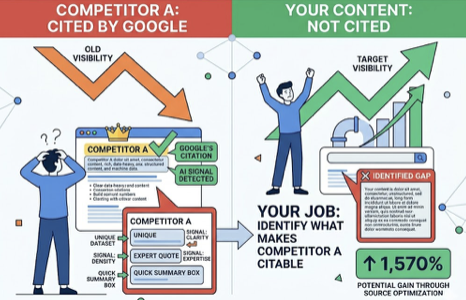
Common gaps fall into three categories. First, structural gaps: your content is written as flowing prose, not modular blocks. MUVERA’s passage-level indexing rewards self-contained sections that answer a specific sub-question within the first 100 words. Second, evidence gaps: your content makes claims without data. AI systems prioritize fact-backed content with clear sourcing. Third, E-E-A-T gaps: no author byline, no credentials, no first-hand experience signals. Google’s 2025 Quality Rater Guidelines put “Experience” as the primary differentiator — a product review with original screenshots outranks a polished summary without them.
Topify’s Source Analysis surfaces the exact domains and content types Google is pulling from in your niche. If the AI is citing Reddit threads, the gap is community presence. If it’s citing structured guides, the gap is content architecture.
What “AI-Citable Content” Looks Like
61% of AI Overviews use unordered lists. 22% use short factual paragraphs. Ordered lists account for 12%. Data tables, while rare at around 5%, are highly citable for pricing and comparison content.
The pattern is clear: AI doesn’t favor long-form storytelling. It favors structured information that can be extracted without interpretation.
Step 3: Build Content Google AI Overviews Will Actually Quote
The framework for AI-citable content is Answer Engine Optimization (AEO). Here’s what it looks like in practice.
The 100-Word Answer Block. Every key section should open with an 80–100 word direct answer to the implied question of that heading. Write the conclusion first. The AI looks for the “TL;DR” it can lift without reading the rest of the section.
Question-format headings. Rewrite H2 and H3 headings to mirror natural language queries. “How does [product] reduce cost?” performs better than “Cost Reduction Benefits.” MUVERA’s semantic matching favors headings that align with how users actually phrase their questions.
Data as authority signals. AI systems treat statistics and cited research as trust indicators. Every key claim should carry a number or a source. Proprietary data — original research, internal test results, first-hand case studies — is particularly valuable because it offers something Wikipedia and Reddit don’t.
How to Optimize Existing Pages for AI Overviews SEO
You don’t need to rebuild your site. Targeted edits to top-performing pages produce faster results.
Start with FAQ and HowTo schema markup. FAQ Schema maps question-and-answer pairs directly in a format AI can parse without interpretation. HowTo Schema signals procedural content structure. Organization Schema helps AI correctly identify your brand as a distinct entity — headquarters, social links, founders — which improves citation consistency across queries.
Internal linking also matters. Pages that sit within a clear pillar-cluster hierarchy signal content modularity to the crawler. A standalone blog post is harder for MUVERA to contextualize than one that belongs to a structured topic cluster.
Off-page optimization rounds it out. Getting your brand cited in industry publications, forums, and niche outlets that Google already trusts creates the “off-page AEO” layer that no amount of on-site schema can replicate.
The Mistake Most Brands Make: Optimizing Without Tracking
Here’s the failure mode. A team audits their content, restructures three key pages, adds FAQ schema, and waits. Three months later, traffic is flat. Nobody knows if AI Overviews shifted, if the pages got cited, or if the optimization even landed.
Without tracking, optimization is guesswork with extra steps.
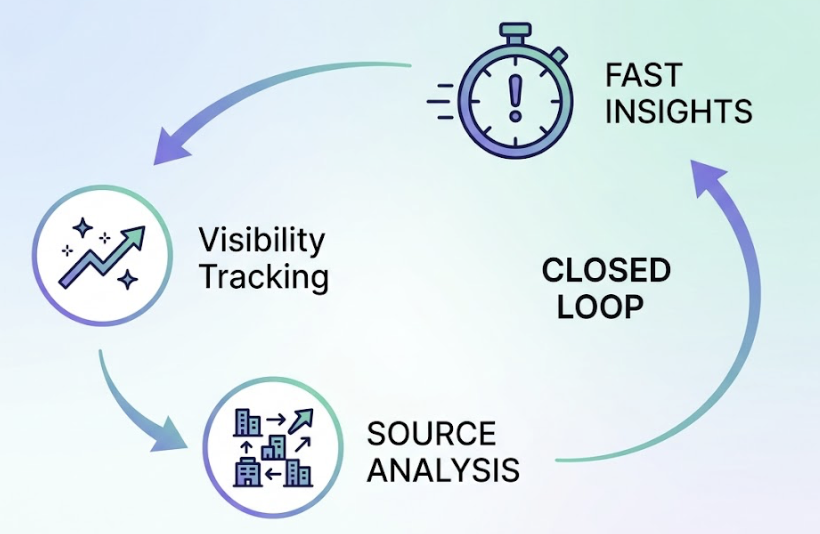
The feedback loop that makes AI Overviews optimization work is: set a prompt corpus → track citation frequency → detect changes → iterate. That loop requires automation because AI responses vary by session and can drift over weeks without any single obvious signal.
Topify closes that loop. Visibility Tracking shows you whether your citation frequency is trending up or down across your tracked prompts. Source Analysis shows whether the domains Google is citing in your niche have changed — sometimes a competitor publishes a piece of original research that suddenly displaces your page. You want to know that the week it happens, not the quarter after.
The Basic plan covers 100 prompts and 9,000 AI answer analyses monthly. For teams managing a focused set of high-value queries, that’s enough to run a systematic optimization program rather than a periodic audit.
AI-referred traffic converts at approximately 2.3x the rate of traditional organic traffic. The ROI case for systematic tracking is straightforward.
Conclusion
The brands winning Google AI Overviews aren’t doing anything exotic. They tracked where they stood. They found the content gap between them and the cited sources. They restructured pages to answer questions directly, in a format AI can extract.
That’s it. Track. Find the gap. Optimize the structure.
What doesn’t work: assuming that organic ranking translates to AI citation, or that a one-time content audit is enough. AI Overviews are non-deterministic — they shift as Google updates its models, as competitors publish new content, and as query patterns evolve. Monitoring has to be ongoing.
If you’re starting from zero, the clearest first step is understanding where your brand currently stands across the prompts your customers are actually typing. Topify’s Basic plan gets you that data for $99/month — and it gives you the source analysis to understand not just whether you’re missing, but why.
FAQ
What triggers Google AI Overviews to appear?
AI Overviews appear most often for complex informational queries, multi-step explanations, and comparison-based searches. Conversational, longer queries trigger them far more reliably than short keyword searches.
How is AI Overviews optimization different from traditional SEO?
Traditional SEO targets keyword density, backlinks, and domain authority to rank links. AI Overviews optimization focuses on modular content structure, semantic clarity, schema markup, and expert attribution — signals that help AI extract and cite your content.
Can small brands appear in Google AI Overviews?
Yes. 80% of sources cited in AI Overviews don’t rank in the top 3 organically, and 47% rank outside the top 10. Structured, expert-led content can outperform much larger competitors on citation frequency.
How do I know if Google AI Overviews are hurting my traffic?
Monitor Google Search Console for keywords where impressions stay stable but CTR drops. A widening impression-to-click gap on informational queries is a reliable signal that an AI Overview is intercepting traffic before it reaches your listing.
What content types are most likely to be cited in AI Overviews?
Unordered lists (61% of AIOs), short factual paragraphs under 100 words (22%), and ordered lists for sequential processes (12%). Data tables and FAQ sections are particularly citable due to their structured, extractable format.
Read More
- The Beginner’s Guide to Generative Engine Optimization (GEO) — How to audit your brand’s footprint across ChatGPT and Google AI Overviews, from zero.
- Why Manual AI Visibility Checking Fails — The non-deterministic problem explained, and why automated tracking is the only way to measure citation trends reliably.
- How to Perform Source Analysis to Close Content Gaps — A tactical walkthrough for identifying why competitors are winning AI citations and how to restructure your pages to compete.

