

You’re ranking #1 on Google. But when someone asks ChatGPT for a recommendation in your category, your brand doesn’t come up.
That’s not a content problem. That’s a strategy problem.
Three optimization disciplines now govern how brands get discovered online: SEO, AEO, and GEO. They’re not competing frameworks. They’re covering different surfaces. And if you’re only running one of them, you’re leaving significant visibility on the table.
Here’s how they actually differ, and what to do about it.
The Search Landscape Already Shifted. Most Brands Haven’t.
The numbers are hard to ignore.
Zero-click search rates have climbed from 64% in 2024 to somewhere between 83% and 93% in 2025 and 2026. When Google’s AI Overviews appear on a results page, organic click-through rates drop from 1.76% to 0.61%, a decline of roughly 61-65%. Paid CTR takes an even harder hit, falling 68%.
Traffic is no longer the right metric. Visibility is.
That’s the gap most brands still haven’t closed.
What SEO Is, and Where It Still Matters
SEO remains the foundation. It focuses on technical crawlability, keyword relevance, and earning high-ranking positions on Google and Bing to drive organic clicks.
It still works. But its coverage has narrowed.
The rise of “Search Everywhere Optimization” means users now discover content across social platforms, community forums, voice assistants, and AI chatbots. Google’s organic blue links are one channel among many, and their share of attention is shrinking by the quarter.
SEO is infrastructure. You need it. But it no longer gets you into the surfaces where discovery is increasingly happening.
AEO: Stop Ranking. Start Being the Answer.
Answer Engine Optimization was coined in 2017 by Jason Barnard. The idea was simple: instead of fighting for position on a results page, structure your content so an algorithm picks it as the direct answer.
AEO targets zero-click environments: Google’s Featured Snippets, “People Also Ask” boxes, and voice assistants like Siri and Alexa. The optimization goal isn’t a click. It’s extraction — getting your content pulled cleanly as the authoritative response to a specific question.
Tactically, this means FAQ structures, clear entity definitions, and Schema markup. Pages with FAQPage Schema average 4.9 AI citations compared to 4.4 without them. That’s a measurable edge from a relatively low-effort implementation.
AEO is less about traffic and more about authority positioning. When your content is the answer, you’re not a link someone might visit. You’re the source the engine trusts.
GEO: From Being Cited to Being Recommended
Generative Engine Optimization goes a step further. Formally introduced in 2023 through research from Princeton University, Georgia Tech, and the Allen Institute for AI, GEO addresses a fundamentally different machine behavior: synthesis.
AI chatbots like ChatGPT, Perplexity, and Gemini don’t extract a single answer from a single source. They pull from multiple documents, synthesize them into a narrative, and then recommend. GEO is the discipline of making sure your brand is part of that synthesis — and that the recommendation is positive.
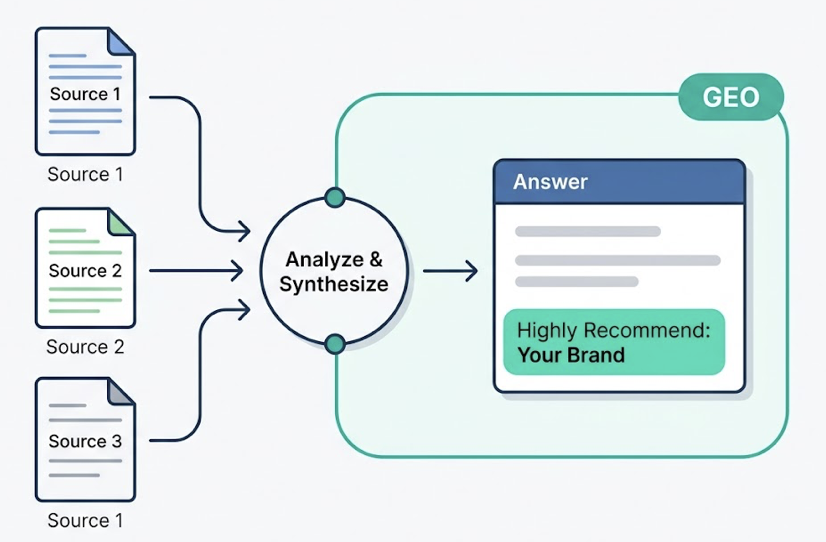
The citation triggers are different from AEO. Princeton’s research identifies two methods that move the needle most. Adding verifiable statistics increases AI visibility by 37-40%. Including expert quotations adds another 22-40%. Vague marketing language gets filtered out. Factual density is what gets you cited.
That’s why GEO also reframes brand sentiment as a ranking factor. AI engines assess whether a brand is credible, well-regarded, or facing criticism by synthesizing signals from reviews, Reddit threads, and news coverage. A mixed sentiment profile directly affects whether the model recommends you or your competitor.
AEO vs SEO vs GEO: The Side-by-Side Breakdown
| SEO | AEO | GEO | |
|---|---|---|---|
| Target engine | Google / Bing | Voice, Featured Snippets | ChatGPT, Perplexity, Gemini |
| Optimization goal | Rank #1 for keywords | Be the extracted answer | Be the recommended brand |
| Key signals | Backlinks, keywords, Domain Authority | FAQ structure, semantic clarity, Schema | Factual density, statistics, earned media, sentiment |
| Success metrics | CTR, traffic, keyword rankings | Snippet presence, voice visibility | Mention share, citation frequency, sentiment polarity |
| User intent mode | Keyword-based browsing | Immediate factual inquiry | Conversational research and comparison |
| Strategic role | Foundational infrastructure | Extraction precision | Synthesized authority |
The table looks like three separate strategies. In practice, they’re three layers of the same stack.
You Don’t Pick One. You Stack Them.
Here’s the framing that matters: SEO, AEO, and GEO aren’t alternatives. They cover different stages of how users find and evaluate brands in 2025.
Think of it as three layers:
Infrastructure (SEO): Keep your site technically sound. GPTBot and PerplexityBot need to crawl your content before they can cite it. If your pages aren’t indexed or load slowly, you’re not even in the pool.
Precision (AEO): Target high-volume question-based queries with FAQ structures and answer-first formatting. This is what wins Featured Snippets and gets your content extracted in voice search.
Authority (GEO): Contribute original research, earn coverage in credible publications, and ensure your brand narrative is consistent across every surface where AI engines look. This is what gets you recommended, not just cited.
Brands in the top quartile for web mentions receive over 10x more citations in AI Overviews than the next quartile. That compounding effect is real. The earlier you build it, the harder it becomes for competitors to close the gap.
How to Know Where Your Brand Stands in AI Search
Most teams don’t have a clear picture of their current AI visibility. That’s the actual starting point.
Manual testing helps: run your category-level queries through ChatGPT, Perplexity, and Gemini and see what comes back. Note which competitors appear. Note the framing.
But manual testing doesn’t scale. The prompt space is too large, and results vary by platform, query phrasing, and even the time of day.
Dedicated GEO tools track the metrics that matter in AI search: Mention Share (what percentage of AI responses reference your brand), Citation Frequency (how often those mentions include a link), Sentiment Polarity (whether the framing is positive, neutral, or negative), and Position Index (where your brand appears in a list of recommendations).
Topify tracks all of these across ChatGPT, Gemini, Perplexity, and other major AI platforms, giving marketing teams a structured view of where they stand and which competitors are pulling ahead. Its Competitor Monitoring feature shows not just who AI engines recommend, but why — which sources are being cited, and what content gaps your brand needs to close.
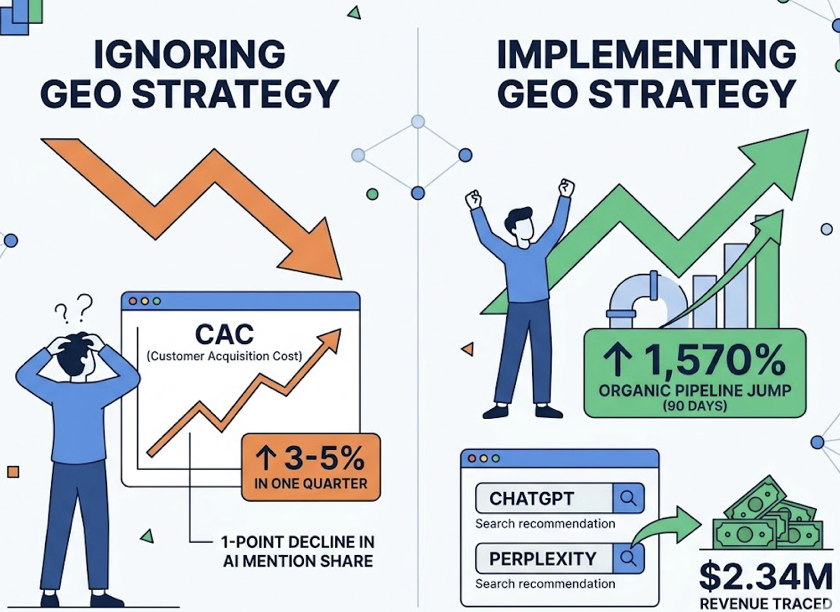
The economics of ignoring this are measurable. A one-point decline in AI first-mention share can increase Customer Acquisition Cost by 3-5% within a single quarter. On the upside, a B2B SaaS company that implemented a GEO content strategy across 50 informational pages saw a 1,570% jump in organic-attributed pipeline within 90 days, with $2.34M in revenue directly traced to ChatGPT and Perplexity recommendations.
That’s not a niche edge case. That’s where the channel is heading.
Conclusion
SEO gets you on the page. AEO gets you into the answer. GEO gets you recommended.
Each layer matters. None of them is optional if you’re competing for attention in 2025.
The brands winning AI search right now didn’t get there by accident. They built authority across every surface that AI engines rely on — credible sources, consistent positioning, factual content, and positive sentiment at scale.
The first step is knowing where you actually stand. Run the queries. Check the outputs. Then build from there.
FAQ
Is AEO the same as GEO?
No, though they’re closely related. AEO focuses on getting your content extracted as a direct answer in zero-click environments like Featured Snippets and voice search. GEO focuses on being synthesized and recommended by generative AI systems like ChatGPT and Perplexity. AEO is about extraction precision. GEO is about synthesized authority.
Does AEO replace SEO?
No. SEO remains the technical foundation that ensures AI crawlers can access and index your content. AEO and GEO build on top of that foundation to address the surfaces where traditional SEO doesn’t reach.
How do I start optimizing for AI answer engines?
Start by auditing your current AI visibility: run your core queries through ChatGPT, Perplexity, and Gemini and see where your brand appears (or doesn’t). Then prioritize FAQ Schema markup, answer-first content formatting, and building credibility signals across external platforms that AI engines treat as authoritative sources.

