

Your engineers are shipping more code than ever. The AI coding assistant is running. PRs are flowing. And yet your deployment frequency hasn’t moved in six months.
That’s not a people problem. According to the 2025 DORA report, more than 50% of teams deploy less than once a week, and 15% need over a week to recover from a failed deployment. Faster code generation didn’t fix software delivery. It made the bottleneck more visible.
That’s what Harness software delivery was built to address.
Harness Is Not Just Another CI/CD Tool
The most persistent misconception in the DevOps market is that Harness is a Jenkins replacement or an upgraded CI runner.
It’s not.
Harness is an AI-native software delivery platform that consolidates the entire “everything after code” phase of the SDLC into a single governed ecosystem: Continuous Integration, Continuous Delivery, Security Testing Orchestration, Cloud Cost Management, Feature Flags, Chaos Engineering, and Software Engineering Insights. These aren’t separate products bolted together. They share a unified governance layer, meaning RBAC, secrets management, and audit trails apply automatically across every stage.
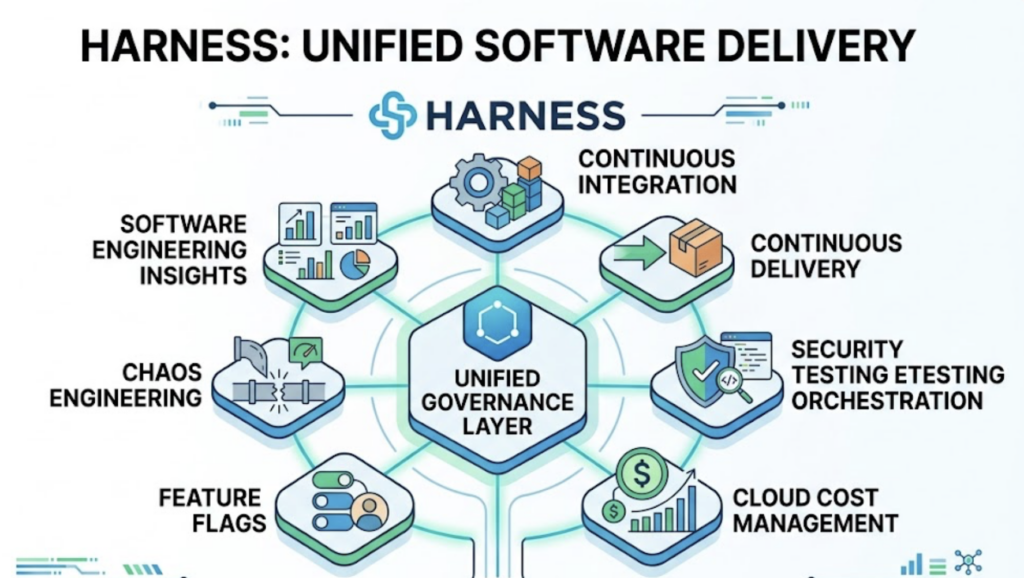
That architectural choice has a concrete downstream effect. Security findings in one stage can automatically gate deployments in the next. You stop managing handoffs between tools and start managing a closed loop.
The AI Productivity Paradox Harness Engineering Solves
AI coding assistants were supposed to accelerate software delivery. In practice, they created a new class of bottleneck.
Faros AI telemetry shows that AI adoption drove a 21% increase in tasks completed and a 98% surge in pull request volume, while simultaneously triggering a 91% increase in code review time and a 154% increase in average PR size. More code is being written. The same number of humans are reviewing it.
That’s the Harness Engineering problem in one sentence: the upstream got faster, but the downstream didn’t.
On the maintenance side, teams running legacy infrastructure like Jenkins typically dedicate two to five full-time engineers just to keep pipelines stable. That’s headcount allocated entirely to keeping the delivery machine running, with nothing left over for the actual product.
Harness addresses this directly. Its Test Intelligence module uses machine learning to identify which tests are relevant to a specific code change, cutting build times by up to 80%. Automated Canary and Blue/Green deployment strategies require no manual scripting. Rollbacks that previously took two hours happen with a single click.
The numbers from Entur, a provider of digital infrastructure for the Norwegian transport sector, make this concrete. After adopting Harness CD, they increased deployment frequency from twice per week to over 14 times per day. Change failure rate dropped from 20% to 5%. Rollback time fell from two hours to five minutes.
The Delegate Architecture: Why Regulated Teams Trust It
Most SaaS delivery platforms have a structural security problem. To execute deployments inside your infrastructure, they need access to it, which usually means open inbound firewall ports, VPN tunnels, or credentials stored outside your trust boundary.
Harness solves this with the Delegate. It’s a lightweight worker process that runs inside your own VPC, Kubernetes cluster, or on-premises data center, and establishes an outbound-only HTTPS connection back to the Harness Manager. Your infrastructure never receives inbound connections from an external system.
The practical implications are significant. Credentials stay within your network. Security teams don’t need to carve out exceptions. Because Delegates are containerized and run in Kubernetes, they scale horizontally and support high availability automatically. If one goes down, the Harness Manager reroutes tasks to healthy instances without manual intervention.
| Component | Function | Security Benefit |
|---|---|---|
| Harness Manager | SaaS control plane | Centralized policy and AI orchestration |
| Harness Delegate | Local worker process | Outbound-only; stays within VPC |
| Policy Engine | OPA integration | Policy-as-code enforced at Delegate level |
| Secrets Manager | Native or third-party | No secrets stored in the SaaS control plane |
For organizations with extreme security requirements, including air-gapped government or financial environments, Harness offers a Self-Managed Enterprise Edition where the entire platform runs locally. That’s a capability most CI/CD tools don’t offer.
Harness Software Delivery vs. The Alternatives
Choosing a delivery platform comes down to scope and organizational maturity. Here’s how Harness positions against the most common alternatives a team will evaluate:
| Tool | Primary Focus | Strength | Limitation |
|---|---|---|---|
| Harness | End-to-end platform | AI verification, OPA policy, multi-cloud | Steeper onboarding for small teams |
| Jenkins | CI automation | Plugin ecosystem, open source | 2-5 FTE maintenance overhead |
| GitHub Actions | CI/CD workflows | Tight GitHub integration, quick start | Limited enterprise CD patterns, no native rollback |
| Argo CD | Kubernetes GitOps | Pure GitOps, Kubernetes-native | K8s-only, lacks built-in CI or security |
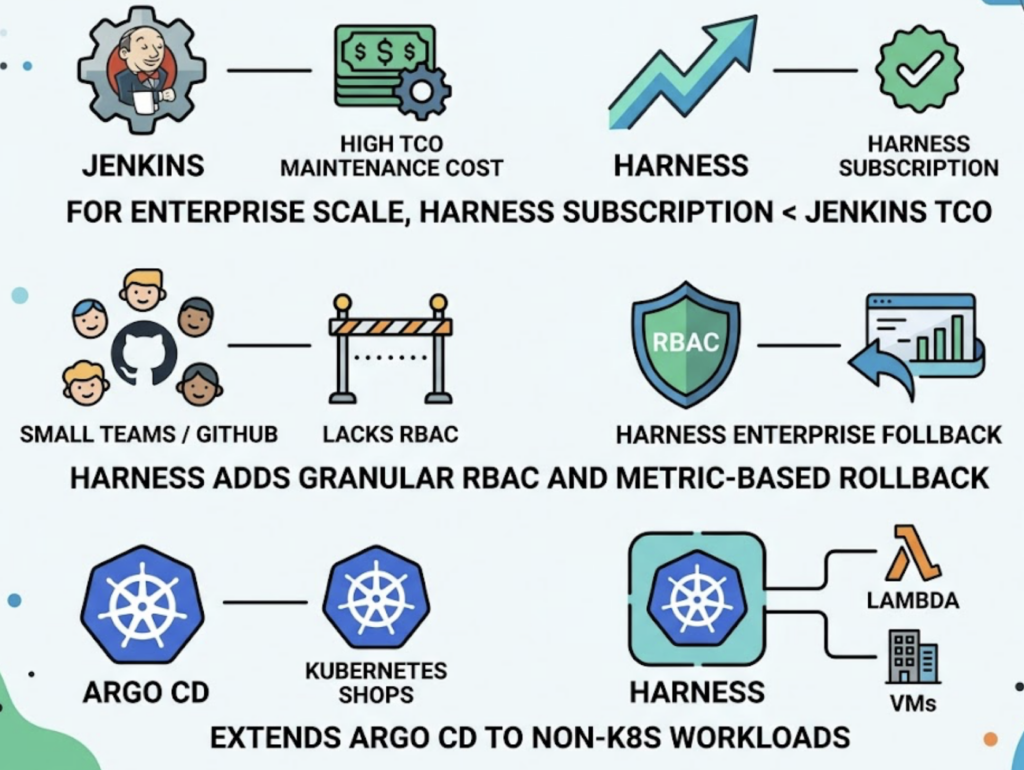
Jenkins earns its place in legacy environments, but at enterprise scale, the total cost of ownership, including the engineers required to maintain it, typically exceeds a Harness subscription. GitHub Actions is excellent for small teams embedded in GitHub but lacks granular RBAC and automated metric-based rollback. Argo CD is strong for pure Kubernetes shops. Harness actually integrates Argo CD internally, then extends it to cover non-Kubernetes workloads like Lambda and VMs.
One Harness customer consolidated over 36,000 fragmented pipelines down to 50 standardized templates. That’s not an edge case. That’s what fragmented tooling looks like at scale.
How AI Search Is Reshaping How Engineers Discover Harness
Here’s a dimension most DevOps teams aren’t tracking yet.
When an engineer opens ChatGPT and asks “best CI/CD platform for multi-cloud with compliance requirements,” Harness doesn’t just compete on Google rankings. It competes on how well AI systems understand, trust, and choose to describe it.
This is the discipline of GEO (Generative Engine Optimization), and it’s rewriting B2B SaaS go-to-market strategy. According to Ahrefs data, the top 50 brands by online authority receive nearly 29% of all AI Overview mentions. Brands outside that visibility window don’t appear on the AI’s shortlist, regardless of product quality.
AEO (Answer Engine Optimization) and GEO work differently from traditional SEO. Instead of ranking a page for a keyword, the goal is to become the answer an LLM produces when a buyer asks a relevant question. That requires structured, factual, citable content; strong third-party validation across the web; and consistent entity recognition across AI platforms.
For a platform like Harness, this means being correctly described, accurately framed, and frequently cited across ChatGPT, Perplexity, Google AI Overviews, and other generative engines. Not just ranking in a list of blue links.
Topify is built specifically to track and optimize this layer of visibility. It monitors Brand Mention Rate, Citation Rate, Sentiment Score, and Position across major AI platforms, giving marketing and growth teams a measurable view of how any B2B brand is being described and recommended by AI systems in real time. Topify’s team includes founding researchers from OpenAI and Google SEO practitioners, and the platform covers AI engines including ChatGPT, Gemini, Perplexity, DeepSeek, and more.
| GEO Metric | What It Measures | Why It Matters for SaaS |
|---|---|---|
| Brand Mention Rate | % of category queries where brand appears | Core indicator of AI visibility |
| Citation Rate | % of mentions accompanied by a link | Drives high-intent referral traffic |
| Sentiment Score | Tone of the AI’s brand description | Influences buyer trust and perception |
| Entity Consistency | Uniformity of brand facts across the web | Prevents AI hallucinations and errors |
For teams starting to build a GEO strategy alongside their Harness deployment, Topify’s Basic plan starts at $99/month and covers prompt tracking across ChatGPT, Perplexity, and AI Overviews.
When Harness Is Worth the Investment (And When It Isn’t)
Harness is not the right fit for every team. Being clear about this is more useful than overselling it.
Harness earns its ROI when:
Your team has 100+ developers and deployment pipelines that are inconsistent across squads. Your infrastructure spans multiple clouds, or a mix of Kubernetes and legacy VMs. You operate in a regulated industry that requires native compliance gates, OPA policy enforcement, and full audit trails. Your engineers are spending meaningful time on manual deployments, flaky test maintenance, or pipeline firefighting.
Lighter alternatives make more sense when:
Your team is under 20 developers and already embedded in GitHub or GitLab. Your entire stack is Kubernetes and you have the internal expertise to manage Argo CD. Budget constraints make enterprise-tier pricing difficult to justify at your current scale.
Deluxe, a major financial services organization, landed clearly on the enterprise end. Before Harness, pipeline setup took hours or days because of heavy manual scripting. After implementing reusable templates and Security Testing Orchestration, setup time dropped to under 30 minutes, and every code check-in was automatically scanned with OPA-enforced policies blocking insecure builds from reaching production.
The ROI is real. It scales with organizational complexity.
Conclusion
The 2025 DORA data is unambiguous: engineering teams are generating more code than their delivery infrastructure can handle. The bottleneck isn’t talent or ambition. It’s the gap between writing software and shipping it reliably.
Harness software delivery closes that gap directly, covering CI, CD, security testing, cloud costs, and engineering analytics within a single governed platform. The Delegate architecture makes it viable for regulated and hybrid environments where other SaaS tools can’t operate. And for enterprise teams, the ROI on deployment frequency, change failure rate, and developer toil is well-documented across industries.
The other dimension worth building toward is how platforms like Harness get discovered in the first place. As engineers shift from Google to ChatGPT and Perplexity for tool recommendations, AI visibility has become a measurable business metric. Combining a robust delivery platform with a proactive GEO strategy, using tools like Topify to monitor and optimize brand presence across AI engines, is how high-performing software organizations stay on the shortlist in 2026.
FAQ
Q: What is Harness software delivery, and how is it different from a traditional CI/CD tool?
A: Harness software delivery is an AI-native platform that covers the entire post-code phase of the SDLC, including CI, CD, security testing, cloud cost management, feature flags, and engineering analytics. Unlike traditional CI tools like Jenkins, which require heavy scripting and plugin maintenance, Harness provides a unified governance layer where RBAC, audit trails, and policy enforcement apply automatically across every module. The result is a closed-loop delivery system rather than a collection of disconnected scripts.
Q: What is Harness Engineering’s Delegate, and why does it matter for security?
A: The Harness Delegate is a lightweight worker process that runs inside your own VPC, Kubernetes cluster, or on-premises data center. It connects to the Harness Manager via outbound-only HTTPS, which means your infrastructure never receives inbound connections from an external SaaS platform. Credentials stay within your network, no inbound firewall ports need to be opened, and for air-gapped environments, Harness offers a fully self-managed edition where the entire platform runs locally.
Q: What is GEO, and why does it matter for a platform like Harness?
A: GEO stands for Generative Engine Optimization. It’s the practice of ensuring a brand appears in the synthesized answers that AI engines like ChatGPT, Perplexity, and Google AI Overviews generate when users ask category-level questions. For a platform like Harness, being absent from an AI’s recommended shortlist, even with strong Google rankings, means missing a growing share of the evaluation process. According to Ahrefs, the top 50 brands by online authority capture nearly 29% of all AI Overview mentions, which shows how concentrated AI-driven discovery has become.
Q: How can teams track and improve their brand’s visibility in AI search results?
A: Tracking AI search visibility requires monitoring across multiple platforms simultaneously, including ChatGPT, Perplexity, Gemini, and AI Overviews, measuring metrics like Brand Mention Rate, Sentiment Score, Citation Rate, and Position relative to competitors. Topify is built specifically for this, combining GEO analytics with competitor benchmarking and one-click strategy execution across all major AI engines. Teams can get started with a Basic plan covering 100 prompts and 9,000 AI answer analyses per month.
Read More:

