


Most brands are still optimizing for rankings. That’s no longer enough.
Google AI Overviews now trigger on approximately 48% of all tracked queries, up 58% year-over-year. When an AI Overview is present, organic CTR for informational queries drops 61%, from 1.76% to 0.61%. Even the first organic position loses 58% of its clicks.
Being cited in the AI Overview isn’t a bonus. It’s often the only way to stay visible at all.
Here’s the part most SEO playbooks miss: AI Overviews doesn’t select sources the same way Google’s ranking algorithm does. It runs on a separate extraction logic that rewards a specific set of content signals. Get those signals right, and your brand gets cited. Miss them, and you’re invisible, regardless of where you rank.
These are the six signals that actually determine whether you make the cut.
AI Overviews Doesn’t Just Pull From Page One. It Pulls From Pages That Answer Directly.
About 76.1% of URLs cited in AI Overviews do rank in Google’s top 10. So yes, authority still matters. But ranking alone doesn’t get you cited.
The filter that comes after ranking is extractability: can Google’s generative parser pull a clean, self-contained answer from your page without needing to read the whole thing? If the answer to a query is buried in paragraph six after 300 words of preamble, the AI will skip your page and pull from the one that leads with the answer.
That’s the gap most brands can’t see in their analytics.
Signal 1: Your Content Answers the Query in the First Sentence, Not the Fifth
AI Overviews are built on RAG (Retrieval-Augmented Generation). The system retrieves candidate passages and evaluates which one most directly satisfies the query intent. It’s looking for a 40-60 word answer block it can extract and synthesize without much interpretation.
If your H2 sections start with background context, history, or “in this section we’ll cover,” you’re training the parser to skip you.
Rewrite every major section so the first sentence delivers the answer. The supporting evidence comes after.
This is the “Inverted Pyramid” format: conclusion first, reasoning second. It feels unnatural for traditional editorial writing. For AI extraction, it’s non-negotiable.
Signal 2: Other Sites Talk About You. You Don’t Just Talk About Yourself.
Here’s the thing: AI models don’t trust brands that describe themselves. They trust brands that are described by others.
Sites with over 32,000 referring domains are 3.5x more likely to be cited by major AI systems than lower-authority sites. That number reflects the same trust logic that drives AI citation decisions. A brand that appears on third-party review sites, industry publications, and comparison platforms carries “entity-level trust” that no amount of owned content can replicate.
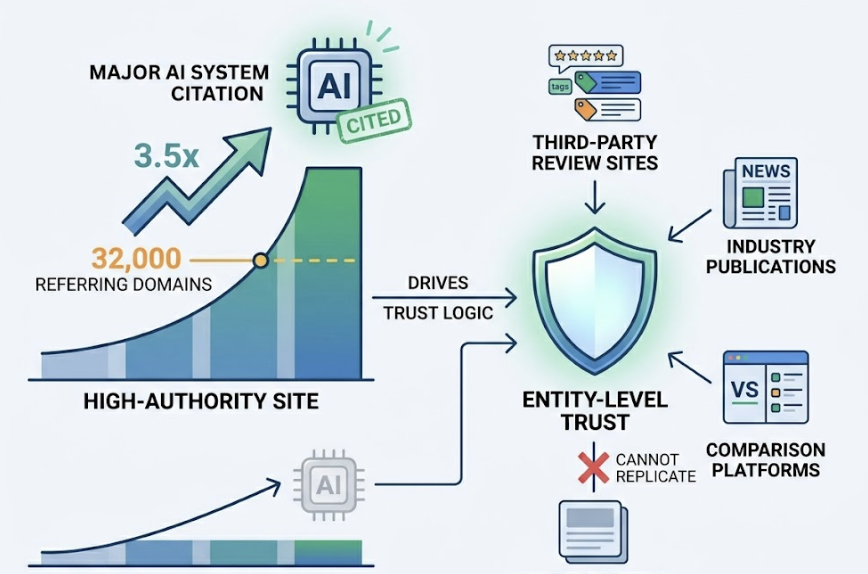
This is less about link building in the traditional sense, more about what the broader web says about you. Product reviews, analyst mentions, press coverage, and community discussions on platforms like Reddit all feed into this signal.
If the only pages citing your brand are your own, the AI has no external consensus to draw from.
Signal 3: Your Expertise Is Verifiable, Not Just Claimed
AI models are risk-averse by design. Before citing a source, Google’s generative system runs a version of E-E-A-T filtering: does this content come from someone with demonstrated, verifiable credentials?
“Demonstrated” is doing a lot of work in that sentence. Saying “our team of experts” in your About page isn’t verifiable. A named author with a linked professional profile, wrapped in Person schema, is.
Every author bio on your site should include: real name, professional title, verifiable credentials, and ideally a link to a third-party profile. The author page itself should be structured with Person schema so Google can machine-read the credential data rather than guess at it.
This single change, adding structured author attribution, is often the fastest route to improved AI citation rates for content-heavy sites.
Signal 4: You Have Original Data That AI Can Attribute to You
“According to [Brand]’s research…” is one of the sentence structures AI Overviews uses most often when it cites a specific source. That phrasing only appears when your content contains something nobody else has: original data.
Research shows that incorporating fact density elements, including specific statistics, proprietary benchmarks, and cited third-party data, can lift visibility for lower-ranked websites by up to 40%. Original data creates an even stronger pull because AI systems can’t get it anywhere else.
This doesn’t mean you need a massive research budget. Even a structured analysis of your own product usage data, a short customer survey with n=50, or a tracked experiment published with methodology counts. The key is owning the number and making it attributable.
Publish it with a clear, citable title. Reference it internally across your content. Give AI something to quote.
Signal 5: Schema Markup Tells the Parser What to Extract and Where
Without schema, AI parsers make probabilistic guesses about what your content means. With schema, you give them hard-coded truth they don’t need to guess at.
FAQPage schema is particularly effective for AI Overview coverage because the question-and-answer format maps directly onto how AI summaries are constructed. HowTo schema does the same for procedural content. Article schema validates authorship and publication date, two signals AI uses to judge recency and credibility.
A page with strong schema doesn’t just have a higher chance of being cited. It’s cited more accurately. That matters if you care about how your brand is represented, not just whether it appears.
Implementing schema on your highest-traffic informational pages is one of the lowest-effort, highest-impact moves for AI Overviews optimization.
Signal 6: You Own a Topic, Not Just a Few Pages About It
AI systems use content topology to estimate authority. A brand with 40 deeply interlinked pages on a single topic reads as an expert. A brand with three pages on that topic and 60 pages on unrelated things reads as a generalist.
Topic clusters, the practice of building a pillar page supported by tightly interlinked subtopic content, were originally an SEO framework. In 2026, they’re also an AI citation signal. When an AI retrieves candidate content for a query, a site with dense topical coverage of that domain is more likely to surface multiple candidate pages, and more likely to win the final citation.
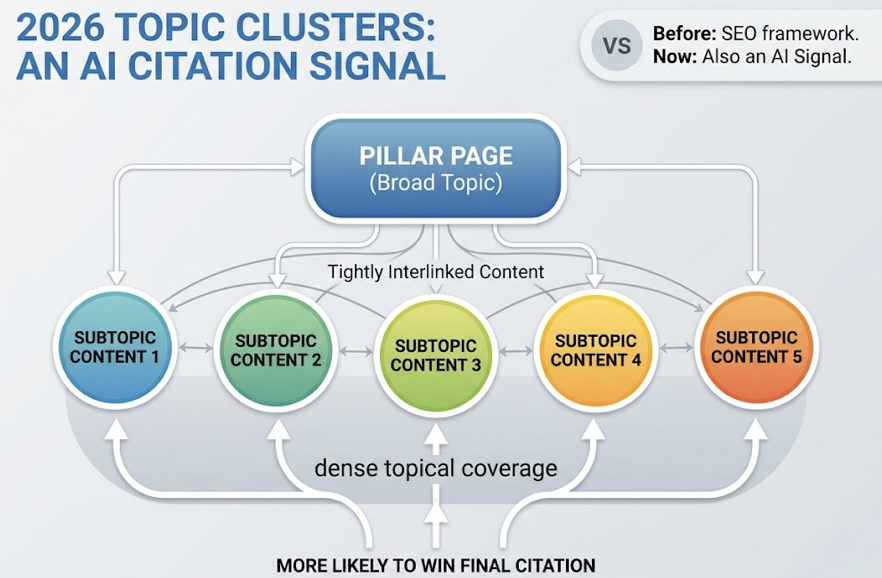
The internal link structure matters too. If your best content isn’t linked from related pages, the AI’s crawler may never connect the dots between what you know and the query it’s trying to answer.
The Fastest Way to Find Out Which Signals You’re Missing
Knowing the six signals is the first step. Finding which ones are actually failing you is where most brands get stuck, because this information doesn’t appear in standard analytics or rank tracking tools.
Brands cited in AI Overviews earn 35% more organic clicks and 91% more paid clicks than those that aren’t. That spread is large enough to be the difference between a profitable content program and one that’s slowly losing ground to competitors who figured this out earlier.
Topify’s Source Analysis feature tracks exactly which domains and URLs Google AI Overviews is pulling from for your core queries. You can see whether your brand appears in the citation pool, which competitors are being pulled instead, and where the content gaps are by topic. The platform’s Visibility Tracking covers AI Overviews specifically, so you’re not relying on proxy metrics or manual spot-checks.
A structured audit using these signals takes about a week to complete. Start with the queries where you rank well but aren’t getting cited, those are the ones where the gap is most likely structural, not authority-based.
Conclusion
Ranking is the cost of entry. Citation is the goal.
AI Overviews has created a two-tier visibility system: brands that rank and brands that get cited. The second group earns the clicks. The first group watches their traffic numbers trend quietly downward while wondering what changed.
The six signals above aren’t new concepts. Direct answers, third-party authority, verifiable E-E-A-T, original data, structured markup, and topical depth have all been on the content quality checklist for years. What’s changed is how consequential each one has become when an AI is deciding which source to trust in under a second.
Fix the signals. Get cited. That’s the playbook.
FAQ
Does domain authority directly affect AI Overviews citation rates?
It correlates, but it’s not determinative. Sites with high authority are cited more often because they tend to satisfy multiple signals at once: they have structured content, third-party mentions, and verified E-E-A-T. A lower-authority site that scores well on extractability, schema, and original data can outperform a higher-authority site that doesn’t optimize for AI extraction. Authority sets the floor; the six signals determine who actually gets cited within that range.
How long does it take to see results after optimizing these signals?
Structural changes like schema markup and content reformatting can show results in two to eight weeks, since Google re-crawls frequently updated pages on a faster cycle. Third-party authority signals take longer, typically three to six months, because they depend on external publications and community platforms updating their content. Original data campaigns tend to accelerate citation rates faster than most tactics because they give AI systems something unique to reference.
Can a small brand with limited authority get cited by AI Overviews?
Yes, especially on long-tail and niche queries where established brands haven’t built deep topical coverage. Brands that own a specific topic at depth, even without massive domain authority, often outperform larger competitors on targeted queries. The key is focus: narrow the topic cluster, maximize extractability, and publish original data. AI Overviews doesn’t always default to the biggest brand. It defaults to the most useful, most extractable source for that specific query.

