
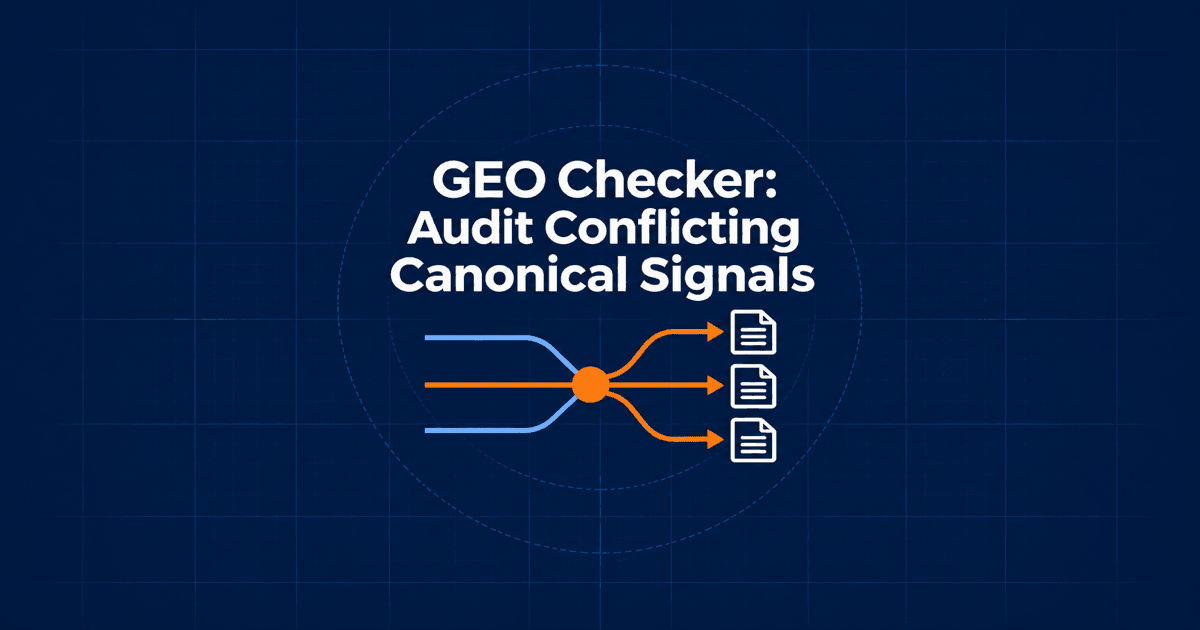
A technical SEO lead receives two apparently incompatible reports about a product guide. The content team says the clean URL is preferred, while the CMS emits a canonical pointing to a parameterized copy. A sitemap lists a third address, and a browser test shows that client-side code changes the preferred target after the initial response. Each system looks internally consistent until the records are compared.
A GEO checker can help organize that investigation, but a single pass or fail label won’t explain which declaration the publisher actually sends. The useful decision is narrower: identify the conflicting signals, establish whether the pages are equivalent, and assign the correction to the system that owns it. Answer citations can inform follow-up without proving which canonical a search engine selected.
Geo Checker: Separate Declared Canonicals From Selected URLs
A declared canonical expresses a publisher preference. A selected canonical is a search engine’s decision about which version represents a group of duplicate or substantially similar pages. An answer citation is another observation: the link a particular response exposes. These fields should never share one ambiguous canonical column.
Google documents redirects and canonical annotations as strong signals, with sitemap inclusion a weaker signal. That hierarchy helps interpret conflicts, but it doesn’t turn a preference into a guaranteed result. Record the declaration and its evidence before writing an explanation of the engine’s behavior.
An analyst’s report should therefore distinguish a detected conflict from a confirmed selection problem. Finding different targets in HTML and a sitemap supports the first conclusion. Establishing what Google selected requires appropriate first-party inspection evidence, and that access may be unavailable to an external reviewer.
Keep unknown values visible. An empty selected-canonical field is more accurate than copying the declared target into it because the dashboard requires a URL. When a stakeholder asks whether AI systems have accepted the preferred address, answer at the level the observation supports.
A citation is evidence of an exposed link, not a complete indexing diagnosis.
Inventory Redirects Headers and HTML Signals
Start with the exact requested URL and preserve its complete form. Record the response status, any redirect destinations, relevant HTTP headers, HTML canonical annotations, and whether the address appears in the site’s sitemap. Keep the time and environment beside the capture so later reviewers can reproduce the discrepancy.
Inspect each layer separately before normalizing addresses. A trailing slash, scheme change, query parameter, or alternate hostname might be central to the defect. A cleanup step that strips the difference too early can make a real disagreement disappear from the report.
Use a small, intentional set of related URLs rather than crawling every address the site can generate. Include the preferred page, one known duplicate, and any destination named by the conflicting signals. Expand the investigation when those observations reveal another template or host with a different implementation.
Assign a likely system owner to each signal. The application may emit the HTML element, the CDN may add a response header, and a separate publishing job may create the sitemap. One engineering ticket can describe the overall conflict while preserving those different implementation responsibilities.
Do not change production directives merely to make the audit easier. Capture the existing state, state the expected target, and let the owner review the proposed correction against the content relationship. This keeps the evidence useful even when a release happens during the investigation.

Compare Initial and Rendered Canonical Targets
Compare the original HTML with the document after the page’s normal rendering behavior. The question is whether the preferred target remains stable, not whether the browser eventually displays an attractive page. A client-side change can make a screenshot look reassuring while leaving the implementation harder to interpret.
Google’s JavaScript SEO guidance describes crawling and rendering as distinct processing stages. Use that distinction to structure your evidence. Don’t assume every other answer engine runs the same rendering pipeline or observes the same final state.
The following is an illustrative audit matrix, not a measurement from a live website. Replace the example labels with captured evidence and links to the relevant response or page record.
| Observation | Example finding | Decision supported | Likely owner |
|---|---|---|---|
| Redirect destination | Duplicate moves to preferred page | Check whether routing matches intent | Application or edge team |
| Response header | Names a different target | Investigate server-level conflict | Hosting configuration owner |
| Initial HTML | Names the clean page | Preserve original declaration | CMS template owner |
| Rendered document | Changes to parameterized page | Investigate client-side mutation | Frontend team |
| Sitemap entry | Lists an alternate host | Align publishing inventory | Sitemap job owner |
Capture the same page state for each comparison. A logged-in view, selected locale, or product variant can change the content and make two records incomparable. Note those conditions rather than treating every URL with similar words as the same document.
Prioritize reproducible contradictions over speculative ones. A saved original element and a different rendered element provide a concrete starting point. A report that merely says rendering might be involved leaves the developer to repeat the entire investigation.
Resolve Conflicts by Content Equivalence
Decide whether the candidate pages actually serve the same content and user purpose before aligning their signals. A parameterized sorting view may be redundant, while a regional product page may contain different availability, terms, or specifications. Similar titles alone don’t establish equivalence.
Use a short content comparison containing the main subject, substantive text, product identity, locale, and any consequential differences. Record the reason the preferred page should represent the group. That explanation should survive a review by someone who didn’t attend the original SEO discussion.
Treat canonicalization as a representation decision rather than a shortcut for removing inconvenient URLs. A page with a distinct purpose may need to remain independently discoverable. Sending it toward a broad category page can obscure useful information without resolving the underlying publishing design.
Where the content is equivalent, propose one coherent preference across the systems you control. Where it differs, stop the consolidation recommendation and document the distinction. The audit can still identify inconsistent declarations without prescribing a merge that the evidence doesn’t justify.
Retest the specific conflict after the responsible owner changes it. Compare the same fields and page state with the baseline. A successful deployment establishes that the implementation changed; it doesn’t establish that every search engine has already reprocessed the page.

Monitor Answer Links Without Inferring Index Selection
Keep answer observation in a separate record from the implementation audit. Save the question, platform, observation time, visible answer, and cited address. When the preferred URL changes, retain the address originally exposed rather than rewriting past observations to match the new configuration.
An answer may continue to expose a previous address after the website changes. That observation creates a follow-up question about current accessibility and the destination’s content. It doesn’t reveal when the provider last fetched the page or whether a canonical declaration caused the answer’s choice.
Google’s AI feature eligibility guidance connects supporting links with ordinary Search requirements. Apply that provider-specific explanation carefully. It doesn’t establish a universal canonicalization policy for every conversational product.
Avoid claiming that an aligned implementation guarantees a citation. The technical work reduces an identifiable source of ambiguity, while answer selection also depends on relevance and other systems. Define completion of the engineering task separately from any later visibility trend.
Use repeated observations to decide what to inspect next. A persistent alternate URL can justify checking that destination and its current signals. It shouldn’t automatically trigger another production change when the implementation evidence is already consistent.
Use Topify Observations to Prioritize Follow-Up
Topify can supply the answer-observation layer alongside this technical audit. Start with a reviewed set of questions related to the affected content and use its AI search analytics to examine brand visibility and cited URLs. Add those observations to an external ledger containing the requested address, declarations, rendering state, expected target, and engineering owner. The resulting queue helps the team decide which persistent discrepancies deserve another inspection.
Keep the product’s role bounded by what its visible output establishes. A cited URL can direct the reviewer to a page; it doesn’t replace response-header captures, original HTML, or first-party selected-canonical evidence. The distinction in AI Search Content Controls: What Google’s Generative AI Setting Actually Changes is useful here: technical participation rules and observed answer outcomes require separate evidence. Close the implementation issue when its acceptance criteria pass, and continue observation without promising that the repair will produce a specific ranking or citation gain.
Conclusion
A canonical audit becomes actionable when it names the conflicting declarations and the content relationship they are meant to represent. Preserve requested addresses, redirects, headers, original HTML, rendered elements, and sitemap entries as separate observations. That makes it possible to assign a precise correction instead of asking engineering to fix an unexplained score.
Begin with one preferred page and its known alternatives, then write the acceptance criteria before changing production. After the correction, repeat the same technical checks and keep answer-link observations in their own timeline. Use Topify’s AI search analytics to prioritize continuing review, while leaving canonical selection and provider processing claims limited to evidence you can actually obtain.
FAQ
Can a GEO checker prove which canonical Google selected?
Only if its evidence includes an appropriate first-party selection signal. A declared HTML target alone doesn’t prove Google’s choice.
Should the rendered canonical differ from the initial HTML?
A difference deserves investigation. Record both states and check the implementation against the provider’s current guidance before proposing a correction.
Does a citation to an alternate URL prove canonical failure?
No. It proves that the observed answer exposed that address. Investigate its current destination and declarations separately.
What should the first audit sample contain?
Start with the intended preferred page, a known duplicate, and destinations named by conflicting signals. Expand when the evidence reveals another implementation pattern.