


Your client asks, “How are we doing in AI search?” and you realize there’s nothing in your monthly report that answers that question. You’ve got two options on the table: post a job for a GEO specialist, or call a fulfillment partner who says they already do this. Neither answer feels obviously right, and every week you wait, another client asks the same question.
What It Costs to Build a GEO Agency Practice From Scratch
Hiring for GEO isn’t like hiring a junior SEO analyst. Job data from mid-2026 shows advertised base pay for GEO specialists in the US usually falls between $65,000 and $120,000, with manager-level roles climbing well past that. Freelance rates run higher still: experienced GEO specialists command $150 to $300 an hour, which prices out a lot of retainer-based agency work before the first deliverable ships.
The bigger problem isn’t the salary line. It’s supply. AI-skilled talent overall is scarce enough that demand outpaces qualified candidates by roughly 3.2 to 1 across key roles, and that scarcity shows up directly in pay. SEO roles that mention AI search or GEO skills carry a median salary of $117,500, a 20.5% premium over roles that don’t. Mentions of GEO in job postings have more than doubled in the past six months, which means the candidates who actually know what they’re doing have their pick of offers.
That’s the gap most agencies underestimate. You’re not just budgeting a salary. You’re budgeting a search that competes against banks, retailers, and AI companies themselves for the same small pool of people.
Even after you hire, there’s a ramp-up period. New GEO hires need time to learn your client roster, your reporting cadence, and how LLM citation behavior differs from Google rankings. Meanwhile, only 14% of brands currently have any defined AI visibility strategy, so most new hires are building the playbook as they go, not executing an established one.
The Hidden Price of Handing GEO to Someone Else
Outsourcing looks like the fast fix. You partner with a fulfillment provider, keep the client relationship, and mark up the invoice. The economics can actually look good on paper. Agencies running SEO fully in-house often land margins of 15% to 30% once overhead and management time are counted, while white-label arrangements frequently produce 40% to 60% margins, since the provider absorbs delivery costs and the agency just marks up the finished work. Standard reseller markups run 2x to 3x wholesale cost, landing gross margins in the 45% to 60% range.
Here’s the trade-off those numbers don’t show. A fulfillment partner serving twenty agencies is running the same playbook for every client in your category. Your GEO reporting starts looking identical to your competitor’s GEO reporting, because it’s coming from the same backend. That’s fine for commodity work. It’s a problem when the client is paying you for a differentiated point of view on their AI visibility, not a templated dashboard with your logo swapped in.
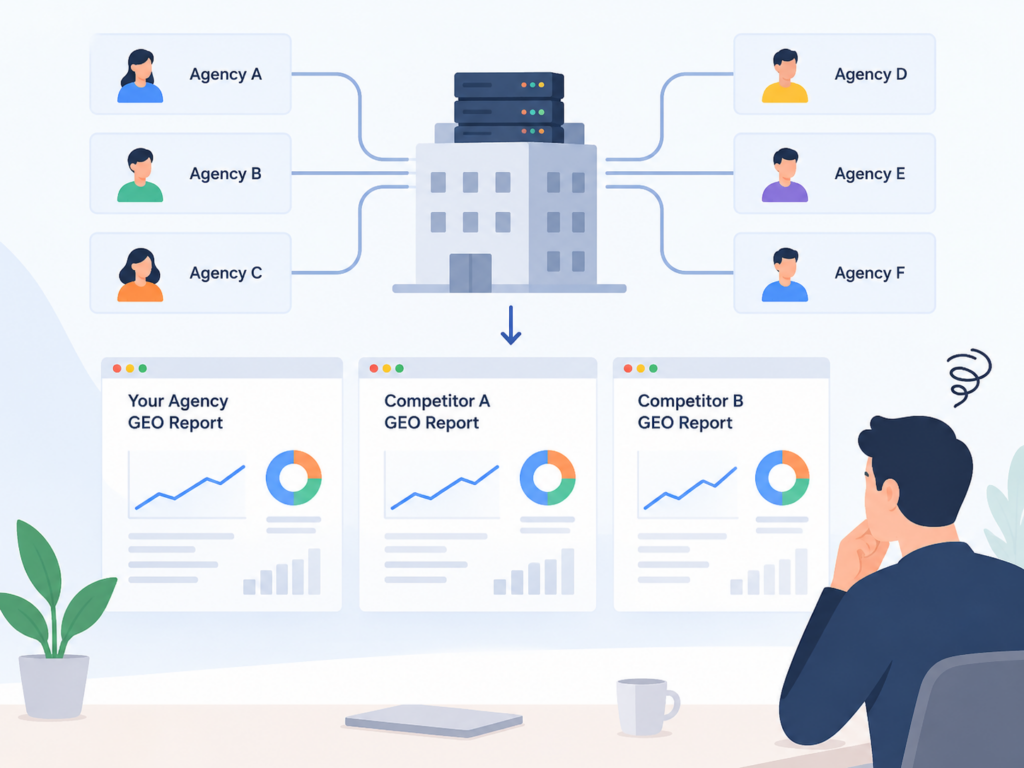
The other risk is control. When execution sits outside your walls, you’re one contract renewal away from losing the capability entirely. If the provider changes pricing, gets acquired, or deprioritizes your account tier, your GEO service line disappears with it. That’s not a hypothetical. It’s the standard risk of any resold service where the fulfillment layer isn’t yours.
The Middle Path: A GEO Agency Stack Instead of a GEO Agency Hire
The build-versus-outsource framing assumes only two paths exist. There’s a third one most agencies haven’t priced out yet: keep the team you already have, and give them a platform that handles the parts that normally require a dedicated LLM researcher.
This is where a tool like Topify changes the math. Your existing SEO or content team doesn’t need to understand how ChatGPT weighs citation sources or how Perplexity ranks entities. Topify’s Comprehensive GEO Analytics tracks visibility, sentiment, and position across major AI platforms in one view, so the diagnostic work that used to require a specialist happens inside a dashboard instead of inside someone’s head.
The execution side works the same way. Instead of hiring someone who can manually test prompts across four AI engines, One-Click Execution lets your team state a goal in plain English and deploy a strategy without building the workflow from scratch. High-Value Prompt Discovery surfaces which AI queries actually matter for a client’s category, which replaces the guesswork a junior GEO hire would otherwise spend months learning.
For client-facing work, Dynamic Competitor Benchmarking gives your account managers something concrete to put in front of clients. Instead of telling a client “we’re working on AI visibility,” you can show them exactly where they rank against named competitors inside ChatGPT and Perplexity responses, and what’s driving the gap.

The economics land differently than either pure option. You’re not paying $65,000 to $120,000 in salary for a role that takes months to fill, and you’re not handing your margin and your client relationship to a fulfillment partner serving your competitors. You keep the delivery in-house, keep the client-facing story yours, and reduce the specialized-headcount problem to a tool subscription your current team can get started with in a fraction of the time it takes to hire.
A Simple Framework to Decide
Not every agency needs the same answer. The right call depends on four things: what your current team can already do, how big your client accounts are, how fast you need to launch, and whether GEO is a long-term line of business or a one-off ask.
| Signal | Leans Build (Team + Platform) | Leans Pure Outsource |
|---|---|---|
| Existing team capability | You already have SEO or content staff who can learn a new dashboard | No marketing staff at all, purely a referral arrangement |
| Client size and budget | Mid-market to enterprise clients who expect a dedicated point of view | One-off small clients where margin matters less than speed |
| Speed to launch | You need a working service line in weeks, not a hiring cycle | You need something live tomorrow with zero setup |
| Long-term intent | GEO is becoming a core, recurring service line | You’re testing demand before committing resources |
In practice, most agencies that plan to keep GEO as a real service line land in the first column. The tool-plus-existing-team model tends to win on both speed and margin once you factor in how long a specialized hire takes to find, and how much control a pure fulfillment arrangement gives away.
Conclusion
The build-or-outsource framing misses the option that actually solves the problem: keep your team, remove the parts that used to require a specialist. Hiring a dedicated GEO expert is slow and expensive in a market where demand for that skill set outpaces supply by more than three to one. Outsourcing protects your time but rents out your margin and your differentiation to whoever else the provider serves. A platform that turns tracking, diagnosis, and execution into something your current team can run closes that gap without asking you to choose between speed and control.
FAQ
Q: How long does it typically take an agency to build a GEO service in-house from a hiring standpoint?
A: Specialized GEO hiring through dedicated talent platforms can take under two weeks for freelance placement, but full-time hires competing against enterprise and AI-company salaries often take longer, especially at the manager level where compensation climbs well above standard SEO roles.
Q: What’s a realistic GEO agency pricing model for a new service line?
A: Most agencies price GEO similarly to existing SEO retainers, layering it as an add-on rather than a standalone product, then adjusting scope based on how many AI platforms and prompts the client wants tracked.
Q: Is white label GEO a good option for agencies just starting out?
A: It can work as a short-term bridge while you validate demand, but it comes with the commoditization risk of reselling the same playbook other agencies are also reselling, which weakens differentiation over time.
Q: How long does it take to see results from an in-house GEO service, whether built with staff or with a platform?
A: Early visibility and sentiment signals typically show up within the first reporting cycle, though meaningful position shifts against competitors tend to take a few months as content and citation signals accumulate.

