

Your SEO team ran its weekly audit. Rankings look fine. Traffic is stable. But somewhere in the last 72 hours, Claude stopped recommending your brand.
You won’t see that in Google Search Console. You won’t find it in your rank tracker. And by the time a competitor notices the gap and fills it, you’re already behind.
That’s the core problem with model updates. They’re invisible to traditional monitoring. And Claude Opus 4.8, released on May 28, 2026, is one of the most consequential updates for brand visibility that AI search has seen.
Claude Opus 4.8: What Actually Changed This Time
Not every model update matters for brand visibility. Most are incremental. Opus 4.8 is different.
The model introduced two structural changes that directly affect how brands get recommended. First, Opus 4.8 significantly increased its “honesty filter”: when the model isn’t confident a brand claim is supported by independent, authoritative sources, it’s now more likely to omit the brand entirely rather than risk citing something unverified. Second, it introduced tunable “effort settings,” where high-effort responses pull from a wider, more authoritative cross-section of training data.
That second point matters more than it sounds.
Why Effort Settings Shift the Recommendation Landscape
When a user runs a high-effort query, Opus 4.8 doesn’t just answer faster. It synthesizes deeper. It draws on a broader range of sources to determine which brands have genuine, cross-referenced credibility versus which ones are simply present online.
Brands that have invested heavily in their own website content but neglected third-party coverage are now disproportionately at risk. Visibility in Opus 4.8 isn’t about how often you appear. It’s about how consistently you appear across independent sources the model treats as authoritative.
The Three Signals Claude Opus 4.8 Uses to Rank Brands
The research is clear on what Opus 4.8 actually weights when deciding which brands to recommend.
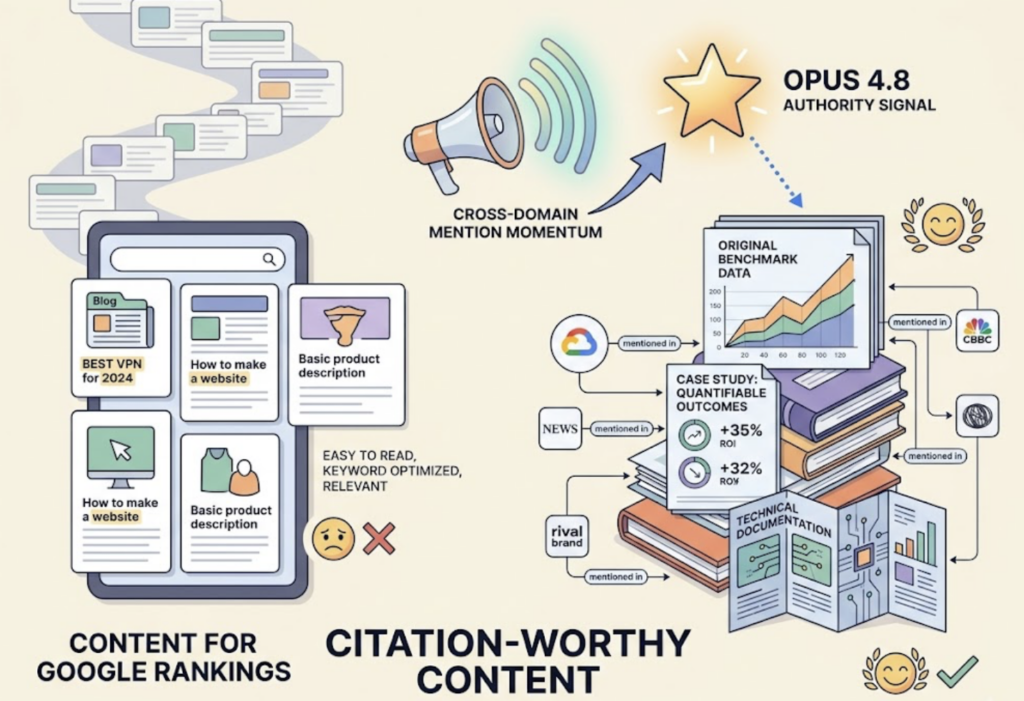
Mention momentum and diversity. Statistical association is the underlying mechanism: the more frequently a brand appears alongside a specific problem category across independent third-party domains (industry blogs, review platforms, analyst reports), the stronger the weight the model assigns to that entity. A brand mentioned 200 times on its own site doesn’t compete with a brand mentioned 50 times across TechCrunch, G2, Capterra, and a handful of respected analyst reports.
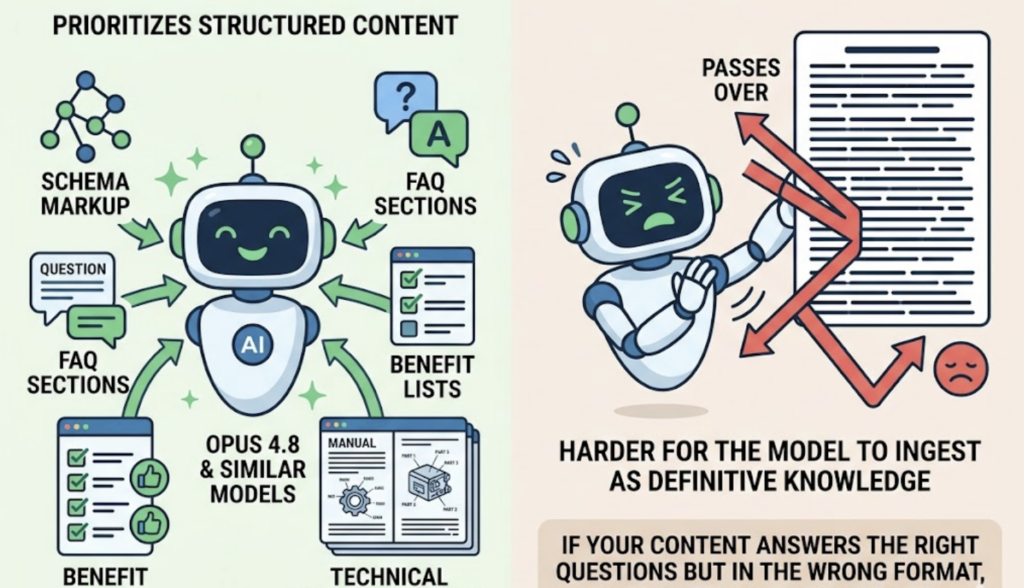
Structural clarity of content. Opus 4.8 prioritizes “extraction-friendly” information: schema markup, FAQ sections with clearly defined answers, benefit lists, technical documentation. Long-form narrative content without structural hierarchy is harder for the model to ingest as definitive knowledge. If your content answers the right questions but in the wrong format, the model may simply pass over it.
Source authority. A single mention in a top-tier industry report can outweigh dozens of mentions in low-quality directories. The model weights citations from recognized aggregators and professional publications as “validation anchors.” These signals tell Opus 4.8 that your brand has been independently evaluated, not just self-described.
Why Traditional SEO Tools Won’t Catch This
Here’s the disconnect most marketing teams are missing: AI models like Claude Opus 4.8 don’t crawl the web to rank websites. They retrieve “reputation patterns” embedded during training and refined through Retrieval-Augmented Generation (RAG). Your domain authority means nothing to the model’s recommendation logic.
This creates a measurement gap that traditional SEO tools simply can’t bridge.
| Dimension | Traditional SEO | GEO (AI Visibility) |
|---|---|---|
| Objective | Driving clicks | Earning citations |
| Visibility unit | Organic position | Entity association strength |
| Ranking logic | Backlinks, keywords | Statistical “ground truth” probability |
| Platform | Claude, ChatGPT, Perplexity |
The practical consequence: a brand can rank #1 in Google for its target keyword and be completely absent from Claude Opus 4.8 recommendations for the same category. These are separate ecosystems with separate rules.
That gap is only going to widen as users increasingly rely on AI to answer product and vendor questions rather than conducting traditional searches.
What a Brand “Disappearing” From Claude Looks Like in Practice
Most brand teams don’t notice AI visibility loss immediately. There’s no alert, no ranking drop notification, no red flag in the dashboard. The decay is gradual and only becomes visible in downstream metrics: lower referral intent from AI sources, fewer inbound inquiries referencing AI-recommended discovery, competitors suddenly showing up in sales conversations as “what the AI suggested.”
By the time a brand realizes it’s been de-emphasized in Claude Opus 4.8 recommendations, weeks of competitive positioning may already have been lost.
The core issue is that brand visibility in AI is probabilistic, not binary. The model doesn’t “remove” you. It just assigns your entity a lower probability weight for a given category. That shift can happen quietly after a model update, and without dedicated monitoring, you won’t know until the downstream effects surface.
This is not an SEO problem. It’s an AI visibility problem, and the tools to solve it are different.
How to Track Your Brand’s Position in Claude Opus 4.8
There are two approaches to monitoring AI visibility after a model update: active prompt testing and passive cross-platform monitoring.
Active prompt testing means running a structured set of category queries across AI platforms (e.g., “What’s the best tool for [your category]?”, “Which brands do you recommend for [use case]?”) and logging whether your brand appears, in what position, and with what sentiment framing. This gives you a point-in-time snapshot.
Passive monitoring means having a system that continuously runs these queries, tracks position shifts over time, and alerts you when your brand’s mention rate or recommendation rank changes significantly.
Topify is built specifically for the second approach. Its AI visibility monitoring tracks brands across ChatGPT, Perplexity, Gemini, and other major platforms, measuring seven core metrics: Visibility Score, Sentiment Score, Position Rank, AI Volume, Mention Count, Intent alignment, and CVR (Conversion Visibility Rate). When Opus 4.8 rolled out, teams running Topify could see in real time whether their brand’s position shifted relative to competitors, without waiting for downstream sales signals.
Build a Visibility Baseline Before the Next Model Update
The single most important thing a brand can do right now is establish a baseline: how often does the brand currently appear for its top category queries across major AI platforms, in what position, and with what sentiment framing?
Without that baseline, you can’t measure the impact of the next model update. And there will be a next one. Opus 4.9 and eventual Opus 5.0 are coming, and each iteration will recalibrate the recommendation weights that determine which brands get cited.
The brands that invested in baseline tracking before Opus 4.8 dropped could quantify the impact and respond within days. The ones without monitoring are still figuring out what changed.
What High-Visibility Brands Do Differently After a Model Upgrade
The brands that maintain strong AI visibility across model updates share a common pattern. They don’t optimize for any single model. They optimize for the underlying signals that every model version tends to reward.
Entity consistency. Brand name, product features, and core use cases are described consistently across all digital touchpoints: website, social profiles, third-party listings, review platforms. Semantic inconsistency (describing the same feature in five different ways across five platforms) is a primary driver of “brand blur” in models with stronger reasoning like Opus 4.8.
Citation-worthy content. The content that earns model citations is structurally different from content that earns Google rankings. Think original benchmark data, case studies with quantifiable outcomes, and technical documentation that other industry players naturally reference. That kind of content builds the cross-domain mention momentum that Opus 4.8 uses as an authority signal.
Source diversification. Brands that appear only on their own properties and in a narrow band of low-tier directories are disproportionately vulnerable to model updates. Teams that systematically earn mentions in recognized publications, analyst reports, and high-authority review platforms build the kind of distributed credibility that holds across model iterations.
Topify’s Source Analysis feature lets teams see exactly which domains and URLs Claude and other AI platforms are citing when recommending brands in their category. That tells you where the authority signals are actually coming from, and where your content distribution strategy has gaps.
Conclusion
Claude Opus 4.8 didn’t just make AI smarter. It made AI more selective. Models that flag uncertainty, weight authority, and synthesize across a wider cross-section of sources are fundamentally raising the floor for brand inclusion in AI-generated answers.
The brands that treat AI visibility as a structured, measurable discipline, not an afterthought to traditional SEO, will widen their lead over the next several model updates. The ones that don’t will keep finding out about changes after the fact, when the competitive ground has already shifted.
A dedicated GEO monitoring platform that tracks brand performance across AI engines at the prompt level isn’t a future investment. After Opus 4.8, it’s a baseline requirement.
FAQ
Does Claude Opus 4.8 change how brands appear in ChatGPT or Perplexity?
Not directly. Claude Opus 4.8 is Anthropic’s model and affects visibility specifically within Claude-powered surfaces. That said, the underlying recommendation logic shifts (weighting source authority, entity consistency, structural clarity) reflect trends across major AI models. A GEO strategy that improves your brand’s authority signals will generally benefit visibility across Claude, ChatGPT, and Perplexity simultaneously.
How often should I audit my brand’s AI visibility?
Weekly monitoring is a practical minimum for most brands. After a major model update like Opus 4.8, a dedicated audit within the first 48-72 hours gives you the clearest view of what changed. Platforms like Topify run these queries continuously, so you’re not dependent on manual audit cycles.
What’s the difference between SEO rank and AI visibility rank?
SEO rank measures your page’s position in a search engine results page for a given keyword. AI visibility rank measures how often your brand appears in AI-generated answers for category queries, in what position relative to competitors, and with what sentiment framing. A brand can rank #1 in Google and have near-zero AI visibility, and vice versa. The signals that drive each are largely separate.
How does Opus 4.8’s honesty filter affect brand recommendations?
The model is now more likely to omit brands entirely rather than cite them with low confidence. If your brand’s digital presence is inconsistent or lacks cross-referenced authority backing, the filter treats that ambiguity as a reason for exclusion. Structural clarity and third-party credibility signals are the most direct countermeasures.

