

An AI shopping agent doesn’t scroll. It doesn’t linger on a hero image or read your brand story. It pulls a query, compares a handful of structured fields across competing listings, and picks a winner in seconds. No human ever sees your product page during that decision.
That’s the shift most brands still haven’t priced in.
Your Product Page Was Never Built for a Buyer That Can’t See It
Every e-commerce page ever designed assumed a human on the other end. Layout, photography, and copy exist to persuade someone who can look, scroll, and feel something. That’s the entire premise of a product page.
An AI shopping agent reads differently. Product detail pages contain an average of 89 distinct attributes, but only about 12 are typically exposed in structured data. The other 77 sit in prose, behind tabs, or inside photographs. An agent can’t reliably parse any of that.
This isn’t a hypothetical concern anymore. Seventy percent of brands, retailers, and agencies are already testing or deploying an agentic storefront, and 40% are actively running one. ChatGPT alone reached 900 million weekly active users in February 2026, and AI referral traffic to U.S. retail sites grew 393% year over year in Q1 2026.
The buyer isn’t hypothetically becoming a machine. It already is one, at scale.
What “Product Data as Marketing Asset” Actually Meant
For twenty years, product data served one job: persuade a person to click “add to cart.” Titles were written for clicks. Descriptions were written for emotion. Photos were art directed for aspiration, not for machine legibility.
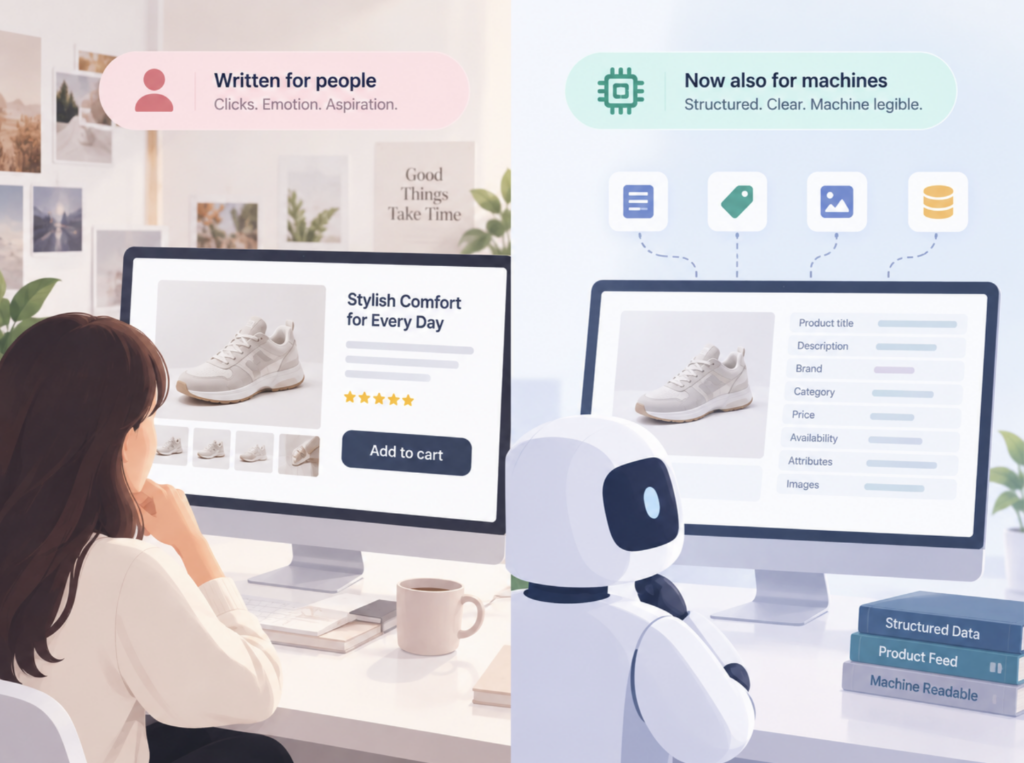
SEO already started chipping away at that model. Schema markup and structured snippets forced brands to describe products in ways search engines could parse, not just readers. But SEO still assumed a search engine that ranked pages for a human to click through.
An AI shopping agent skips the click entirely. It reads the answer to the question directly, decides, and sometimes checks out on the shopper’s behalf. When that happens, the “marketing asset” version of product data, the version built to persuade, never enters the decision at all.
The Moment an Agent Buys, Your Copywriting Stops Mattering
Break down what an agent actually does when a shopper asks for “a relaxed-fit linen shirt under $120.” It pulls candidate products from structured feeds, filters by the attributes it can verify, checks trust signals like reviews and return policy, and ranks what’s left.
Adjectives don’t survive that pipeline. Neither does brand voice, mood boards, or a well-turned headline.
Retailers need 12 core attributes complete on every SKU: title, description, brand, GTIN, MPN, category, price, sale price, availability, condition, image URL, and product URL. Miss one, and the product’s chance of being recommended drops.
Trust signals matter just as much as the basics. ChatGPT’s shopping answers now favor stores that explicitly declare return policies in schema, yet 94% of stores scanned are missing that field entirely. That’s not a content problem. It’s a data architecture gap that copywriting can’t fix.
What Actually Determines Whether an Agent Picks You
The signals an agent weighs look nothing like the signals a landing page was optimized for. Here’s the practical split.
| What Humans Responded To | What Agents Actually Read |
|---|---|
| Hero imagery, brand story | JSON-LD Product schema, GTIN, MPN |
| Persuasive copy, adjectives | Structured price, sale price, availability |
| Visual trust cues (badges, design) | Declared return policy, shipping details in schema |
| Scroll-depth engagement | AggregateRating and review data in structured form |
| SEO keyword density | Category mapped to a standard taxonomy |
Google’s Shopping Graph now holds over 50 billion product listings, and the OpenAI Product Feed Specification has emerged as a critical standard for agentic commerce, defining fields optimized specifically for AI decision-making. A feed also needs to speak at least one agentic commerce protocol: OpenAI’s commerce feed format, Google’s Universal Commerce Protocol, Stripe’s Agentic Commerce Protocol for checkout, or a Model Context Protocol server for real-time inventory.
None of that lives in a marketing calendar. It lives in a data pipeline.
Why This Is a Visibility Problem Before It’s a Conversion Problem
Here’s the trap most teams fall into: they treat this as a conversion optimization problem, something to fix after the agent already found them. But the agent has to find and trust the data first. Agents don’t recommend what they can’t parse, and stores that skip this layer become invisible before a conversion question ever comes up.
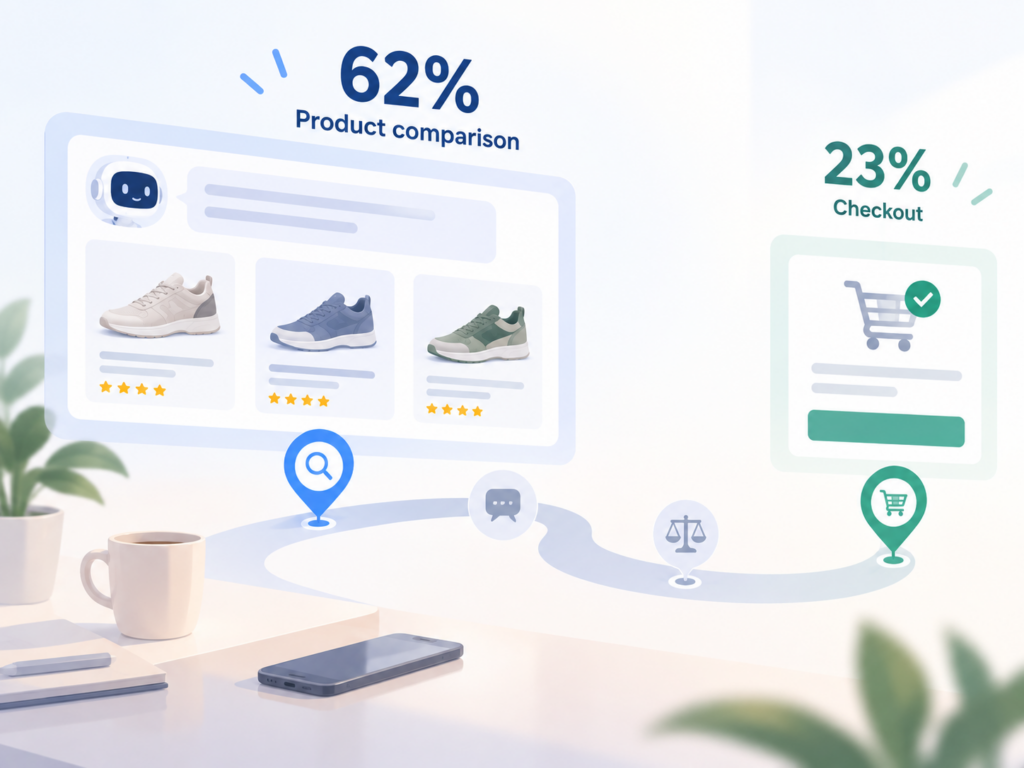
Right now, AI adoption in commerce concentrates early in the journey: about 62% of usage happens at product comparison, versus roughly 23% at checkout. That means the decisive moment, the one where your brand gets shortlisted or dropped, happens before a shopper ever reaches a cart.
This is exactly the gap Topify was built to close. Its Source Analysis capability tracks which domains and content structures AI platforms actually cite when they answer a shopping query, so a brand can see whether its product data is even entering the agent’s decision set, not just guess. Paired with CVR, Topify’s Conversion Visibility Rate metric, teams get a way to connect “are we being read” to “are we being chosen,” instead of treating AI visibility and commerce conversion as two separate reports.
That connection matters because shoppers who engage with an AI agent convert at 12.3%, compared to 3.1% for unassisted browsers. The upside is real. It’s just gated behind data that’s structured correctly in the first place.
How to Prepare Your Product Data for an Agent-First Buyer
Fixing this isn’t about writing better copy. It’s about treating product data as infrastructure that agents depend on, not marketing collateral that humans admire.
Start with feed completeness. Every SKU needs the core structured fields filled in, not just the ones your PIM system happened to inherit from a legacy catalog. Missing GTINs and vague categories are the most common reason agents skip a listing entirely.
Then check consistency across channels. An agent that finds conflicting prices or availability between your site and a marketplace feed will often deprioritize the source it trusts less, and it usually doesn’t tell you why.
Build in trust signals deliberately. Return policy, shipping timelines, and verified review data need to live in schema, not just on a policy page three clicks away. Review and sentiment signals matter here too: if that data isn’t structured or syndicated properly, the context an assistant would otherwise surface simply gets lost.
Finally, monitor rather than assume. Structured data can be technically valid and still be ignored if it doesn’t match what’s visible on the page, or if a platform changes what it prioritizes. Ongoing tracking of how AI systems actually describe and recommend your catalog is what turns a one-time schema project into a maintained asset.
Conclusion
Product data used to answer one question: will this convince a person to buy? Now it has to answer a different one first: can a machine even understand what I’m selling well enough to consider it?
That’s not a content upgrade. It’s a shift in what your product data is for. Brands that keep treating it as marketing collateral will keep losing decisions they never got to compete for. Brands that start treating it as infrastructure, complete, structured, and continuously verified, get a seat at the table when the buyer is a model instead of a person.
FAQ
What is an AI shopping agent?
An AI shopping agent autonomously researches, recommends, and completes purchases on behalf of a consumer, replacing traditional browse-and-buy shopping with intent-driven, conversational transactions.
How do AI shopping agents choose which products to recommend?
They parse structured data fields like price, availability, GTIN, and review aggregates from product feeds and schema markup, then rank candidates against the shopper’s stated criteria. Prose descriptions and imagery typically aren’t part of that evaluation.
Do I still need SEO if I optimize for AI shopping agents?
Yes, but the priorities shift. Traditional SEO still matters for discovery, while AI-readiness depends more on structured data completeness, feed accuracy, and declared trust signals like return policy and shipping details.
What’s the fastest first step to prepare for agentic commerce?
Audit your product feed against the core structured attributes agents require, then check whether that data is consistent across every channel you sell through.

