


Your team holds a Position 1 ranking on Google. Solid domain authority. Steady organic traffic. Then someone on your team opens ChatGPT and types a prompt your buyers use every day. Your brand doesn’t appear. A competitor gets recommended three times.
Traditional SEO metrics can’t tell you this is happening. They weren’t built to.
The SEO Dashboard That Doesn’t Show What AI Thinks of You
Google Analytics 4 tracks clicks, sessions, and conversions — all behaviors that happen after a user visits your site. But in AI search, the most important moment happens before any click: the AI decides whether to mention you at all.
When a user asks ChatGPT or Perplexity to recommend a tool, the AI synthesizes an answer and the user often stops there. According to recent research, 93% of sessions in Google’s AI Mode end without a click to any external website. Standard search data registers nothing — no impressions, no sessions, no signal that you were (or weren’t) recommended.
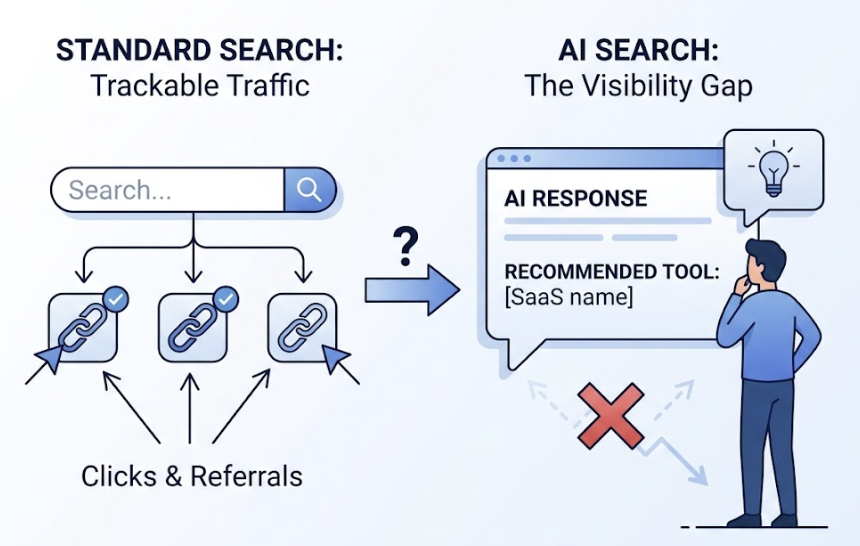
There’s also a measurement blind spot that most marketing teams haven’t confronted yet. Only 27% of marketers currently track whether their brand appears in AI-generated answers. 12% don’t even know such tracking is possible. Meanwhile, AI chatbot traffic grew by 80.92% between April 2024 and March 2025, totaling over 55 billion visits in a single year.
That’s a lot of conversations your dashboard isn’t capturing.
| Metric | Traditional SEO | AI Search Visibility |
|---|---|---|
| Primary interaction | Click to website | Mention in synthesized answer |
| Zero-click rate | ~34% (Standard Google) | ~93% (Google AI Mode) |
| Success indicator | Rank position 1-10 | Persistence & recommendation strength |
| User intent tracking | Keyword-based | Prompt-based / conversational |
What AI Search Visibility Actually Measures
AI search visibility is a performance layer that tracks how effectively a brand is recognized, cited, and recommended by generative engines — not where your URL sits in a database.
The clearest framework breaks it into four dimensions:
Mention Rate (Share of Model): How often your brand name appears across a broad set of category-specific prompts. This is your baseline presence in the AI’s “memory.”
Sentiment Profile: AI doesn’t just list brands — it describes them. Whether a model calls your product “enterprise-grade,” “budget-friendly,” or “outdated” has a direct effect on buyer trust.
Narrative Position: Order matters in conversational answers. Research on “Position Adjusted Word Count” shows users pay the most attention to the first one or two brands mentioned in a response.
Source Attribution: Which third-party websites is the AI citing when it talks about your brand? This is where optimization strategy begins — and where most brands have no visibility at all.
One detail that surprises most teams: AI visibility isn’t a single, global number. The same brand can see its citation volume differ by 615x between platforms like Grok and Claude. Tracking one platform and calling it done is a common mistake.
Why Most Brands Score Zero on This Metric
Here’s the data point that tends to land hard: only 30% of brands that appear in an AI-generated answer show up again in the very next response to the identical query. Run the same prompt five times, and only 20% of brands persist across all five runs.
Most brands aren’t just hard to find in AI search. They’re invisible by default — and the root causes are structural.
Training data gaps: AI models build opinions during training by reading the open web. If your brand lacks consistent narrative across Wikipedia, Reddit, industry publications, and review sites, the model doesn’t have enough “parametric memory” to recommend you confidently.
Poor content structure: AI engines don’t read websites the way humans do. They extract chunks of information. Most brand sites aren’t structured for this — no JSON-LD schema, no direct FAQ sections, no modular summaries. If the AI can’t easily pull your value proposition into an answer, it skips you.
No measurement, no optimization: Because only 16% of brands track AI search performance, most never know they’re invisible. And if you don’t know, you don’t fix it.
Content that hasn’t been updated in more than 90 days is three times more likely to lose citations. Pages without sequential headings or schema see a 2.8x lower citation rate. Brands with low presence on Reddit and third-party forums miss out on the channel that drives 85% of AI citations.
How AI Engines Decide What to Recommend
AI recommendations come from two sources: what the model learned during training, and what it finds in real time.
Training data (called “parametric memory”) determines the model’s instinctive brand preferences. If your brand was mentioned consistently in major publications during the model’s training window, you have a baseline advantage. If not, you’re starting from zero.
Retrieval-Augmented Generation (RAG) is the real-time layer. When a user asks a current or specific question, the AI searches the live web, extracts relevant chunks, and synthesizes a response. To win in RAG, your content needs to be easy to parse and grounded in specific, verifiable facts.
Three criteria determine whether an AI recommends you:
Content authority: Who else is citing you? Reputable third-party platforms like G2, Reddit, and industry journals act as “consensus trust” signals. The AI interprets external citations as social proof.
Semantic relevance: Does your content directly answer the prompts your buyers are using? Pages that lead with a direct answer in the first 200 words are significantly more likely to be cited.
Factual consistency: If your brand description varies across platforms, the AI perceives this as a hallucination risk. Consistency across your entity graph — brand name, category, key stats, positioning — is treated as a reliability signal.
There’s also the “Ghost Citation” problem. Gemini and other platforms have been documented citing specific content hundreds of times while mentioning the source brand zero times. Your content is authoritative enough to reference; your brand isn’t established enough to name. That’s the gap most brands still can’t see.
Tools like Topify include Source Analysis precisely for this reason — to show you which domains the AI is citing, and whether your brand is getting the credit.
Your Competitors May Already Be Optimizing for This
Generative Engine Optimization (GEO) has moved from an experiment to a front-line marketing priority. By the second half of 2025, 47% of B2B buyers were starting their research with AI search rather than traditional Google.
In sectors like finance, nine out of ten AI citations come from sources that are not on page one of traditional Google search results. That means ranking well on Google doesn’t protect you in AI search — and being invisible on Google doesn’t mean you’re invisible to AI.
The competitive window is narrowing. Brands that accumulate citation history now will benefit from a compounding effect that’s difficult for late movers to break. The GEO market is projected to grow at a 40.6% CAGR through 2034. Early movers are already building the kind of entity authority that AI engines treat as default trust.
The other risk is harder to quantify: you may already have competitors who are monitoring your AI search presence even if you’re not monitoring theirs. Topify’s Competitor Monitoring feature tracks which brands AI engines recommend in your category, how they’re described, and how their position shifts over time — across ChatGPT, Gemini, Perplexity, and other major platforms.
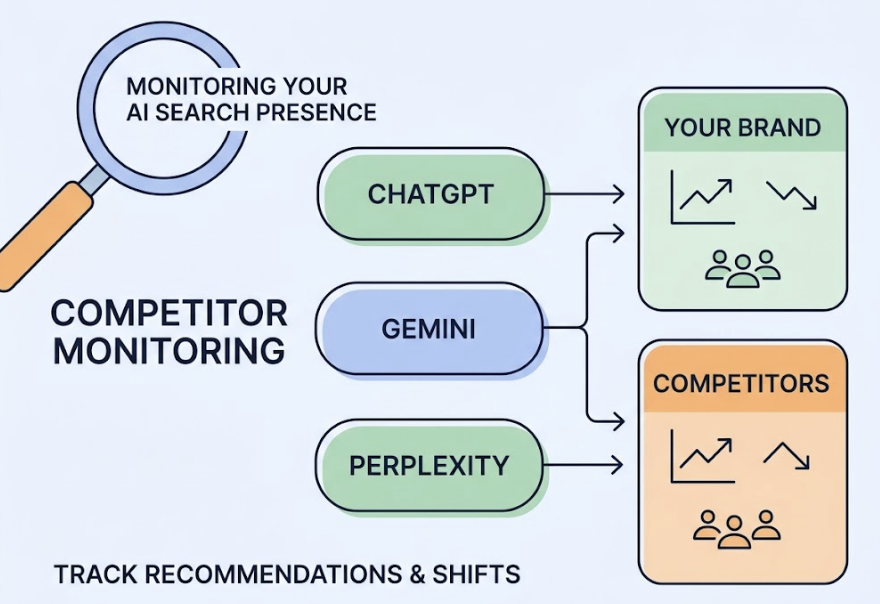
If a competitor is gaining ground in AI recommendations, you’ll want to know before it shows up in your pipeline numbers.
How to Start Tracking Your AI Search Visibility
The entry point is simpler than most teams expect. You don’t need a full GEO strategy on day one — you need a baseline.
Step 1: Define your core category prompts. Think in conversational terms, not keywords. Instead of “CRM software,” the prompt is “What’s the best CRM for a 50-person agency with a $500/month budget?” These are the queries your buyers are actually running.
Step 2: Run them across platforms. Test on ChatGPT, Perplexity, Gemini, and Claude. For each response, record: Was your brand mentioned? What position? What language did the AI use to describe you? Which third-party sources were cited?
Step 3: Track persistence over time. A single manual check tells you almost nothing. Because only 30% of brand visibility persists from one run to the next, you need repeated measurements to build a statistically meaningful score.
The limitation of manual tracking is obvious at scale. Managing hundreds of prompts across five platforms isn’t sustainable for a lean team. This is where automated platforms earn their place.
Topify handles multi-platform tracking across ChatGPT, Gemini, Perplexity, DeepSeek, and others — running thousands of prompts per day, comparing platform behavior side by side, and surfacing Source Analysis to show why competitors are being recommended instead of you. The Basic plan starts at $99/month and covers 100 prompts across four projects.
| Tracking Method | Manual Audit | Automated Platform (e.g., Topify) |
|---|---|---|
| Scalability | Low (10-20 prompts) | High (1,000s of prompts/day) |
| Platform coverage | Spotty | Comprehensive |
| Trend analysis | Difficult | Built-in dashboards |
| Execution link | High manual labor | One-click optimization |
One data point worth keeping in mind: AI search traffic converts at an average of 14.2%, compared to traditional Google’s 2.8%. That’s a 5x conversion advantage — because a user who follows an AI recommendation has already been pre-qualified by the answer they received. Visibility in AI search isn’t just a brand metric. It’s a revenue metric.
Conclusion
AI search visibility isn’t a trend to prepare for. It’s a measurement gap that’s already costing brands recommendations they don’t know they’re losing.
Your SEO dashboard will keep looking healthy. Your Google rankings may hold. But if AI engines aren’t naming you when buyers ask for solutions in your category, that traffic — and those conversions — are going somewhere else.
The starting point is simple: pick ten prompts your buyers actually use. Run them on ChatGPT and Perplexity today. See what comes back. What you find will tell you more about your current AI search position than six months of traditional analytics.
FAQ
Is AI search visibility the same as SEO?
No. Traditional SEO focuses on ranking in a list of links (SERPs). AI search visibility measures whether you’re mentioned and recommended within the synthesized narrative of an AI’s response. Good SEO provides a technical foundation, but AI visibility requires additional optimization for chunkable content and third-party consensus.
Which AI platforms should I track my brand on?
Prioritize the platforms your buyers actually use. ChatGPT dominates with over 800 million weekly active users. Perplexity is favored for research-heavy and citation-focused queries. Google AI Mode and Microsoft Copilot matter for general search integration. Citation behavior can differ by 615x across platforms, so multi-platform coverage is worth the investment.
How often does AI search visibility change?
It’s highly volatile. Only 30% of brand visibility persists from one query to the next. Citation performance for newly published content typically starts declining after just 4-5 days if the content isn’t refreshed or reinforced with new third-party mentions.
Can a small brand improve its AI search visibility without a big content team?
Yes. AI search tends to be more meritocratic than traditional search. Small brands can gain traction by targeting specific, niche prompts, participating in community platforms like Reddit, and implementing structured data (JSON-LD schema, FAQPage markup) that makes content easier for AI to extract. One-click optimization tools also help small teams execute GEO strategies without heavy headcount.

