


Your impressions are holding steady. Your rankings haven’t moved. But clicks are down 30%, and your team is staring at a GSC chart that makes no sense by traditional logic.
Here’s what’s actually happening — and what you can do about it.
The Traffic Didn’t Disappear. It Got Answered Before the Click.
Google AI Overviews (AIO) don’t just push your result down the page. They answer the question directly, at the top, before a user ever sees your blue link.
This is the zero-click shift. And it’s no longer a trend — it’s the default. The global zero-click rate climbed from 58% in 2024 to approximately 65% by late 2025, with mobile searches hitting 77.2%. On mobile, an AI Overview combined with ads and “People Also Ask” boxes can consume up to 75.7% of the initial screen. Your Position 1 result? It’s sitting 1,200 pixels down the page.
That’s not a ranking problem. That’s a visibility architecture problem.
The Number That Should Scare You: 41%
Here’s the part most teams miss: even when an AI Overview doesn’t appear, organic CTR has declined 41% year-over-year as of late 2025.
The behavior shift is permanent. Users have been retrained to expect synthesized answers. Even when Google doesn’t serve an AIO, users scan faster and click less. The muscle memory of “click the first result” is eroding — replaced by “read the summary and move on.”
This means your content strategy can’t just aim to avoid AIO displacement. It has to adapt to a fundamentally different user psychology.
Not All Queries Bleed the Same Way
AI Overviews aren’t uniform across your keyword portfolio. The impact is asymmetric — and knowing which queries are most at risk is the starting point for any AI Overviews optimization strategy.
Informational queries (what is, how to, define, explain) trigger AIOs in roughly 88% to 91% of cases. Healthcare queries alone see summaries in 60.7% of searches. If your traffic depends on top-of-funnel educational content, you’re on the frontline.
The harder truth is that commercial and transactional territory is no longer safe either. Commercial intent AIO trigger rates grew from 8.15% to 18.57% across 2025. Transactional intent jumped from 1.98% to nearly 14%. Google isn’t just answering “how to fix a faucet” anymore — it’s increasingly suggesting which faucets to buy.
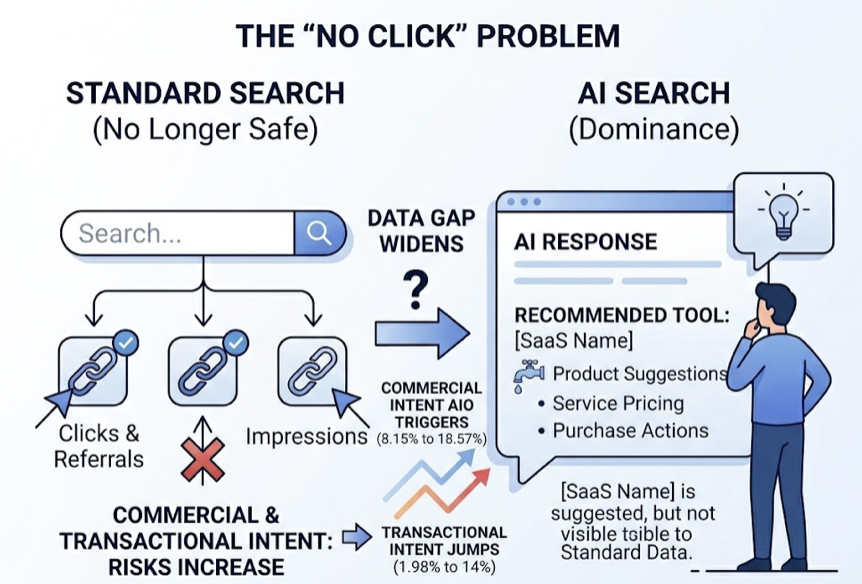
Quick diagnostic: Pull your top 50 traffic-driving keywords in GSC. Filter by the “AI Mode” segment (available since June 2025). Look for keywords where impressions are stable but clicks have collapsed. Those are your AIO casualties.
Google Is Pulling From Somewhere. That Somewhere Might Be Your Competitor.
When an AI Overview appears, Google is citing specific sources. If you’re not one of them, someone else is — and they’re getting the visibility you used to own.
This is where AI Overviews optimization diverges most sharply from traditional SEO. After Google’s Gemini 3 rollout, only 37% of AIO citations now come from the organic top 10, down from 75% previously. A staggering 36.7% of cited URLs come from domains ranking outside the top 100. Ranking #1 matters less than being the most extractable, authoritative answer for a specific sub-question.
That’s not to say rankings are irrelevant — a Position 1 page still has a 33.07% probability of being cited, roughly double that of a Position 10 page. But the correlation is far weaker than it used to be.
To know who’s getting cited for your target prompts — and whether it’s you or a competitor — you need tools that go beyond GSC. Topify’s Source Analysis tracks the exact domains and URLs that AI platforms cite across thousands of prompts, letting you see in real time where your content is winning citations and where it’s being displaced. Paired with Visibility Tracking across ChatGPT, Gemini, Perplexity, and AI Overviews, you get a unified picture of citation share — not just keyword rank.
AI Overviews Optimization Is a Citation Play, Not a Ranking Play
This is the mindset shift that separates teams gaining ground in 2026 from those still chasing positions.
The goal is no longer to rank #1. The goal is to be selected as the fragment that feeds the AI’s synthesis. Google’s AIO system decomposes queries into 10 to 16 sub-queries, evaluating sources across this expanded set — not just for the original keyword. A page ranking at position 40 for a sub-topic may be cited in a primary AIO if it’s the clearest, most structured answer to that specific component.
Three signals matter most for AI Overviews optimization:
Answer-first structure. AI models parse content in 150 to 300-word chunks, weighting the opening passage most heavily. Your core answer needs to be in the first 50 to 70 words of each section — not buried after context-setting paragraphs.
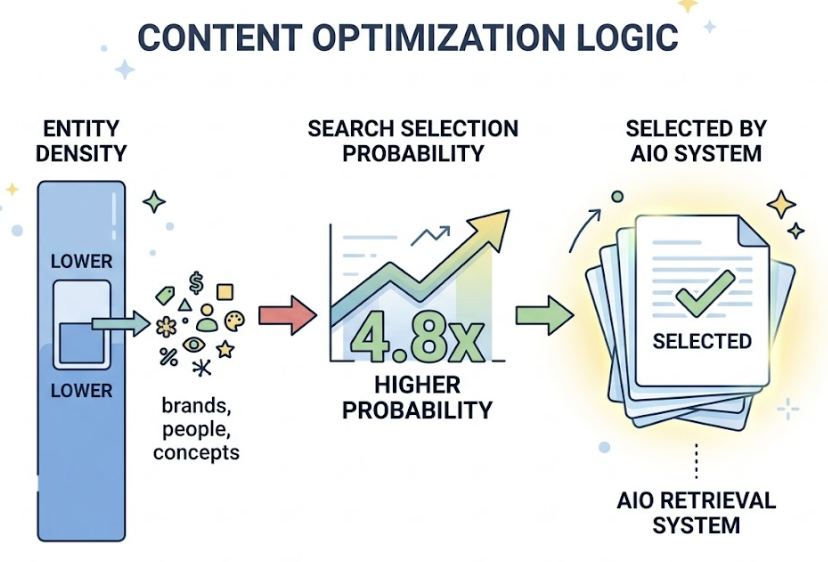
Entity density. Pages that include 15 or more recognized entities (brands, people, concepts) have a 4.8x higher probability of being selected by the AIO retrieval system. Entity-based writing isn’t jargon — it’s structuring content around the relationships between specific, verifiable things.
Schema as communication. FAQ schema has become a core GEO asset. Content grounded in FAQ, HowTo, or Organization schema is interpreted correctly by LLMs 300% more often than unstructured prose. Schema doesn’t guarantee citation. It removes friction between your content and the AI’s extraction process.
One more signal that most teams underweight: brand mentions across the web. Brand mentions correlate with AIO visibility at 0.664 — a stronger predictor than backlinks or domain rating. If your brand isn’t recognized as an entity in Google’s Knowledge Graph, it’s excluded from the synthesis process regardless of content quality. Off-site signals — media mentions, industry reviews, Reddit threads, LinkedIn posts — are now core inputs to search discoverability.
How to Tell If Your AI Overviews Optimization Is Working
Traditional metrics break down in a zero-click environment. Sessions and clicks won’t tell you whether you’re winning or losing in AI Overviews. You need a different measurement framework.
The metrics that matter now:
| Metric | What It Measures | Why It Matters |
|---|---|---|
| Citation Share | % of AIOs where your URL is cited for target keywords | Direct measure of AIO presence |
| Share of Model (SoM) | % of AI responses mentioning your brand vs. competitors | Tracks brand-level AI visibility |
| Pixel Depth | Physical position of your result on-screen | Position 1 with 1,200px offset = functionally invisible |
| AI Sentiment Score | How AI describes your brand (recommended / neutral / cautionary) | Affects conversion, not just visibility |
| Citation Stability | How often your citation status changes week-over-week | Post-Gemini 3, 42% of cited domains rotate out |
GSC’s AI Mode filter gives you a starting point, but it doesn’t show competitor citations or cross-platform performance. For teams managing brand visibility across AI platforms, Topify tracks all seven of these dimensions — Visibility, Sentiment, Position, Volume, Mentions, Intent, and CVR — across ChatGPT, Gemini, Perplexity, DeepSeek, and AI Overviews from a single dashboard. Plans start at $99/month, with a 30-day trial included on the Basic tier.
That’s a meaningful advantage when citation rotation happens weekly and you can’t afford to discover a displacement after the traffic has already left.
3 Actions SEO Teams Should Take This Week
You don’t need a six-month roadmap. The AIO environment rewards fast iteration.
1. Audit your “killing” keywords. Use GSC to isolate keywords where impressions are stable but CTR has collapsed since mid-2024. These are your AIO casualties. Manually verify whether an AI Overview appears and whether you’re cited. If not, these pages become your first rewrite priority.
2. Restructure high-priority pages for extraction. Move your core answer to the first 50 to 70 words of each section. Add question-based H2 headers. Implement FAQ schema. Add “Last Updated” timestamps and expert bylines to YMYL content — these signals close the freshness and authority gap that causes citation loss.
3. Start tracking citation share, not just rank. Set a baseline for how often your brand appears in AI-generated answers for your 50 most important prompts. Track it weekly. Without this baseline, you won’t know if your optimization efforts are working — or if you’re losing ground silently.
The teams that adapt fastest won’t just stop the bleeding. They’ll capture citation share that their slower competitors are giving up.
Conclusion
CTR decline is the symptom. The structural change in how users interact with search is the cause. AI Overviews haven’t broken traditional SEO — they’ve made it insufficient on its own.
The teams winning in 2026 have shifted from “rank higher” to “get cited.” They’re measuring Share of Model alongside sessions. They’re tracking citation stability weekly, not checking rankings monthly. And they’re treating off-site brand authority as a core search input, not just a PR outcome.
The zero-click era isn’t coming. It’s here. The question is whether your visibility strategy has caught up.
FAQ
Does ranking #1 still matter if an AI Overview is present?
Yes, but less than it used to. A Position 1 page has a 33.07% probability of being cited in an AIO — roughly double that of a Position 10 page. That said, even a cited Position 1 result sees significantly lower CTR than pre-AIO levels. Ranking well helps, but citation is the primary goal.
How do I know if AI Overviews is appearing for my target keywords?
Start with GSC’s AI Mode filter (available since June 2025) to identify queries where AIO is active. For deeper visibility — including competitor citations and cross-platform AI tracking — you’ll need a dedicated AI visibility tool that monitors actual AI responses, not just GSC signals.
What content format is most likely to be cited in AI Overviews?
Answer-first structure with the core response in the first 50 to 70 words of each section. Question-based H2 headers, FAQ schema, structured comparison tables, and 15 or more recognized entities per page. Original data and primary research are harder for AI to synthesize without direct citation — making them a natural citation defense.

