

AI engines cite sources. Your brand might not be one of them.
You already track your keyword rankings. You monitor your backlink profile. But if you’re not tracking which sources AI engines cite when answering your customers’ questions, you’re missing a layer of visibility that’s quietly reshaping how brands get discovered.
That’s where an AI citation tracker comes in.
AI Answers Don’t Come from Nowhere
When someone asks ChatGPT, Perplexity, or Gemini a question, the answer they get isn’t invented. It’s pulled from specific domains, specific URLs, specific pieces of content that the AI system has decided to trust.
That selection process isn’t random. Platforms like Perplexity run queries through a multi-stage reranking system. A single user prompt gets expanded into several search queries, retrieves around 10 candidate pages, and then typically cites just 3 to 4 as numbered sources. Most content doesn’t make the cut.
For brands, that cutoff has real consequences.
Being cited means being recommended. Not being cited means your brand simply doesn’t exist in that answer.
So, What Exactly Is an AI Citation Tracker?
An AI citation tracker is a monitoring tool that tells you whether your brand’s content is being pulled into AI-generated answers, and if so, how often, for which topics, and in what context.
It’s a fundamentally different instrument from the tools you’re already using.
A backlink tracker monitors when other humans link to your site. An AI citation tracker monitors when AI systems reference your content to generate an answer. One measures human behavior. The other measures machine behavior.
A rank tracker tells you where you appear in a Google SERP. An AI citation tracker tells you whether you appear inside the AI’s actual response, as a cited source, not just a result.
That distinction matters because the two often don’t overlap. A page ranking on page two of Google can still become a primary AI citation source if its structure, fact density, and semantic clarity are strong enough.
Why This Matters More in 2026 Than It Did Last Year
The numbers have crossed a threshold that makes this impossible to ignore.
ChatGPT’s weekly active users surpassed 900 million in early 2026, handling over 1 billion queries per day. Gartner projects that traditional search engine traffic will drop 25% by 2026, not because people are searching less, but because queries are being absorbed by conversational AI interfaces.
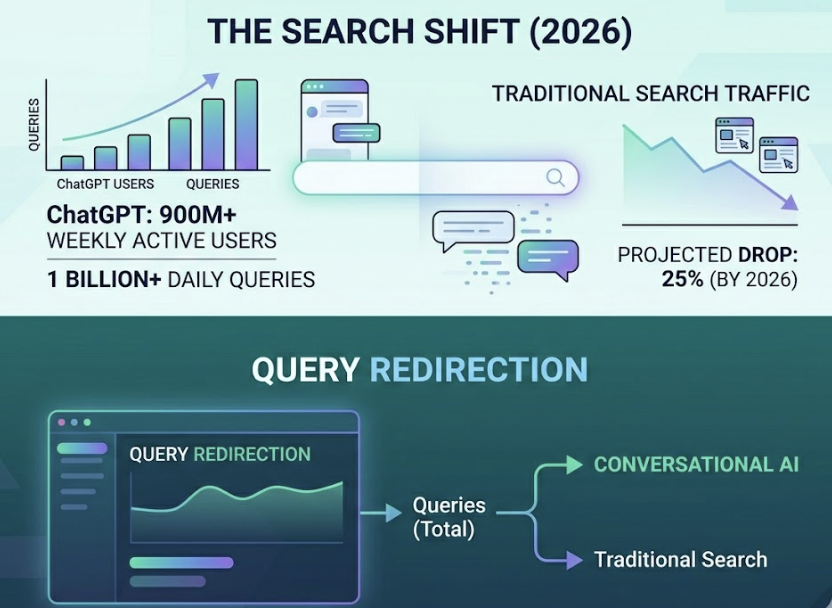
Zero-click behavior has accelerated that shift. With Google’s AI Mode active, 93% of searches now end without a click to any external site. The only way to capture attention in that environment is to be the source AI cites.
And the traffic that does come through AI citations converts at a rate that justifies the investment. AI-referred traffic converts at roughly 4.4 times the rate of traditional organic search. In some industries, AI citation traffic hits a 14.2% conversion rate, compared to 2.8% for standard search.
On the B2B side, 51% of software buyers now start their vendor research through AI chatbots rather than Google. If your brand isn’t in the AI’s answer, you’re not in the consideration set at all.
5 Things a Good AI Citation Tracker Should Tell You
Not all citation tracking tools deliver the same depth. Here’s what actually matters.
Which Domains AI Cites in Your Category
You need to know whether your domain appears when AI answers questions in your space. But equally important: which competitor domains show up when yours doesn’t? That gap is your first strategic priority.
Which Prompts Trigger Your Citations
Different questions lead to different citation patterns. A good tracker identifies the specific prompts where your brand gets cited, whether that’s comparison queries, definition queries, or purchase-intent queries. Knowing the context tells you what content is actually working.
How Your Citation Frequency Trends Over Time
AI models update their retrieval weights frequently. A weekly view of your citation share reveals whether you’re gaining ground or slipping. A sudden drop often signals a content freshness issue or a competitor publishing something stronger.
What Your Competitor Citation Share Looks Like
In a query like “best B2B analytics tools in 2026,” how many times does your domain appear versus your top three competitors? Citation share is a direct proxy for perceived authority in that topic area.
Where You’re Losing Citations You Should Be Winning
This is the highest-value output. When AI cites a competitor instead of you on a topic you’ve written about, that’s not just a traffic miss. It’s a signal that your content has a structural or semantic problem worth fixing.
How SEOs Are Already Using Citation Data
The SEO role is shifting. Keyword optimization is still relevant, but it’s no longer sufficient on its own. The practitioners getting ahead in 2026 are using citation data as a core strategic input.
Content gap analysis looks different now. If AI cites a competitor’s whitepaper when answering “how to evaluate B2B marketing automation tools,” and ignores your in-depth guide on the same topic, citation data can tell you why. Was it a comparison table the competitor included? A specific FAQ schema markup? More recent publication date? That’s actionable intelligence, not just a ranking gap.
Content validation has a new feedback loop. If a piece you published gets cited across ChatGPT, Perplexity, and Gemini repeatedly, that’s the clearest possible signal that the topic selection, structure, and fact density are working. It becomes a repeatable template.
Link building strategy gets a sharper filter. Research shows that 76.1% of AI citation sources already rank in Google’s top 10. But beyond domain authority, the domains that AI frequently cites are the same sites worth pursuing for external links. A mention on a domain that AI already trusts creates an authority transfer effect that improves your own citation probability.
Topify’s Source Analysis is built for exactly this kind of investigation. It breaks down which URLs are being cited in your category, traces which content elements AI is pulling from those pages, and identifies the structural gaps between what AI references and what you’ve published. The platform tracks citation patterns across ChatGPT, Gemini, Perplexity, and other major AI engines, so you’re not guessing which platform matters most for your audience.
What to Do If AI Isn’t Citing Your Brand
Don’t assume the problem is brand awareness. In most cases, it’s a content architecture issue.
The most common reason is EEAT signal gaps. AI models are risk-averse. If your content doesn’t include verifiable author credentials, original research, or proprietary data, the system flags it as a potential hallucination risk and skips it. The fix is to embed structured author profiles using Person Schema and incorporate original survey data or first-party research wherever possible.
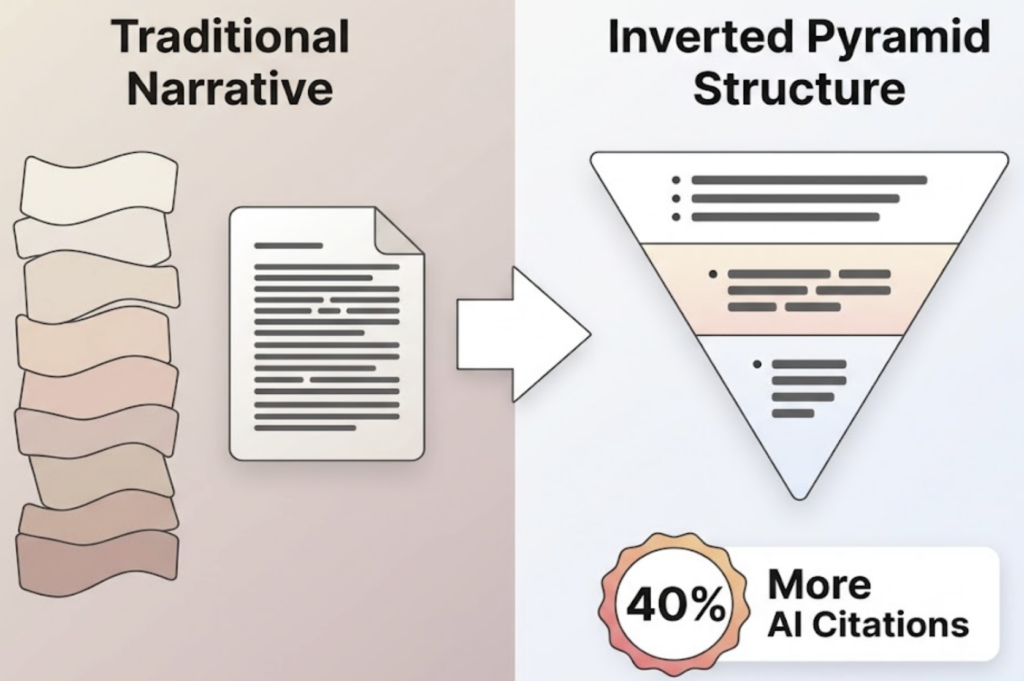
The second reason is semantic mismatch. Your content might be written around marketing language rather than the natural-language questions your audience actually asks AI. Research shows that content using an inverted pyramid structure (direct answer in the first 50 words of each section) gets cited 40% more often than traditional narrative formats. Restructuring H2 and H3 headers as questions, and leading each section with the answer, makes a measurable difference.
The third reason is technical inaccessibility. If your core content is buried behind JavaScript rendering, lazy-loading, or deep HTML nesting, AI crawlers like PerplexityBot may never parse it correctly. Core answers should be visible in raw HTML source. Page load speed (FCP) should stay under 0.4 seconds. Robots.txt should explicitly allow AI crawlers.
According to research from Princeton, adding authoritative citations to your content can increase AI citation probability by 115.1%. Incorporating specific statistics boosts it by 37%. Including verifiable expert quotes adds another 40%.
These aren’t marginal improvements. They’re structural decisions that determine whether your content enters the AI retrieval pool at all.
Conclusion
An AI citation tracker isn’t an add-on for advanced practitioners. It’s becoming the baseline observability layer for any SEO strategy that accounts for how search actually works in 2026.
You track keyword rankings because you need to know where you stand in search results. You track backlinks because you need to know what’s building your authority. Now you need to track AI citations because that’s where brand discovery increasingly begins.
The brands that build this monitoring into their workflow now won’t just see the data earlier. They’ll understand the new rules of the game before their competitors do.
FAQ
Is AI citation tracking the same as GEO?
Not exactly. AI citation tracking is the measurement layer: it tells you what’s happening right now. GEO (Generative Engine Optimization) is the execution layer: the content and technical changes you make to improve what happens next. They work together, the way rank tracking works alongside on-page SEO.
How do I know if ChatGPT is citing my website?
The most reliable method is using a dedicated AI visibility platform that runs prompts automatically and captures attribution data at scale. You can also analyze your GA4 traffic for AI search referral sources, or look for high-impression, low-click anomalies in Google Search Console’s AI Mode reports.
Do AI citations affect Google rankings?
There’s an indirect relationship. About 76.1% of AI citation sources already appear in Google’s top 10, which suggests that traditional search authority is still the entry ticket. That said, AI systems prioritize content structure and fact density, so a page ranked 20th with stronger extractability can outperform a page ranked first in AI citations.
What’s the difference between AI visibility and AI citation?
AI visibility includes any brand mention in an AI response, with or without a source link. AI citation is a specific technical action where the AI assigns your URL as a numbered footnote or source card. Mentions build awareness. Citations drive referral traffic and signal technical authority to the AI system.

