

You’ve been ranking on Google’s first page for three years. Traffic is steady. Conversions look normal.
But when someone asks ChatGPT to recommend tools in your category, your brand doesn’t come up. Not once.
That’s the gap most SEO dashboards can’t show you. Traditional rank trackers tell you where you stand in link lists. They don’t tell you whether AI systems are citing you, ignoring you, or actively recommending your competitors instead.
This is why LLM visibility tracking has become a distinct discipline. The tools below are built specifically for this problem.
Most Brands Are Invisible to AI Search Without Knowing It
Here’s what’s changed: approximately 60% of Google searches now end without a click. AI Overviews appeared in 13.14% of all queries by March 2025, a 102% increase over 14 months. When an AI-generated summary is present, click-through rates drop from 15% to around 8%.
The implication is direct. Your brand doesn’t need to lose a ranking to lose visibility. It just needs to be excluded from the AI’s synthesized answer.
That’s the invisibility problem. And it’s compounding.
Researchers call it the “Ghost Citation” phenomenon: AI systems use your content to support a factual claim, but name a competitor in the recommendation. You provided the proof, someone else got the mention.
What makes it harder is that only 11% of domains are cited by both ChatGPT and Perplexity. A brand can be well-represented on one platform and completely absent from another. Without dedicated tracking, you’d never know which scenario applies to you.
3 Things That Separate a Real LLM Tracking Tool From a Checkbox
Not every tool in this category measures the same thing. Before comparing specific platforms, it helps to understand what actually matters.
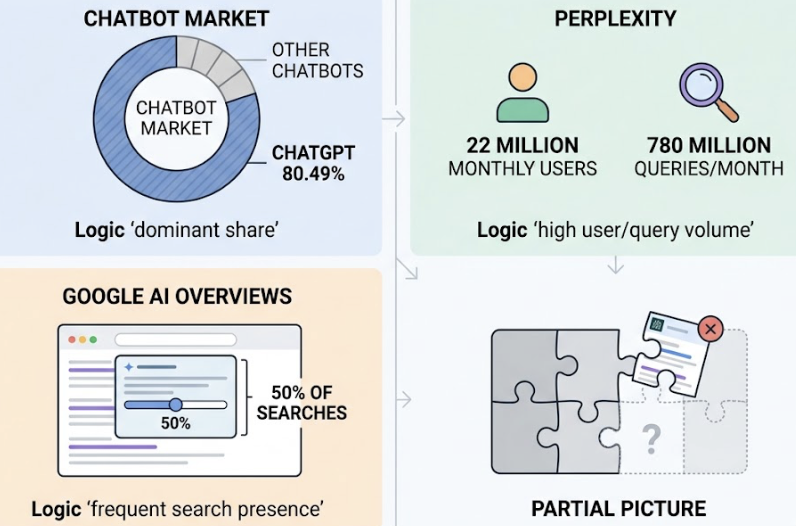
Platform coverage breadth. ChatGPT holds 80.49% of the chatbot market. Perplexity serves 22 million monthly users and processes 780 million queries per month. Google AI Overviews appears in roughly half of all searches. A tool that only tracks one of these platforms gives you a partial picture at best.
Data granularity beyond mention counts. Knowing your brand appeared in an AI response is a starting point. Knowing your position relative to competitors, the sentiment of the mention, and whether that mention had any conversion intent is what drives decisions.
Accuracy methodology. This one’s often overlooked. LLMs are non-deterministic, meaning the same prompt can produce different answers based on session history or randomization settings. Tools that use standard browser sessions often achieve accuracy scores below 60% because the AI “learns” the brand from the tracker itself. Credible tools use what’s called Swarm Probing: sending thousands of prompt variations across different geographic nodes to calculate a statistically reliable Share of Voice.
The 6 Best LLM Visibility Tracking Tools in 2026
| Tool | Platforms Covered | Standout Feature | Starting Price | Best For |
|---|---|---|---|---|
| Topify | ChatGPT, Gemini, Perplexity, AI Overviews, DeepSeek, Doubao + more | Full-spectrum tracking + one-click GEO execution | $99/mo | Growth teams, agencies, multi-platform coverage |
| Profound | ChatGPT (starter), broader on paid | CDN bot log integration, SOC 2 compliance | Free / $99/mo | Enterprise security-focused teams |
| Evertune | Multi-platform | Foundational vs. real-time knowledge split | $3,000/mo | Large enterprise, statistical rigor |
| Peec AI | Multi-platform + DeepSeek | Multilingual, unlimited seats | €89/mo | International brands, agencies |
| Otterly AI | Core AI platforms | GEO Audit (25+ on-page factors) | $29/mo | Solo marketers, early-stage testing |
| LLMClicks.ai / Akii | Varies | AI hallucination detection | Varies | B2B SaaS with complex product specs |
Topify: Best for Full-Spectrum LLM Visibility Tracking
Topify is the tool most growth and SEO teams land on when they need cross-platform data with a clear path to optimization. It’s built by a team that includes founding researchers from OpenAI and Google SEO practitioners, and it’s designed around one premise: visibility data is only useful if it tells you what to do next.
What It Actually Tracks
Topify monitors seven dimensions of brand representation: Visibility, Sentiment, Position, Volume, Mentions, Intent, and CVR (Conversion Visibility Rate). It covers ChatGPT, Gemini, Perplexity, AI Overviews, and regional models including DeepSeek, Doubao, and Mistral.
That range matters more than it sounds. There’s only a 13.7% overlap between citations in Google AI Overviews and Google’s AI Mode. Platform diversification isn’t optional for brands targeting multiple audiences.
Two features stand out technically. First, URL-Level Citation Analysis: Topify maps which specific pages on your site AI crawlers are actually ingesting, so you can prioritize optimization where it’s already working. Second, Information Density Audits: the platform compares your content’s fact-to-word ratio against the sources currently winning citations, giving you a concrete improvement roadmap rather than a vague “create better content” suggestion.
Where It Stands Out From Competitors
Most tracking tools stop at the report. Topify includes an Action Center with one-click GEO execution, meaning teams can deploy optimization strategies, such as restructuring content for AI extraction or clarifying entity signals, directly from the dashboard without exporting to a separate workflow.
Competitor Benchmarking is also real-time. You can see which brands AI platforms are recommending in your category right now, track position shifts over time, and reverse-engineer the citation sources your competitors are using.
That last capability is where a lot of teams find immediate value.
Pricing and Who It Fits
| Plan | Price | Capacity |
|---|---|---|
| Basic | $99/mo | 100 prompts, 9,000 AI answer analyses, 4 projects |
| Pro | $199/mo | 250 prompts, 22,500 analyses, 10 seats |
| Enterprise | From $499/mo | Custom prompts, dedicated account manager |
A 30-day trial is available on Basic. For agencies managing multiple client accounts, Topify’s Batch Workflows handle cross-account monitoring from a single dashboard, which meaningfully cuts manual tracking time.
Tools #2–#6: Where Each One Fits
Profound is the tool Fortune 100 companies reach for when security posture matters as much as data. Its integration with CDN providers (Cloudflare, AWS, Akamai) lets enterprise teams track how AI bots are crawling their infrastructure in real-time. It’s the only major platform in this category with SOC 2 Type II compliance and SSO at the enterprise level. The free Starter tier covers 50 prompts on ChatGPT only, which is enough to run a basic audit. Paid plans start at $99/month. The trade-off: limited optimization execution compared to Topify.
Evertune was built by veterans from The Trade Desk, and it shows in the methodology. The platform processes over 1.25 million prompts per brand monthly, specifically to counteract the non-deterministic problem. Its defining feature is the “Dual-Layer Insight”: separating what an AI knows from its training data (foundational knowledge) versus what it retrieves in real-time. PR teams and brand strategists find this especially valuable for understanding long-term brand perception versus recency effects. Price starts at $3,000/month, so it’s positioned firmly at the enterprise end.
Peec AI is a Belgian-founded platform built for international coverage. It tracks across multiple geographic IP locations, supports DeepSeek and other global models, and offers transparent pricing with no per-seat fees. That unlimited collaboration model makes it practical for agencies running lean. Starting at €89/month for 25 prompts and 3 competitors, it’s one of the more accessible options for teams with a global brief.
Otterly AI earned a “Gartner Cool Vendor 2025” designation and offers the lowest entry point in the category at $29/month. Its GEO Audit analyzes 25+ on-page factors and generates a Brand SWOT Analysis covering digital PR and content structure. For solo marketers or small startups testing whether LLM tracking is worth the investment, Otterly is the lowest-friction starting point. It doesn’t offer the execution layer or deep competitor benchmarking of Topify, but for a baseline audit, it delivers.
LLMClicks.ai / Akii takes a different approach. Rather than broad visibility tracking, these tools focus on hallucination detection: identifying when an AI is presenting incorrect pricing, outdated features, or wrong specifications for a specific product. For B2B SaaS brands with complex or frequently updated product lines, this is a real risk. A prospect asking ChatGPT about your pricing tier shouldn’t get last year’s answer.
How to Pick the Right Tool for Your Team
The honest answer is that there’s no single best tool for every situation. The right pick depends on what you’re trying to measure and what you plan to do with the data.
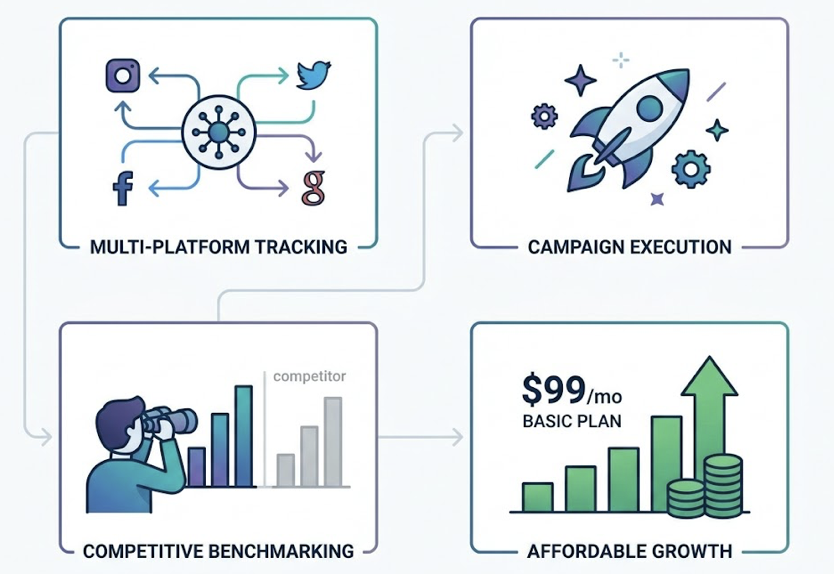
If your priority is cross-platform coverage with a direct path to optimization, Topify is the practical choice. It handles the full cycle: tracking, competitive benchmarking, and execution. The Basic plan at $99/month is a reasonable entry point for growth teams.
If you’re in an enterprise environment with strict data governance requirements, Profound is built for that context. The free tier lets you validate whether the data is useful before committing to a paid plan.
If statistical rigor is non-negotiable, and you need to separate what an AI “believes” from what it’s retrieving in real-time, Evertune’s methodology is the most defensible. The $3,000/month price reflects that.
For international brands tracking APAC markets or running multilingual campaigns, Peec AI’s geographic IP tracking and DeepSeek coverage make it worth the consideration.
If you’re at the “is this worth exploring?” stage, Otterly at $29/month gives you a functional audit without a meaningful financial commitment.
One thing worth noting across all of these: none of them replace the underlying work. As research from Princeton’s GEO-bench study shows, adding statistics to content improves LLM visibility by 22% to 37%, and adding authoritative citations improves it by up to 115.1%. The tracking tool shows you the gap. Closing it still requires the content work.
Conclusion
LLM visibility tracking isn’t a subfeature of SEO platforms. It’s a separate measurement problem that requires purpose-built tooling.
The AI platforms your customers are using, whether that’s ChatGPT, Perplexity, or AI Overviews, have their own citation logic, their own source preferences, and their own ways of deciding which brands to recommend. Tracking your performance on one doesn’t tell you what’s happening on the others.
For most teams starting out, the path forward is straightforward: run a baseline audit, understand where your brand currently stands across the platforms your audience actually uses, and then decide which tool’s scope matches your optimization roadmap.
Topify covers the broadest ground for teams that need both the measurement and the execution layer in one place.
FAQ
What is LLM visibility tracking? It’s the practice of monitoring how AI language models, such as ChatGPT, Perplexity, and Google AI Overviews, represent your brand in their generated responses. Unlike traditional SEO rank tracking, it measures whether you’re being cited, what position you hold relative to competitors, and how the AI characterizes your brand.
Can I track my brand in ChatGPT for free? Profound offers a free Starter tier that covers 50 prompts on ChatGPT. Otterly AI offers a paid entry point at $29/month with broader audit features. Most full-featured platforms require a paid plan for meaningful volume and multi-platform coverage.
How is AI Overviews tracking different from standard SEO rank tracking? Traditional rank tracking measures where a link appears in a list of results. AI Overviews tracking measures whether your brand appears in a synthesized paragraph that most users read instead of clicking through. The signals that drive each are different: domain authority affects rank; citation density and content structure affect AI inclusion.
How often do LLM visibility tools update their data? It varies by tool. Peec AI offers daily high-frequency tracking. Others update weekly or on-demand. Because LLMs are non-deterministic, credible tools average results across thousands of prompt variations rather than relying on single-point snapshots.
Do these tools work for both Perplexity and ChatGPT at the same time? Yes, the full-featured platforms do. Topify, Peec AI, and Evertune all offer multi-platform tracking. Keep in mind that only 11% of domains are cited by both ChatGPT and Perplexity, so cross-platform data often reveals meaningful divergence in how your brand is represented.

