

AI now cites sources the way Google once ranked them. Here’s how to find out if yours is one of them.
Your brand can rank on page one of Google and still be completely invisible to ChatGPT. That’s not a hypothetical — it’s the reality for most brands in 2026.
AI systems don’t just generate answers. They curate them from a narrow set of sources they consider authoritative. And without a way to track which brands get cited, who gets recommended, and which third-party sites are actually shaping the AI’s opinion of you, you’re navigating blind.
That’s what AI citation tracking tools are built to solve.
Why Your Brand’s AI Visibility Is Harder to Track Than You Think
The numbers tell an uncomfortable story. Traditional organic click-through rates have dropped by up to 61% as AI summaries absorb user intent before a single link gets clicked. Meanwhile, brands that do get cited by AI see conversion rates 5 to 11 times higher than visitors from traditional search — because the AI has already done the pre-qualification work.
That’s the trade-off: fewer clicks, but dramatically higher quality.
Here’s the thing most tracking setups miss: your own website is rarely where the AI gets its information. Brand-owned domains account for only 5% to 10% of cited sources in AI answers. The other 90% comes from Reddit threads, niche forums, G2 reviews, and industry publications. That makes traditional analytics essentially useless for understanding your actual AI visibility.
You need a dedicated tool. The question is which one.
5 Things That Separate a Good AI Citation Tracker from a Great One
Before jumping to the list, it’s worth building a choosing framework. These five criteria separate the tools that give you data from the ones that help you act on it.
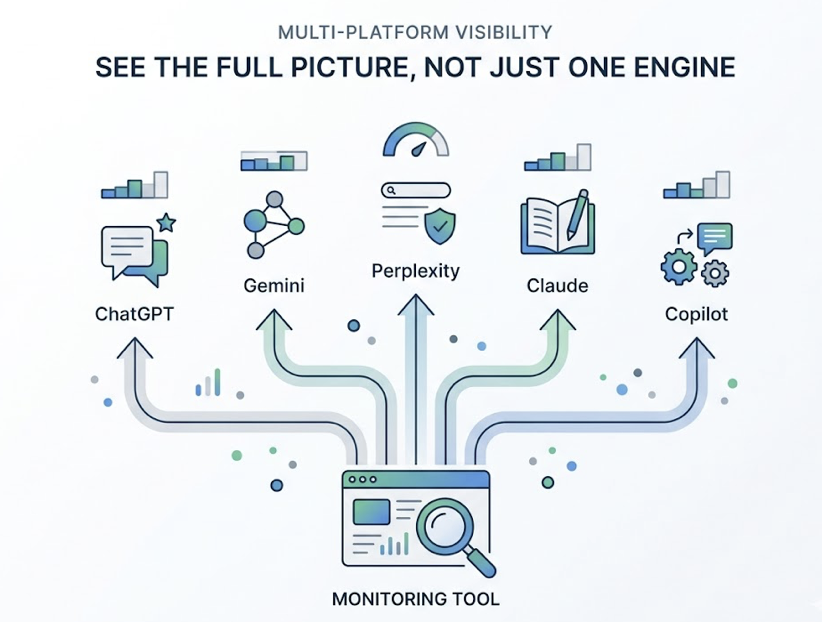
1. Multi-platform engine coverage. Your brand’s visibility in ChatGPT can look completely different from its visibility in Perplexity or Google AI Overviews. Any tool that monitors only one platform is giving you a partial picture. Look for coverage across ChatGPT, Gemini, Perplexity, Claude, and Copilot at minimum.
2. Citation vs. mention distinction. A mention means your brand name appeared in text. A citation means the AI linked to a specific URL. These are fundamentally different signals, and confusing them leads to bad strategy.
3. Source-level attribution. You need to know which domains are driving your citations — not just that citations happened. Is it your blog? A G2 review? A Reddit thread from 2022? That distinction determines where to focus your PR and content efforts.
4. Competitive benchmarking. Knowing your own citations in isolation isn’t enough. The metric that matters is your Share of Model — the percentage of relevant AI answers where your brand appears versus your competitors. Without a comparison point, you have no way to know if you’re winning or losing ground.
5. Actionability beyond dashboards. In 2026, data without direction is noise. The strongest tools don’t just show you what happened — they surface which prompts you’re losing, which third-party sources are helping competitors, and what you can do about it.
The 7 Best AI Citation Tracking Tools, Ranked
1. Topify
Best for: Growth teams and B2B SaaS brands that want to connect AI visibility directly to revenue
Topify stands apart because it treats AI citations as a conversion channel, not just a reporting metric. Most tools tell you whether you were cited. Topify tells you whether that citation actually mattered.
The platform’s Source Analysis module is particularly useful for brands trying to understand the “hidden influencer” problem. Third-party sources are 6.5 times more likely to be cited than a brand’s own domain, and Topify’s Source Analysis identifies exactly which of those third-party domains are shaping the AI’s perception of your brand — and which are doing the same for your competitors.
Topify monitors across ChatGPT, Perplexity, and Google AI Overviews, tracking seven core metrics: Visibility, Sentiment, Position, Volume, Mentions, Intent, and Conversion Visibility Rate (CVR). CVR is the most distinctive of these. It accounts for the fact that a citation in a zero-click context — where the AI fully summarizes your value proposition without leaving a knowledge gap — is a visibility win but a traffic loss.
Pricing: Basic $99/month (100 prompts), Pro $199/month (250 prompts), Enterprise from $499/month
2. Evertune
Best for: Fortune 500 brands with high-volume statistical requirements
Evertune’s core differentiator is its “Dual-Layer” methodology. It monitors not only what an AI says about your brand in real-time responses, but also what the model inherently believes based on its foundational training data. For enterprise brands where reputation management spans years of accumulated content, that distinction matters.
The platform supports over 1 million prompts per month per brand — a level of scale that smaller tools simply can’t match. It also segments sources into “Strength URLs” (helping your visibility) and “Opportunity URLs” (sources driving competitor citations that you’re missing from).
Pricing: Starts at $3,000/month
3. Profound
Best for: CMOs and enterprise marketing teams managing multi-platform brand safety
Profound achieved unicorn status in February 2026, which reflects both its feature depth and the pace at which the GEO category is growing. The platform covers 10+ AI answer engines simultaneously, making it one of the broadest in terms of platform coverage.
Its Agent Analytics module tracks AI crawler hits and ties GEO activities to actual revenue attribution — a capability most tools in this space haven’t built yet. Prompt Volume analysis also surfaces conversational clusters that traditional keyword tools would never catch.
Pricing: Starter $99/month (ChatGPT only), Growth $399/month (ChatGPT, Perplexity, AIO), Enterprise custom
4. Omnia
Best for: Growth-stage SaaS companies that need to move fast on visibility drops
Omnia is built for teams experiencing “data paralysis” — the condition where you have a dashboard full of numbers but no clear next action. Instead of reporting that a citation dropped, Omnia reverse-engineers successful competitor citations and produces specific content recommendations: which URL structures to use, which content formats to prioritize, which third-party placements to target.
It also supports localized tracking across countries and regions, which matters for brands operating in multiple markets with different AI platform dominance.
Pricing: Growth €79/month, Pro €279/month
5. Scrunch AI
Best for: Regulated industries where accuracy and brand safety are non-negotiable
Scrunch AI approaches the category from a brand protection angle. Its hallucination detection capability actively monitors for AI answers that describe your product with incorrect features, outdated pricing, or misattributed comparisons — a real risk given that AI models don’t update in real time.
The platform’s Agent Experience Platform (AXP) is designed to help marketers serve AI-readable content that actively shapes how AI agents represent the brand in real time. For healthcare, fintech, or legal-adjacent brands, that’s not a nice-to-have.
Pricing: Starts at $250–$300/month
6. Peec AI
Best for: Growing B2B teams and agencies that need daily data without enterprise pricing
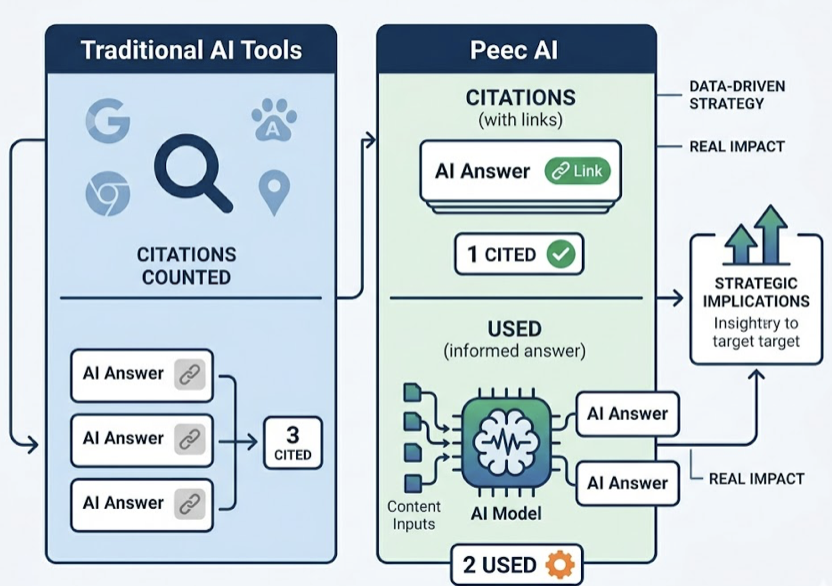
Peec AI’s standout feature is its Used vs. Cited distinction. Most tools count citations. Peec AI separates instances where your content informed an AI answer (used, but not linked) from instances where your URL was explicitly mentioned(cited). That’s a technically meaningful difference with real strategic implications.
It also segments brand positioning into four quadrants — Leaders, Niche Players, Laggers, and Controversial — giving teams a visual framework for understanding competitive standing at a glance.
Pricing: Starts at €89/month
7. Otterly AI
Best for: Solo marketers and small teams entering GEO for the first time
Otterly AI lowers the barrier to entry without sacrificing utility. Its prompt-first interface automates what many teams are still doing manually — testing AI queries one by one and noting the results. Real-time alerts notify users of sudden visibility drops or new competitors entering target prompt results, which is genuinely useful for resource-constrained teams.
Pricing: Lite $29/month, Standard $189/month
Side-by-Side: How These 7 Tools Compare
| Platform | Best For | Engine Coverage | Unique Feature | Update Frequency | Starting Price |
|---|---|---|---|---|---|
| Topify | Growth & SaaS | ChatGPT, Perplexity, AIO | CVR + Source Analysis | Daily | $99/mo |
| Evertune | Enterprise | 6+ Platforms | Dual-Layer (base + live) | Real-Time | $3,000/mo |
| Profound | CMO Strategy | 10+ Platforms | Agent Analytics | Daily | $399/mo |
| Omnia | Scaleups | Core Engines | Actionable content briefs | Daily | €79/mo |
| Scrunch AI | Regulated industries | 7+ Platforms | Hallucination detection | Real-Time | $250/mo |
| Peec AI | B2B SMBs | 3+ (Expandable) | Used vs. Cited tracking | Daily | €89/mo |
| Otterly AI | Solo/Small teams | Core Engines | Real-time drop alerts | Daily | $29/mo |
The Citation Metric Most Tools Still Don’t Measure
Getting cited isn’t the finish line. It’s closer to the starting line.
When an AI cites your brand in a way that fully summarizes your value proposition — “Brand X is the best CRM for small teams at $10/user with built-in email tools” — the user has no reason to click. That’s a zero-click citation. Visibility win, traffic loss.
Research shows that when an AI summary is present, users click through to an external link only 8% of the time. That doesn’t mean citations are worthless. It means how you’re cited matters as much as whether you’re cited.
Topify’s CVR (Conversion Visibility Rate) metric was built specifically for this problem. It accounts for recommendation prominence, prompt intent alignment, and the AI’s level of endorsement — whether your brand is the top pick or item seven on a list. Brands optimizing for CVR typically focus on creating what practitioners call “non-summable” assets: calculators, raw datasets, downloadable templates. Content that compels a click even after an AI has described it.
That’s the layer most dashboards don’t show you yet.
How to Start Tracking AI Citations in 3 Steps
You don’t need an enterprise budget to start. A systematic approach gets you meaningful data within 30 days.
Step 1: Run a baseline audit. Start with Otterly AI or Topify Basic. Define a “Prompt Universe” of 50–100 questions your customers actually ask — especially comparison and use-case queries. Establish your current Share of Model and identify which competitors are consistently showing up in the “authoritative framing” position.
Step 2: Find your influence sources. Use Source Analysis to identify where the AI is actually pulling information about your brand. If a specific industry forum or review platform appears repeatedly, that’s where your content and PR efforts need to shift. Remember: third-party sources are cited 6.5x more often than brand-owned pages.
Step 3: Optimize for machine extraction. AI models are 2.8x more likely to cite content with organized headings and structured data tables. Implementing author schema and statistical fact blocks has been shown to improve AI visibility by 30–40%. Run your tracking tool for 30–60 days after changes — that’s typically how long it takes for models to re-index and adjust their citation patterns.
Conclusion
| Team Size | Recommended Tool | Primary Goal |
|---|---|---|
| Solo / Small team | Otterly AI or Topify Basic | Baseline monitoring, fast experimentation |
| Mid-market / Growth | Topify Pro or Omnia | CVR optimization, actionable content briefs |
| Enterprise / Multi-brand | Evertune or Profound | Share-of-voice, base-model reputation management |
| Regulated / High-risk | Scrunch AI | Hallucination detection, brand safety |
AI citation tracking isn’t an advanced GEO tactic anymore. It’s the baseline requirement for knowing where your brand stands in the most important discovery channel of 2026.
The gap between brands that track this and brands that don’t is widening every month. The tools above make that gap measurable. What you do with the data is the actual work.
FAQ
What is AI citation tracking?
It’s the process of monitoring how often and in what context AI platforms like ChatGPT, Perplexity, and Gemini reference your brand’s content or domain. Unlike traditional rank tracking, it focuses on narrative inclusion and URL-level attribution within synthesized AI answers.
Does getting cited by AI actually drive traffic?
Yes, but the nature of that traffic has shifted. While click-through rates from AI answers are lower than traditional search, the conversion rate of AI-referred visitors is typically 5 to 11 times higher. These users arrive pre-qualified by the AI’s recommendation.
How often should I monitor AI citations?
Daily monitoring is the 2026 standard. A single model update can shift your visibility by 70% or more within a 24-hour cycle. Monthly snapshots miss too much.
Can I track competitor citations too?
Yes. Competitive benchmarking is a core feature of platforms like Topify, Profound, and Peec AI. You can see which competitors are recommended for your target prompts and identify the specific third-party sites giving them a citation advantage over you.
Why does AI cite other websites more than mine?
AI models prioritize sources perceived as unbiased. Third-party reviews, forums, and news publications are cited 6.5x more often than brand-owned pages. That’s why tracking your Source Influence — not just your own domain mentions — is central to any GEO strategy.

