

Most AEO platforms are built for a single brand. One dashboard, one set of competitors, one client’s problems.
That’s fine if you’re an in-house team. It’s a friction problem if you’re running an agency.
When you’re managing 20 clients across SaaS, healthcare, and e-commerce, the bottlenecks aren’t strategic. They’re operational: switching between accounts without losing context, pulling reports that clients actually trust, and proving that AI visibility is doing something measurable for their pipeline.
The tools on this list were evaluated specifically through that lens. Not “does it track AI mentions?” but “does it scale across clients, survive a CMO review, and tell you what to do next?”
Most Agencies Pick the Wrong Tool for the Same Reason
The mistake isn’t choosing a bad platform. It’s choosing a platform built for brand teams and assuming it’ll work at agency scale.
Here’s what that looks like in practice: a tool that charges per seat makes sense for a five-person in-house team. For an agency adding junior analysts across a dozen accounts, that pricing model quietly erodes your margin every quarter.
The same logic applies to reporting. A dashboard designed for internal use shows raw data. Agency clients need a narrative: what changed, why it matters, what happens next. Those are two very different products.
There are also five hard red flags worth filtering for before any trial.
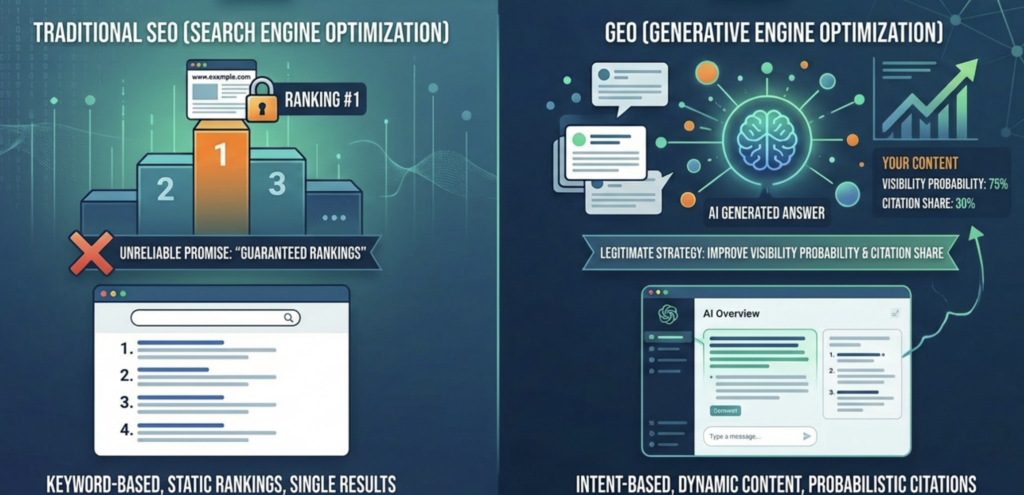
First, any tool that “guarantees” AI rankings. AI responses are stochastic by nature — context-dependent and dynamic. No platform can lock a position in ChatGPT or AI Overviews. What legitimate tools offer is visibility probability and citation share trends.
Second, no source-level citation data. If a tool tells you your brand was “mentioned” but can’t identify which URL the AI pulled from, you can’t execute. AEO optimization happens at the content and source level. Without that, you’re guessing.
Third, blurred terminology. Tools that use “prompt” and “keyword” interchangeably, or can’t distinguish between AEO and GEO technically, will struggle to hold up under client scrutiny.
Fourth, no entity analysis. AI engines understand the world through entities and relationships. A platform that only tracks page performance without Schema validation or knowledge graph monitoring is leaving out half the picture.
Fifth, per-seat pricing. If your internal team can’t grow without your tool costs spiking, the unit economics don’t work for agencies. Look for prompt-based or analysis-volume pricing, or an agency bundle with unlimited seats.
The 7 Best AEO Tools Agencies Are Using in 2026
Here’s the full comparison before the detail:
| Tool | Multi-Client Support | AI Platform Coverage | White-Label Reporting | Starting Price | Agency Edge |
|---|---|---|---|---|---|
| Topify | Dedicated agency mode, multi-tenant | All major LLMs + regional models | High, custom heatmaps and radar charts | $99/mo | URL-level source analysis + one-click GEO execution |
| Profound | Sandbox environments + sub-billing | 10+ engines, query fanout analysis | Enterprise-grade, compliance audits | $99–$399+/mo | HIPAA/SOC 2 compliance, identity journey simulation |
| AIclicks | Partner mode, revenue share | ChatGPT, Gemini, Perplexity, Claude | Standard, sentiment-focused | $79/mo | Native AI data accuracy, citation-level sentiment |
| SE Ranking | Agency Pack, unlimited users | Core LLMs + traditional search | Mature white-label system | $129+/mo | SEO and AEO data in one stack |
| Writesonic GEO | Pro/Enterprise multi-account | Content-production model coverage | Mid, focused on content suggestions | $199/mo | Real-time GEO scoring before publish |
| Vismore | Grid UI for multi-site management | 6+ major platforms | Mid, growth task progress | Custom | Action Center, citation gap automation |
| AthenaHQ | Agency-specific reporting workflows | 8+ platforms including Grok, Meta AI | High, ROI and attribution | $295/mo | Cross-modal optimization, GA4 conversion attribution |
Topify: The Closest Thing to an Agency Operating System
Topify is the platform agencies reference most often when talking about full-cycle AEO management, and the reason is structural: it connects measurement to execution in a single workflow rather than requiring a separate content tool or analyst layer to bridge the gap.
For agencies, the architecture matters. Topify supports multi-brand configurations with fast client context switching, which means your team isn’t rebuilding prompt sets and competitor lists every time they open a new account. The platform runs across all major AI platforms — ChatGPT, Gemini, Perplexity, DeepSeek, and others — which gives you a defensible cross-platform story when clients ask why their Perplexity visibility looks different from their ChatGPT numbers.
Two capabilities stand out in agency workflows specifically.
Source analysis at the URL level. Topify doesn’t just tell you your brand was cited — it tells you which domain the AI pulled from, whether that was a Reddit thread, a G2 review, or a third-party media piece. That’s the data you need to run a citation gap analysis and tell a client exactly where to build authority next. Most tools stop at the mention level. That’s not enough to execute.
CVR (Conversion Visibility Rate). This is Topify’s model for estimating which AI mentions are most likely to drive downstream intent — not just awareness. For an agency trying to tie AEO work to pipeline, this is what turns a monthly report from a visibility scorecard into a revenue attribution conversation. The difference between “your brand was mentioned 45% of the time in relevant prompts” and “that mention pattern correlates with an 8% lift in assisted revenue” is the difference between an AEO line item and a retained AEO budget.
Pricing starts at $99/month for the Basic plan, which covers 100 prompts and 4 projects. The Pro plan at $199/month scales to 250 prompts and 10 seats. Agencies running larger client portfolios typically move toward the Enterprise tier starting at $499/month.
Profound: Built for Regulated Industries and Enterprise Scrutiny
Profound is the default recommendation when an agency’s client base includes healthcare, financial services, or any sector where data handling needs to survive a legal review. Its SOC 2 Type II and HIPAA compliance certifications aren’t marketing copy — they’re the reason it gets approved where other tools don’t.
Beyond compliance, Profound’s “query fanout” analysis gives agencies a structural view of how AI engines reason through a question before generating an answer. That’s useful when you’re trying to understand why a competitor is being cited and you aren’t. It covers 10+ AI engines and supports an “Agency Mode” with complex client workspace management and audit reports formatted for sales proposals. Pricing sits at the higher end at $99–$399+/month.
AIclicks: Native AI Data and Strong Partner Economics
AIclicks was built for the AI search era rather than adapted from traditional SEO, which shows in its data accuracy. It provides 360-degree coverage across ChatGPT, Perplexity, Gemini, and Claude with citation-level sentiment analysis — meaning it can tell you not just that a source was cited, but whether the framing around your brand was positive, neutral, or pulling in the wrong direction.
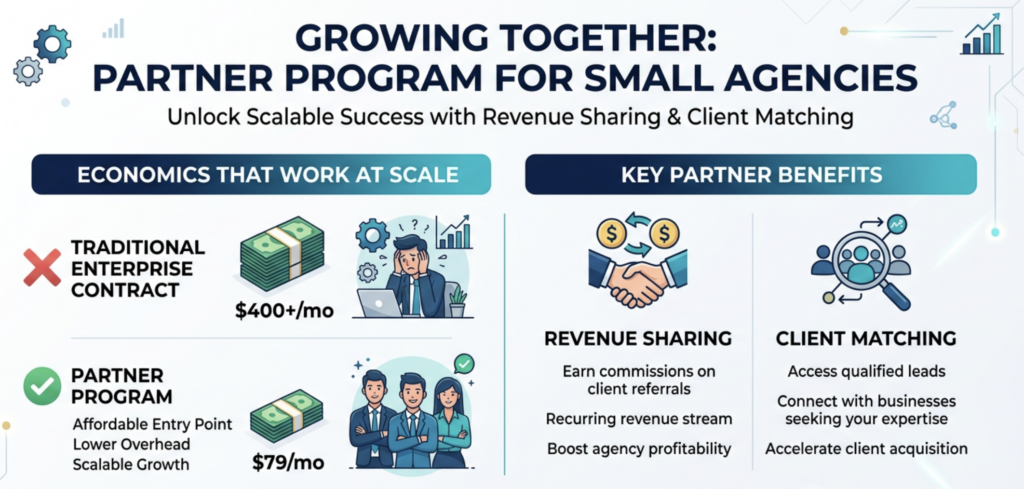
For smaller agencies, the partner program is worth a close look. Revenue sharing and client matching arrangements make the economics work at scales where a $400/month enterprise contract would be hard to justify. Starts at $79/month.
SE Ranking: For Agencies That Don’t Want to Abandon Their SEO Stack
The strongest argument for SE Ranking is practical: if your team already runs traditional SEO out of it, adding AI visibility tracking through its AI Search module doesn’t require a workflow rebuild. The Agency Pack includes unlimited users and a mature white-label reporting system — two checkboxes that matter for scaling.
The cross-analysis between historical keyword data and AI visibility data is genuinely useful for identifying where traditional search rankings and AI recommendations diverge. For clients in competitive categories, those divergence points often reveal either a threat or an opportunity that neither channel surfaces on its own. Starts at $129/month plus add-ons.
Writesonic GEO: When Your Agency Also Produces the Content
Writesonic’s GEO module doesn’t just generate content — it scores it against AI adoption probability before you publish. The “real-time GEO checker” estimates how likely a piece is to be cited by ChatGPT or Perplexity based on structural and semantic signals.
For agencies running content production alongside visibility tracking, this collapses a two-step process into one. It’s less strong on deep visibility monitoring, but for the production side of AEO — getting content into a format AI engines actually extract — it’s the most focused tool in this group. Starts at $199/month.
Vismore: Action-Oriented for Agencies Focused on Throughput
Vismore’s “Action Center” is its core differentiator. Rather than leaving you to interpret a dashboard and decide what to optimize, it surfaces specific recommendations: which prompts need content attention this week, which competitor is gaining citation share and why.
The grid-based UI is designed for managing hundreds of pages or clients simultaneously — closer to a spreadsheet mental model than a traditional analytics dashboard. For agencies that measure success by weekly optimization cadence rather than monthly reporting cycles, Vismore’s workflow logic fits well.
AthenaHQ: The ROI-Focused Option for Conversion-Driven Agencies
AthenaHQ stands apart on two dimensions. First, it covers cross-modal optimization — as AI search begins pulling video clips and images alongside text, AthenaHQ tracks visibility across formats. Second, its GA4 integration connects AI-surface click-throughs to actual on-site conversion behavior, which supports the kind of detailed attribution analysis that performance-focused clients expect. Starts at $295/month.
How Topify Fits Into an Agency’s Day-to-Day Workflow
The operational value of Topify isn’t one feature — it’s where it fits across the full client lifecycle.
Within 48 hours of onboarding a new client, an agency can run an automated GEO diagnostic from a single URL input. Topify scans across 200+ high-value prompts and generates a baseline report that includes “citation blind spots” — specific prompt scenarios where a competitor is being cited and the client isn’t. That’s the kind of concrete, immediate finding that sets the tone for the engagement.
In day-to-day operations, Topify’s dynamic competitor benchmarking runs continuously. When a new competitor appears in ChatGPT responses for a key prompt category, the platform flags it and surfaces the likely cause — whether that’s a new Reddit thread gaining traction or a schema update on a competitor’s page. That loop is what keeps citation share from eroding without anyone noticing until the quarterly review.
At the reporting stage, the white-label output combines visibility trends, source analysis, and CVR signals in a format that can carry a client meeting without supplemental slides. When an agency can show a CMO that the brand’s recommendation rate moved from 12% to 45% in targeted prompts, and connect that to an 8% lift in assisted revenue, AEO stops being a line item and starts being a budget priority.
Conclusion
The agencies pulling away from the pack in 2026 aren’t the ones with the best content strategy. They’re the ones who built measurement infrastructure early and can now show clients exactly where they stand in AI-generated answers — and exactly what to do about it.
That requires tools built for agency scale: multi-client architecture, source-level citation data, white-label reporting that holds up in a boardroom, and metrics that connect AI visibility to revenue.
Topify covers most of that stack. Complement it with Writesonic for content production and SE Ranking for cross-channel SEO alignment, and you have a workflow that can grow with your client base without the operational overhead multiplying at the same rate.
The shift from “SEO agency” to “AI brand visibility advisor” is already underway. The tool selection decision is less about features and more about which infrastructure you want to be building on for the next three years.
FAQ
What’s the difference between AEO and GEO?
AEO focuses on making information extractable — structured, factual answers that voice assistants or featured snippets can surface directly. GEO focuses on synthesis and trust: getting an LLM to include your brand as one of several cited sources while building positive sentiment associations. For agencies, AEO is the foundation. GEO is the brand reputation layer built on top of it.
Can one tool handle all your clients’ AEO needs?
Platforms like Topify or Profound cover the majority of use cases. In practice, agencies tend to run a “1+N” model: one core visibility tracking platform paired with a content production tool like Writesonic and an existing SEO audit stack like SE Ranking. The combination gives you the broadest data coverage and execution depth without redundancy.
How should agencies price AEO services?
The current range for a monthly AI visibility monitoring and reporting package is roughly $1,500 to $3,000 as an SEO add-on. Full-stack GEO strategy — covering content restructuring, schema deployment, cross-modal optimization, and citation building — typically runs $5,000 to $15,000 per month as a retainer. More sophisticated agencies are building performance bonuses tied to citation share growth or AI-referred pipeline.
Which AI platforms should agencies be tracking in 2026?
At minimum: ChatGPT (highest query volume, broadest use case coverage), Perplexity (highest citation density, preferred by research-oriented users), Google AI Overviews (carries over traditional search traffic), and Claude (strong in B2B and professional services content). Vertical additions depend on client profile — Grok for social-adjacent categories, DeepSeek for regional markets.

