

Your brand ranks on the first page of Google. Your content team has been publishing for years. Your domain authority is solid.
Then someone opens ChatGPT and asks, “What’s the best tool for [your category]?” and gets a confident, four-paragraph answer, complete with three recommended brands. Yours isn’t one of them.
That gap, between where you rank on Google and where you appear in AI answers, is what AI visibility platforms are built to close. And right now, most brands don’t even know the gap exists.
Your Google Rankings Don’t Tell You What AI Is Saying About You
Here’s the uncomfortable truth: only 12% of citations in AI-generated answers overlap with the top 10 results in traditional organic search. That means nearly nine out of ten brands that dominate Google rankings are invisible inside the AI answer.
The reason is structural. Google crawls pages and ranks them in a list. AI engines like ChatGPT, Gemini, and Perplexity don’t return a list. They synthesize sources into a direct narrative answer. That changes everything about what “visibility” means.
Traditional SEO tools were built to track your position in a list. They can’t tell you whether Perplexity is recommending your competitor or whether Gemini is describing your product accurately. That’s a different data problem entirely.
And it’s growing fast. Gartner projects a 25% drop in traditional search volume by 2026 as users migrate to AI-powered interfaces. For brands unprepared for that shift, the estimated traffic loss from traditional channels ranges from 20% to 50%.
What Is an AI Visibility Platform, Exactly?
An AI visibility platform (AIVP) is a specialized intelligence tool that tracks, measures, and optimizes how often and how accurately a brand is mentioned, cited, or recommended in the narrative responses generated by AI search engines and large language models.
Think of it as a monitoring layer for a world where users don’t click, they consume answers.
Where a traditional SEO tool tracks your rank on a results page, an AI visibility platform tracks your presence inside the synthesized paragraph. The metrics are different too. Instead of tracking click-through rate and keyword position, you’re tracking citation rate, sentiment score, and share of voice within AI-generated narratives.
| Dimension | Traditional SEO Tools | AI Visibility Platforms |
|---|---|---|
| Primary target | Search Engine Results Page | AI-generated narratives |
| Core mechanism | Page ranking (1-100) | Citation and mention influence |
| Data sources | Keyword volume, backlinks | Prompts, RAG retrieval, training data |
| Key metrics | CTR, organic traffic, keyword position | Citation rate, sentiment, share of voice |
| User behavior | Click-through to website | Zero-click information consumption |
Most AIVPs perform four core functions: visibility tracking across AI platforms, sentiment and narrative analysis of how the AI describes your brand, competitor monitoring to benchmark your share of voice, and source attribution to identify which third-party URLs the AI is pulling to form its answers.
How an AI Visibility Platform Actually Works
To understand what these platforms measure, it helps to understand how AI search engines generate their answers.
Modern AI search engines like Perplexity and ChatGPT operate through a process called Retrieval-Augmented Generation (RAG). When you submit a prompt, the engine doesn’t recall an answer from static memory. It runs sub-queries across a live index, retrieves and scores relevant content chunks, then synthesizes those chunks into a narrative response with citations.
The critical factor is what researchers call “extractability”: the ability of your content to be cleanly chunked and incorporated into that narrative. Content that is promotional, verbose, or buried in complex scripts tends to be skipped. Concise, structured text with clear factual claims tends to win.
What makes this harder is that each AI engine has different citation behaviors. Google Gemini pulls brand-owned websites for over 52% of its citations, rewarding strong E-E-A-T signals. Claude cites user-generated content and reviews at two to ten times the rate of other models, meaning your Reddit presence matters as much as your blog. Perplexity favors well-structured pages with clear factual claims and niche expertise.
An AI visibility platform runs systematic prompts across all these engines, collects the generated responses, extracts brand mentions and citations, and feeds the results into a structured dashboard. The output is a set of metrics your team can actually act on.
5 Things You Can Actually Measure with an AI Visibility Platform
The best platforms in this category turn AI answers into structured data. Here’s what that looks like in practice.
Visibility Rate is the percentage of tracked prompts where your brand appears in the AI response. Research suggests that mature brands typically target a rate above 30% for their core prompt sets. If you’re below that, the AI isn’t finding you credible enough to cite.
Sentiment Score measures how the AI describes you, not just whether it mentions you. An AI might cite your brand frequently while characterizing your product as “a budget option” or “missing enterprise features.” A sentiment score above 70% positive is generally the baseline to protect.
Position Ranking tracks where in the narrative your brand appears. Being cited first carries meaningful weight, even without a click. AI users tend to treat the first-mentioned brand as the implicit recommendation.
Source Attribution tells you which third-party domains the AI is using to form its narrative about your brand. This reveals whether your story is being shaped by your own site, by a G2 review from 2022, or by a Reddit thread you’ve never read.
CVR (Conversion Visibility Rate) connects the loop to revenue. AI-referred traffic converts at 4.4 times the rate of traditional organic traffic because the AI acts as a pre-filtering mechanism. Users who arrive from an AI recommendation have already been “sold” on the category. Being cited isn’t just a visibility win. It’s a conversion advantage.
When AI SEO Hits a Wall: Common Mistakes Brands Make
Most brands that start tracking AI visibility make the same four errors.
The first is what researchers call “ChatGPT-only verification.” A marketing manager opens ChatGPT, searches for their brand, and assumes that result is representative. It isn’t. Only 30% of brands maintain consistent visibility from one AI response to the next, because AI outputs are non-deterministic. What you see in one session may differ from what a customer sees in the next. And Gemini, Perplexity, and Claude often reach completely different conclusions about the same brand.
The second mistake is treating visibility data as a vanity metric. Knowing your citation share is low is only useful if it connects to a specific action: identifying which third-party sources are driving competitor citations, and building content that earns a place in those same sources.
The third error is optimizing only for brand-name queries. AI users don’t ask “What is [your brand]?” They ask scenario-based questions: “Best CRM for a remote sales team,” “Which project management tool works offline?” These “dark queries” often carry zero traditional search volume, but they’re where actual purchase decisions happen. Brands that focus exclusively on branded terms miss these high-intent moments entirely.
The fourth mistake is treating AI visibility as a one-time audit rather than an ongoing channel. AI citation patterns shift weekly as models retrain or update their retrieval layers. A snapshot from three months ago is already stale.
How Topify Turns AI Visibility Data Into Action
Most AI visibility platforms stop at data. Topify is designed to close the loop between insight and execution.
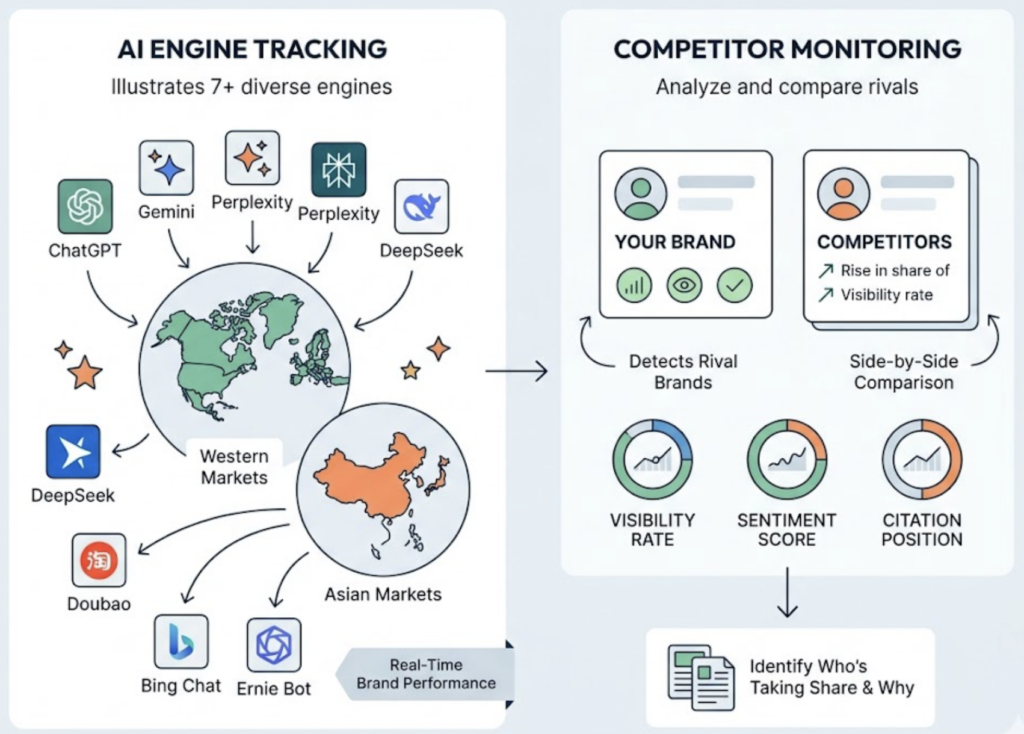
The platform tracks brand performance across 7+ AI engines in real time, including ChatGPT, Gemini, Perplexity, DeepSeek, and Doubao, covering both Western and Asian markets where enterprise brands increasingly operate. For marketing teams managing multiple product lines or geographies, this breadth of coverage matters.
The competitor monitoring layer automatically detects which rival brands are being recommended across the same prompt sets, then surfaces a side-by-side comparison of visibility rate, sentiment score, and citation position. In practice, this means you can see not just that you’re losing share of voice, but exactly which competitors are taking it, and which sources are being used to justify those citations.
Source analysis goes a level deeper. Topify reverse-tracks which third-party URLs the AI platforms are citing when they recommend a competitor, revealing specific content gaps: the G2 page you haven’t updated, the industry publication that keeps citing your rival, the FAQ structure that’s easier for AI engines to extract than your own.
What sets the platform apart for teams that don’t have a dedicated GEO strategist is the one-click execution layer. Rather than delivering a report that sits in a shared drive, Topify translates analytical findings into actionable GEO tasks and deploys them without requiring manual workflows. You define the goal, the system handles the execution.
Topify is trusted by 50+ enterprises and startups, and pricing starts at $99 per month for the Basic plan, which covers 100 prompts across 4 major AI platforms with daily refreshes, enough to establish a credible baseline for most scaling brands.
| Plan | Price | Best For |
|---|---|---|
| Basic | $99/mo | Scaling brands, 100 prompts, 4 AI platforms |
| Pro | $199/mo | Agencies, 250 prompts, 8 projects |
| Enterprise | $499+/mo | Enterprise teams, API access, dedicated strategist |
How to Choose the Right AI Search Intelligence Tool for Your Team
The AIVP market is growing fast enough that the selection criteria matter more than brand names. Here’s a practical checklist before you commit budget.
Platform coverage. A tool that only monitors ChatGPT gives you a partial picture. Gemini, Perplexity, and Claude have meaningfully different citation behaviors. Look for at least five major models covered, with bonus points for DeepSeek and Grok as emerging platforms gain traction.
Update frequency. AI citation patterns can shift in a matter of weeks. Monthly snapshots are close to useless for active optimization. Daily or weekly refresh rates are the baseline for teams that want to act on data rather than just report it.
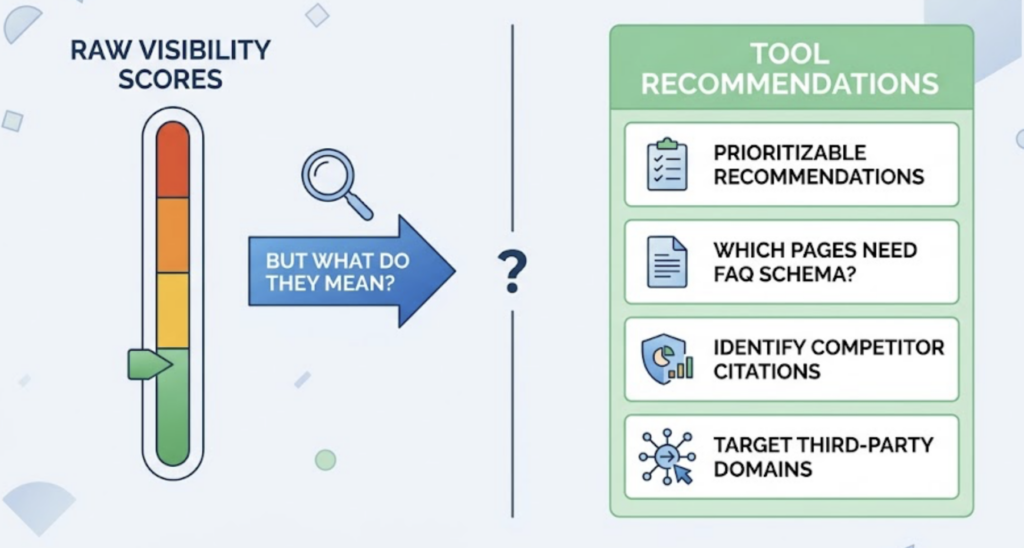
Path from data to action. Raw visibility scores don’t tell your content team what to do. The best tools surface specific, prioritizable recommendations: which pages need FAQ schema, which dark queries are driving competitor citations, which third-party domains you should be targeting for coverage.
Pricing model predictability. Some platforms charge per prompt, which makes budgeting unpredictable at scale. Flat-rate or tiered seat-based pricing is generally easier to plan around, especially for agencies managing multiple client brands.
A few other platforms worth knowing about: Profound targets enterprise teams at higher price points with strong compliance features. LLMrefs uses weighted statistical rankings to reduce noise from AI output volatility. AppearOnAI offers a low-cost entry point for one-time visibility audits.
The honest trade-off is that most tools built for enterprise scale don’t offer the execution layer that makes data actionable for in-house teams. That gap is where platforms like Topify tend to differentiate.
Conclusion
Google visibility and AI visibility are no longer the same thing. They measure different phenomena, they’re tracked by different tools, and they’re influenced by different factors. A brand can be number one on Google and functionally invisible to the AI engines that more than 50% of consumers now use for information and purchase research.
The brands that are moving now are doing three things: establishing a baseline across multiple AI platforms, identifying specific prompt sets where they’re losing share of voice to competitors, and restructuring content to be more extractable for AI synthesis. None of this requires a complete overhaul of your existing SEO strategy. It requires adding a measurement layer that traditional tools simply aren’t built to provide.
Get started with Topify to run a baseline audit and see exactly where your brand stands across the AI engines your customers are already using.
FAQ
Q: What is an AI visibility platform? A: An AI visibility platform is a marketing technology that tracks, measures, and optimizes how often and how accurately your brand is mentioned or recommended in the narrative responses generated by AI search engines like ChatGPT, Gemini, and Perplexity. Unlike traditional SEO tools that track page rankings, these platforms track citation rate, sentiment, and share of voice within AI-generated answers.
Q: How is an AI visibility platform different from traditional SEO tools like Semrush or Ahrefs? A: Traditional SEO tools track your position in a list of search results. AI visibility platforms track your presence inside the synthesized paragraph that AI engines generate. The metrics are fundamentally different: SEO tracks rank and click-through rate, while AI visibility platforms track how often you’re cited, how the AI describes you, and how you stack up against competitors within the same prompt set.
Q: How do I measure my brand’s AI search visibility? A: Measurement typically involves running a set of scenario-based prompts across multiple AI platforms and analyzing the responses for brand mentions, sentiment, and citation position. Platforms like Topify automate this by providing a structured Visibility Score based on systematic prompt tracking across 7+ AI engines, so you’re not relying on manual, non-deterministic spot-checks.
Q: What’s a realistic budget for an AI visibility platform? A: It depends on scale. Brands just getting started can establish a baseline with tools like Topify at $99 per month. Mid-market teams and agencies typically work within the $199 to $499 range. Enterprise teams managing hundreds of prompts across multiple brands or geographies tend to invest $499 to $1,500 per month for deeper analytics, API access, and strategic support.

