

Your domain authority is 72. You’re ranking on page one for a dozen commercial keywords. Monthly organic traffic is trending up. Then a potential customer opens Perplexity, types a 60-word question about your product category, and gets a detailed recommendation that doesn’t include your brand once.
Traditional SEO metrics can’t detect that gap. They weren’t built to.
Your Rankings Are Solid. Your AI Search Visibility Might Not Be.
31% of Gen Z consumers now start their search queries on AI platforms rather than traditional engines. That number is growing. And the queries they’re running look nothing like what Google was built for. The average Google search is 3.4 words. The average ChatGPT prompt in 2026 is approximately 60 words, with context, constraints, and nuance that requires a synthesized answer, not a list of links.
The result is a quiet redistribution of buyer intent. Google still handles the majority of queries. But the “discovery” and “research” phases of the buyer journey, the moments that shape brand consideration, are increasingly happening on answer engines.
That’s the part traditional AI SEO dashboards miss entirely.
What “AI SEO” Actually Means (and What It Doesn’t)
AI SEO is the practice of optimizing your brand’s presence in AI-generated answers across platforms like ChatGPT, Gemini, Perplexity, and DeepSeek. It’s not a replacement for traditional SEO. It’s a separate discipline with a different unit of success.
In classic search, you win by getting a URL into the top ten results. In AI search, there are no “results” in that sense. The model synthesizes an answer and either includes your brand or doesn’t. The shift is from ranking to recognition.
The formal framework for this is called Generative Engine Optimization (GEO), first defined by researchers at Princeton, Georgia Tech, and IIT Delhi in late 2023. It focuses on making content citable by language models, not just crawlable by bots. The core logic is simple: AI models don’t rank pages. They extract “chunks” of information that are factually dense, structurally clear, and semantically matched to the user’s intent. Page authority has been replaced by what researchers call “Chunk Authority.”
| Traditional SEO | AI Search Optimization |
|---|---|
| Focus on keyword phrases | Focus on topical comprehensiveness |
| Measure position rankings (1-10) | Measure citation frequency and presence rate |
| Trust signal: link volume / PageRank | Trust signal: entity consistency / corroboration |
| Outcome: capture a user’s click | Outcome: capture a machine’s citation |
The 5 Metrics That Actually Matter in AI Search Analytics
Tracking “rank” doesn’t translate to AI search. The performance metrics have been rebuilt from scratch.
AI Visibility Score is a composite index (typically 0-100) that blends mention rate, citation quality, and prominence within generated responses. This is your baseline. Without it, you’re navigating blind.
Citation Rate measures how often AI platforms attribute information directly to your domain. A high visibility score with a low citation rate is a red flag: the model knows of you but doesn’t trust your content as primary evidence.
Share of Voice (SOV) puts your AI search performance in competitive context. It compares your mentions against your top competitors across 100+ representative prompts. This is where brand gaps become visible.
Sentiment Framing tracks the tone and adjectives AI uses to describe your brand. Words like “reliable” or “leading” build what researchers call “probabilistic confidence,” making the model more likely to cite you in subsequent runs. Negative or vague framing compounds over time.
AI Search Volume tells you how often real users are prompting about your category across AI platforms. This is the demand signal that traditional keyword tools can’t capture.
Together, these five metrics form the core of AI search intelligence. Platforms like Topify track all of them in a unified dashboard, alongside position tracking and conversion visibility rate (CVR), giving teams a complete picture instead of scattered data points.
Why Brand Vulnerability Is AI SEO’s Biggest Blind Spot
Here’s the finding that tends to stop marketing teams cold: 62% of enterprise brands are effectively invisible to generative models, according to research from Fuel Online in early 2026. Of those invisible brands, 94% had strong traditional SEO foundations.
Strong Google rankings don’t transfer to AI search visibility. The two systems operate on different trust logic.
This is what practitioners call “GEO brand vulnerability”: the specific prompts and topic clusters where your competitors are being recommended and you’re absent. It’s not a single problem. It’s a map of gaps. A brand might have solid AI visibility for its core category but zero presence in adjacent queries that feed buyer intent earlier in the funnel.
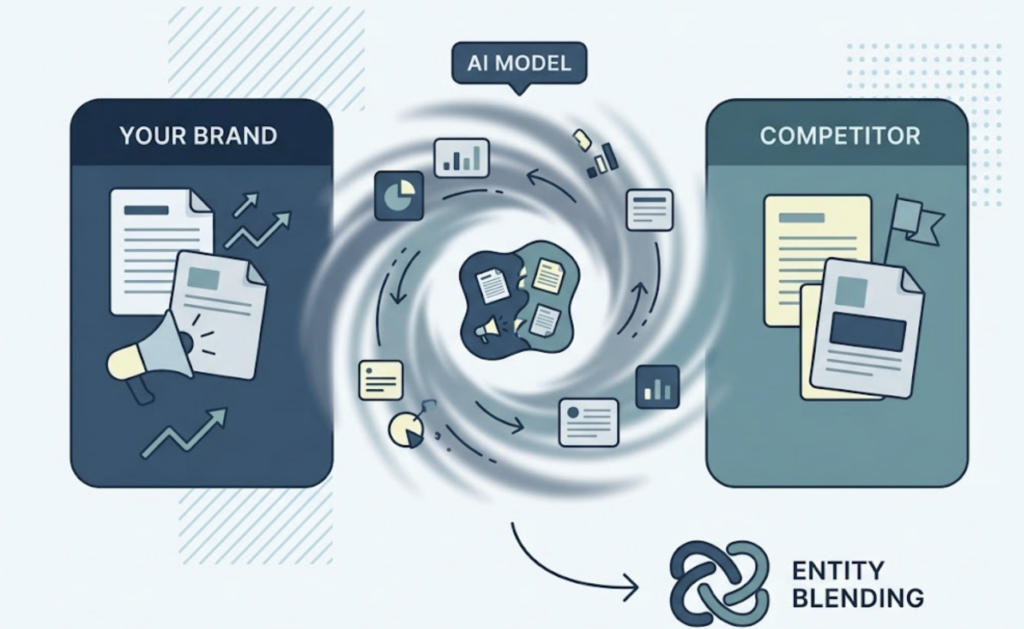
The causes are varied. Some brands suffer from what researchers call “entity blending,” where inconsistent information across the web causes models to merge your brand with a similarly named competitor. Others hit the “PR-AI disconnect”: a major feature in a top publication goes unrecognized because that site has blocked AI crawlers via robots.txt, so the model never learns about the win. The brand’s actual authority grows while its perceived authority in the AI layer stagnates.
The fix isn’t just more content. Brands mentioned in 15 credible external sources are cited 6.5 times more frequently by AI than those relying solely on their own domain. Source diversity matters more than domain authority in this new context.
Identifying vulnerability requires prompt-level visibility data. You need to know which specific queries return competitors, not you, and how that distribution compares across ChatGPT, Gemini, and Perplexity. That’s where AI search optimization GEO brand vulnerability platforms come in: they automate the discovery process across hundreds of prompts that no team can manually track at scale.
How to Build an AI Search Optimization Strategy That Moves Numbers
The GEO research from Princeton and IIT Delhi gives a clear, empirical starting point. Across 10,000+ analyzed queries, specific content changes produced measurable citation gains:
- Adding quotations from credible sources: +41% visibility boost
- Adding statistics with source attribution: +35-40%
- Citing external sources within the content: +30-40%
- Content updated within the last 60 days: 1.9x more likely to be cited by RAG systems
These are not design choices. They’re structural changes to how information is packaged.
In practice, a working AI SEO strategy runs on three steps.
Audit first. Before optimizing anything, establish your current AI visibility baseline across the platforms your audience uses. Track your brand against the 20-30 prompts most relevant to your category. This gives you a “Visibility Score” to measure against, not just impressions and clicks.
Find the vulnerability gaps. Cross-reference your visibility data with AI search volume for those prompts. High-volume prompts where your brand scores zero are your highest-priority targets. These are the “existence gaps” where competitors are capturing consideration that should include you.
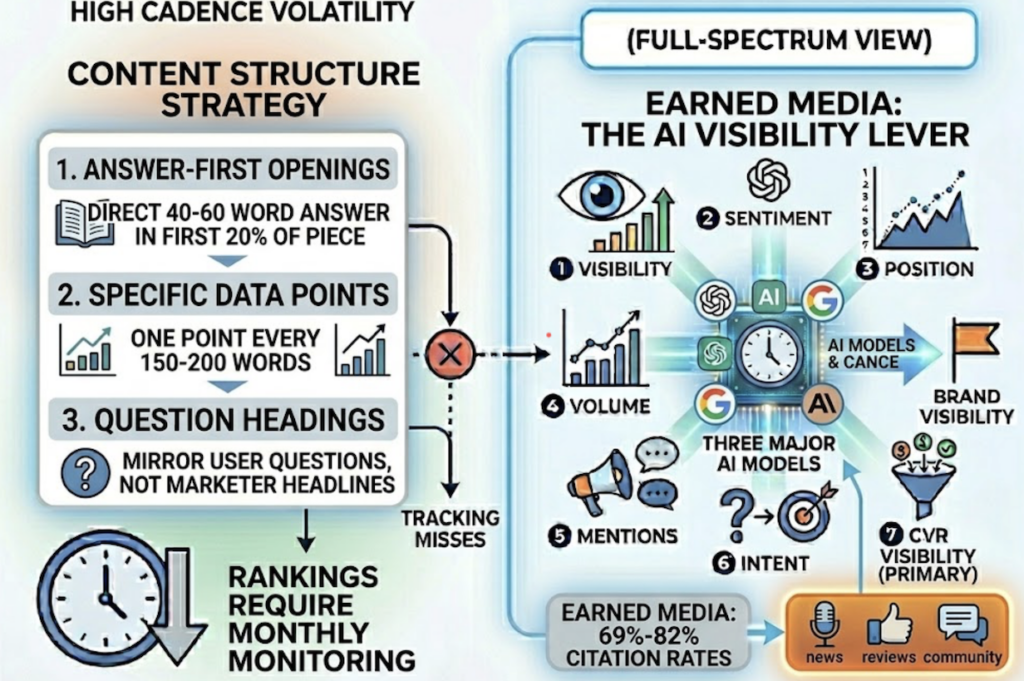
Optimize for machine extraction. Structure content with answer-first openings (a direct 40-60 word answer in the first 20% of the piece), one specific data point every 150-200 words, and headings that mirror how users ask questions, not how marketers write headlines. AI platforms cite earned media (third-party reviews, news coverage, community discussions) at rates between 69% and 82%, which means outbound content strategy is now a core AI visibility lever.
Topify’s One-Click Execution takes this framework and automates the execution layer. You define your goals, review the proposed strategy, and deploy. The platform handles prompt discovery, competitor benchmarking, and source gap analysis continuously, so the strategy stays current as AI recommendation patterns shift.
What an AI Visibility Platform Does That Spreadsheets Can’t
Many teams start their AI SEO audit the same way: manually searching their brand and competitors on ChatGPT, copying the outputs into a spreadsheet, and trying to spot patterns. It’s a reasonable first step. It doesn’t scale past the first month.
AI answers are non-deterministic. Ask the same question twice and you get different results. A single snapshot is not a trend. And a spreadsheet tracking five platforms, 30 prompts, and 4 competitors generates data volume that quickly outpaces manual analysis.
An AI visibility platform solves three specific problems that spreadsheets can’t. First, coverage: tracking brand performance across ChatGPT, Gemini, Perplexity, DeepSeek, and others simultaneously, not sequentially. Second, frequency: running queries at regular intervals to detect shifts in AI recommendation patterns before they compound into lost share. Third, structure: converting unstructured AI outputs into comparable metrics, so a drop in Perplexity sentiment can be traced back to a specific source domain that stopped citing your brand.
Topify covers all major AI platforms including ChatGPT, Gemini, Perplexity, DeepSeek, Doubao, and Qwen, tracking seven performance dimensions per query. The Basic plan starts at $99/month, which includes 100 prompts and 9,000 AI answer analyses across 4 projects. For teams managing multiple brands or client portfolios, the Pro plan at $199/month scales to 250 prompts and 22,500 analyses. The platform was built by founding researchers from OpenAI and Google SEO practitioners, which shows in the depth of the citation analysis layer, specifically the ability to identify which source domains are driving competitor visibility and how to displace them.
Bottom line: if you’re serious about AI brand visibility, you need data at a cadence and scale that manual tracking can’t provide. The platform cost is the easy part. The alternative is not knowing where you stand while competitors are actively building AI search consensus.
Conclusion
Traditional SEO is still necessary. Technical health, crawlability, and backlink authority remain the foundation. But they only tell half the story now, and it’s the easier half to measure.
The other half is whether AI systems recognize your brand, trust your content, and include you in the answers that increasingly shape buying decisions before a user ever visits your website. That half requires different metrics, different content strategies, and tools built specifically for how AI search works.
Start with an AI visibility audit. Find where your brand has zero presence in high-intent prompts. Fix the source gaps and content structure issues that create that absence. Then measure the shift in visibility score, citation rate, and share of voice over 60 to 90 days. The data from AI-referred traffic is clear: visitors from ChatGPT and Perplexity spend 68% more time on site and convert at 4.4 times the rate of standard organic visitors. The audience being shaped by AI search is worth reaching. The question is whether your brand shows up when they ask.
FAQ
Q: What is the difference between SEO and AI SEO?
A: Traditional SEO optimizes web pages to rank in Google’s link-based results. AI SEO, often called Generative Engine Optimization (GEO), focuses on making your brand visible and citable within AI-generated answers on platforms like ChatGPT, Perplexity, and Gemini. The core difference is the unit of success: SEO targets a position in a ranked list; AI SEO targets inclusion in a synthesized answer. Both disciplines are necessary in 2026, but they require different content strategies and measurement frameworks.
Q: How do I know if my brand has AI search visibility gaps?
A: The most direct method is a prompt-level visibility audit. Run the 20-30 queries most relevant to your category on ChatGPT, Perplexity, and Gemini, and record whether your brand is mentioned, how prominently, and what competitors appear instead. Platforms like Topify automate this process at scale across hundreds of prompts and multiple AI engines, making it possible to identify GEO brand vulnerability patterns that manual spot-checks would miss.
Q: Which AI platforms should I prioritize for AI SEO?
A: By early 2026, ChatGPT holds approximately 60-68% of AI search market share, making it the highest-priority platform for most brands. Google Gemini has grown to 15-21% and is particularly important for mobile and productivity users. Perplexity (2-6.6%) punches above its weight for high-intent research queries, especially among high-income and academic users. If your audience skews toward enterprise or B2B, Microsoft Copilot’s 13-14% share is also worth tracking. The right starting point is wherever your target buyers are doing their research.
Q: Is AI SEO the same as GEO (Generative Engine Optimization)?
A: They’re closely related but not identical. GEO is the specific academic and technical framework for optimizing content to be cited by generative models, formalized by researchers at Princeton, Georgia Tech, and IIT Delhi. AI SEO is the broader practice that encompasses GEO alongside platform-specific strategies, entity management, earned media optimization, and AI visibility analytics. Think of GEO as the content architecture layer within a larger AI SEO strategy.

