

Your brand ranks on page one of Google. You’ve got the backlinks, the technical SEO, the content calendar. And yet, when someone asks ChatGPT to recommend a tool in your category, your brand doesn’t appear.
That’s not a ranking problem. That’s an AI search visibility problem.
The two have almost nothing to do with each other, and in 2026, that gap is costing brands real pipeline.
When ChatGPT Becomes the Buyer’s First Stop
Here’s what the purchase journey looks like now for a lot of B2B buyers. They don’t search “best CRM software.” They open an AI assistant and ask: “What’s a good CRM for a 12-person remote team under $200/month that integrates with Slack?”
AI doesn’t return ten blue links. It reasons through the query and recommends two or three brands by name, with specific justifications.
If your brand isn’t in that answer, you don’t exist for that buyer.
Research backs this up: over 50% of software purchase decisions now start with an AI chatbot, a figure that grew 71% in a matter of months. The AI assistant has effectively become the first filter in the sales funnel, and most marketing teams aren’t measuring what happens inside it.
Your SEO Dashboard and Your AI Performance Are Telling Different Stories
This is where things get counterintuitive.
A Princeton University GEO study found that only 12% of ChatGPT citations come directly from Google’s top-ten results. In an analysis of 7,800 queries, the overlap between traditional rankings and AI citations was strong for Google AI Overviews, but dropped sharply for ChatGPT and Perplexity. High domain authority doesn’t automatically translate into AI mentions.
The click-through rate data is equally striking. When AI summaries appear in search results, average CTR drops from 15% to 8%. About 60% of searches now end in zero clicks.
That sounds like bad news. But here’s the flip side: AI-referred visitors convert at 4.4 times the rate of traditional organic visitors. The traffic is smaller, but the intent is far higher. AI has already done the qualifying work before the user ever lands on your site.
This means the metrics you’re watching, rankings, CTR, impressions, aren’t capturing where actual buying decisions are being shaped.
What “Being Visible” in AI Search Actually Means
AI brand visibility isn’t a single number. It’s a four-part quality matrix, and each dimension tells you something different.
Inclusion rate is the baseline. It measures how often your brand appears across thousands of prompts related to your category. In competitive markets, an inclusion rate below 20% typically means you’re invisible.
Sentiment framing is what separates a mention from an endorsement. AI doesn’t just cite brands, it characterizes them. “Innovative leader in enterprise security” and “expensive legacy option” are both mentions. Only one of them drives pipeline.
Position and recommendation rate tracks whether AI lists your brand first or buries it in a footnote. Research shows about 70% of users only read the first third of an AI summary. Getting recommended versus getting mentioned in passing aren’t the same thing.
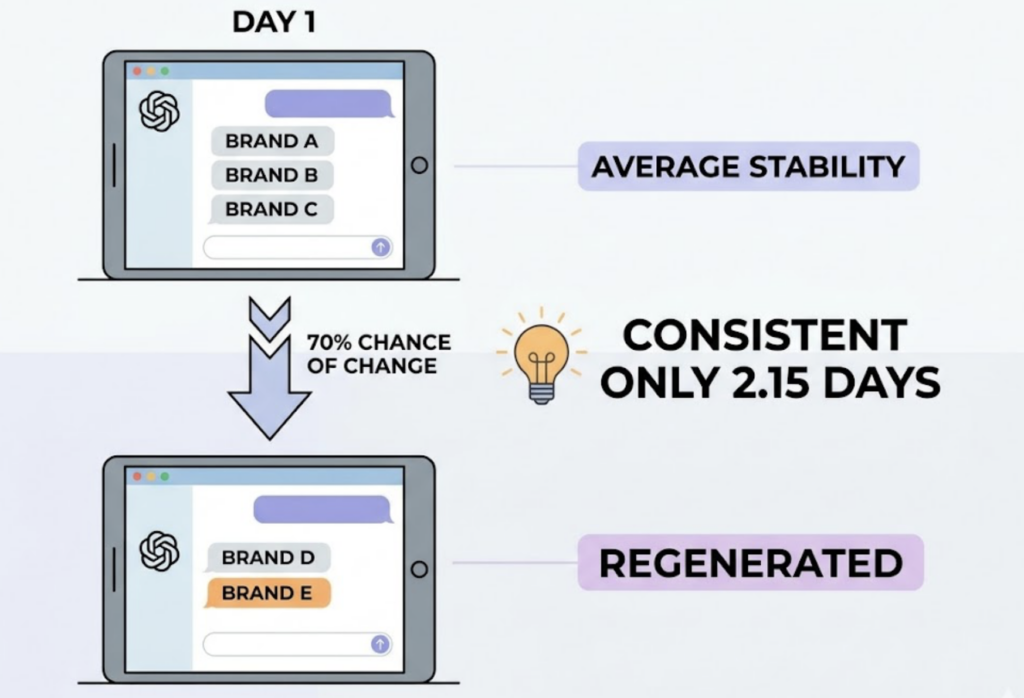
Citation attribution matters most in platforms like Perplexity and Google AI Overviews, where sources are shown explicitly. One caveat: AI-generated answers are less stable than most teams assume. About 70% of AI Overview content changes when regenerated, and the average answer stays consistent for only 2.15 days. Visibility isn’t a one-time ranking. It’s a continuous presence challenge.
Why Cross-Media Campaigns Can’t Treat AI as a Side Channel
AI search intelligence platforms reveal something that surprises most marketing teams: AI models don’t just index your website.
They pull from podcast transcripts, YouTube video captions, Reddit threads, PR coverage, and industry forums. Your “AI search visibility platforms cross media campaigns” strategy is actually a reflection of your entire digital footprint, not just your owned content.
One number makes this concrete. Reddit accounts for 46.7% of Perplexity’s citation sources. That means a brand with no community presence is structurally disadvantaged in one of the fastest-growing AI search engines, regardless of how strong its domain authority is.
The underlying logic is that AI models cross-reference information across channels to establish credibility. If your LinkedIn describes you as “enterprise-grade SaaS” and Reddit discussions position you as a tool for freelancers, that inconsistency can lower AI’s confidence in recommending you at all.
For cross-media campaigns, this changes the measurement question entirely. It’s not just “how did our paid social perform?” It’s “did this campaign shift how AI characterizes our brand across platforms?”
Also worth noting: according to Semrush data, about 68% of the terms that trigger AI Overviews have monthly search volumes below 100. The long tail isn’t a fringe case anymore. It’s where most AI-generated recommendations actually happen. Traditional campaign measurement tools aren’t built to capture this.
4 Things a Real AI Visibility Platform Has to Track
The market for AI search analytics tools is growing fast, but not all platforms measure the same things. Here’s a framework for evaluating what actually matters.
Cross-platform coverage. AI engines have different training data, different citation preferences, and different “personalities.” A brand that performs well in ChatGPT but is invisible in Gemini has a real gap, not just a reporting gap. Any credible AI visibility platform needs to track across ChatGPT, Perplexity, Gemini, and ideally emerging models like DeepSeek and Qwen. Topify covers all of these from a single dashboard, which is the baseline for meaningful AI search analytics today.
Sentiment scoring, not just mention counts. Raw mention volume without sentiment context is misleading. A platform that tracks 0-100 sentiment scoring per mention lets teams distinguish between brand presence and brand reputation. They’re often moving in opposite directions.
Competitor benchmarking. You can’t optimize AI visibility in a vacuum. You need to know whether your inclusion rate is rising because you improved, or because a competitor slipped. Topify’s competitor monitoring automatically tracks rival brands across the same prompt sets and shows you position changes in real time.
Citation source analysis. This is the layer most platforms skip. It’s not enough to know you were cited. You need to know which of your pages AI is pulling from, which domains are being cited instead of yours, and what content structure led to that citation. Topify’s source analysis maps the exact URLs AI platforms reference, so teams can identify content gaps and act on them directly.
Starting AI Search Optimization Without Rebuilding Your Stack
The most common hesitation teams express is that GEO requires a full site rebuild. In practice, it doesn’t.
The first step is auditing what AI says about you right now across 20 to 30 prompts that reflect real buyer questions in your category. This gives you a baseline inclusion rate, sentiment score, and position rank before any changes are made.
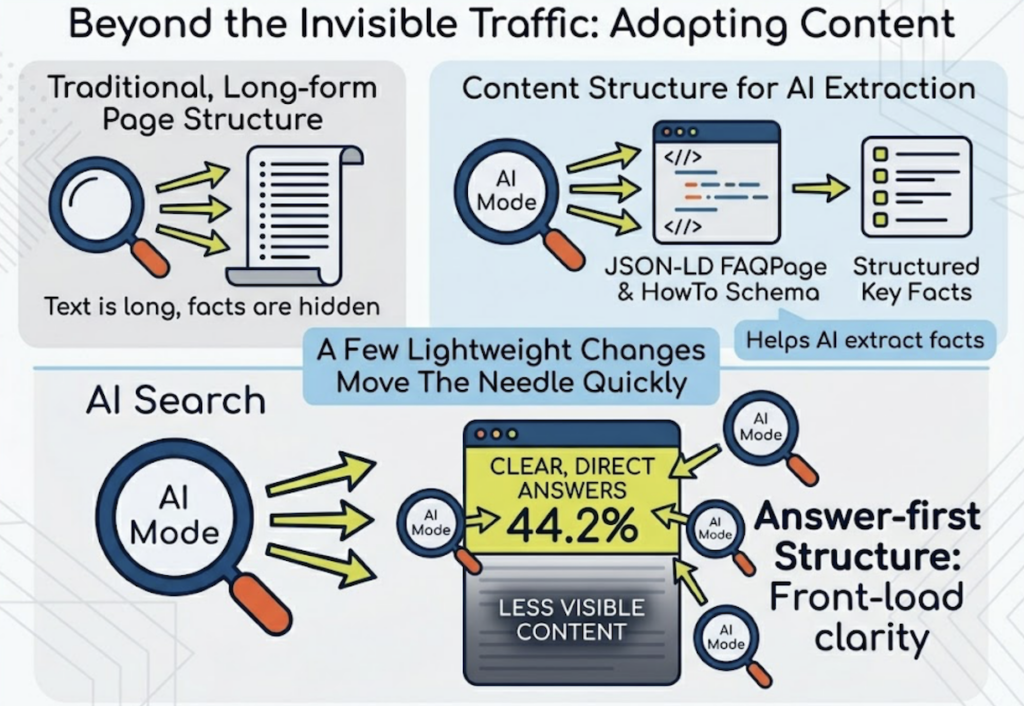
From there, a few lightweight content changes tend to move the needle quickly. Structured data (JSON-LD) for FAQPage and HowTo schemas helps AI extract key facts with minimal processing overhead. Answer-first content structure matters a lot: research shows 44.2% of ChatGPT citations come from the first third of a page, so front-loading your clearest, most direct answers pays off disproportionately.
Plain language matters more than it gets credit for. AI systems have a harder time extracting value from marketing-speak. “Empowering your future” doesn’t get cited. “A cloud-based platform for real-time inventory tracking” does.
On the platform side, Topify’s approach is worth noting here. Rather than giving generic recommendations, it identifies specific actions at the prompt level: which pages to update, what competitor content is being cited instead of yours, and what structural changes would likely shift citation behavior. The Basic plan starts at $99/month, which makes it accessible to in-house teams that aren’t ready to commit to a full agency GEO engagement.
Conclusion
Traditional SEO and AI search visibility aren’t variations of the same metric. They’re measuring fundamentally different things, and in 2026, the second one is increasingly where buyer decisions are made.
The brands that treat AI search analytics as a core growth metric today are building an advantage that compounds over time. AI models update continuously, citation behavior shifts, and competitors are figuring this out too.
The practical starting point isn’t complex. Pick 20 prompts. Run them across ChatGPT, Perplexity, and Gemini. See where your brand appears, how it’s characterized, and who’s showing up instead of you.
That audit alone will change how your team thinks about content, PR, and campaign measurement.
Read More

