

Your domain authority is solid. Your keyword rankings look healthy. But when someone asks ChatGPT for a recommendation in your category, your brand doesn’t show up. Not because your SEO is bad. Because the rules of being found have shifted, and the scoreboard you’re reading no longer tells the full story.
Here’s what makes 2026 tricky: traditional search hasn’t disappeared. Google still commands 84.17% of the U.S. search market. Total search volume, combining traditional engines and AI platforms, has actually grown 26% worldwide. The pie got bigger. But the slice that matters most to your brand may have moved to a plate you’re not watching.
AI search visibility in 2026 isn’t about replacing your SEO playbook. It’s about understanding which parts of it still apply, which parts don’t, and where the new leverage points are.
What “Visibility” Means in AI Search Now
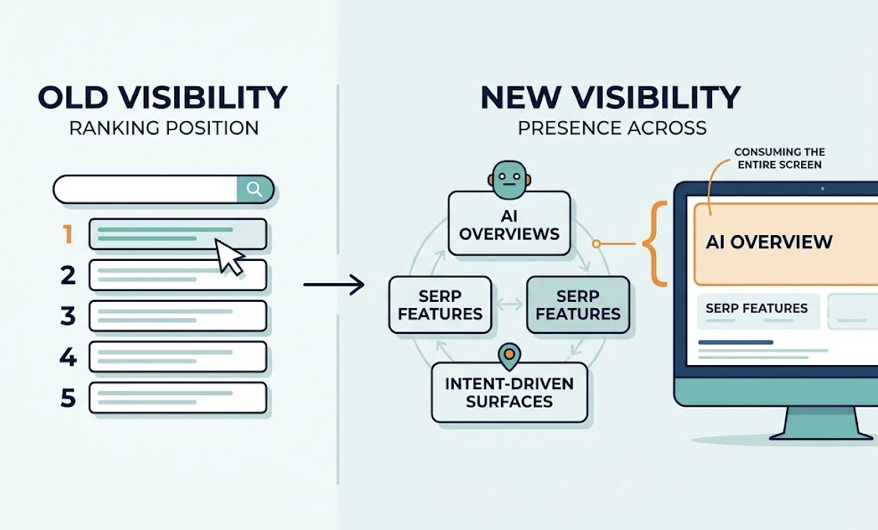
For two decades, visibility meant ranking. Page one, position three, maybe a featured snippet if you were lucky. In 2026, that definition is incomplete.
76% of SEO practitioners now describe visibility as presence across AI-generated answers, SERP features, and intent-driven surfaces, not just ranking position. The reason is straightforward: nearly 60% of Google searches now end without a click. AI Overviews appear on roughly 48% of all tracked queries, and their average height exceeds 1,200 pixels, consuming the entire above-the-fold screen on a standard desktop.
That’s the gap most brands still can’t see.
When an AI Overview is present, the top organic result loses nearly a fifth of its clicks. The second position sees CTR declines of up to 39%. And here’s the part that breaks traditional SEO logic: only 17% of sources cited in Google’s AI Overviews also rank in the organic top 10. The generative engine and the ranking algorithm are pulling from fundamentally different pools of authority.
The new currency isn’t the click. It’s the citation, the mention, and the entity reference. Answer Engine Optimization (AEO), the practice of structuring content so AI systems can extract, cite, and summarize it, has become a standalone discipline. Pages optimized with structured data and FAQ schema are 30% more likely to appear in AI-generated summaries. Content that answers questions directly in the first 100 words sees significantly higher citation rates.
3 Things That Changed in AI Search Visibility This Year
Not everything shifted overnight. But three changes in 2026 have made the old playbook feel noticeably outdated.
AI Traffic Now Converts Better Than Every Other Channel
This is the data point that should stop marketing leaders mid-scroll. In March 2026, AI-referred traffic converted 42% better than non-AI traffic across U.S. retail sites. That’s a complete reversal from March 2025, when AI traffic converted 38% worse.
The volume is surging, too. Traffic from AI sources to U.S. retail sites grew 393% year-over-year in Q1 2026. These visitors spend 48% more time on site and browse 13% more pages per visit. The conversion gap between platforms is even more dramatic: ChatGPT referrals convert at 15.9%, roughly 9x the rate of standard Google organic traffic at 1.76%.
Why? Because AI does the vetting before the click. By the time someone follows a ChatGPT citation to your site, they’ve already been told your product fits their criteria. They’re not browsing. They’re buying.
AI Overviews Are Expanding Into Commercial Territory
AI Overviews started as an informational feature. In 2026, they’re pushing into commercial and transactional queries. Commercial keywords triggering an AI Overview increased 128% year-over-year, rising from 8.15% in October 2024 to 18.57% in October 2025, and that trajectory has continued into 2026.
For the healthcare vertical, AIOs now trigger on 63% of queries, the highest of any industry. B2B tech sits at 42%. Finance remains cautious at just 5%, creating a wide-open opportunity for brands that can secure citations in that limited space.
The Measurement Gap Is the Biggest Risk No One Talks About
Here’s the uncomfortable truth: 43% of marketers say they’re optimizing for AI search in 2026, but only 14% are actually measuring it. Just 11% monitor branded search or share of voice in AI platforms.
That’s not a data availability problem. The tools exist. It’s a measurement scope problem. Teams are still reporting on keyword rankings and organic sessions while the discovery layer has shifted to a place those dashboards don’t cover.
What Hasn’t Changed: The Fundamentals Still Hold
The temptation in 2026 is to treat AI search as an entirely new game. It’s not.
Domain authority remains the single strongest predictor of AI citations. High-traffic sites earn roughly 3x more citations than low-traffic ones. The AI models still use traditional web signals, popularity, credibility, backlink profiles, as a primary filter for what gets cited. If your SEO foundation is weak, GEO won’t save you.
Google still holds 90%+ global market share. Traditional search hasn’t decreased in absolute terms. The total search pie expanded, which means traditional engines and AI platforms grew in parallel. For commercial and transactional queries, organic rankings and paid ads still dominate the user experience. Google has strong economic incentives to keep it that way.
And the oldest principle in marketing still applies: what others say about you matters more than what you say about yourself. Brands are 6.5x more likely to be cited through third-party sources than through their own domains. Roughly 85% of brand mentions in AI search come from external content: media publications, review platforms, forums like Reddit (which appears in 22% of AI answers), and specialized review sites. PR and community management haven’t become less important. They’ve become search strategies.
Where Most Brands Get Stuck Between Old and New
The hardest part of 2026 isn’t learning new tactics. It’s letting go of old assumptions while keeping the fundamentals intact.
Mistake 1: Measuring citations with ranking tools. Traditional rank tracking tells you where you sit in a list of blue links. It says nothing about whether ChatGPT mentions your brand, Perplexity cites your product page, or Gemini describes your pricing accurately. These are different systems with different logic, and they require different dashboards.
Mistake 2: Optimizing only your own site. When 85% of your brand mentions in AI search come from third-party sources, pouring all your content budget into your blog isn’t enough. Distributing content to authoritative external publications can increase AI citations by up to 325% compared to owned-site-only strategies.
Mistake 3: Assuming one AI platform represents all of them. Research analyzing 118,000 AI-generated answers found that only 11% of cited domains appeared across multiple platforms. Each engine, Google AIO, ChatGPT, Perplexity, Claude, uses a different retrieval architecture, different data sources, and different freshness signals. Perplexity cites an average of 21.87 sources per response with an 82% citation rate for content updated within 30 days. ChatGPT averages 7.92 citations and lags behind the live web by several weeks. Optimizing for one platform doesn’t guarantee visibility on another.
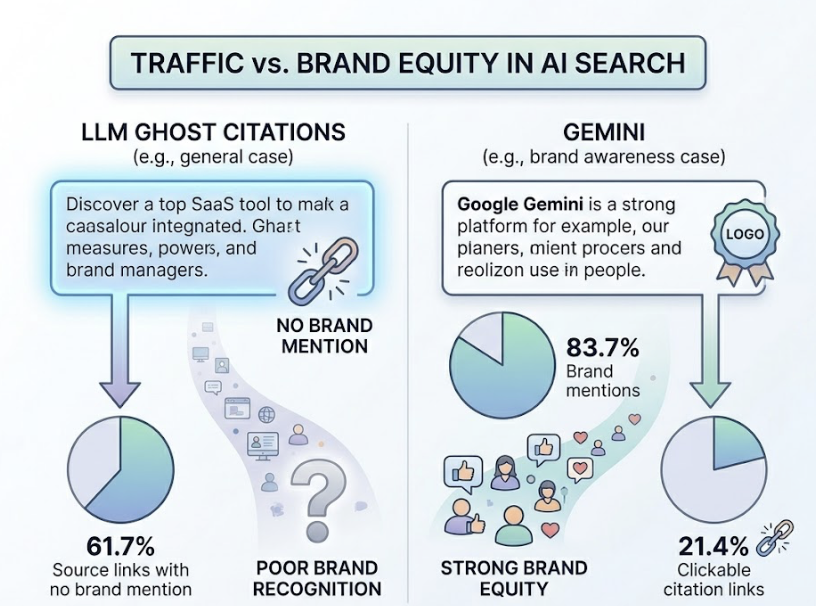
There’s also the “ghost citation” problem: 61.7% of LLM citations provide a source link but never mention the brand name in the generated text. Your site might be driving AI-referred traffic without building any brand recognition in the conversation itself. On the flip side, Gemini mentions brands in 83.7% of responses but only provides a clickable citation link 21.4% of the time. Traffic and brand equity in AI search are two separate objectives.
How to Track AI Search Visibility Across Platforms
If you can’t see where your brand stands in AI answers, you can’t improve it. And manual spot-checking, typing your brand name into ChatGPT and hoping for the best, doesn’t scale.
Tracking AI search visibility in 2026 requires monitoring multiple dimensions simultaneously: how often your brand appears (visibility), how AI describes it (sentiment), where it ranks relative to competitors (position), which sources AI pulls from (citation analysis), and how those patterns shift over time.
The industry benchmarks for 2026 give you a target to aim for:
| Metric | Definition | Benchmark |
|---|---|---|
| AI Share of Voice | % of relevant prompts where your brand appears | 30%+ |
| Citation Rate | % of AI responses linking to your site | 25%+ |
| First-Mention Rate | % of prompts where you’re the first recommendation | 15%+ |
| Sentiment Score | How positively AI describes your brand (scale of -100 to +100) | 85+ |
| Competitive Gap | Prompts where competitors appear but you don’t | Below 10% |
Topify was built to solve exactly this problem. Its Visibility Tracking monitors brand presence across ChatGPT, Gemini, Perplexity, DeepSeek, and other major AI platforms from a single dashboard. The Competitor Monitoring feature automatically detects rivals and benchmarks your visibility, sentiment, and position against theirs. Source Analysis shows which domains AI engines are citing, so you can spot content gaps and prioritize your earned media strategy.
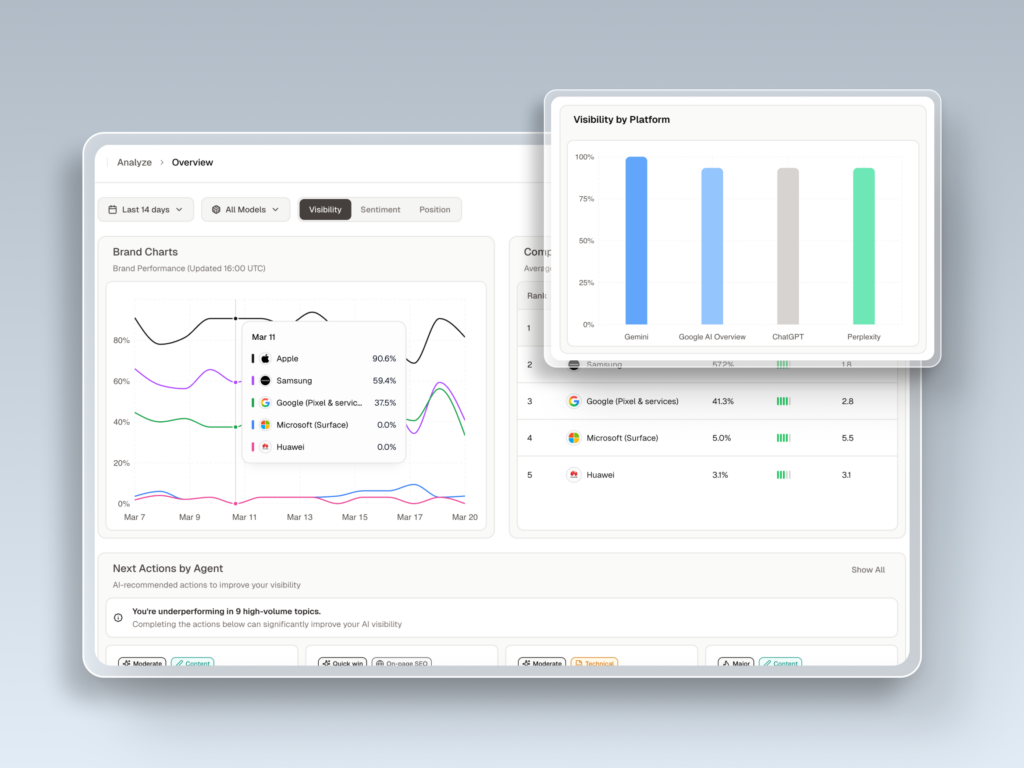
What makes Topify particularly useful for the fragmentation problem is its cross-platform coverage. Rather than checking each AI engine manually, you get a unified view of where you’re visible, where you’re missing, and what your competitors are doing differently. The platform’s AI Volume Analytics also surfaces high-value prompts relevant to your brand, prompts where real users are asking questions and AI is recommending your category, so you can focus optimization on the queries that actually drive business outcomes.
For teams that have been tracking traditional SEO metrics but haven’t started measuring AI visibility, Topify’s dashboard is the fastest way to close that measurement gap.
FAQ
What is AI search visibility?
AI search visibility refers to how frequently and favorably your brand appears in AI-generated answers across platforms like ChatGPT, Gemini, Perplexity, and Google’s AI Overviews. It’s measured through metrics like share of voice, citation rate, sentiment score, and first-mention rate, rather than traditional keyword rankings.
How has AI search visibility changed in 2026?
The biggest shifts are the conversion value of AI traffic (42% higher than non-AI traffic), the expansion of AI Overviews into commercial queries (128% YoY increase in commercial keyword triggers), and the growing disconnect between traditional rankings and AI citations (only 17% overlap between AIO sources and organic top 10).
Do I still need traditional SEO if I focus on AI search?
Yes. Traditional SEO and AI search visibility are complementary, not competitive. Domain authority remains the strongest predictor of AI citations. Google still holds 90%+ global market share, and transactional queries still convert through traditional organic results. The winning strategy in 2026 is dual-track: maintain SEO for clicks, build GEO for citations.
How do I track my brand’s visibility in AI answers?
Manual checking doesn’t scale across platforms. Tools like Topifyprovide cross-platform monitoring of brand mentions, sentiment, citation sources, and competitive positioning across ChatGPT, Gemini, Perplexity, and other AI engines in a single dashboard.
What’s the difference between SEO and GEO?
SEO optimizes for ranking position in traditional search results. GEO (Generative Engine Optimization) optimizes for citation and mention probability in AI-generated answers. GEO focuses on machine readability, structured content, front-loaded key claims, and third-party validation rather than backlink profiles and keyword density.

