

Your competitor just appeared in a ChatGPT answer about your core category. You didn’t.
That’s not a fluke. It’s a visibility gap that’s been growing while your team was focused on Google rankings. And if you don’t know exactly where you stand in AI search right now, you’re already behind.
The good news: AI search visibility is measurable, and it’s fixable. Here’s a 30-day tactical playbook for doing both.
Most Brands Don’t Know They’re Invisible to AI Until It’s Too Late
AI agent requests have reached approximately 88% of human organic search activity as of early 2026. That’s not a distant projection. It’s happening now, and most marketing teams are navigating it blind.
Here’s what makes this shift different from previous disruptions: 93% of AI-driven search sessions end without a user clicking through to a website. The AI answers the question directly. No traffic. But the recommendation it gives, whether it names your brand or your competitor, heavily influences the final purchase decision.
The gap between traditional SEO performance and AI visibility is wider than most brands expect. A 40-60% disconnect exists between Google rankings and AI citation rankings. You can rank first on Google and never appear in an AI answer, because LLMs evaluate content using entirely different criteria than search crawlers.
That’s the gap most brands still can’t see.
Platforms like Topify are built specifically for this problem, giving marketing teams a structured way to track, measure, and act on their AI search presence across ChatGPT, Gemini, and Perplexity. Without that kind of visibility, you’re optimizing in the dark.
The 30-Day Framework: Audit, Optimize, Amplify
The framework runs in three phases, each building on the last:
- Days 1-10: Audit — Establish a baseline. Where does your brand actually appear? On which platforms? For which prompts? How do you compare to competitors?
- Days 11-20: Optimize — Fix the structural and narrative gaps that cause AI to skip your brand.
- Days 21-30: Amplify — Expand your presence in the third-party ecosystem where AI models source their citations.
The sequence matters. Skipping the audit and jumping straight to optimization is guesswork.
The stakes are real: visitors arriving via AI search recommendations convert at 4.4x to 5x the rate of traditional organic traffic. These users arrive pre-qualified by the AI’s synthesis of reviews, documentation, and community sentiment. Losing visibility in this channel means losing your highest-intent customers.
Days 1-10: Run Your AI Visibility Audit Before You Fix Anything
The first ten days are about measurement, not action. You need a baseline before you know what to fix.
Step 1: Track your brand across AI platforms simultaneously
ChatGPT holds over 80% of the AI search market. But Perplexity is the tool of choice for senior decision-makers and technical researchers. Google AI Overviews appear in roughly half of all global searches. Each platform pulls from different data sources, weights citations differently, and surfaces different brands for the same query.
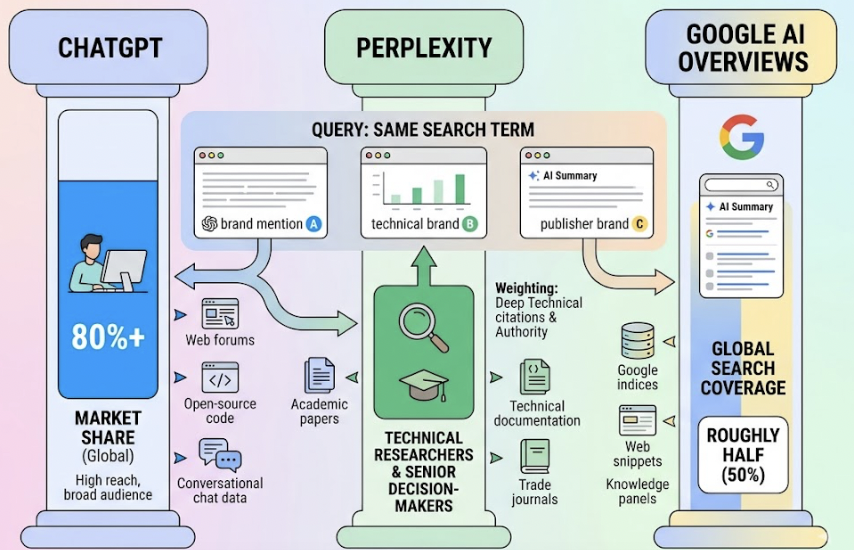
Your brand might be well-represented in ChatGPT and completely absent in Perplexity. That’s “visibility variance,” and it’s common.
Manual testing won’t get you there at scale. Testing 100 prompts across three platforms takes 2-4 hours per platform, with results that shift based on time of day and phrasing. Topify’s Visibility Tracking automates this, giving you a statistically reliable presence rate across all major AI platforms simultaneously.
Step 2: Identify which prompts trigger your category
Don’t just track your brand name. Track the prompts your buyers actually use. Category discovery prompts (“What are the best CRM tools for healthcare?”) and competitor comparison prompts (“Brand A vs. Brand B for scalability”) are where the real visibility battles play out. The audit maps which prompts surface your brand and which hand the win to a competitor.
Step 3: Run a horizontal competitive comparison
Appearing in an AI answer is only half the metric. Position matters. Research shows the AI’s top-ranked recommendation becomes the user’s top choice 74% of the time. If you’re appearing fifth out of five, you’re technically visible but practically invisible.
Topify’s Competitor Monitoring automates this comparison, showing you where rivals outrank you, on which prompts, and which sources are driving their advantage. That last piece is what makes the remediation phase actionable.
| Platform | Primary Citation Sources | User Persona |
|---|---|---|
| ChatGPT | Wikipedia (47.9%), Product Docs | General, Personal, Creative |
| Perplexity | Reddit (46.7%), Industry News | Executive, Research-heavy |
| Google AI Overviews | YouTube (23.3%), Reddit (21%) | Broad Consumer, E-commerce |
Days 11-20: Fix the Gaps AI Keeps Skipping Over
AI models fail to recommend a brand for one of three reasons: the sources aren’t authoritative, the content isn’t extractable, or the sentiment signals are mixed. The second ten days address all three.
The 85/15 Problem
Here’s the finding that usually surprises marketing teams: 85% of the information an AI uses to describe a brand comes from third-party domains. Only 15% comes from the brand’s own website.
AI engines operate on consensus, not claims. If your product page is the only source for a specific differentiator, the AI won’t trust it. If that same differentiator is corroborated by three industry publications and a Reddit thread, it becomes part of the AI’s confident recommendation.
Topify’s Source Analysis reverses this blind spot. It shows you which domains the AI is citing most frequently in your category, so your team can identify exactly where your content footprint is missing.
Sentiment correction
LLMs don’t just list brands. They frame them. A recommendation might read: “Brand X is a strong choice, though users frequently report issues with the onboarding process.” That caveat is often sourced from a single forum thread or an outdated review. Left unaddressed, it shapes how every AI answer positions your brand.
Topify Sentiment Analysis gives you a 0-100 score for how AI perceives your brand across different themes, from customer support to pricing to product reliability. When sentiment is low in a specific area, you can trace the sources, address the underlying issues, and update your owned content with evidence-based responses that AI models can ingest.
Structural optimization for extractability
AI models prioritize content they can chunk and synthesize cleanly. A few specific changes have outsized impact:
- Answer blocks: a concise 40-60 word summary at the start of each content section
- Hierarchical structure: strict H1-H2-H3 formatting that helps models parse topic relationships
- Data density: including statistics and tables increases citation-worthiness by 25-40%
- Schema markup: Wikidata-linked JSON-LD helps AI systems verify entity authority
These aren’t cosmetic changes. They’re the difference between content that AI can extract and content it skips.
Days 21-30: Get Your Brand Into More AI Answers
The final phase isn’t about your own content. It’s about your presence in the third-party ecosystem where AI models hunt for authoritative signals.
Because AI models function as probabilistic consensus engines, they need distributed corroboration. Branded web mentions correlate with AI visibility at a rate of 0.664. Traditional backlinks, by comparison, correlate at only 0.218. The signals that drive SEO rankings and the signals that drive AI citations are not the same thing.

Three amplification channels matter most:
Community engagement: Reddit is the most cited domain across all major AI platforms. Authentic participation in relevant subreddits and industry forums, not promotional posts, but genuine answers and discussions, builds the kind of distributed signal AI models weight heavily.
Earned media distribution: Journalistic sources account for 47% of all AI citations. A mention in a credible industry publication isn’t just a PR win; it’s a direct citation signal to every major LLM.
Content clusters: Building 10-15 pieces of content that thoroughly cover a specific topic from multiple angles increases the AI’s confidence in recommending your brand as the authoritative source on that subject. Breadth alone doesn’t do it. Depth does.
As this phase progresses, Topify’s Position Tracking monitors whether your Recommend Rank is climbing relative to competitors. The CVR (Conversion Visibility Rate) metric ties this back to business impact, estimating how changes in AI visibility translate to lead quality and conversion behavior.
The 5 Metrics That Tell You the 30 Days Actually Worked
Don’t measure effort. Measure outcome.
| KPI | What It Measures | 30-Day Target |
|---|---|---|
| Visibility Score | % of category queries where your brand appears | +20-40% from baseline |
| Position | Average rank in AI recommendation lists | Top 3 for priority prompts |
| Sentiment Score | % of positive or neutral brand framing | Above 80% |
| Source Coverage | Diversity of external domains citing your brand | Mentions across 4+ platforms |
| CVR | Lead/conversion rate from AI-referred traffic | 4x traditional organic |
The Visibility Score and Position tell you if you’re in the room and where you’re standing. Sentiment tells you how you’re being described. Source Coverage tells you how defensible that position is. CVR ties everything to revenue.
Topify’s dashboard surfaces all five metrics in a single unified view, which matters when you’re presenting GEO impact to a CMO or board who still think in terms of Google rankings.
Conclusion
The 30-day playbook isn’t a campaign. It’s the beginning of a permanent function.
AI retrieval models update frequently. Data licensing agreements shift citation patterns. Emerging platforms change which sources get weighted. A single sprint won’t hold your position. What holds it is a continuous monitoring loop: regular audits, ongoing source coverage, and systematic sentiment correction.
The brands that will own AI search visibility in 2026 and beyond aren’t the ones with the biggest content budgets. They’re the ones that started measuring earliest, fixed their gaps methodically, and built a broad enough third-party footprint that AI models treat them as consensus choices.
That process starts with knowing where you actually stand. Start your AI visibility audit with Topify and find out.
FAQ
What is AI search visibility and how is it measured?
AI search visibility measures how frequently and prominently your brand appears in answers generated by large language models. Unlike traditional SEO, it’s tracked using citation rates and share of voice within AI-generated responses rather than SERP positions.
How is AI search visibility different from traditional SEO?
Traditional SEO optimizes for keywords, backlinks, and page speed to rank in “ten blue links.” AI search visibility focuses on citation-worthiness, entity clarity, and multi-source corroboration. A page can rank first in Google and never appear in an AI answer if it lacks the structural elements LLMs prioritize.
How long does it take to see results in AI search?
Brands typically see measurable visibility shifts within 1-3 months of consistent optimization and seeding. That’s significantly faster than traditional SEO, which often takes 6 months or more to show rank movement. AI retrieval models update their knowledge more frequently through RAG processes.
Can small brands improve AI visibility without a big content budget?
Yes. AI models prioritize structural clarity and answer quality over domain authority or content volume. A small brand that provides the most extractable, well-structured answer for a specific niche query can outrank much larger incumbents that haven’t optimized for extractability.
Which AI platforms matter most for brand visibility?
For general consumer reach, ChatGPT holds the largest market share. For B2B and technical research audiences, Perplexity carries significant weight with senior decision-makers. Google AI Overviews are most critical for brands dependent on traditional organic traffic and e-commerce discovery.

