

You’re ranking on page one of Google. Your content team is publishing consistently. Your SEO metrics look fine.
But when someone types “What’s the best [your category] tool?” into ChatGPT, your brand isn’t mentioned once.
That gap is the problem AI brand intelligence solutions were built to solve. And most marketing teams don’t even know it exists yet.
What an AI Brand Intelligence Solution Actually Measures
An AI brand intelligence solution is not a social listening tool with a new coat of paint. It’s a different category entirely.
Traditional monitoring asks: “Where was our brand mentioned?” AI brand intelligence asks: “When a user asks an AI for a recommendation, does our brand appear, and how does the AI describe us?”
The distinction matters because AI systems don’t rank. They synthesize. When ChatGPT or Perplexity responds to a high-intent query, it typically references between two and seven domains. If your brand isn’t one of them, you don’t exist for that interaction. No impression. No click. No conversion opportunity.
The core metric is Brand AI Visibility: the percentage of relevant category prompts where your brand appears in the AI’s response. But visibility alone is incomplete. A full AI brand intelligence solution also tracks sentiment (how the AI describes you), position (whether you’re the first recommendation or a footnote), and citation sources (which URLs the AI is pulling from to form its view of your brand).
By 2026, 25% of organic search traffic is projected to migrate to AI assistants. AI-driven search referrals already convert at a rate 23 times higher than traditional organic search. The stakes of this channel are real, even if most dashboards don’t show it yet.
Why Traditional Brand Monitoring Tools Miss the Whole Picture
Here’s the thing: traditional brand monitoring was designed for an era of explicit, crawlable data. It tracks what people say about you. AI brand intelligence tracks what AI systems recommend about you. Those are fundamentally different things.
A brand can have thousands of positive social mentions and still be invisible in generative search. That’s because AI platforms don’t just mirror the internet. They filter it. They apply a layer of “conversational authority” to the content they retrieve, prioritizing sources that are semantically structured, authoritative, and clearly attributed, not necessarily popular.
There’s also a phenomenon researchers call “Dark Search.” When a user asks ChatGPT for the best project management tool for a remote team, that query happens in a private, dynamic conversation. The AI’s recommendation never appears in a search results page. It’s never trackable by standard analytics. The user follows the recommendation, visits the suggested brand, and converts, with no attribution trail pointing back to the AI interaction. Your current tools don’t see any of this.
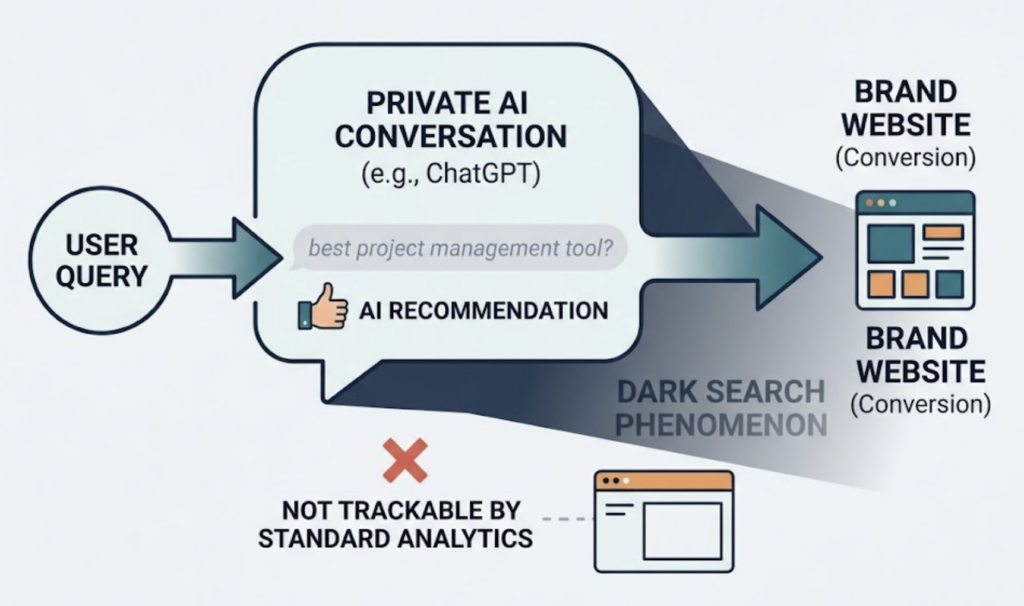
The practical result: brands are losing high-converting customers to competitors they don’t even know are winning in AI. That’s not a traffic problem. That’s a visibility blindspot.
The 6 Signals a Real AI Brand Intelligence Platform Should Track
Most AI brand intelligence software tracks one or two signals. That’s not enough. The brands that manage their AI presence effectively are monitoring six.
Visibility measures the inclusion rate: what percentage of relevant prompts trigger a brand mention? This is the baseline. It tells you whether AI systems consider your brand relevant to the category at all.
Sentiment goes deeper. It’s not just whether you appear, but how you’re described. An AI calling you “a legacy solution with limited integrations” is worse than not mentioning you. A proper AI brand intelligence analytics layer should produce a Net Sentiment Score (NSS) calculated from the ratio of positive to negative mentions across sampled responses.
Position tracks where you appear in a list of recommendations. Being first carries a “halo effect” of authority that being fourth simply doesn’t. Research shows the first recommendation in an AI response functions more like an endorsement than a ranking.
Volume measures consistency over time. Single-snapshot data is misleading because LLM responses carry stochastic variance. You need rolling averages across multiple query runs to spot real trends versus noise.
Mention Context reveals the narrative. Is the AI linking your brand to “enterprise security” or “affordable for startups”? The themes AI associates with your brand shape how potential customers form their first impression, often before they ever visit your site.
Source Citations are arguably the most actionable signal. They identify the specific URLs the AI is using to ground its view of your brand. These citations are your roadmap for content strategy and digital PR. If a competitor is dominating citations because of a cluster of authoritative third-party articles, that’s a solvable problem once you know it exists.
Relying on one or two of these signals gives you a partial picture. Relying on all six gives you a system.
How to Read Your AI Brand Intelligence Dashboard Without Getting Lost
The single biggest mistake teams make with an AI brand intelligence dashboard is treating it like a vanity scoreboard.
Your absolute visibility score means less than your Share of Model: your visibility relative to your top competitors for the same set of prompts. If your competitor’s visibility exceeds yours by more than 25% on high-value queries, that’s a Visibility Growth Action, a signal that content or PR work is needed in a specific area. That’s the number that should drive prioritization.
Sentiment trend lines matter as much as sentiment scores. LLMs can recirculate outdated or negative information indefinitely because their training data doesn’t expire on its own. A declining sentiment trend, even while absolute visibility holds steady, is an early warning of a narrative problem developing in the model’s perception of your brand.
Don’t make decisions from single data points. LLM responses have natural variance, the same prompt can return slightly different results on different runs. A well-designed AI brand intelligence system tracks rolling averages and flags statistically significant shifts, not one-off fluctuations.
The most useful dashboards include per-response drill-downs: the ability to trace exactly what language the AI is using about your brand and which sources are feeding that output. That’s where actionable intelligence lives, not in the aggregate number at the top of the page.
3 Mistakes Brands Make When Choosing an AI Brand Intelligence Tool
The market for AI brand intelligence software is maturing fast, and so are the selection mistakes.
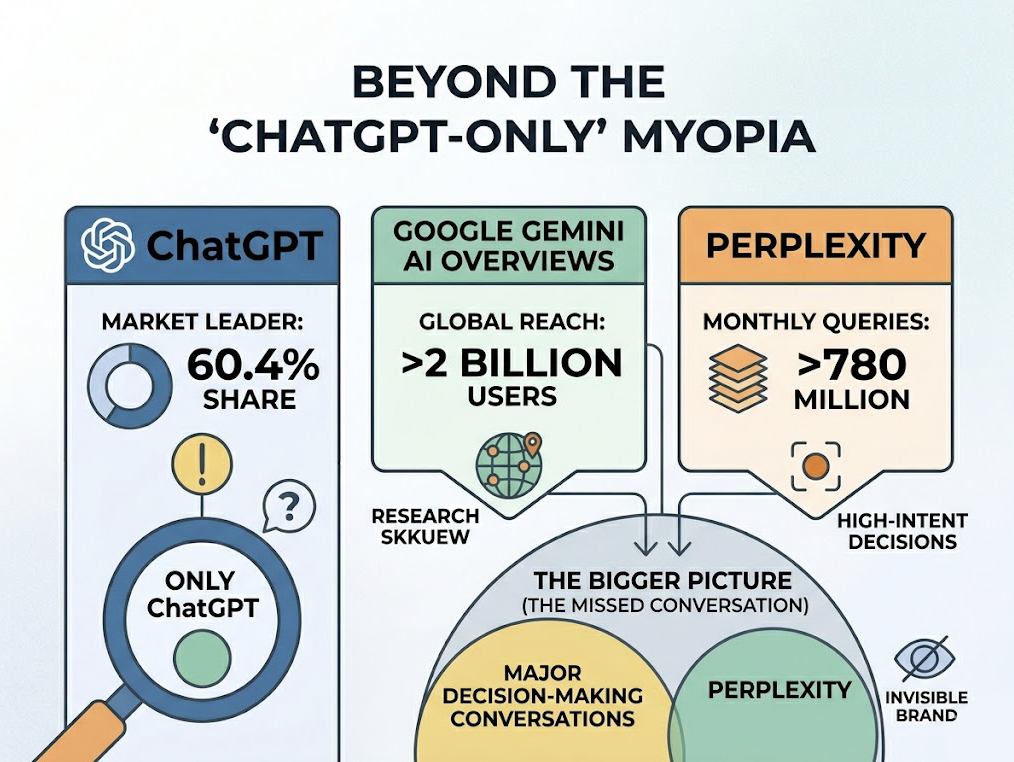
Single-platform myopia is the most common error. Teams evaluate a tool based on its ChatGPT coverage, then stop there. But ChatGPT, while the current leader at 60.4% market share, is not the whole picture. Google’s Gemini AI Overviews now reach over 2 billion users across 200 countries. Perplexity processes over 780 million queries monthly with a user base heavily skewed toward research-oriented, high-intent decisions. A brand that looks strong in ChatGPT and invisible in AI Overviews is missing a massive portion of the decision-making conversation.
Quantitative bias is the second mistake. Mention volume is a seductive metric because it’s easy to measure and easy to report upward. But being mentioned frequently in a negative or dismissive context is actively harmful. “They’re an option if budget is your only concern” is not a brand asset. A real AI brand intelligence analytics layer classifies recommendation quality, not just count.
Data siloing is the third. AI visibility data and traditional SEO data are not separate systems. They inform each other directly. If your AI brand intelligence platform shows that a specific industry publication is being cited as the source for your competitor’s favorable descriptions, that’s a backlink and content placement opportunity for your SEO team. Treating AI metrics as a standalone reporting exercise wastes the most actionable insights the data produces.
How Topify Works as a Full-Spectrum AI Brand Intelligence Solution
Consider a real scenario: a B2B SaaS company runs its first AI visibility audit and discovers that its primary competitor is being recommended for “best enterprise collaboration tool” in Perplexity 80% of the time. The brand itself appears in the “other options” section, if at all. The question isn’t just “why?” It’s “which sources are driving this, and what can we do about it?”
That’s precisely the workflow Topify was built for.
The platform tracks brand performance across ChatGPT, Gemini, Perplexity, DeepSeek, Doubao, Qwen, and other major AI platforms, covering every significant market where discovery decisions are happening. Its Citation Intelligence module identifies the exact URLs and domains powering the AI’s recommendations, which turns an abstract “we’re losing” signal into a concrete content and PR action list.
Topify’s seven core metrics cover visibility, sentiment, position, volume, mentions, intent, and CVR (Conversion Visibility Rate), giving teams a complete view of not just whether they appear, but how their appearance translates to commercial outcomes. The sentiment module goes beyond binary positive/negative classification, tracking the specific narrative themes the AI associates with the brand so you can see if you’re being positioned as a category leader or an afterthought.
What separates Topify from tools that stop at data is its One-Click Agent Execution. Once the dashboard surfaces a Visibility Growth Action, teams can state their goals in plain English, review the proposed GEO strategy, and deploy it in a single click. No manual workflows. The algorithm was built by founding researchers with Stanford LLM research credentials and Fortune 500 SEO backgrounds, which shows in the depth of the semantic analysis.
Pricing starts at $99/month for the Basic plan (100 prompts, 9,000 AI answer analyses, 4 platforms) and $199/month for Pro (250 prompts, 22,500 analyses, 8 projects). Enterprise plans start at $499/month with dedicated account management and custom configurations.
AI Brand Intelligence Solution Pricing: What You Should Expect to Pay
The market has stratified into four clear tiers.
Entry-level SaaS tools ($29-$199/month) typically cover two to three AI platforms with weekly data refreshes and limited prompt sets. They’re suitable for startups running initial diagnostics, but they often lack the competitive benchmarking and citation tracking needed for ongoing strategy.
Mid-market platforms ($199-$900/month) offer the coverage and refresh frequency that growth-stage brands and agencies need, including multi-platform tracking, daily updates, and competitor monitoring. Topify’s Basic and Pro plans sit in this tier and are positioned to deliver the full-spectrum analytics that entry-level tools can’t.
Enterprise SaaS ($1,000-$15,000/month) handles multi-brand portfolios, custom APIs, and compliance requirements like SOC 2 certification for global marketing organizations with complex reporting structures.
Managed GEO services ($4,000-$6,000/month) are the fastest path to measurable results. Brands using full-service execution have reached 80%+ AI visibility scores in under 30 days. The trade-off is cost and the dependency on external execution.
The ROI calculation is straightforward: AI search converts at 23 times the rate of traditional organic search. Losing visibility in this channel isn’t a branding problem in the abstract. For a business with significant search-driven revenue, a 20-50% decline in AI visibility translates directly to measurable lost pipeline. The cost of inaction consistently exceeds the cost of the tool.
Conclusion
AI brand intelligence is not a future concern. It’s a present one.
The brands winning in AI search right now aren’t winning by accident. They’re tracking six visibility signals across multiple platforms, reading their dashboards for competitive shifts rather than absolute scores, and connecting AI data back into their SEO and PR workflows.
The brands losing are the ones who still define “brand visibility” as a Google ranking.
If you don’t know your Share of Model today, you don’t know what your brand looks like to the 37% of consumers who now start their searches with AI tools rather than search engines. That’s a blind spot worth closing.
FAQ
What is an AI brand intelligence solution?
An AI brand intelligence solution is a platform that tracks, measures, and helps optimize how a brand is represented in AI-generated responses from systems like ChatGPT, Gemini, and Perplexity. Unlike social listening tools, it focuses on conversational authority: how often an AI recommends your brand, in what context, and with what sentiment.
How does an AI brand intelligence solution work?
The system programmatically sends thousands of high-intent prompts to major AI platforms and analyzes the responses using semantic models. It identifies brand mentions, tracks citation sources, scores sentiment, and benchmarks position relative to competitors. The output is aggregated into a dashboard showing Share of Model and actionable growth signals.
How do you measure an AI brand intelligence solution?
Measurement runs across six dimensions: Visibility (inclusion rate in prompts), Sentiment (Net Sentiment Score), Position (rank in recommendation lists), Volume (mention count over time), Mention Context (narrative themes), and Source Citations (URLs driving AI logic). Share of Model relative to competitors is the most strategically meaningful single metric.
What are the best tools for an AI brand intelligence solution?
Topify is currently the strongest option for full-spectrum optimization, combining visibility tracking, sentiment analysis, competitor monitoring, and One-Click Agent Execution in a single platform. It covers ChatGPT, Gemini, Perplexity, DeepSeek, and several other major AI systems.
What is a strategy for an AI brand intelligence solution?
Effective strategy runs in four phases: Diagnostic (run 20+ baseline prompts across major platforms), Infrastructure (implement schema markup and structured data for AI crawling), Narrative Management (build authoritative third-party citations on publications and community platforms), and Continuous Monitoring (track sentiment and competitive shifts on a rolling basis).
Is there a checklist for an AI brand intelligence solution?
Yes. Verify multi-platform coverage beyond ChatGPT. Confirm the tool provides Citation Intelligence showing which URLs drive AI recommendations. Check that sentiment and entity accuracy tracking are included. Look for integration with SEO workflows. Prioritize platforms that surface actionable growth signals, not just raw mention counts.

