

Your domain authority is strong. Your keyword rankings haven’t moved. Google Search Console shows stable impressions. Then someone on the exec team asks ChatGPT for a vendor recommendation in your category, and your brand doesn’t come up once.
That’s not an SEO problem. That’s a measurement problem. The dashboards you’re relying on weren’t built to track how AI describes your brand, whether it includes you in a recommendation, or what sources it’s pulling to form that opinion. That’s exactly what AI search analytics is designed to do.
What AI Search Analytics Actually Tracks (and Why Your Current Dashboard Won’t Show It)
AI search analytics measures how generative AI platforms like ChatGPT, Perplexity, and Gemini perceive, describe, and recommend your brand within synthesized conversational answers. It’s a fundamentally different discipline from traditional web analytics.
Traditional SEO analytics tracks traffic behavior: sessions, clicks, rankings, CTR. AI search analytics tracks what you might call “synthetic reputation.” The core questions it answers are not “how many people visited our site” but “does AI include us in the consideration set for our category,” “how does it frame our brand when it does mention us,” and “what sources is it using to form that narrative.”
The gap matters because traditional metrics can’t see what AI search is doing. Zero-click rates hit 83% when AI Overviews are present in search results, and climb to 93% for Google’s AI Mode. That’s the vast majority of search volume being resolved inside the AI interface, never touching your site. Google Analytics can’t measure an interaction that never generated a click.
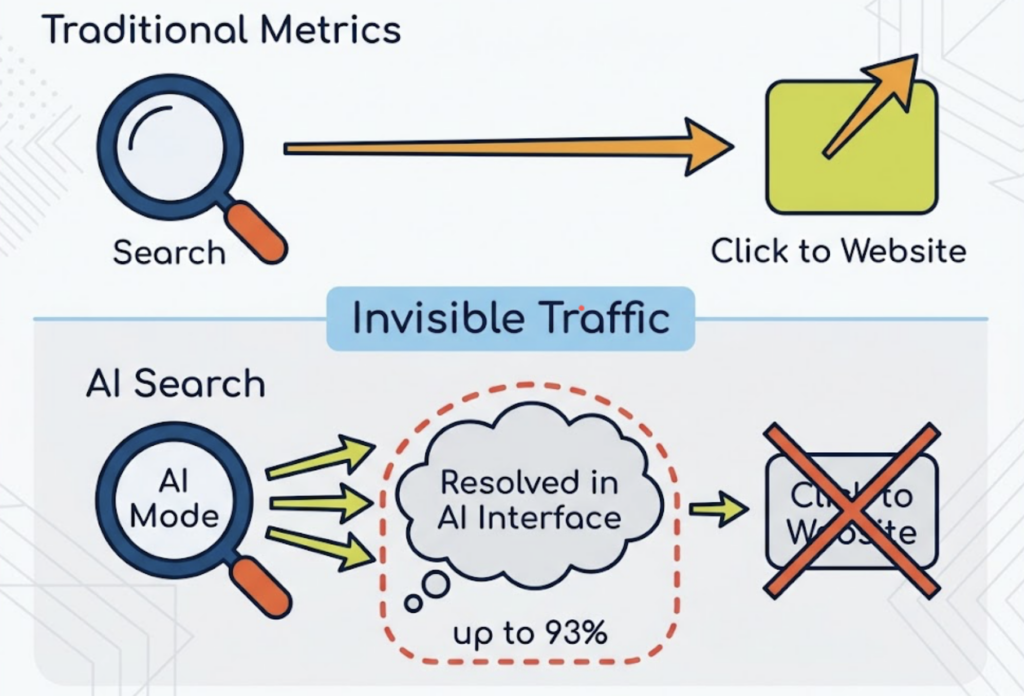
This is what makes AI search visibility a separate tracking problem entirely. You’re not optimizing for a page visit. You’re optimizing for a recommendation.
The 6 Metrics That Define a Real AI Search Analytics Framework
Not all visibility data is equally useful. A serious AI search analytics framework tracks six distinct metrics, each answering a different strategic question.
Visibility Rate is the foundation. It measures how often your brand appears in AI responses across a target set of prompts. If you’re mentioned in 30 out of 100 prompt variations, your visibility rate is 30%. A low rate usually means the AI doesn’t associate your brand with the problem-space you’re trying to own.
Position Score tracks where in the answer you appear. The primacy effect in AI responses is real: being the first brand named in a three-option list carries significantly more weight than being third. Position Score quantifies that prominence and tells you whether you’re the default recommendation or a secondary mention.
Sentiment Score is where most teams have a blind spot. It quantifies the tone attached to your brand’s mention, typically on a 0-to-100 scale. High visibility with low sentiment is a conversion killer. If the AI consistently pairs your brand name with “expensive,” “limited integrations,” or outdated pricing data, that visibility is working against you.
Intent Coverage maps your brand across the full customer journey: informational prompts (“what is X”), comparative prompts (“X vs Y for enterprise use”), and transactional prompts (“best pricing for X”). A brand can have near-perfect visibility for its own name and zero visibility for the problems it solves. That’s a critical gap.
Source Citation Frequency identifies which URLs and domains the AI is pulling to generate information about your brand. This is the “upstream” metric: it tells you who’s influencing what the AI says about you, whether that’s your own site, a competitor’s blog, or a three-year-old forum thread.
Share of Voice (SOV) benchmarks your AI presence against competitors. It’s a zero-sum metric. Enterprise leaders in mature categories typically aim for 25% to 30% SOV across their core query clusters. If your competitor’s SOV is rising, yours is falling.
| Traditional SEO Metric | AI Search Analytics Equivalent |
|---|---|
| Keyword Rankings | Prompt Coverage & Position Score |
| Domain Authority | Entity Strength (AI association signals) |
| Backlink Count | Citation Frequency |
| Page Impressions | Answer Inclusion Rate (Visibility) |
| Organic Sessions | AI-Referred Conversion Events |
For teams looking to structure this across platforms, Topify tracks all seven of these metrics in a unified dashboard, covering ChatGPT, Gemini, Perplexity, and DeepSeek simultaneously.
3 Mistakes That Make Your AI Search Data Unreliable
Most brands that attempt AI search monitoring end up with data that looks impressive but can’t guide a decision. Here’s where things typically go wrong.
Mistake 1: Single-platform monitoring. Many teams track only ChatGPT and assume it represents the AI search landscape. It doesn’t. Research shows that only 11% of domains are cited by both ChatGPT and Perplexity for the same set of queries. ChatGPT tends to prioritize brand popularity and conversational fluency, Perplexity prioritizes real-time citations and factual accuracy, and Gemini leans heavily on Google’s existing Knowledge Graph. Monitoring one platform gives you one filter on reality, not the full picture.
Mistake 2: Measuring presence without sentiment. Visibility is a quantity. Sentiment is the quality filter that determines whether that visibility helps or hurts. An AI can mention your brand at position one in response to “companies with the worst data security practices.” That’s high visibility with catastrophic sentiment. Even more common: AI hallucinations that describe your pricing as double the actual number, creating an “overpriced” narrative based on bad data you’d never catch without sentiment tracking.
Mistake 3: Ignoring the source citation gap. This is the most common tactical error. AI platforms don’t generate answers from nothing; they synthesize from retrieved documents. If competitors are consistently cited from high-authority third-party sources while your brand is not, you have an authority gap that no amount of on-site optimization will fix. You need to know which sources the AI trusts before you can start influencing what it says.
How to Build an AI Search Analytics Strategy That Actually Works
The following framework moves from discovery to baseline to optimization. Use it as a starting checklist.
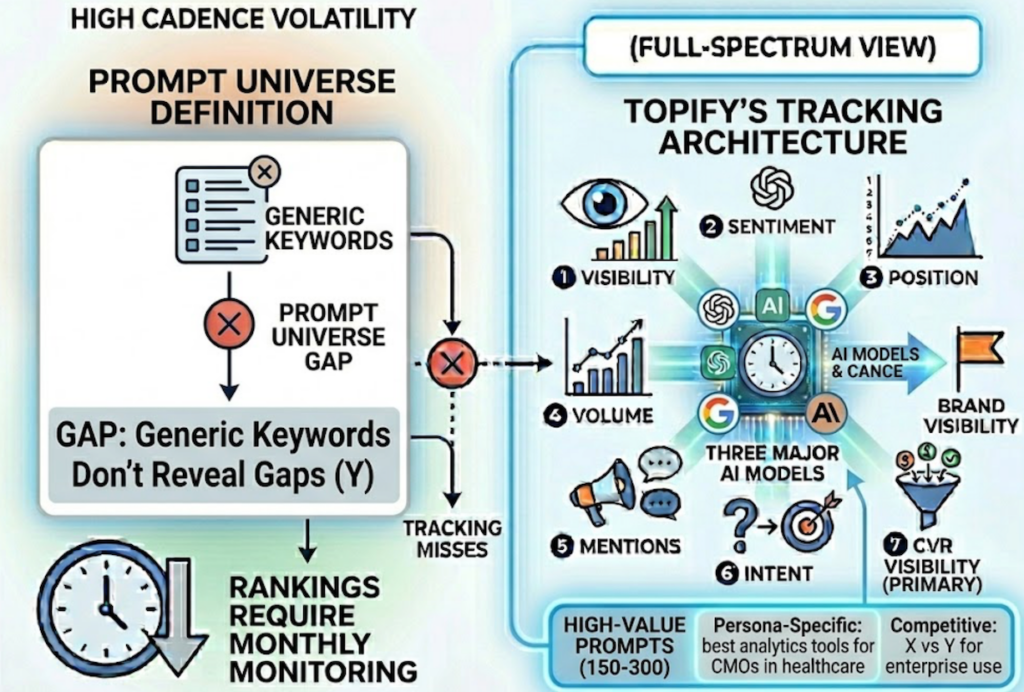
- Define your Prompt Universe. Identify 150 to 300 high-value prompts across informational, comparative, and transactional intent. Include persona-specific variants (“best analytics tools for CMOs in healthcare”) and competitive prompts (“X vs Y for enterprise use”). Generic keywords won’t reveal the gaps that matter.
- Run a 30-day cross-platform baseline. Track simultaneously on ChatGPT, Perplexity, and Gemini. Eighty-five percent of AI users cross-check answers across multiple platforms, which means gaps on any single platform directly impact how prospects verify your brand.
- Audit your source citations. Identify which URLs the AI is using to describe your brand. Check for outdated content, competitor domains, and third-party sources that may be shaping the AI’s narrative without your knowledge.
- Establish a weekly reporting cadence. AI recommendation logic and retrieval sets can shift every few weeks as models update. Daily tracking is worth it during major launches or PR events.
- Prioritize AI search optimization for content. Structure key pages with direct answers in the first 200 words, implement FAQ schema, and inject proprietary data so your site becomes a primary citation source rather than a secondary one.
- Track sentiment changes after content updates. Sentiment Score is the clearest signal that your AI search optimization is working. A rising score means the AI is picking up your updated narrative.
This is what AI search optimization looks like in practice: not a one-time fix, but a continuous measurement-and-adjustment cycle.
Why Visibility Without Conversion Context Gives You False Confidence
A 2026 audit of Uplimit, an enterprise learning platform, shows exactly how this goes wrong. The brand had a 50% mention rate among Strategic Enterprise CLOs, which looks strong on paper. But deeper analysis revealed a sentiment and category gap: Uplimit was being mentioned in high-level strategy discussions while remaining entirely absent from “sales enablement” and “employee engagement” queries, the transactional prompts where actual vendor selections happen.
That’s the gap most brands still can’t see.
AI-referred visitors are not the same as organic traffic. They convert at 4.4 times the rate of standard organic visitors and spend 68% more time on-site. In some categories, AI search traffic converts 23 times better than organic. A brand invisible in bottom-of-funnel AI prompts isn’t just missing visibility. It’s missing the highest-converting traffic channel available.
The Right Tools for AI Search Analytics: What to Look For and What to Expect to Pay
Not every platform built for AI visibility actually delivers on the full framework. Here’s what matters when evaluating your options.
The core capabilities you need: multi-platform coverage (at minimum ChatGPT, Perplexity, and Gemini), the full six-metric suite including sentiment and source citation, competitor share of voice benchmarking, and enough prompt capacity to cover 150+ queries without sampling errors.
For most marketing teams and agencies, Topify is currently the only AI visibility platform that delivers the complete analytics matrix across all major AI engines. Its platform covers visibility tracking, sentiment scoring, source citation analysis, and competitor benchmarking in a single dashboard, built by founding researchers with OpenAI and Google SEO backgrounds.
Topify’s pricing is structured around team size and tracking depth:
| Plan | Price | Best For |
|---|---|---|
| Basic | $99/mo | Individual marketers, small teams. 100 prompts across 4 platforms. |
| Pro | $199/mo | Mid-market teams and agencies. 250 prompts, full sentiment suite, 10 seats. |
| Enterprise | From $499/mo | Global brands. Unlimited prompts, API integration, dedicated account manager. |
For teams tracking high-value categories where a single customer represents thousands in LTV, the Pro plan pays for itself quickly. A 5% lift in AI visibility across 250 prompts often covers the annual cost within the first quarter, given the 4.4x conversion premium of AI-referred traffic.
Conclusion
The data gap isn’t subtle anymore. Fifty-eight percent of consumers are already using AI for product discovery and research. The brands invisible in those answers aren’t losing visibility in a secondary channel. They’re losing it in the primary channel where purchase intent is forming.
AI search analytics gives you the measurement infrastructure to change that. Start with a Prompt Universe, build a 30-day baseline across ChatGPT, Perplexity, and Gemini, and let the Source Citation data tell you where the AI’s narrative about your brand is actually coming from. Once you can see it, you can optimize it.
Get started with Topify and have your first AI search analytics baseline running within a week.
FAQ
Q: What is AI search analytics and how is it different from SEO analytics?
A: AI search analytics measures how generative AI platforms like ChatGPT and Perplexity perceive, describe, and recommend your brand in synthesized conversational answers. Traditional SEO analytics focuses on keyword rankings, sessions, and click-through rates. AI search analytics focuses on Share of Voice, sentiment scores, position within AI responses, and source citation frequency — metrics that standard SEO tools don’t track at all.
Q: How often should I run AI search analytics reports?
A: A weekly cadence works for most competitive industries. AI recommendation logic and retrieval sets can shift every few weeks as models update, so monthly reporting is too slow to catch meaningful changes. During major product launches, PR events, or high-volatility periods, daily tracking is worth it, particularly for platforms like Google AI Overviews where retrieval sets refresh frequently.
Q: What’s the most important metric to start tracking in AI search analytics?
A: Visibility Rate (also called Answer Inclusion Rate) is the right starting point. It tells you whether the AI includes your brand in its consideration set for your category at all. Once you establish a visibility baseline, Sentiment Score becomes the next priority — it determines whether that visibility is actually helping conversions or creating friction.
Q: How much do AI search analytics tools typically cost?
A: Professional plans typically range from $99/month for basic monitoring (covering 100 prompts across 4 platforms) to $499+/month for enterprise solutions with unlimited prompts and API access. The main cost driver is prompt volume: tracking 150 to 300 prompts across multiple platforms requires a Pro or Enterprise tier on most platforms.

