

Search “AI visibility tool” and you’ll find dozens of platforms, each claiming to tell you how your brand performs in AI search. Most of them track brand mentions. That sounds useful until you realize that a mention and a citation are two completely different things, and only one of them drives referral traffic, content authority, or real competitive intelligence.
The teams that are winning in AI search in 2026 aren’t the ones with the highest mention scores. They’re the ones who know exactly which URLs the AI is treating as its source of truth.
Most “AI Visibility” Tools Don’t Actually Track AI Citations. Here’s the Gap.
There’s a structural difference between knowing that an AI said your name and knowing that an AI cited your content.
AI mention tracking is a continuation of traditional social listening. It measures how often an AI platform generates your brand name in a response. This tells you that the model “knows” your brand exists. What it doesn’t tell you is whether the model trusts your content enough to use it as source material.
AI citation tracking does something different. It monitors which external URLs and domains the AI platform retrieves as the grounding material for its answers. These are the sites the model treats as authoritative. And in 2026, that distinction matters more than ever.
Research from 2025-2026 shows that brands earning both a mention and a citation are 40% more likely to maintain repeat visibility across consecutive user sessions compared to brands that only earn a textual mention. Citations act as a stability anchor. They’re also the primary mechanism for any remaining referral traffic: while 93% of AI search sessions end without a click, the few clicks that do occur go almost exclusively to cited sources.
That’s the gap most teams still haven’t closed.
What an AI Citation Tracking Tool Actually Does
At its core, an AI citation tracking tool is a platform that systematically monitors which external URLs and domains are referenced when AI systems generate answers to specific prompts.
Here’s how it works in practice. The tool generates “fan-out” variations of a target keyword (“best CRM,” “top CRM for small business,” “how to choose a CRM”) to simulate real user behavior. Those prompts are then sent across multiple platforms — ChatGPT, Gemini, Perplexity, DeepSeek — from different geographic contexts to capture model variance. The tool extracts both the answer text and the citation metadata: the URL, its position in the response, and the sentiment of the surrounding context.
Because AI citation patterns are highly volatile — with up to 70% of citations potentially changing between runs — aggregation across repeated queries is the only way to identify which sources are genuinely “sticky.”
Three core dimensions typically get tracked:
Source Domain Analysis identifies which domains the AI consistently trusts for a given category. Is it preferring government sites, industry forums, or competitor blogs?
Brand Source Presence measures how frequently your own managed URLs appear in the citation list. This is your “owned authority” score.
Competitor Source Share benchmarks your citation frequency against named rivals, surfacing the exact gap you need to close.
The most advanced tools add a fourth layer: prompt-level citation breakdown, which shows whether your citation performance changes based on query intent. You might win the “what is” citation and lose the “best for” citation entirely.
4 Metrics That Separate Real Citation Tracking from Vanity Data
Most tools give you a citation count. Professional teams need a framework. Here’s what a decision-grade citation tracking report should actually show.
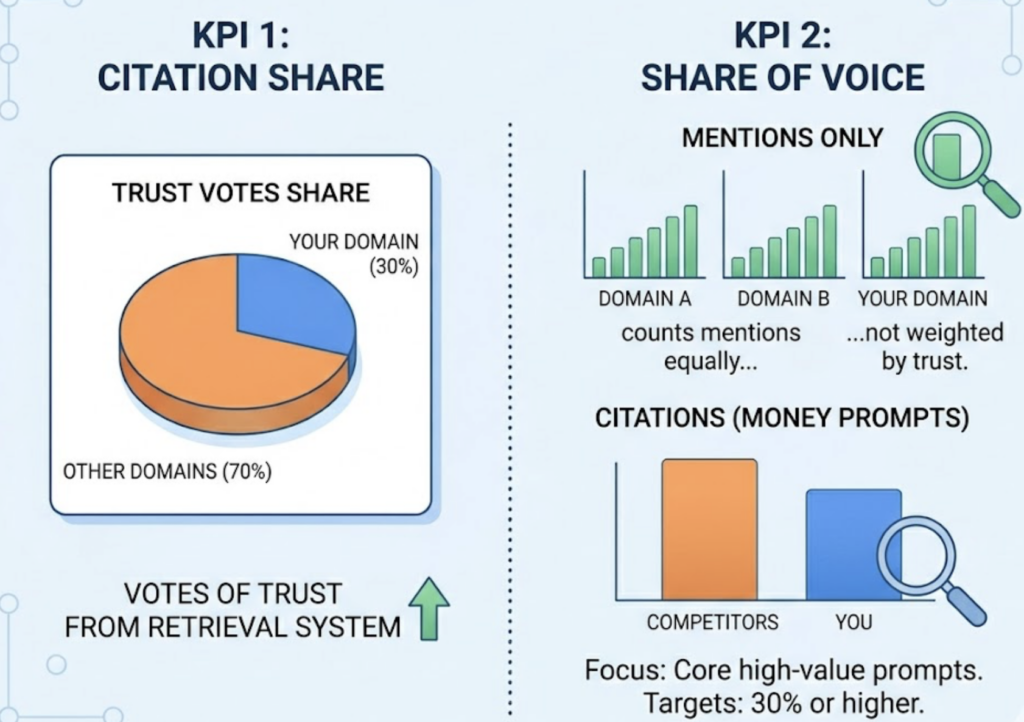
Citation Share measures the percentage of all citations in a given prompt set that point to your domain. This is your baseline KPI. Unlike Share of Voice, which counts mentions, Citation Share counts votes of trust from the retrieval system. A healthy Citation Share for core “money prompts” typically targets 30% or higher.
Competitor Citation Gap shows the specific difference between your reference rate and your primary competitors’. Good tools segment this into “Outrankable” targets (weak pages you can displace with better content) and “Partner” targets (third-party directories where you need to earn a listing).
AI Source Domain Authority classifies the types of domains the AI prefers for your specific category. This matters because the distribution is rarely what teams expect. Data from 2026 shows that for many categories, community platforms like Reddit account for up to 48% of all citations — meaning a brand focusing solely on its own blog is statistically at a disadvantage.
Volatility Index tracks how quickly citation status changes over time. High volatility signals unstable authority. Low volatility means the model has developed consistent trust in specific sources — including, ideally, yours.
The table below shows how these metrics work together:
| Metric | What It Measures | Why It Matters |
|---|---|---|
| Citation Share | % of citations pointing to your domain | Baseline visibility and authority |
| Citation Prominence | Position of the citation in the response | High prominence correlates with higher conversion |
| Source Diversity | Breadth of different domains cited for your brand | Low diversity = fragility risk |
| Volatility Index | Rate of change in citation status over time | High volatility = unstable authority signals |
The Best AI Citation Tracking Tools in 2026
The market has matured into distinct tiers. For most marketing and SEO teams, the decision comes down to a few platforms.
| Feature | Topify | Profound | AtomicAGI | Peec AI |
|---|---|---|---|---|
| Platforms | ChatGPT, Gemini, Perplexity, DeepSeek, Claude | 10+ engines (incl. Grok, Copilot) | ChatGPT, Gemini, Perplexity, Claude | ChatGPT, Perplexity, Google AIO |
| Source Analysis | Deep URL level | Conversation level | Technical level | Dashboard level |
| Automation | One-Click Execution | Limited | Full AI Agents | Limited |
| Starting Price | $99/mo | $499/mo | $20/mo | €89/mo |
| Best For | SEO/Marketing teams | Global enterprises | Growth/tech teams | Multi-region brands |
Topify is the strongest option for marketing teams that need to turn citation data into content action. Its Source Analysisfeature goes beyond tracking: it reverse-engineers competitor citation strategies by identifying not just who is being cited, but the specific content structures and data points the AI retrieved. If a competitor is winning citations for a high-intent prompt, Topify lets you analyze their content architecture and build a direct response.
The platform tracks seven dimensions simultaneously: visibility, sentiment, position, volume, mentions, intent, and CVR. That breadth matters because citation data without sentiment context can be misleading — a brand can appear in 40% of citations while being framed negatively.
Topify covers ChatGPT, Gemini, Perplexity, DeepSeek, Doubao, Qwen, and other major AI platforms. The team includes founding researchers from OpenAI and former Google SEO leads, which shows in the algorithm’s depth.
Pricing: Basic at $99/mo (100 prompts, 9,000 AI answer analyses), Pro at $199/mo (250 prompts), Enterprise starting at $499/mo. Get started with Topify here.
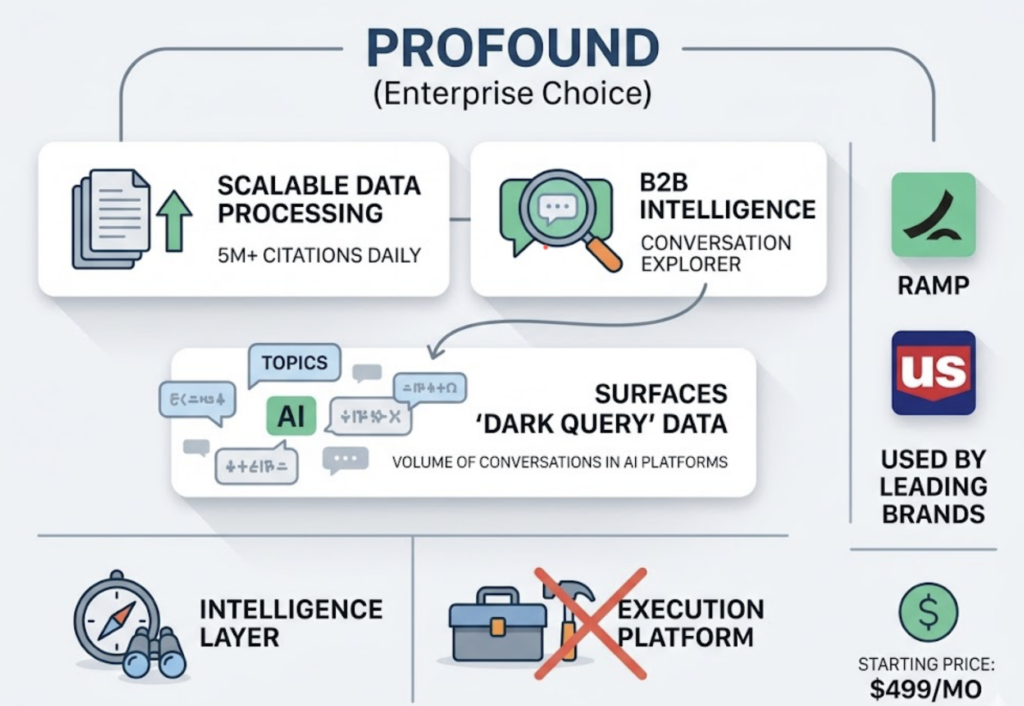
Profound (formerly Tryprofound) remains the enterprise choice for scale. It processes over 5 million citations daily and is particularly strong for B2B intelligence through its “Conversation Explorer” tool, which surfaces “dark query” data — the actual volume of conversations happening within AI platforms about specific topics. It’s been used by brands like Ramp and US Bank. That said, it’s more of an intelligence layer than an execution platform, and the starting price of $499/mo reflects that positioning.
AtomicAGI ($20/mo) is designed for technical teams. It uses autonomous agents to automatically fix schema and bot permission issues that prevent citations. Useful if your citation problem is structural rather than strategic.
Peec AI (€89/mo) supports 115+ languages and is the practical choice for global brands tracking visibility across multiple markets.
5 Mistakes That Kill Your AI Citation Strategy
Teams adopt citation tracking and then wonder why their numbers don’t improve. Usually, the problem isn’t the tool — it’s the approach.
Mistake 1: Tracking mentions instead of sources. If an AI mentions your brand but cites a competitor’s review site to describe you, the AI is endorsing the competitor as the expert on your own product. You need to track the URL of the citation, not just the text of the mention.
Mistake 2: Monitoring ChatGPT only. Only 11% of domains are cited by both ChatGPT and Perplexity for the same query. A brand can have a 5% citation share on ChatGPT and nearly 0% on Gemini. Multi-platform tracking isn’t optional.
Mistake 3: Assuming citation equals recommendation. A citation is a reference, not an endorsement. High-visibility brands sometimes appear as examples of “declining legacy players.” Tools like Topify include sentiment analysis in every citation report specifically to catch this.
Mistake 4: No competitor baseline. If you’re cited in 40% of responses but your primary rival is cited in 75%, you’re losing the authority battle despite a high absolute number. Citation Share only becomes useful when it’s relative.
Mistake 5: Monthly monitoring on a weekly-volatile signal. Citation rates can decline by 34% in just five weeks due to model updates or competitor content refreshes. A monthly cadence means you’re always reacting to damage that already happened.
A Practical AI Citation Tracking Checklist for Marketing Teams
This is how teams that are improving their AI citation tracking strategy actually structure their work.
Weekly (The Pulse): Review your 20-30 “money prompts” for citation source changes. Check competitor win/loss on core queries. Resolve any automated alerts about sudden drops in citation frequency.
Monthly (The Engine): Audit Citation Share trend relative to category average. Use Source Analysis to identify 5-10 specific topics where competitors are earning citations you’re missing. Check schema markup and bot permissions to ensure AI crawlers can still access your grounding data.
Quarterly (The Pivot): Deep-refresh any top-cited pages older than 90 days. Freshness is a primary signal — quarterly updates reduce citation loss by 3x. Expand your prompt library based on new conversation data. Translate research into action: update headings, add FAQ schema blocks, and integrate new statistics.
On content structure, the data is clear on what makes a page “citeable.” A 40-60 word BLUF (Bottom Line Up Front) answer at the start of each section is easily extractable as a grounding block. Sequential heading structure (H1 → H2 → H3) helps AI parse topic boundaries. Specific statistical claims increase citation probability by over 40% compared to qualitative text alone. Valid JSON-LD FAQ schema is directly preferred by Google AI Overviews for extraction.
Topify’s One-Click Execution handles the translation from insight to action — you identify the citation gap, define the goal, and the platform deploys the content strategy without requiring manual workflows at each step.
Conclusion
The brands building durable visibility in AI search aren’t the ones with the most mentions. They’re the ones whose content has become the AI’s preferred source of truth.
Citation tracking is how you measure that. It’s also how you close the gap when a competitor is pulling ahead. The tools exist, the metrics are well-defined, and the operational cadence is straightforward. What’s missing for most teams isn’t access to data — it’s the habit of treating citation authority as a structured growth channel rather than a background metric.
Topify offers the most actionable path for marketing and SEO teams that need both the intelligence and the execution layer in one place. Start with Source Analysis on your five most important commercial prompts. You’ll know within two weeks where the gaps actually are.
FAQ
Q1: What is an AI citation tracking tool? An AI citation tracking tool is a platform that monitors which external URLs and domains are referenced as sources when AI systems like ChatGPT or Perplexity generate answers to user prompts. Unlike traditional SEO tools that track rankings, these tools track reference authority — whether the AI is treating your content as a trusted source.
Q2: How does AI citation tracking differ from traditional backlink tracking? Backlink tracking measures human-created links intended to pass PageRank for SEO. AI citation tracking measures AI-selected sources used to ground a generated answer. A site can have thousands of backlinks but zero AI citations if its content isn’t structured for machine extraction.
Q3: What are the best tools for AI citation tracking in 2026? Topify is the strongest choice for marketing teams that need an integrated GEO strategy with source analysis and automated execution. Profound is the enterprise standard for deep query intelligence at scale. AtomicAGI is best for technical teams focused on structural fixes.
Q4: How often should I check my AI citation tracking data? Weekly for core money prompts. AI citation patterns can shift by over 30% in a single month due to model updates and competitor content changes. Monthly monitoring is too slow to catch drops before they affect quarterly performance.

