

Most brand managers have a complete picture of how their brand performs on Google. Rankings, impressions, click-through rates. All measurable. All actionable.
What they don’t have is any visibility into what ChatGPT says when a potential customer asks, “What’s the most reliable tool in this category?” Or what Gemini generates when someone searches for a comparison that includes your brand. These answers exist, they’re being read by millions of users, and they’re shaping purchase decisions, and most brands have no idea what’s in them.
That’s the gap AI reputation monitoring services are built to close.
AI Search Created a Reputation Layer Nobody Was Tracking
The shift from search engines to generative AI has changed how brand reputation actually works.
In the traditional model, Google acted as a directory. It returned links, and users decided who to trust. In the generative model, AI platforms act as surrogate researchers. They read the web, synthesize a conclusion, and deliver a single authoritative answer. No list of links. No alternative interpretations. Just a confident response that most users treat as fact.
Here’s the consequence: nearly 60% of desktop searches and 77% of mobile searches now end without a click to any external website. The AI’s summary is the final word. And direct referral traffic from AI platforms grew 527% year-over-year between January and May 2025, meaning the brands that appear in those summaries are capturing real, measurable traffic growth.
Brands that don’t appear aren’t just missing an opportunity. They’re invisible at the exact moment a decision is being made.
What AI Reputation Monitoring Services Actually Do
An AI reputation monitoring service tracks how generative AI platforms describe, frame, and evaluate your brand in response to user queries.
That definition matters because it’s fundamentally different from what traditional ORM and social listening tools do. Social listening monitors what humans are saying: reviews, forum posts, social media comments. AI reputation monitoring tracks what machines are generating: the synthesized answers that AI systems produce when asked about your brand.
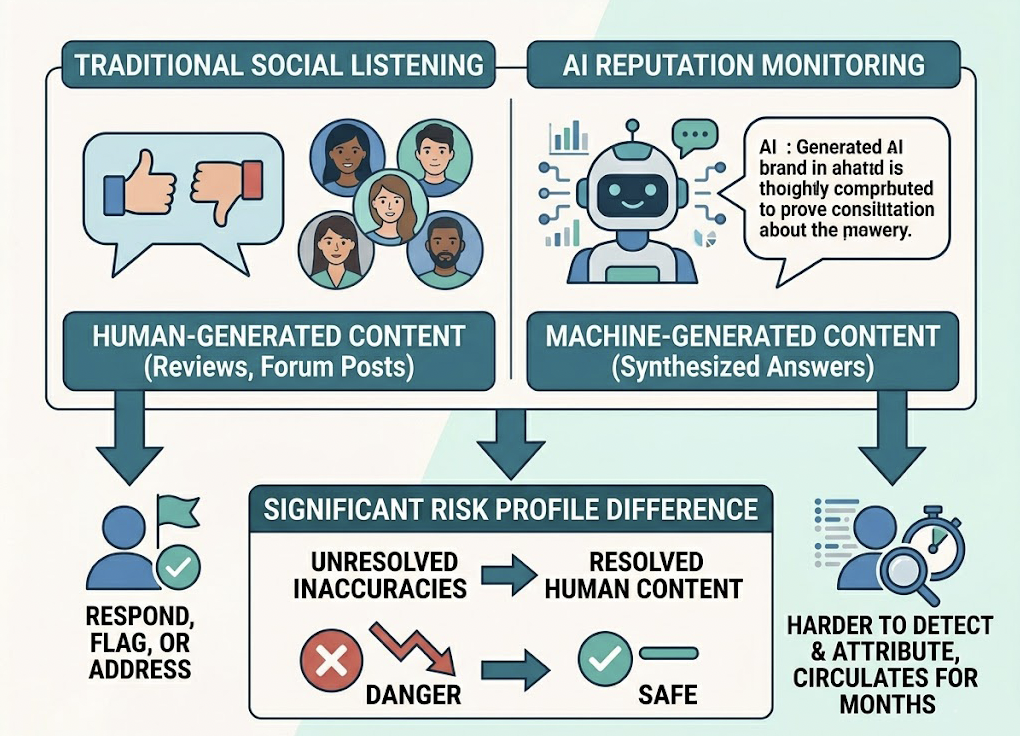
The difference in risk profile is significant. Human-generated content can be responded to, flagged, or addressed directly. AI-generated content is harder to detect, harder to attribute, and can circulate for months before anyone notices it’s inaccurate.
The core question these services answer is: What does the AI believe to be true about this brand, and why?
AI models don’t retrieve your official brand page and quote it back to users. They synthesize from thousands of sources, prioritizing frequency and consensus over official claims. The result is what researchers describe as a “shadow reputation”: a brand narrative living inside these models that exists independently of your positioning, your messaging, or your brand guidelines.
An AI reputation monitoring tool makes that shadow reputation visible.
The 4 Metrics That Define Your AI Brand Health
A professional AI reputation monitoring platform tracks four core dimensions. Each one reveals a different layer of how AI systems perceive your brand.
Visibility measures how frequently your brand appears in AI-generated answers across a defined set of prompts. Being omitted is functionally equivalent to not existing for that query. High visibility means your brand has successfully permeated the retrieval sets of major models.
Sentiment quantifies how the AI frames your brand when it does appear. Not whether humans feel positively or negatively, but whether the model recommends you with confidence, mentions you with caveats, or describes you in ways that contradict your positioning. This is a machine-readable metric, scored on a 0-100 scale, not a subjective assessment.
Position tracks where your brand ranks when it appears in recommendation lists. Being the first brand mentioned in “The 5 Best Tools for Enterprise Marketing Teams” carries significantly more authority weight than being the fifth. Position data shows exactly where you stand in the model’s competitive hierarchy.
Source Citations is the most actionable dimension of any AI reputation monitoring dashboard. By identifying which specific domains the AI uses to justify its claims about your brand, you get a direct line to what’s driving the narrative and where optimization will have the highest ROI.
These four dimensions work together. High visibility with negative sentiment is a problem. Strong sentiment with poor position means you’re being mentioned but not prioritized. Source Citation analysis tells you why. Pulling just one metric in isolation leads to decisions based on incomplete data.
5 Warning Signs Your AI Reputation Is Already Off Track
Most brands discover they have an AI reputation problem by accident. A sales rep mentions an odd customer conversation. A teammate sends a screenshot. By then, the narrative has usually been circulating for weeks or months.
Positioning mismatch. The AI describes your product using language you’ve never used in any official channel. A premium B2B platform described as “affordable for freelancers.” An enterprise security tool described as “good for startups.” This typically happens when discount aggregator sites or outdated promotional content have accumulated enough citations to shape how the model interprets your category position.
The competitive recommendation gap. In “best of” or comparison queries, competitors appear consistently and you don’t. This is almost never a product quality issue. It’s a citation network issue: the sources that AI platforms trust most mention your competitors more frequently.
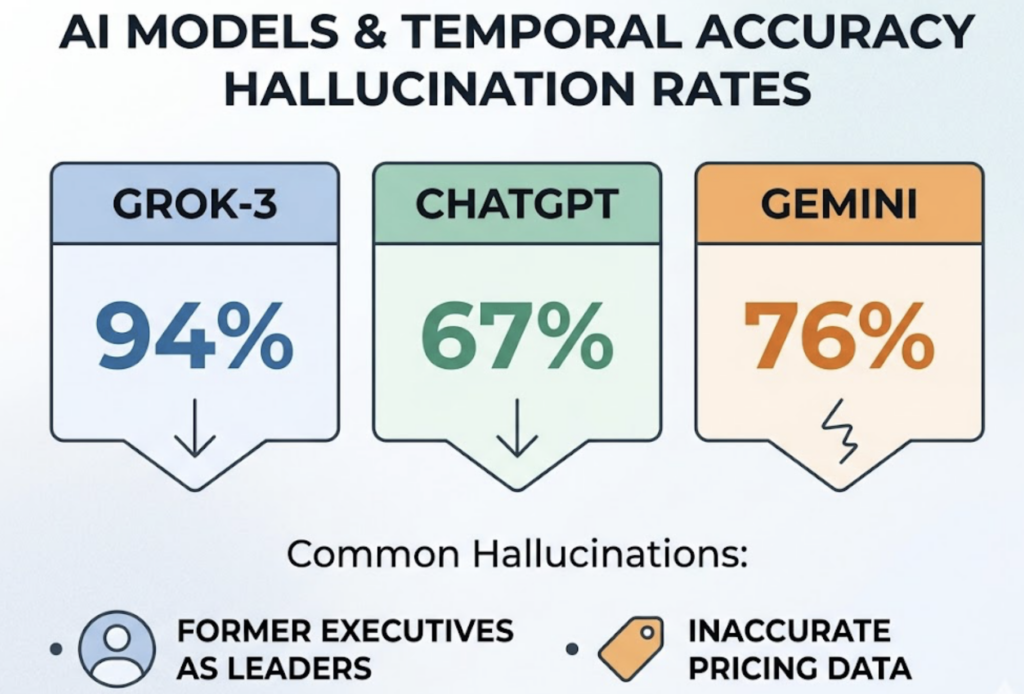
Outdated or factually incorrect information. AI models struggle with temporal accuracy. Research shows hallucination rates remain high across all major platforms: Grok-3 hallucinates on general knowledge queries 94% of the time, ChatGPT at 67%, and Gemini at 76%. Former executives named as current leaders, discontinued features described as active, pricing data that hasn’t been accurate in years. These aren’t edge cases when your brand’s knowledge footprint hasn’t been actively managed.
Contradictions across platforms. Your brand appears accurately in Perplexity but is misrepresented in Gemini or ChatGPT. This signals that while you may have niche authority in some source domains, your broad-market digital footprint is inconsistent. Consumers who research across multiple AI tools get contradictory impressions.
Zero data on what AI says about you. This is the most common situation and the highest-risk state. No data means no ability to detect any of the above problems.
Why Different AI Platforms Trust Different Sources
Understanding how AI models process brand information explains why monitoring a single platform gives you an incomplete picture.
Most major AI platforms use Retrieval-Augmented Generation (RAG). When a user submits a query, the system retrieves relevant content from the web, feeds it to the model, and generates a synthesized answer. But each platform retrieves from different sources, weighted differently.
Google Gemini pulls 52.15% of its citations from brand-owned websites. Structured, factual content on your main domain, schema-marked pages, and consistent subdomains carry real weight in Gemini’s outputs. ChatGPT, by contrast, sources nearly 49% of citations from third-party directories like Yelp, TripAdvisor, and Google Maps. Perplexity prioritizes niche expertise, with industry-specific sources accounting for 24% of citations for unbranded queries, the highest rate among major platforms.
Your brand reputation isn’t a single thing. It’s a fragmented set of narratives across different ecosystems, shaped by different source types, recombined differently each time a user runs a query.
This is why “Semantic Stability” matters. AI systems develop confidence in a brand when its description is consistent across high-authority sources. When one domain calls your product “premium” and another calls it “affordable,” the model loses confidence and either produces a vague, watered-down description or omits your brand in favor of a competitor with a clearer digital identity.
An AI reputation monitoring software detects these inconsistencies. The question is whether you’re measuring it before or after a competitor exploits the gap.
How to Choose an AI Reputation Monitoring Solution That Actually Works
The market for AI reputation monitoring tools has expanded quickly, and not all platforms deliver the same depth. Here’s what separates a useful solution from an expensive dashboard.
| Criterion | What to Look For | Red Flag |
|---|---|---|
| Platform Coverage | ChatGPT, Gemini, Perplexity, DeepSeek, regional variants | Single-platform monitoring only |
| Data Depth | Full Sentiment + Position + Citation breakdown | Visibility counts with no context |
| Update Frequency | Weekly minimum; daily for regulated industries | Monthly batch reports |
| Actionability | Specific recommendations tied to metrics | Raw data with no optimization guidance |
Most entry-level tools cover one or two platforms and report on mention counts. That’s a starting point, not a monitoring strategy. AI citation patterns shift frequently, sometimes in response to a single viral article or a shift in a competitor’s PR coverage. A monthly report misses most of it.
Topify runs across 400+ daily prompts per brand, tracking seven indicators: Visibility, Sentiment, Position, Volume, Citations, User Intent, and CVR (Conversion Visibility Rate). It monitors across ChatGPT, Gemini, Perplexity, DeepSeek, Doubao, and other major AI engines, covering both global and regional markets.
The Source Analysis function identifies the specific URLs that AI platforms are citing for your brand, which directly informs where content and PR investment will move the needle. Plans start at $99/month for the Basic tier, covering 100 prompts across ChatGPT, Perplexity, and AI Overviews. The Pro tier at $199/month scales to 250 prompts across 8 projects. Enterprise plans start at $499/month with dedicated account management.
A 4-Step Strategy for Managing Your AI Reputation
An AI reputation monitoring system provides the data. A strategy determines what to do with it. Here’s the sequence that works in practice.
Step 1: Build a prompt library. Start with the queries your actual customers ask, not just branded searches. Category queries (“What’s the most reliable X for enterprise use?”), comparison queries (“Brand A vs. Brand B for mid-market teams”), objection queries (“Is Brand X worth the price?”), and factual queries (“Where is Brand X headquartered?”). A diverse prompt library gives you a representative sample of how AI describes you across different contexts.
Step 2: Establish a baseline. Run your prompt library across at least three major AI platforms and record the current state. Visibility score, sentiment, position in recommendation lists, which domains are being cited. This baseline reveals the “Visibility Gap” between your traditional SEO performance and your actual AI representation. Most brands are surprised by how large it is.
Step 3: Run a citation gap analysis. Compare which high-authority domains cite your competitors but not you. That gap is your most direct guide to where content and PR investment will generate AI visibility gains. If ChatGPT is consistently citing industry review platforms that don’t mention your brand, that’s a concrete, addressable problem, not a vague SEO directive.
Step 4: Optimize for AI citation. Content that performs in generative search is structured differently from traditional SEO content. Self-contained, fact-dense paragraphs that AI can extract and reuse. Consistent brand descriptions across authoritative third-party domains to build semantic stability. FAQ schema and structured data to give AI retrieval systems explicit signals about your content’s purpose and accuracy.
Topify’s one-click execution feature lets teams define goals in plain English and deploy a GEO strategy without building manual workflows, compressing the time between insight and action.
Conclusion
The financial consequences of unmanaged AI reputation are already documented. Hallucinations alone account for an estimated $67.4 billion in annual business losses, and legal precedent, including the Air Canada tribunal ruling, has established that companies can be held liable for AI-generated misrepresentations made in their name.
AI reputation monitoring services don’t solve these risks overnight. What they do is give you visibility into a narrative that already exists and is already influencing how consumers evaluate your brand. You can’t optimize what you can’t see, and right now, most brands are flying blind. Get started with Topify to find out exactly where your brand stands.
FAQ
Q: What is an AI reputation monitoring service?
A: An AI reputation monitoring service continuously tracks how generative AI platforms like ChatGPT, Gemini, and Perplexity describe and evaluate a brand in response to user queries. It monitors Visibility, Sentiment, Position, and Source Citations to identify gaps between a brand’s intended positioning and the AI’s synthesized narrative.
Q: How does AI reputation monitoring differ from traditional online reputation management?
A: Traditional ORM monitors user-generated content: social posts, reviews, and forum discussions. AI reputation monitoring tracks machine-generated content, specifically the synthesized answers that AI models produce, including hallucinations, outdated information, and positioning mismatches that social listening tools don’t capture.
Q: How often should I check my brand’s AI reputation?
A: Weekly monitoring is the practical minimum, since AI citation patterns shift frequently. Brands in regulated industries or those navigating active PR situations should consider daily monitoring to detect hallucinations before they propagate across multiple platforms.
Q: What’s the typical pricing for AI reputation monitoring services?
A: Entry-level tools designed for startups typically start between $29 and $99 per month. Mid-market platforms with multi-engine coverage and full sentiment analysis generally range from $99 to $499 per month. Enterprise-grade solutions with custom configurations and revenue attribution can exceed $1,500 per month.

