

You’ve spent years refining your brand positioning. Then you ask ChatGPT to recommend solutions in your category, and it describes your product using attributes you’ve never claimed, pricing that’s outdated, and a market position you don’t occupy. The AI didn’t get it wrong because of malice. It got it wrong because nobody was watching.
That’s the core problem an AI brand intelligence system is designed to solve.
Your Brand Has a Reputation in AI Search. You Probably Don’t Know What It Is.
AI platforms have quietly become the first stop for product research. ChatGPT now sees 4.7 billion monthly visits with 81% AI search market share. Perplexity grew 239% year-over-year to 133 million monthly visits. Google AI Overviews serves 2 billion users globally. These aren’t early-adopter experiments anymore.
Here’s what makes this structurally different from traditional search: AI sessions last significantly longer. Google AI Mode averages 4 minutes 37 seconds per session, compared to the quick click-and-bounce behavior of legacy search. During that extended session, the AI shapes the user’s understanding of your brand, your competitors, and the entire category, without ever sending you a notification.
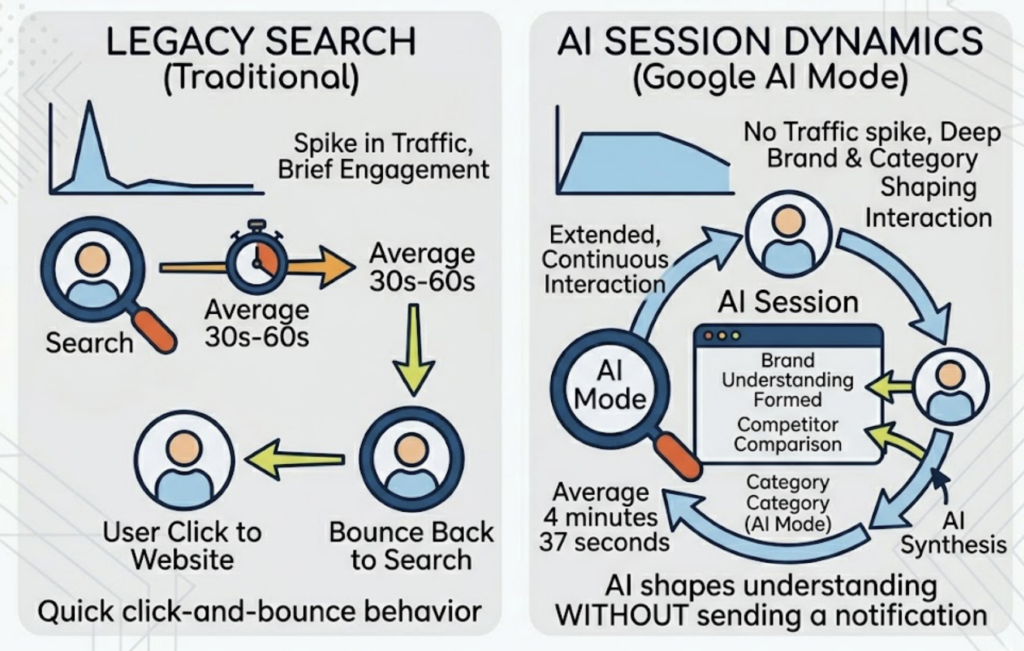
By late 2025, approximately 60% of AI search queries ended in zero-click answers. The user got what they needed inside the chat. Your organic traffic data, your CTR, your Google Search Console reports: none of that captured what the AI said about you, or whether it mentioned you at all.
That’s the gap an AI brand intelligence system is built to close.
What an AI Brand Intelligence System Actually Measures
An AI brand intelligence system is a specialized analytics layer that tracks how AI models interpret, reference, and rank a brand across generative platforms. It’s distinct from social listening (which monitors what humans post) and traditional SEO tools (which monitor Google rankings). The object being measured is different: not human opinions, but AI-synthesized recommendations.
A comprehensive AI brand intelligence dashboard covers five dimensions.
Visibility tracks how often your brand appears in relevant AI-generated responses. This is sometimes called “Inclusion Probability,” not “ranking.” The question isn’t where you rank; it’s whether you’re included at all. The Visibility Depth Index goes further, measuring whether the AI integrates your brand’s logic into its reasoning or simply drops your name as a footnote.
Sentiment measures whether the AI describes your brand positively, neutrally, or negatively, and whether that description aligns with your intended positioning. A “Narrative Consistency Index” quantifies the gap between what the AI says and what you actually stand for. If you position as enterprise-grade and the AI calls you “a budget option for small teams,” that’s a sentiment misalignment that needs to be tracked and corrected.
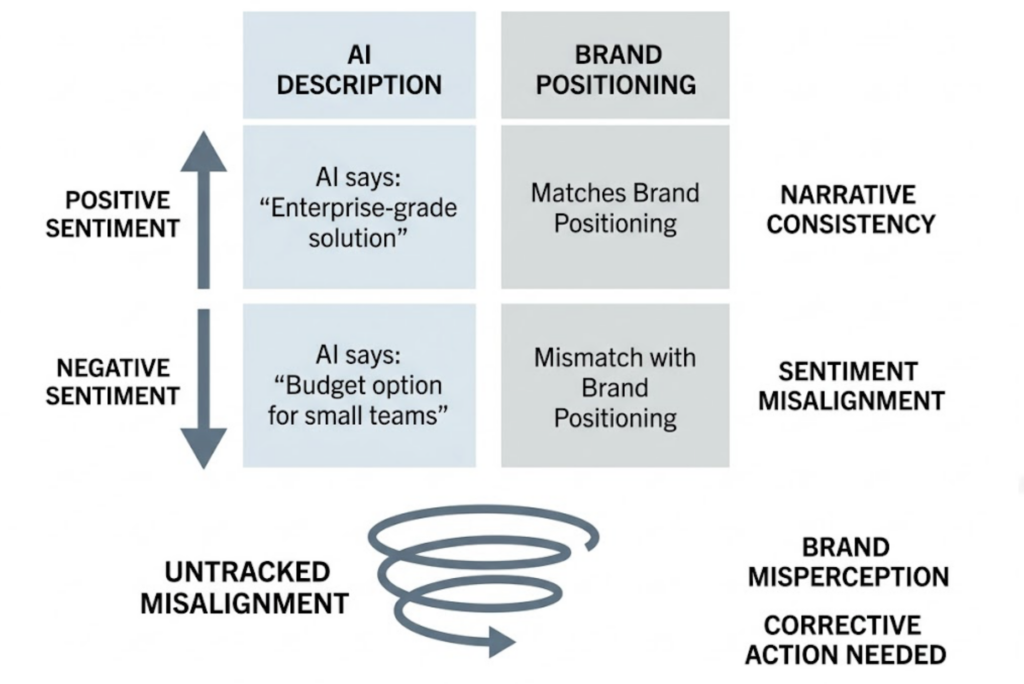
Position monitors where your brand appears in AI recommendation lists. Being the first option recommended carries substantially higher trust weight than appearing fourth or fifth. The AI’s “Retrieval-Augmented Generation” (RAG) logic determines which brands are chosen as the primary answer source versus those used only as supporting evidence.
Source Attribution is one of the most powerful features of a mature AI brand intelligence analytics layer. It identifies the specific URLs, articles, and forum threads the AI model cites when it talks about your brand. If the AI is describing you based on a three-year-old review or a competitor-written comparison, you can only fix that if you know the source exists.
Competitive Share provides real-time comparison against peers. This includes direct head-to-head analysis (how does the AI answer “Brand X vs. Brand Y?”) and AI share of voice across category-level prompts.
5 Common Mistakes Brands Make Without an AI Brand Intelligence Analytics Layer
Most brands aren’t ignoring AI search out of negligence. They just don’t have the right system yet. That gap produces predictable and costly errors.
Mistake 1: Assuming Google rankings predict AI inclusion. Research shows that 52% of AI citations come from websites that don’t rank in the top 100 organic search results. AI models prioritize reasoning depth and factual density over backlink volume. Your SEO authority doesn’t automatically translate to AI authority.
Mistake 2: Only monitoring branded prompts. Searching for your own brand name tells you almost nothing about new customer acquisition. The “unbranded discovery layer” — queries like “what’s the best CRM for mid-market manufacturing?” — is where most category-level decisions are made in the GenAI era. If you’re not tracking those prompts, you’re monitoring the wrong question.
Mistake 3: Treating AI responses as static. A traditional keyword ranking shifts slowly. AI answers fluctuate based on prompt phrasing, model version, and real-time data updates. Brands that test themselves with one prompt on one platform get a single data point, not a picture.
Mistake 4: Skipping sentiment and association tracking. AI models build associations. If your brand is frequently co-mentioned with “security breach,” “outdated,” or “acquired,” the model creates an algorithmic link between your entity and those concepts. Without an AI brand intelligence solution that tracks entity co-occurrence, you won’t know those associations exist until they start affecting buying decisions.
Mistake 5: No source analysis for correction. When the AI “hallucinates” about your pricing or features, brand managers often don’t know why. Without source attribution, you can’t identify the outdated or incorrect content that’s feeding the model’s error. You can’t fix what you can’t locate.
How to Build an AI Brand Intelligence Strategy in 4 Steps
A functional AI brand intelligence strategy doesn’t require a massive team or a six-month project. It requires a structured sequence.
Step 1: Audit. Run a library of 100-250 intent-based prompts across ChatGPT, Gemini, Perplexity, and other platforms you care about. The goal is a reputation snapshot: where are you mentioned, where are you absent, and where is the AI’s description drifting from your actual positioning? Topify automates this process, generating a comprehensive baseline across 7+ AI platforms and categorizing results by visibility, sentiment, and position in a single AI brand intelligence dashboard.
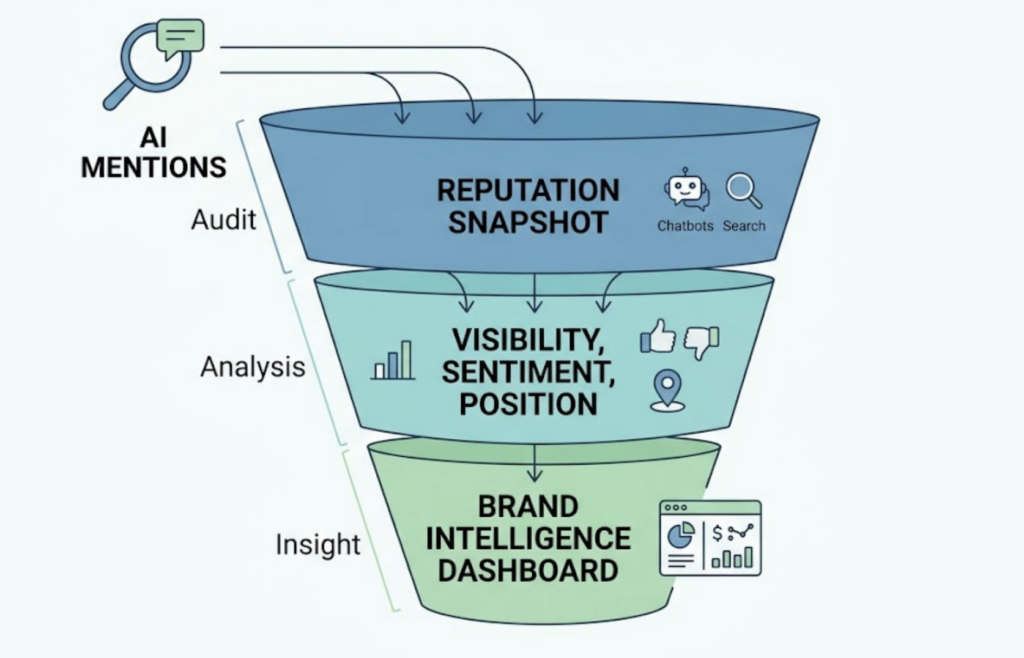
Step 2: Benchmark. Once you have the snapshot, set competitive baselines. Measure your AI share of voice against three to five key competitors. Identify the “Source Trust Differential” — the gap between the authority of sources citing you versus those citing your competitors. Topify’s Competitor Monitoring surfaces which rivals are gaining ground on specific prompts, and which content is driving those gains.
Step 3: Optimize. Research from Princeton and Georgia Tech found that specific content tactics can increase AI visibility meaningfully. Adding statistics to content increased visibility by up to 40%. Adding citations to sources increased it by up to 115% for lower-authority sites. Topify’s Source Analysis identifies exactly which content updates — adding an FAQ section, refreshing outdated statistics, sourcing expert quotes — will have the highest impact on AI citation frequency for your specific brand.
Step 4: Monitor. AI behavior isn’t a “set-and-forget” problem. Model updates, competitor PR activity, and new user question patterns all shift how your brand is represented. Get started with Topify to set automated alerts for sentiment shifts or drops in recall probability on specific platforms, so your team responds to changes within days rather than quarters.
How to Choose an AI Brand Intelligence Platform: A Practical Checklist
The market for AI brand intelligence software has matured enough that the options look similar at first glance. The differences show up in what the platform actually measures and how.
Here’s what to evaluate before committing:
Multi-platform coverage. A tool that only tracks ChatGPT is insufficient in 2026. Reputation is distributed across ChatGPT, Gemini, Perplexity, Claude, DeepSeek, and regional models. Topify covers 7+ major AI platforms and search surfaces. Most lighter tools top out at two or three.
Sentiment depth, not just mention count. Knowing you were mentioned 40 times doesn’t tell you whether the AI is recommending you or dismissing you. The AI brand intelligence solution you choose should include sentiment scoring and entity association mapping.
Source attribution capability. This is the feature that separates serious platforms from dashboards. If the tool can’t tell you which URLs the AI is citing when it talks about your brand, it can’t help you fix anything upstream.
Competitive intelligence automation. Manual competitor tracking doesn’t scale. The platform should automatically surface which competitors are gaining visibility, on which platforms, and on which prompt types.
Prompt diversity and volume. AI answers vary dramatically by phrasing. A platform that tests 10 prompts is giving you 10 data points. Platforms like Topify support 100-250 prompts per project, segmented by customer intent, giving you a statistically meaningful picture of your AI reputation.
Technical data reliability. Some tools use sanitized API responses. Others use browser automation to capture exactly what a real user sees. Topify was built by a team with founding researchers from OpenAI and champion Google SEO practitioners, with retrieval methods designed for accuracy across live model outputs.
For a head-to-head comparison of what’s in the market, Topify’s blog on AI visibility and GEO tools is worth reading before you finalize a shortlist.
AI Brand Intelligence Tool Pricing: What to Budget in 2026
The market has consolidated into three tiers.
| Category | Price Range | Typical Audience |
|---|---|---|
| Lightweight | $29 – $130/mo | SMBs, solo founders |
| Professional | $199 – $500/mo | Mid-market, agencies |
| Enterprise | $1,000/mo – $40k/yr | Fortune 500, global brands |
For context: enterprise competitive intelligence platforms like Klue or Crayon typically run $20,000–$40,000 per year. They cover broad market intelligence. Topify focuses specifically on the AI discovery layer, which is where brand reputation is increasingly formed.
Topify’s tiers are structured around how teams actually use the product:
Basic ($99/mo): 100 prompts, 4 AI platforms, 9,000 monthly analyses, 4 projects, 4 seats. Well-suited for small teams running regular brand audits and monitoring a defined competitor set.
Pro ($199/mo): 250 prompts, 8 projects, 22,500 monthly analyses, 10 seats. Designed for growing teams managing multiple brand lines or agency clients.
Enterprise (from $499/mo): Custom prompt volume, dedicated account manager, custom model integrations, unlimited historical data. Built for organizations where AI brand visibility is a board-level concern.
See the full pricing breakdown at Topify to map your prompt and project volume to the right plan.
Conclusion
The question isn’t whether AI platforms have formed an opinion of your brand. They have. The question is whether you have a system to measure it, correct it, and stay ahead of it as model behavior shifts.
An AI brand intelligence system turns a blind spot into a measurable channel. Start with the audit — understand what the AI is saying about you today, across which platforms, and based on which sources. From there, you can benchmark against competitors, optimize the content driving AI citations, and monitor for changes before they compound into market share erosion.
Topify covers the full stack: visibility tracking, sentiment analysis, source attribution, competitor benchmarking, and one-click GEO execution. If you’re ready to stop guessing what AI thinks of your brand, start here.
FAQ
Q1: What is an AI brand intelligence tool?
An AI brand intelligence tool is a specialized platform that monitors how your brand is mentioned, characterized, and ranked across generative AI models like ChatGPT, Gemini, and Perplexity. Unlike traditional monitoring tools that track social media or news, these tools measure how AI engines synthesize and recommend your brand, including metrics like AI citation frequency, sentiment alignment, and source attribution.
Q2: How do you measure AI brand intelligence effectively?
Effective measurement requires tracking four layers simultaneously. The awareness layer covers AI mention volume and share of voice relative to competitors. The consideration layer tracks position in recommendation lists and the authority of cited sources. The sentiment layer analyzes the tone and attributes the AI associates with your brand. The consistency layer checks how well AI answers align with your core messaging across different prompts, models, and platforms.
Q3: What are examples of AI brand intelligence systems?
Topify offers comprehensive tracking across 7+ AI models, including deep source analysis and one-click GEO execution, making it well-suited for mid-market and enterprise teams. Lighter tools like Mint and Otterly focus on specific platforms or content optimization. Enterprise-grade market intelligence platforms like Klue and Crayon include AI features as part of broader competitive intelligence suites, typically at significantly higher price points.
Q4: How does an AI brand intelligence tool work technically?
These tools run a structured library of prompts through AI platforms using either API access or browser automation to capture what real users see. The system then applies Natural Language Processing (NLP) to identify brand mentions, evaluate sentiment, classify entity associations, and extract citation URLs for source attribution. The prompt library, typically 100-250 prompts segmented by customer intent, is what allows the system to build a statistically reliable picture of brand reputation rather than a single snapshot.

