

Your brand has a 4.6-star rating on Google. Your review response time is under 24 hours. Your Google Business Profile is fully verified. By every traditional measure, your reputation is in good shape.
Then someone asks ChatGPT to compare you against a competitor, and it describes your product as “a solid but dated option” while citing a review from two years ago that no longer reflects your pricing or features. Nobody flagged it. Nobody could have.
That gap is the whole story behind AI reputation management. It isn’t a rebrand of review monitoring for a new channel. It runs on different inputs entirely, and most teams are still watching the wrong dashboard.
Reviews Tell You What Customers Think. AI Tells You What It Thinks They Should Think
Star ratings and review counts are a lagging aggregate. They summarize what people who already bought from you experienced, filtered through whoever bothered to leave a rating.
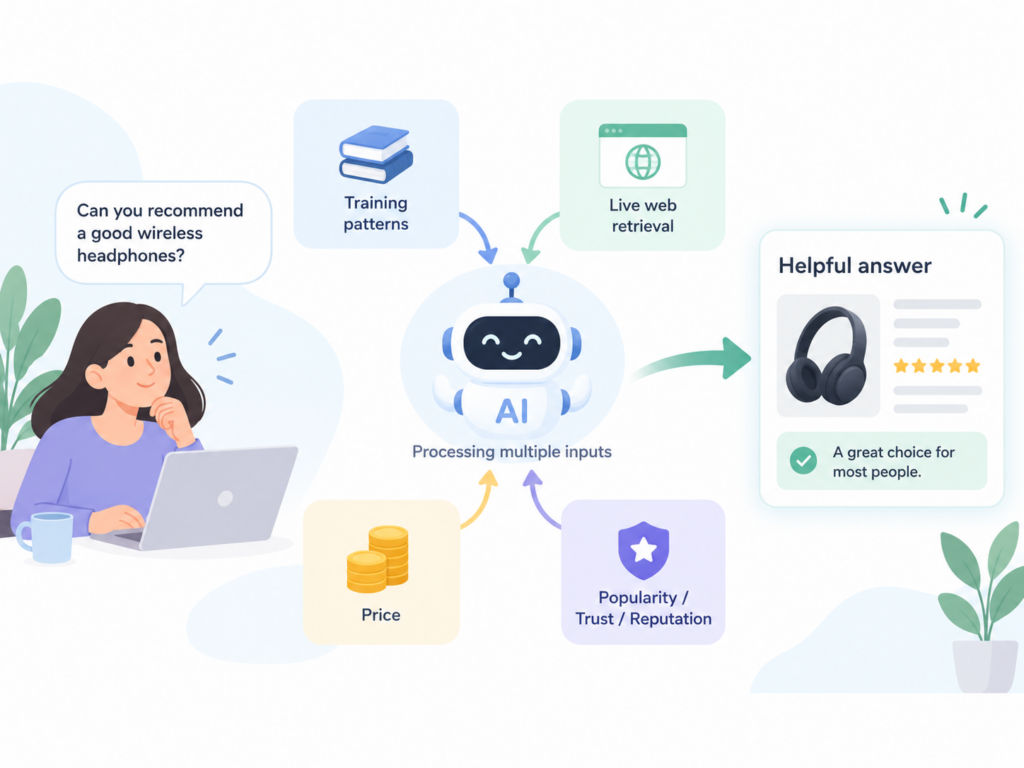
AI-generated answers work differently. When someone asks an AI assistant for a recommendation, the model isn’t polling your customer base. It’s predicting the most likely helpful response based on patterns in its training data and whatever it retrieves live from the web. Reputation, in this context, is an input the model weighs alongside price, popularity, and trust signals, not the final word.
That distinction matters more than most teams assume. Research on ChatGPT’s citation behavior found that reputation drives only 12.1% of brand inclusions in its answers, the lowest of any major AI platform. Price and trust barely register at all, at 3.1% and 1.5% respectively. Performance framing and content depth do far more of the work.
Here’s the part that catches brands off guard. A high star rating doesn’t automatically translate into a favorable AI answer, because the model isn’t reading your rating widget. It’s reading whatever text it can retrieve about you, and weighing that against everything else written about your category.
The Real Inputs: Prompts and Citations, Not Ratings and Reviews
Two mechanics decide what an AI assistant says about your brand, and neither one appears on a review platform.
Prompts are the actual questions people type into ChatGPT, Gemini, or Perplexity. Not every prompt about your category mentions your brand. Commercial-intent phrasing, things like “best deals on” or “where to buy,” triggers brand mentions at rates several times higher than purely informational questions. If your brand only shows up for one type of prompt, you’re invisible for the rest of the buying journey.
Citations are the sources the AI actually pulls from to build its answer. This is where the real leverage sits. Analysis of tens of thousands of tracked prompts found that brand mentions correlate with AI visibility roughly three times more strongly than traditional backlinks do, a 0.664 correlation compared to 0.218 for links, according to Ahrefs research cited by Omnia. Reddit and Wikipedia dominate the citation pool across most categories, which explains why brands with a strong presence on owned blogs alone still get skipped over.
The same research found that ChatGPT cites a different set of unique URLs for the exact same prompt 37% of the time. That’s not a monitoring inconvenience. It means a single snapshot tells you almost nothing about your actual exposure, and it’s part of why a citation footprint has to be tracked continuously rather than checked once and filed away.
This is not a small technical footnote. It’s the mechanism.
Why Your Current Reputation Stack Can’t See Any of This
Most reputation tooling was built to watch a fixed set of public channels: review platforms, your Google Business Profile, social mentions, maybe a press monitoring feed. That coverage model assumes the content sitting on the internet is what shapes perception.
AI-generated answers break that assumption, because they’re synthesized in real time from retrieved sources plus whatever the model already learned during training. There’s no URL to crawl for the answer itself. Two people can ask the identical question minutes apart and get different citations, different framing, and a different tone, and neither version ever gets indexed anywhere your monitoring tool can reach.
| What traditional reputation tools track | What AI reputation actually runs on |
|---|---|
| Star ratings and review volume | Which prompts trigger a brand mention at all |
| Google Business Profile activity | Which sources the AI cites when it does mention you |
| Social sentiment on public posts | Sentiment expressed inside a generated answer, not a public post |
| Page-one search rankings | Retrieval and synthesis behavior that changes response to response |
Link behavior alone illustrates the blind spot. Perplexity and Copilot include clickable source links in over 77% of their responses, while ChatGPT links out in roughly 31%, and Claude typically doesn’t link at all, per tracking data from RocketBlue. If your monitoring depends on tracking outbound clicks, you’re missing most of what Claude and a meaningful share of ChatGPT say about you, simply because there’s no link to follow.
There’s no dashboard that pings you the moment an AI model starts describing your brand as outdated. You have to go looking, and you have to know which prompts to ask.
What It Actually Takes to Manage Reputation in Prompts and Citations
Fixing this starts with a question most teams have never asked in a structured way: which specific prompts, across which AI platforms, actually surface your brand, and what does the model cite when they do?
That’s a two-part discovery problem. First, you need visibility into the high-value prompts your buyers are actually typing, the comparison questions, the “best for” questions, the “is it worth it” questions, not a guess based on your own SEO keyword list. Topify’s High-Value Prompt Discovery surfaces exactly this, continuously, since the prompts that matter shift as AI recommendations evolve and new competitors enter the conversation.
Second, once you know which prompts trigger a mention, you need to see what’s actually being cited when it happens. That’s the job of AI citation tracking: mapping the specific URLs and domains an AI model references for your brand and your category, so you can tell the difference between “we’re not mentioned” and “we’re mentioned, but the model is quoting a three-year-old blog post instead of our current site.”
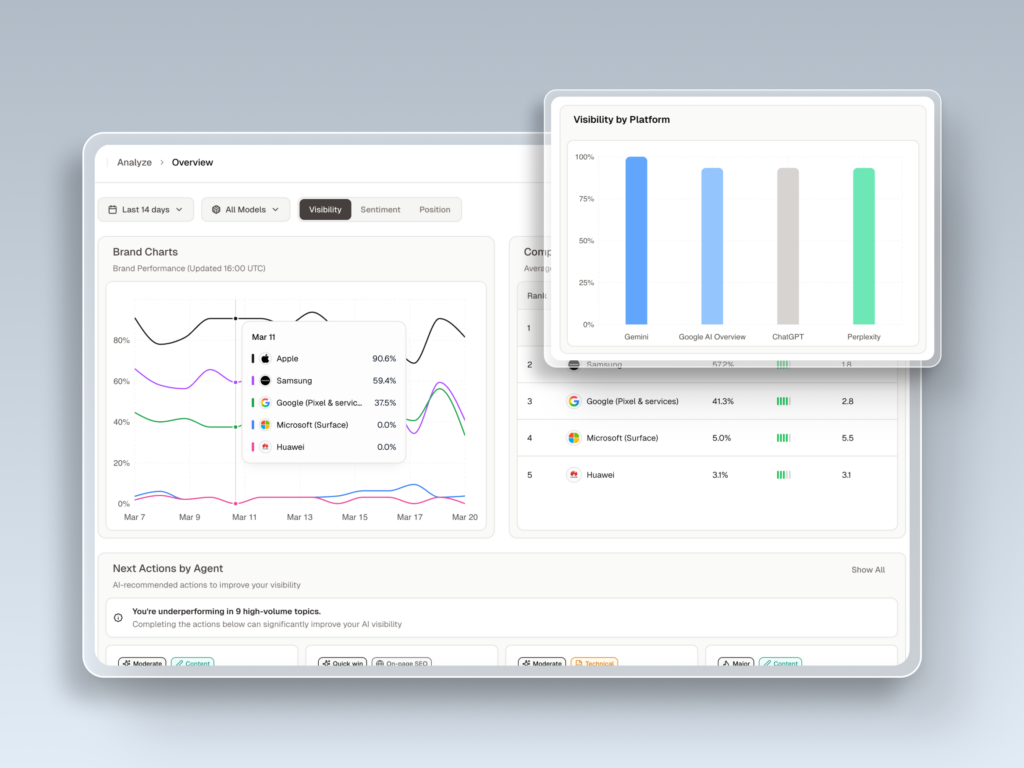
Sentiment sits on top of both. A brand can appear in plenty of AI answers and still be described in lukewarm or negative terms, which is a different problem than not appearing at all. Topify’s brand sentiment tracking scores tone on a 0 to 100 scale across ChatGPT, Gemini, and Perplexity, and breaks it down by topic, since a brand can score well on one prompt category and poorly on another for reasons that have nothing to do with its actual reviews.
Put the three together and you get a picture that no review dashboard can produce: which questions bring you into the conversation, what sources shape how you’re described when you get there, and whether the tone of that description is helping or hurting.
From Insight to Action: Fixing What AI Actually Cites
Finding a citation gap or a sentiment dip is only useful if you can act on it, and this is where the framing shifts again. Managing AI reputation isn’t crisis response. It’s closer to content supply chain management, run on an ongoing basis rather than triggered by a bad news cycle.
A retail brand discovered ChatGPT was quoting prices roughly 20% higher than what it actually charged, because the model was weighting an outdated blog post more heavily than the brand’s current product pages. Once the team optimized those pages for clearer, more citable pricing data, the hallucinated figure was corrected within weeks, and AI-referred sales inquiries rose 34% once accurate information started surfacing in responses.
That pattern generalizes. Source diversity compounds directly into AI coverage: brands citing from a single type of source see roughly 18% average AI coverage, two source types reach about 35%, three reach 58%, and five or more reach 78%, according to research tracked by Erlin. Structured, fact-dense content that names specific numbers instead of vague claims performs measurably better across the board, which is consistent with what Princeton and Georgia Tech researchers found when they benchmarked content optimization techniques for AI visibility.
The gap between brands actively managing this and brands ignoring it is already wide and getting wider. The same research puts the visibility gap between AI search winners and laggards at roughly 9 times, expanding another 3.2% every month. Only 16% of brands currently track AI search performance in any systematic way, which means the other 84% have no idea whether any of this is working for or against them.
That’s the opening. Brands that treat prompt discovery and citation tracking as a standing practice, not a one-off audit, are the ones building a compounding advantage while most of the market still checks Google reviews and calls it done.
Conclusion
Star ratings still matter. They’re just not the mechanism deciding what an AI assistant tells the next prospective buyer about you. That job belongs to which prompts surface your brand and which sources get cited when they do.
Brands that keep watching review dashboards while ignoring their prompt and citation footprint are managing half a reputation. The other half is already shaping purchase decisions, invisibly, every time someone asks an AI a question instead of typing one into Google.
Frequently Asked Questions
What is AI reputation management?
AI reputation management is the practice of tracking and influencing how AI assistants like ChatGPT, Gemini, and Perplexity describe a brand in generated answers. It centers on the prompts that trigger brand mentions and the sources those answers cite, rather than star ratings or review volume.
How does AI reputation management differ from traditional reputation management?
Traditional reputation management monitors fixed public channels: reviews, social posts, press coverage. AI reputation management tracks synthesized, non-indexed answers that change from session to session based on retrieval and model behavior, which requires different tools and a different monitoring cadence entirely.
How do you monitor brand reputation in ChatGPT?
Effective monitoring means running a defined set of high-value prompts across AI platforms on a recurring basis, tracking which sources get cited when your brand appears, and scoring the sentiment of those mentions over time rather than checking once.
Why do AI citations matter for brand reputation?
Citations are the evidence trail behind an AI-generated answer. The domains and pages an AI model cites directly shape how it frames your brand, including outdated claims, pricing, or positioning that no longer reflect reality.

