

Your brand has solid SEO rankings. Your content team publishes consistently. But when leadership asks, “Are we showing up in ChatGPT when someone searches our category?” most teams go quiet.
You could open ChatGPT, type a few queries, and screenshot the results. But that’s not tracking. It’s a one-time snapshot with no repeatability, no trend data, and no way to tell whether you’re gaining or losing ground against competitors.
That’s the gap an AI query tracking tracker is built to close.
What Is an AI Query Tracking Tracker (and What It Isn’t)
An AI query tracking tracker is a system that monitors how — and how often — your brand appears in AI-generated answers across platforms like ChatGPT, Gemini, and Perplexity. It works by sending a defined set of prompts to AI engines on a recurring basis, parsing the responses, and recording whether your brand was mentioned, how it was described, and where it ranked relative to competitors.
That’s fundamentally different from what most teams are doing today.
Manually searching your brand name on ChatGPT doesn’t constitute an AI query tracking tool. Research shows that running the same question 100 times produces a completely identical response list less than 1% of the time. Without a structured system running consistent prompts at regular intervals, there’s no trend, no baseline, and no signal — just browsing.
Also worth clarifying: AI query tracking software is not the same as traditional SEO monitoring. SEO tools track keyword rankings and backlink profiles. An AI query tracking platform tracks what AI systems actually say about your brand — the natural language, the context, the sentiment, and the competitive positioning baked into every answer.
How an AI Query Tracking System Actually Works
Most AI engines use a process called Retrieval-Augmented Generation (RAG). When a user submits a question, the system breaks it into multiple sub-queries, pulls from several sources simultaneously, and synthesizes the results into a single answer. That process has direct implications for how tracking needs to work.
An AI query tracking system operates by defining a prompt library — typically 50 to 250 queries covering your category, use cases, and competitive comparisons. These prompts are sent to each AI platform at regular intervals, and the responses are parsed for brand mentions, sentiment signals, citation sources, and ranking position. Over time, this builds a trend layer that shows whether your visibility is improving or declining — and why.
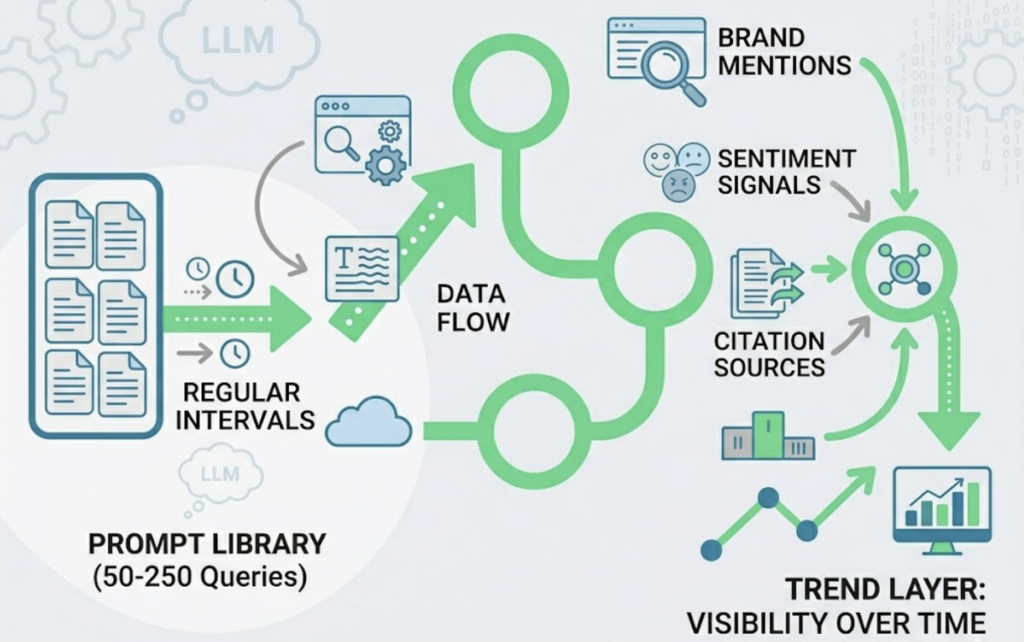
Scale matters here. A single prompt run tells you very little. Running 100 prompts across four platforms every week gives you data you can actually act on.
Different AI platforms also behave differently. ChatGPT citations lean heavily toward media publishers and community content — Reddit contributes roughly 40% of ChatGPT’s citation sources. Perplexity draws more from brand websites and research content, while YouTube accounts for around 16% of Perplexity citations. Research indicates that different platforms show citation preference divergence of up to 86%, which means an AI query tracking solution that only covers one platform is missing most of what’s actually happening across your audience.
5 Metrics a Real AI Query Tracking Dashboard Should Show
Not all AI query tracking dashboards are built the same. Here’s what a complete setup should measure, and what many tools still skip.
| Metric | What It Measures | Why It Matters |
|---|---|---|
| Visibility Rate | % of relevant queries where your brand appears | Core benchmark for AI presence across platforms |
| Position / Ranking | Where your brand appears relative to competitors in AI answers | Being first vs. fifth carries meaningfully different weight |
| Sentiment Score | Whether AI describes your brand positively, neutrally, or negatively | AI can introduce brand narratives you’ve never approved |
| Query Volume Trend | How the frequency of specific prompts changes over time | Identifies which topics are gaining or losing traction |
| Source Attribution | Which domains AI platforms cite when mentioning your brand | Shows where your content authority is — and where it’s missing |
Most entry-level tools surface visibility rate and maybe position. The ones that skip sentiment and source attribution are leaving out the metrics that actually explain why your numbers look the way they do.
For established brands, a visibility rate above 50% signals a healthy AI presence. Below 20% is worth investigating. Sentiment scores above 80% positive tend to be stable — brands landing in the 75-82% range typically see noticeably more volatility in their AI visibility data over time.
Common Mistakes That Break AI Query Tracking
Getting a tracking setup in place is step one. Getting it right is a separate challenge. Here are the mistakes that cost teams the most.
Tracking only your brand name. Category-level queries — “best project management tool for remote teams” or “top CRM for startups” — are where most AI-driven discovery actually happens. Limiting your prompt library to direct brand mentions means missing the queries that reach audiences who don’t know you yet.
Covering only one AI platform. ChatGPT currently holds around 60% of the AI search market, but Perplexity accounts for roughly 15% of AI referral traffic and attracts a research-oriented, higher-intent audience. Gemini is integrated across Google’s ecosystem for 2 billion monthly active users. A single-platform AI query tracking system produces a partial picture, and partial pictures lead to bad strategy calls.
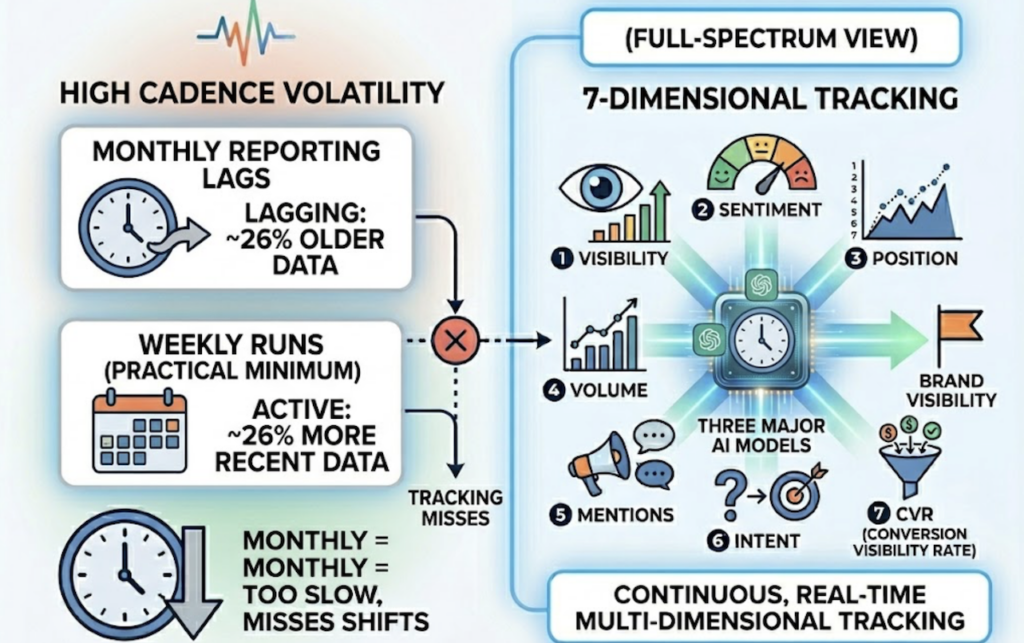
Running queries too infrequently. AI search results aren’t static. Citation patterns shift every few weeks as models update and new content enters the training pipeline. Monthly reporting is already lagging. Weekly runs are the practical minimum for a tracking cadence that means anything. AI-cited content tends to be about 26% more recent than what traditional search surfaces, which means your data needs to move at a similar pace.
Ignoring competitor data. Knowing your own visibility score without knowing your competitors’ is like knowing your revenue without knowing your market share. The gap between your Visibility Rate and a direct competitor’s is where the real strategic signal lives.
Skipping baseline establishment. The first four weeks of tracking should focus on building a reference point, not acting on the data. Without a baseline, there’s no way to tell whether a change is meaningful or just statistical noise.
Strategy for Building an Effective AI Query Tracking Tracker
A solid AI query tracking strategy follows a clear sequence. Here’s how to build one that generates usable data from week one.
Step 1: Build your prompt library. Start with three query categories: category-level prompts (“best tools for [your use case]”), competitive comparison prompts (“X vs. Y”), and brand-specific prompts including name variants. Target 50 to 100 prompts initially, then expand. The most effective AI query tracking trackers handle this automatically — platforms like Topify use prompt discovery to continuously surface high-value queries your audience is actually asking, so you’re not starting from a blank spreadsheet.
Step 2: Select your platforms. At minimum, cover ChatGPT, Perplexity, and Gemini. These three account for the vast majority of AI-driven referral traffic. If your audience spans international markets or specific verticals, extend to DeepSeek, Copilot, or other regional platforms.
Step 3: Set your tracking cadence. Weekly is the recommended frequency for most teams. Anything slower than bi-weekly produces data that’s too lagged to respond to in time.
Step 4: Establish your baseline. Collect data for the first four weeks before drawing conclusions or making content changes. This reference point is what every future measurement gets compared against.
Step 5: Set alert thresholds. Once you have a baseline, define the triggers that prompt action — for instance, a Visibility Rate drop of 10 percentage points or a Sentiment Score shift below 75%. Proactive alerts turn passive tracking into a real-time competitive tool.
This is also where the right AI query tracking platform separates itself. Topify tracks seven core metrics — visibility, sentiment, position, volume, mentions, intent, and CVR — across ChatGPT, Gemini, Perplexity, DeepSeek, and other major AI engines, all in one dashboard. The prompt discovery feature continuously identifies new high-volume queries relevant to your brand as AI recommendation patterns shift. You don’t have to chase the landscape manually — the platform surfaces it.
Best AI Query Tracking Tools in 2026
The market for AI query tracking software has matured quickly. Here’s how the main options compare on the dimensions that matter most for marketing and SEO teams.
| Tool | AI Platforms | Key Strength | Starting Price |
|---|---|---|---|
| Topify | ChatGPT, Gemini, Perplexity, DeepSeek + others | 7-metric tracking, automated prompt discovery, one-click GEO execution | $99/mo |
| Profound | ChatGPT, Perplexity, others | High-volume enterprise tracking (10K+ daily prompts), SOC 2 certified | $5,000+/mo |
| SE Ranking | ChatGPT, Perplexity, AI Overviews | “Uncited” brand analysis, local AI search tracking by ZIP code | $150-240/mo |
| Ahrefs Brand Radar | Multiple platforms | Integrates 250M+ real user prompt data, covers TikTok, Reddit, YouTube | $828+/mo |
Topify‘s Basic plan at $99/mo includes 100 prompts and 9,000 AI answer analyses per month across four projects — enough for most growing brands to establish a complete tracking baseline. The Pro plan at $199/mo scales to 250 prompts and 22,500 analyses, built for teams managing multiple brands or competitive categories. Enterprise starts at $499/mo with custom configurations and a dedicated account manager.
The economic case for investing in an AI query tracking solution is worth spelling out. Research indicates that AI referral traffic converts at around 14.2%, compared to roughly 2.8% for traditional organic search. Visitors arriving from AI platforms also tend to spend 38% longer on-site, bounce 27% less, and carry roughly 4.4x the visitor value of traditional search traffic. That traffic is already flowing. The question is whether you’re measuring what’s driving it, or finding out about it secondhand.
You can explore how brands are currently building AI visibility strategies and understand the deeper mechanics of how GEO reshapes brand visibility in AI search to build more context around where tracking fits in the broader strategy.
Conclusion
The brands performing well in AI search right now aren’t necessarily the ones with the largest content libraries. They’re the ones that know exactly which prompts trigger AI recommendations in their category, and which ones don’t.
An AI query tracking tracker makes that visible. Without one, you’re relying on anecdotal spot-checks to understand a channel that’s already influencing purchase decisions at scale. Traditional search engine query volume is forecast to decline around 25% by the end of 2026 as AI-driven answers absorb more of the demand. That shift is already underway.
The practical starting point: define 50 core prompts, cover at least three AI platforms, and spend the first four weeks building a baseline. Get started with Topify to automate prompt discovery and track your AI visibility across all major platforms from day one.
FAQ
Q: What is an AI query tracking tracker?
A: An AI query tracking tracker is a tool that systematically monitors how and where your brand appears in AI-generated answers across platforms like ChatGPT, Gemini, and Perplexity. It runs a defined prompt library at regular intervals and records brand mentions, sentiment, position, and citation sources over time — producing trend data rather than one-off snapshots.
Q: How does an AI query tracking tracker work?
A: The system sends a library of prompts to AI platforms on a scheduled basis, parses each AI response for brand mentions and competitive data, and aggregates the results into dashboards with trend visibility. Advanced platforms also automate prompt discovery, identifying new high-value queries relevant to your brand as AI recommendation patterns evolve — without requiring manual input to keep the library current.
Q: How do I measure the effectiveness of my AI query tracking?
A: Start with Visibility Rate (the percentage of relevant queries where your brand appears) and Sentiment Score. Track both weekly over a minimum of four weeks to establish a reliable baseline, then measure changes relative to that reference point. A Visibility Rate above 50% and a Sentiment Score above 80% positive are generally considered healthy benchmarks for established brands.
Q: What’s the difference between AI query tracking software and traditional SEO tools?
A: Traditional SEO tools track keyword rankings, backlinks, and organic traffic — metrics built for search engines that return a list of links. AI query tracking software tracks what AI systems actually say about your brand in natural language responses, including sentiment, competitive positioning, and citation sources. The two measure fundamentally different things, and in 2026, you need both.

