
Your domain authority is solid. Your keyword rankings haven’t moved in months. But when a potential customer opens ChatGPT and asks, “What’s the best [your category] for a mid-sized team?”, your brand doesn’t come up. A competitor does, three times in a row.
That’s not a ranking problem. Traditional SEO tools can’t detect it, report on it, or explain why it’s happening. AI platforms don’t pass referral headers. They don’t leave footprints in GA4. They synthesize an answer, recommend a brand, and move on.
AI query tracking software was built to close that gap.
What AI Query Tracking Software Actually Does (And Why It’s Not Just Another Analytics Tool)
AI query tracking software is a category of marketing intelligence tools designed to monitor how brands are mentioned, positioned, and described within the generative responses of AI platforms. The key word is “generative.” Unlike GA4 or Search Console, which track what users do after they arrive at your site, AI query tracking focuses on what the AI said before a user ever clicked anything.
The difference matters more than it looks. Traditional web analytics are reactive: they capture footprints users leave behind. AI query tracking is proactive: it audits what AI models are recommending in real time.
| Metric | Traditional Analytics (GA4) | AI Query Tracking Software |
|---|---|---|
| Primary unit | Clicks and sessions | Mentions and citations |
| Visibility metric | Search rank (1–100) | Share of Voice (SoV) |
| Data source | User referrer headers | Batch prompt ingestion |
| Core question | “What did the user click?” | “What did the AI say?” |
The reason this gap exists is structural. A meaningful share of sessions originating from ChatGPT land as “(not set)” or “Direct” in GA4, because AI platforms often don’t pass standard referral data. Without a dedicated AI query tracking tool, that traffic is invisible, even when it’s converting at rates that should raise flags.
How AI Query Tracking Software Works Under the Hood
The core mechanism is batch prompting. Instead of waiting for users to mention your brand, AI query tracking software proactively sends large volumes of conversational prompts to AI platforms via their APIs, then analyzes the responses.
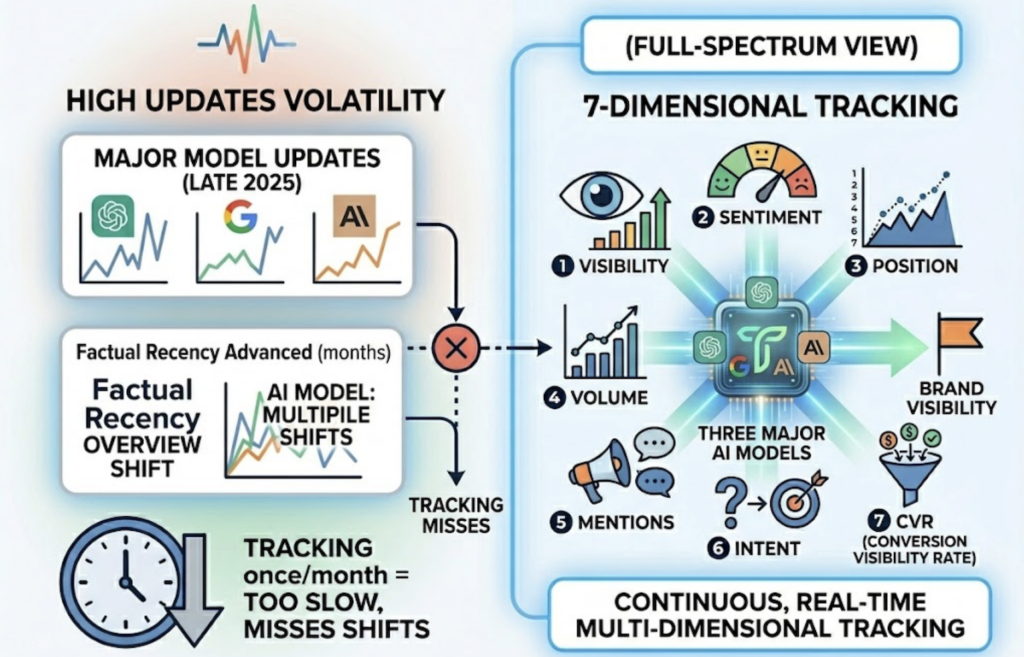
The technical workflow breaks into three steps. First, the software injects hundreds of prompts: category queries, comparison questions, use-case scenarios. Second, it parses the AI’s text responses using NLP to extract brand mentions and competitor references. Third, it categorizes each mention across three dimensions: Visibility (how often the brand appears), Position (where in the response, since primacy bias means first-mentioned brands receive significantly higher click-through intent), and Sentiment (what qualifiers the AI attaches, like “cost-effective but limited” versus “the most trusted option in the market”).
Tracking frequency matters just as much as what you track. AI models are probabilistic, and their outputs shift with training data changes, knowledge cutoff updates, and retrieval source adjustments. In late 2025, major model updates from OpenAI, Google, and Anthropic occurred within weeks of each other, each advancing factual recency by months and shifting citation preferences across categories. A brand’s AI visibility can change significantly after any of those updates.
One-off audits don’t catch this. Continuous tracking does.
5 Signs Your Marketing Team Needs an AI Query Tracking Solution Right Now
You don’t always know you have an AI visibility problem until you see one of these patterns.
You rank #1 on Google but don’t appear in ChatGPT results. Google authority and AI citation authority are built on different signals. Google rewards backlinks and technical health. AI models prioritize “citable authority”: factual, well-structured content that’s easily extracted and referenced by a retrieval system. Many top-ranking pages are effectively invisible to AI.
You’re seeing unexplained “Direct” traffic that converts unusually well. Visitors arriving from AI platforms convert at roughly 14.2% compared to around 2.8% for traditional organic search. They also spend 68% longer on site and bounce 27% less. If your “Direct” bucket is growing with high-converting sessions you can’t explain, AI is likely sending them. Without an AI query tracking platform, you can’t confirm it or replicate it.
The AI is describing your brand in ways you don’t recognize. Narrative misalignment is common. If an AI describes your enterprise software as “a budget-friendly option for freelancers,” it’s pulling that framing from third-party sources you haven’t addressed. An AI query tracking system surfaces these discrepancies before they erode top-of-funnel positioning.
You can’t answer your CMO’s question: “What’s our AI search presence?” Teams without an AI query tracking dashboard are forced to offer manual screenshots or anecdotal evidence. That’s not a sustainable answer in 2026, when stakeholders are increasingly asking for standardized metrics like Share of Voice and Answer Inclusion Rate.
Your content strategy doesn’t account for how AI retrieves information. AI models favor direct, factual formats: data tables, structured comparisons, “answer nuggets.” Long-form prose without that structure often won’t get cited. If your team is producing content without tracking which formats the AI actually pulls from, you’re optimizing blind.
What a Strong AI Query Tracking Platform Should Be Able to Do: A Practical Checklist
Not all tools in this category are equal. A dashboard that only counts brand mentions won’t get your team very far. Here’s what a mature AI query tracking platform needs to cover:
| Capability | Why It Matters |
|---|---|
| Multi-platform coverage (ChatGPT, Gemini, Perplexity, DeepSeek, Claude, Google AIO) | User behavior varies by platform. Single-platform tracking creates blind spots. |
| Batch prompt simulation (100+ prompts/day) | Provides statistical confidence in probabilistic AI environments. One-time tests aren’t reliable. |
| Citation source analysis | Identifies which specific URLs and domains the AI uses to form its answers. Lets you reverse-engineer competitor advantages. |
| Competitor benchmarking | Shows your visibility versus competitors for the same query set. Surfaces category gaps before they cost you pipeline. |
| Historical trend tracking | Measures whether your GEO efforts are actually working over time, and whether model updates are helping or hurting you. |
| Sentiment polarity scoring | Distinguishes between positive mentions and reputation risks embedded in how the AI qualifies your brand. |
Bottom line: if the tool can’t tell you why the AI is recommending a competitor, it’s not giving you enough to act on.
How Topify Turns AI Query Tracking Into a Measurable Growth Channel
Topify was built specifically around the architecture described above. It covers ChatGPT, Gemini, Perplexity, DeepSeek, Grok, and Google AI Overviews natively, plus regional models including Doubao and Qwen for brands operating in Asian markets where AI-driven consumer behavior is evolving along its own trajectory.
What separates it from basic monitoring tools is the Prompt Discovery engine. Most teams start AI tracking by monitoring their own brand name. That’s reputation management, not growth. Topify’s system continuously surfaces “dark queries”: the category-level, comparison, and use-case prompts that users are actually asking AI models when they’re in discovery mode, before they’ve formed any brand preference. These are the queries where market share is won or lost.
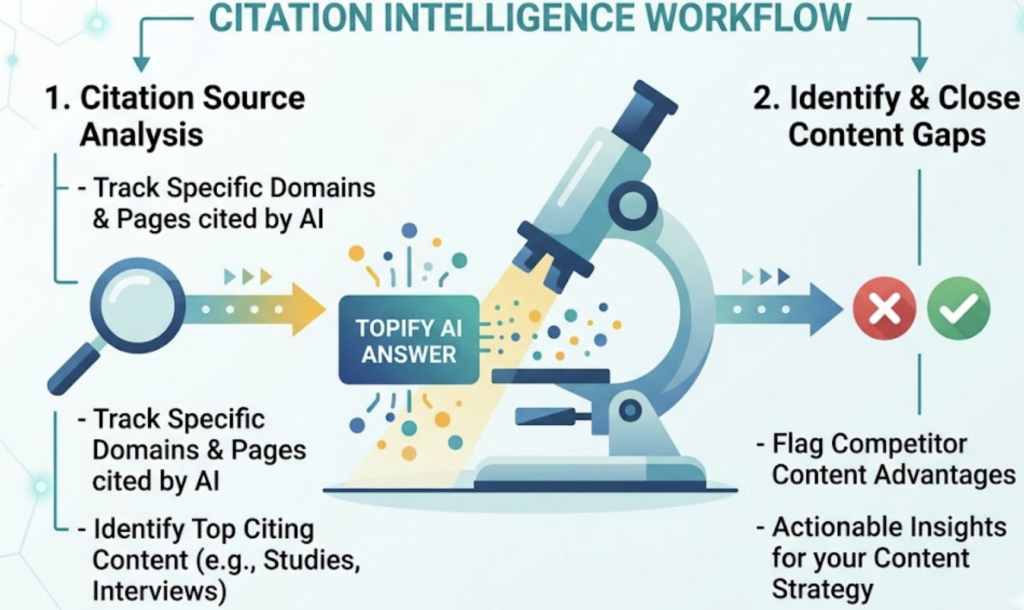
The Citation Intelligence feature goes a layer deeper. It reverse-engineers which specific domains and pages the AI draws from to construct its answers. If a competitor is being cited because of a particular data study or expert interview, Topify surfaces that source and flags the content gap. That’s the difference between knowing you’re losing ground and knowing exactly why.
Topify tracks across seven core dimensions: Visibility, Sentiment, Position, Volume, Mentions, Intent, and CVR. The platform was built by a team that includes former OpenAI researchers and veteran Google SEO practitioners, which gives it depth in both the LLM retrieval mechanics and the content optimization strategy required to act on the data.
| Plan | Price | Prompts | AI Answer Analyses |
|---|---|---|---|
| Basic | $99/mo | 100 | 9,000/mo |
| Pro | $199/mo | 250 | 22,500/mo |
| Enterprise | From $499/mo | Custom | Custom |
See the full breakdown at Topify’s pricing page, or get started with a 30-day trial on the Basic plan.
3 Common Mistakes Teams Make When Setting Up AI Query Tracking Analytics
Even with the right AI query tracking software in place, most teams make at least one of these errors in how they configure it.
Tracking only brand queries. Searching “[Your Brand] alternatives” tells you about consideration. It doesn’t tell you about discovery. The real competitive intelligence sits in category queries: “best [category] for [specific use case].” These are the prompts where a potential customer hasn’t formed a preference yet. If the AI excludes your brand there, you lose the customer before they ever reach the validation stage.
Running one-off tests and treating the result as fact. AI outputs are probabilistic. A brand might have 80% visibility across a week’s worth of prompt batches, but 0% on a single Tuesday after a model update. Basing strategy on a snapshot is like checking your Google ranking once and assuming it never changes. Continuous batch testing, run daily, is the only way to get statistically valid AI visibility data.
Measuring presence without measuring sentiment. Appearing in an AI response isn’t inherently good. If the AI qualifies your brand as “the most expensive option in the category” or “better suited for legacy environments,” that mention is actively working against your positioning. An AI query tracking analytics setup that only counts appearances creates a false sense of security.
What the AI says about you matters as much as whether it mentions you at all.
Conclusion
By late 2025, 50% of consumers were already using AI to guide buying decisions, and 84% of brands have no systematic way to track what those AI systems are actually saying about them. That gap is getting more expensive every quarter.
Traditional SEO tools were built for a world where every search produces a ranked link list. That world still exists, but it’s no longer the full picture. AI query tracking software fills the measurement gap between what you’ve built and what AI models are currently recommending.
Start with category-level queries, not just brand queries. Measure sentiment alongside visibility. Track continuously, not episodically. Use source analysis to understand why the AI cites what it cites. That’s how you stop optimizing for clicks and start optimizing for citations.
Get started with Topify to see exactly where your brand stands in AI search today.
FAQ
Q: What is AI query tracking software?
A: AI query tracking software is a category of marketing analytics tools that monitor how your brand is mentioned, positioned, and described within the responses generated by AI platforms like ChatGPT, Gemini, and Perplexity. It measures Share of Voice in conversational AI interfaces rather than search rank in traditional link-based results.
Q: How does AI query tracking software work?
A: These tools send large batches of conversational prompts to AI platforms via API, then analyze the text responses to identify brand mentions, competitor references, and sentiment. The output covers three core dimensions: Visibility (how often you appear), Position (where in the response), and Sentiment (the qualifiers and framing the AI uses to describe you).
Q: What’s the difference between AI query tracking and traditional SEO analytics?
A: Traditional SEO tools like Google Search Console track clicks from link-based search results to your website. AI query tracking measures mentions within AI-generated answers, often before a user clicks anything. It focuses on what the AI recommends, not what the user navigates to.
Q: How much does AI query tracking software cost?
A: Pricing varies by scale. Entry-level plans start around $29 to $99/month for basic mention tracking. Professional platforms typically range from $99 to $199/month for growing teams, with enterprise tiers starting at $499/month for custom prompt volumes and dedicated support. Topify’s pricing page has a full breakdown.