


Your page can rank #1 and still get skipped by Google’s AI. Here’s what actually gets you cited.
You’ve done everything right. The page is optimized. The keywords are placed. The backlinks are solid. And it still doesn’t show up in AI Overviews.
That’s not a fluke. It’s a signal that the rules have changed in ways most SEO playbooks haven’t caught up to yet.
Google AI Overviews (AIO) doesn’t evaluate content the way a traditional ranking algorithm does. It’s not looking for the most authoritative domain or the densest keyword match. It’s asking a different question entirely: can this content be extracted, verified, and synthesized into a reliable answer?
If your content can’t pass that test, your ranking doesn’t matter.
Ranking #1 Doesn’t Mean Getting Cited Anymore
Here’s the uncomfortable truth about the current search landscape. AIO now appears in over 50% of all Google searches, and in verticals like B2B tech and healthcare, that figure exceeds 80%. When AIO shows up, the top-ranking organic result sees its click-through rate drop by 58 to 61%.
That’s not a minor dip. That’s a structural shift.
And the overlap between AIO citations and traditional top-10 rankings has collapsed faster than most anticipated. In late 2024, roughly 75% of AIO citations came from the top 10 results. By early 2026, that overlap had fallen to somewhere between 17% and 38%. Today, 36.7% of citations come from pages ranking outside the top 100 entirely.
Ranking and being cited have become two separate games.
What AI Overviews Actually Does Under the Hood
AI Overviews isn’t a smarter Featured Snippet. It’s a fundamentally different system built on Retrieval-Augmented Generation (RAG), currently powered by Google’s Gemini models.
Here’s what that means in practice. When a user submits a query, AIO doesn’t just pull the top result. It runs a process called query fan-out, breaking a complex question into multiple sub-queries. A search like “best CRM for a 50-person team” might spawn simultaneous retrieval threads for core CRM features, budget benchmarks, and vendor comparisons, all at once.
The system then uses vector embeddings to find semantically relevant content chunks, not keyword matches. It scores fragments by how much they reduce uncertainty in the final generated answer. Then it stitches those fragments together into a synthesized response.
Why Most Pages Get Skipped
The RAG pipeline is ruthless about extractability. If your content structure is messy, the AI can’t chunk it cleanly. If your key facts rely on five paragraphs of context before they make sense, the AI won’t wait. If your page depends heavily on JavaScript rendering or sits behind a login, the crawler can’t reach it.
And if the facts on your page conflict with Google’s Knowledge Graph, the system actively avoids you to prevent generating hallucinations.
High DA doesn’t override any of this. A Forbes article that buries its answer in editorial prose will lose to a niche blog that leads with clean, verifiable data.
The 4 Things On-Page SEO Optimizes for That AI Overviews Doesn’t Care About
Traditional on-page SEO has four main levers: keyword density, H-tag hierarchy, internal link structure, and page speed. All four still matter for organic rankings. None of them are what gets you cited in AIO.
| Dimension | Traditional Ranking Signal | AI Overviews Citation Signal |
|---|---|---|
| Content structure | Keyword placement in titles and first paragraph | Extractability and “island test” performance |
| Authority proof | Backlink quantity and domain authority | Factual consistency, expert quotes, data density |
| Technical metrics | Core Web Vitals (LCP, FID, CLS) | Machine readability, Schema attribute richness |
| Content length | Long-form content (1,500+ words) | Atomic knowledge blocks (100-300 words per chunk) |
| Link strategy | Internal links and anchor text | External citations linking to verifiable sources |
| H-tag usage | Hierarchical page structure | Direct-answer triggers for sub-queries |
Keyword density optimizes for string matching. AI operates through entity recognition. It’s not looking for the phrase “AI Overviews optimization” repeated twelve times. It’s looking for the entities that define the concept: RAG, Gemini, LLM, Schema markup, citation signals. If those entities aren’t logically connected in your content, the keyword frequency means nothing.
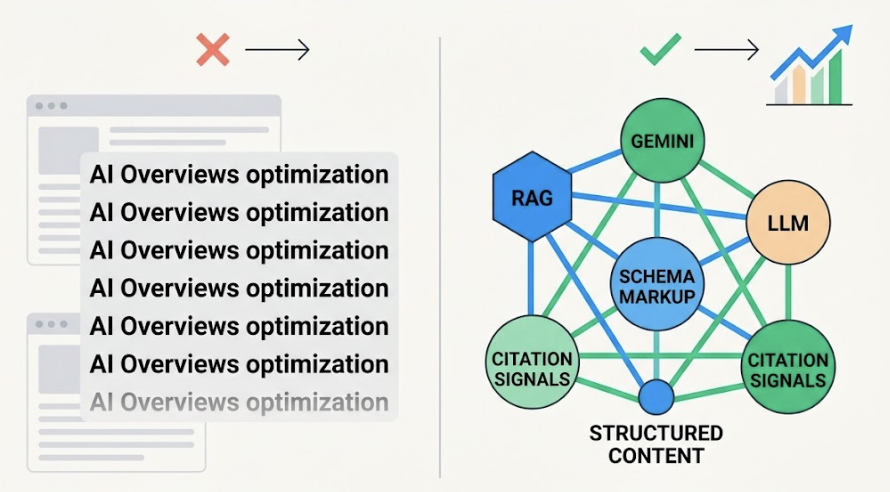
The H-tag issue is worth calling out specifically. Descriptive headings like “Our Service Features” or “About This Topic” contribute almost nothing to AIO selection. What works are headings that function as implicit questions, the kind a user might actually type. “What qualifies a source for AI Overviews?” is a better H2 than “Qualifying Sources.” The shift sounds minor. The impact isn’t.
What Google’s AI Actually Looks For in a Source
Four signals drive AI citation decisions. These aren’t guesses. They’re consistent across the research on how RAG systems select and weight content fragments.
Entity Clarity. AI systems use NLP to identify and classify the specific “things” your content discusses. Core entities should appear in H2 headings and paragraph openers, with a salience score above 0.30 if you’re using tools that measure it. Ambiguous pronouns and vague references hurt you. Schema markup using mainEntity and sameAs attributes, linking to authoritative databases like Wikidata, helps AI build confidence in your content’s identity.
Factual Density. This is the ratio of verifiable facts, statistics, and data points to total word count. Content containing specific numerical statistics increases citation probability by 22 to 30%. Content with direct expert quotes sees a 37 to 40% lift. Original research or experimental data pushes that to 35 to 45%. Adjective-heavy opinion (“highly cost-effective solution”) doesn’t move the needle. Specific numbers do.
Semantic Completeness. Every content block should be able to pass what researchers call the “island test”: if you extract a single paragraph, does it still provide a complete, self-contained answer? AIO does exactly this during fragment extraction. If your conclusion requires four paragraphs of setup before it lands, it won’t get cited as a standalone fact. Target 134 to 167 words per chunk, with each chunk containing a definition, a mechanism, and an outcome.
Direct Answer Structure. The most important information must appear in the first 150 words of each section. No warm-up, no scene-setting. The answer comes first, then the support. This isn’t just a stylistic preference: it’s how the RAG system decides whether to keep or skip a fragment during retrieval.
5 Signals That Push Your Content Into AI Overviews
Knowing the principles is one thing. Here’s what execution actually looks like.
Structured data and Schema depth. Schema isn’t just for star ratings anymore. It’s how AI reads your page’s identity. Use nested types: Organization, Product, FAQ, and HowTo. Define authorship through Schema that links to professional profiles, published work, and third-party platforms. This directly strengthens E-E-A-T signals in AIO’s evaluation.
Multimodal integration. Pages that combine text, images, and structured data are selected for AI Overviews at a rate 156% higher than text-only pages. A 60 to 90-second explanatory video with a full transcript gives AI a second surface to extract from. Data tables outperform equivalent prose descriptions in extraction rate, because the machine can parse structured formats faster and more reliably.
Content freshness. AIO has a strong recency bias, especially in finance, healthcare, and tech. Content updated in the past 30 days is cited at 3.2 times the rate of older, unchanged content. For competitive keywords, plan a deep review and data refresh every 8 to 12 weeks. A visible “last updated” date signals freshness to both AI and users.
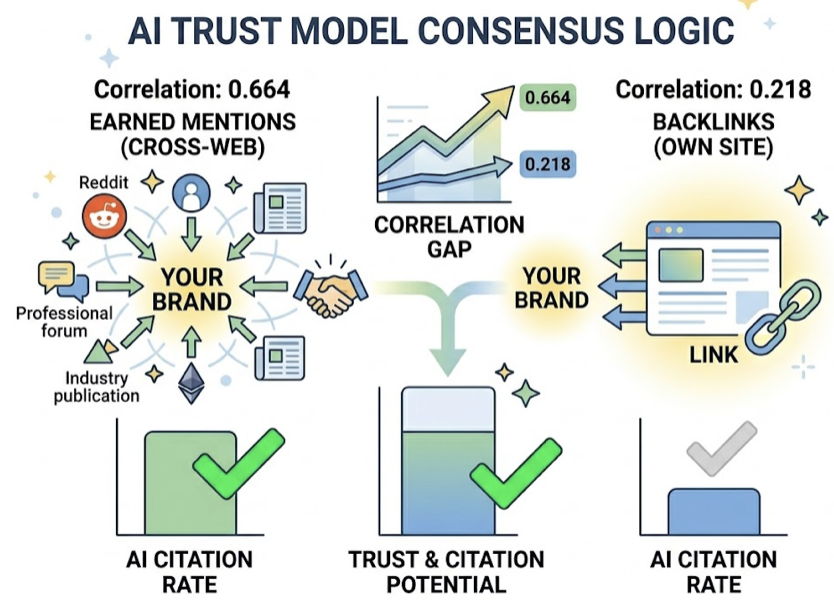
Earned mentions, not just backlinks. AI builds its trust model from cross-web consensus, not just your own site. The correlation between third-party brand mentions and AI citation rates is 0.664. The correlation for backlinks? 0.218. Reddit threads, industry publications, and professional forums mentioning your brand in context matter significantly more than most link-building campaigns.
Source gap analysis with Topify. Guessing which sources AI prefers is the wrong approach. Topify’s Source Analysisidentifies the exact domains and URLs that AI platforms are citing for your target queries, and surfaces the structural reasons they’re winning. Is it because they have a more detailed comparison table? Because they cited a government dataset? Topify maps those citation gaps and generates specific content recommendations to close them. That’s not speculation. That’s reverse-engineering what’s already working.
How to Know If Your Content Is AI Overviews-Ready
Run this checklist before publishing or refreshing any page you want considered for AIO.
Direct opening. Does the first paragraph of each section deliver an unambiguous answer within 150 words? If it starts with context-building instead of the answer, rewrite the lead.
Data density. Does the page include at least three specific statistics or third-party research citations? Vague claims don’t survive AIO’s extraction filter.
Entity markup. Have you defined mainEntity in your Schema and used sameAs to connect it to an authoritative external source?
Structured formatting. Are comparisons in HTML tables rather than images? Are step-by-step instructions in ordered lists? Unstructured visual elements can’t be parsed.
Island test. Pull any paragraph out of context. Does it still make sense as a standalone answer? If it doesn’t, restructure the section so it does.
Freshness signal. Is there a visible “last updated” date within the last three months? Content with no update signal is disadvantaged in time-sensitive verticals.
Crawl accessibility. Can a plain-text browser see all your core facts? If they’re loaded by JavaScript or hidden behind interaction triggers, AI crawlers can’t reach them.
Once you’ve got the content side right, monitoring becomes the next problem. AIO citation sources turn over at a rate of 40 to 60% per month. What’s cited today may not be cited next week. Topify’s Visibility Tracking monitors your brand’s citation presence across Google AI Overviews, ChatGPT, and Perplexity in real time, flagging when competitors have displaced you and identifying exactly which content update triggered the change. Manual monitoring at that speed isn’t realistic. Automated tracking is.
Conclusion
AI Overviews hasn’t killed SEO. It’s restructured where the competition happens.
Traditional ranking signals are now the entry fee, not the winning move. Getting into the AI citation pool requires a different capability: the ability to present information in a form that a generative system can extract, verify, and confidently include in a synthesized answer.
The brands that make that shift, from keyword optimization to entity clarity, from long-form content to atomic knowledge blocks, from backlink accumulation to earned mentions and structured data, are the ones building durable visibility in the AI-first search era.
The ones that don’t will keep ranking. They just won’t get cited.
FAQ
Q: Is AI Overviews Optimization the same as GEO?
Not exactly. GEO (Generative Engine Optimization) is the broader discipline covering all AI platforms, including ChatGPT, Claude, and Perplexity. AI Overviews optimization is GEO applied specifically to Google’s RAG architecture, which has its own quirks around Knowledge Graph integration and how it weights freshness and entity signals. The core principles overlap, but the execution details differ by platform.
Q: Does my content need to rank in the top 10 to appear in AI Overviews?
No. While top-10 pages have a higher baseline probability of citation (around 33 to 37%), over 60% of AIO citations come from pages ranked 11th or lower. And 36.7% come from outside the top 100 entirely. AI prioritizes extractability and factual density over ranking position. A page ranking 40th with clean structure and strong data will often beat a page ranking 3rd with dense, hard-to-parse prose.
Q: How often does Google update what it cites in AI Overviews?
Very frequently. Unlike traditional rankings that can hold stable for weeks or months, AIO citation sources shift in days or even hours, driven by model updates, new content being crawled, and freshness weighting in specific verticals. Monthly citation source turnover runs between 40% and 60%. That’s why ongoing monitoring matters as much as initial optimization.
Q: Can small sites compete with big brands in AI Overviews?
Yes, and this is one of the more significant opportunities in the current search environment. AIO doesn’t systematically favor high-DA domains. It favors sources that provide unique data, direct answers, and structured content. There are documented cases of niche vertical blogs, with relatively low domain authority, displacing Forbes and similar large publishers from AIO citation slots by offering more specific, better-structured information.

