

Your team tripled content output last quarter. The blog pipeline is full, the social calendar is stacked, and every AI writing tool is running at capacity. Then someone asked ChatGPT for a recommendation in your category, and your brand wasn’t on the list.
That disconnect is more common than most content teams admit. Scaling AI content creation is a solved problem. Getting that content cited by AI search engines is a fundamentally different challenge, and the gap between the two is where most content strategies quietly fail.
More Output, Same Invisible Brand: Why AI Content Volume Isn’t the Problem
According to industry research, 87% of marketing organizations now use some form of AI to assist with content creation. Yet the correlation between high-volume AI output and inclusion in AI-generated responses remains remarkably weak.
Here’s the structural issue: AI search systems don’t read content the way humans do. They parse it for extraction signals, entity authority, and citation potential. A blog post that says exactly what ten other blog posts already say gives a model no logical reason to cite it specifically.
Meanwhile, the search environment itself has shifted. Zero-click searches now capture 60% of user behavior, and Google AI Overviews more than doubled their appearance rate in early 2025, moving from 6.49% to over 13% across informational queries. That’s the category where most MOFU content lives. The content is being intercepted before the click ever happens.
Volume isn’t the bottleneck. Citation architecture is.
What AI Search Actually Looks for in AI-Generated Content
Researchers at Princeton and Georgia Tech analyzed over 10,000 queries to identify what actually moves the needle for AI citation. The findings don’t align with traditional SEO intuition.
Adding verified citations to authoritative sources increases AI visibility by up to 115.1%. Including expert quotations adds another 37–40%. Replacing vague claims with first-party statistics contributes a further 22–40% lift. None of these are about keyword density. All of them are about information credibility.
The backlink-versus-brand-mention gap is equally striking. Brand mentions across trusted sites correlate with AI visibility at 0.664, roughly three times the strength of traditional backlinks at 0.218. AI systems aren’t reading the link graph; they’re reading linguistic consensus across their training and retrieval data.
That’s the core shift in AI content writing: what made content rank on Google doesn’t automatically make it citable by an LLM.
How to Build an AI Content Creation Workflow That Drives GEO Results
A workflow that produces content at scale and produces content that gets cited are not the same thing. Here’s how to build one that does both.
Step 1: Start with AI Search Demand, Not Just SEO Volume
Most content teams begin with keyword research tools built for Google. Those tools measure search volume in traditional databases. They miss what researchers call “dark queries”: conversational prompts that users ask AI assistants but never type into a search bar.
An AI-powered content strategy needs a separate layer of topic intelligence. Topify’s AI Volume Analytics maps which topics are being frequently requested across ChatGPT, Gemini, and Perplexity, including prompts that show zero volume in conventional keyword tools. Starting here means you’re building for where your audience actually discovers brands, not where they used to.
Step 2: Draft with AI, Structure for Citation
The drafting phase is where most automated content production workflows lose citability. Here’s what needs to change structurally.
Open every article with a direct answer in 40–60 words. AI systems prioritize “answer-first” formatting because it’s easy to extract and synthesize. After that anchor, integrate at least five to eight external citations per 1,000 words. Use consistent naming conventions for your brand and its specific product categories, because entity fragmentation across platforms (inconsistent descriptions on LinkedIn, Reddit, and your site) directly weakens how AI models recognize and represent your brand.
The research supports a clear division of labor: use AI copywriting tools to generate the structural skeleton and first draft, then have humans add the statistics and expert quotes that actually drive citation rates.
Step 3: Apply Brand Voice Before Publishing
Research suggests that AI-generated content with a detectable mechanical tone leads to a 14% decrease in purchase consideration. At scale, that’s not a minor quality issue; it compounds across every asset you publish.
The fix isn’t to slow down production. It’s to systematize brand voice application. Feed your AI tools your highest-performing human-written pieces as reference examples. Build persona-specific templates so the tone shifts appropriately between a CFO and a growth marketer. And treat the final editorial pass not as a grammar check but as a voice alignment pass, which is the only layer that actually needs a human every time.
How to Review and Approve AI Content Without Creating a Bottleneck
Scaling content generation without scaling the review process creates a different kind of failure: a bottleneck where human editors spend two hours reviewing an article that took AI ten minutes to write, which negates the efficiency gains entirely.
A three-tier review structure solves this. The first tier is automated: AI agents check for factual consistency, brand voice alignment, and GEO structural requirements. This alone eliminates roughly 70% of production time spent on basic corrections. The second tier is a human spot-check focused on storytelling, emotional resonance, and strategic alignment. This is where editors add judgment, not grammar fixes. The third tier is a subject matter expert sign-off, applied only to high-stakes technical claims or compliance-sensitive B2B content.
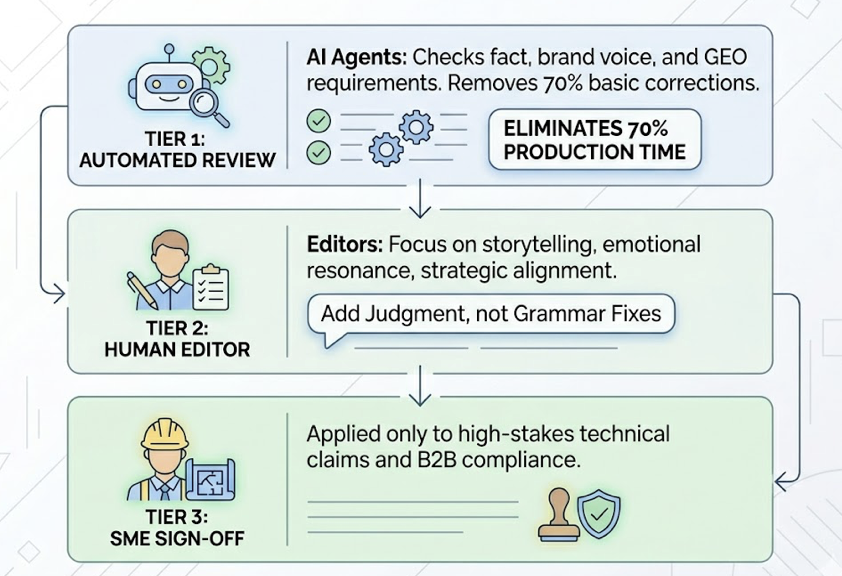
Organizations that implement structured human-AI content collaboration report a 40% boost in content output and 67% better content performance. The efficiency gains don’t come from removing humans; they come from deploying humans only where human judgment actually changes the outcome.
That’s the real model for content generation at scale.
AI Content Creation for B2B Brands: What the Numbers Actually Require
B2B content carries a different weight. Nearly 90% of B2B buyers now use generative AI at some stage of their buying process. They’re not looking for top-ten lists; they’re looking for technical authority and a clear chain of evidence.
The trust gap is significant. Only 6% of B2B leaders trust AI with high-stakes tasks like market positioning, and 57% identify strategic thinking as its biggest weakness in marketing applications. That’s not a reason to avoid AI content creation; it’s a reason to structure the workflow so AI handles volume and humans handle positioning.
For B2B teams, AI content creation strategy works best when applied to asset repurposing: turning a 60-minute customer interview into a blog post, a LinkedIn series, and an email nurture sequence. The strategic core stays human. The distribution and adaptation layer gets automated.
Multilingual content is another high-return application. AI can localize content far faster than traditional translation workflows. The key distinction in 2025 is moving beyond word-for-word translation toward cultural adaptation, where regional tone and example selection are adjusted to match local market expectations, not just local language.
For B2B brands measuring ROI: top-performing content programs driven by AI report a 748% return on high-quality, well-cited content assets. The compounding effect comes from the fact that a well-structured article continues generating inbound interest and AI citations long after it’s published, with no recurring cost.
How AI Content Creation Impacts Your AI Search Rankings
Here’s the thing most content teams still don’t fully understand: being cited by an AI assistant isn’t a downstream result of good content. It’s a prerequisite for being found at all.
Research from Ahrefs’ analysis of 250 million AI responses found that traditional SEO ranking factors explain only 4–7%of AI citation outcomes. A page ranking first on Google has less than a 40% chance of being the primary source cited in a corresponding AI Overview. The ranking signal and the citation signal are largely different systems.
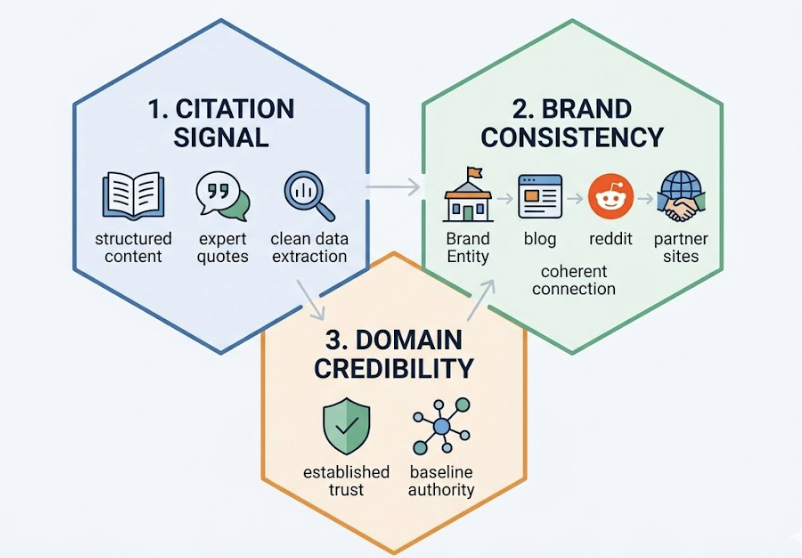
AI search rankings depend on three factors working together. First, citation signal: does your content provide the data points, expert quotes, and structured summaries that retrieval-augmented generation (RAG) systems can extract cleanly? Second, brand consistency: is your brand entity clearly defined and coherent across your blog, Reddit presence, industry publications, and partner sites? Third, domain credibility: while backlinks explain less of AI visibility than they once did for SEO, they still establish a baseline of trust that influences whether an AI engine treats your content as a reliable source.
The traffic quality argument is compelling even when raw volume drops. Visitors referred by generative AI convert at 4.4x to 5.1x the rate of traditional organic search visitors. A brand that appears in fewer AI answers but in the right ones, with high-intent users, often outperforms a brand with high organic traffic and no AI presence.
That said, the two channels reinforce each other. Sites that rank in the top 10 on Google are 76% more likely to be cited by AI Overviews. The implication is that strong SEO and strong GEO aren’t competing strategies; they’re the same underlying bet on content quality and authority.
Topify’s Source Analysis tracks which content domains are being cited by AI for specific prompts. This makes competitive gap analysis concrete: you can see exactly where a competitor is being recommended over your brand and trace it back to the domain or article being cited. Visibility Tracking then provides real-time data on your brand’s appearance rate across ChatGPT, Gemini, and Perplexity, which is the number you need when proving GEO impact to leadership.
Conclusion
The teams that scale AI content creation and see no improvement in brand visibility aren’t doing content wrong. They’re doing it for the wrong system.
Traditional content automation builds for the Google ranking model: keyword density, link equity, and click-through rates. AI content creation for SEO and GEO requires a different output: information density, entity consistency, and citation architecture. Those are learnable, buildable, and measurable. But they require intentional workflow design, not just faster output.
The practical starting point is simple: audit your last 20 published articles against the citation criteria above. Check whether they open with a direct answer, whether they include verified data points linked to primary sources, and whether your brand is consistently named and described. Most teams find immediate gaps. Fixing those gaps doesn’t require more content. It requires better-structured content, which is where the actual leverage is.
Get started with Topify to track how your current content is performing in AI search, and where the gaps are before competitors fill them.
FAQ
Q: What is the best AI content creation process for blogs?
A: The most effective approach is a five-step hybrid model: identify AI search demand using tools that surface conversational prompts (not just Google volume); draft with an answer-first structure and high data density; apply a brand voice layer before publishing; run a three-tier review (automated facts check, human editorial, expert sign-off on technical claims); and optimize for GEO by adding schema, expert quotes, and primary source citations. The goal isn’t just readable content; it’s citable content.
Q: How do I integrate AI into my existing content workflow without disrupting my team?
A: Start with the lowest-risk tasks: summarization, first-draft generation, and content repurposing from existing assets like webinars or research reports. Keep humans in the strategic roles, specifically topic selection, positioning, and the final editorial pass. Establish clear usage guidelines so the team knows which decisions AI can make and which require human judgment. Disruption typically comes from ambiguity, not from the tools themselves.
Q: How to create consistent content at scale with AI?
A: Consistency at scale depends on two things: centralized brand voice documentation and a repurpose-first content strategy. Build custom prompts that embed your tone, terminology, and audience expectations directly into every generation task. Then treat each high-quality human-led asset, like a customer case study or research report, as a source to be atomized into multiple AI-assisted formats. The core message stays consistent because it originates from a single authoritative source.
Q: How does AI content creation affect organic and AI search rankings differently?
A: Traditional SEO rankings are graduated (positions 1 through 100) and depend primarily on backlinks and keyword relevance. AI search visibility is largely binary: your brand is either cited or it isn’t. The ranking signals are different too. SEO favors external link authority; AI citation favors brand mention frequency, information density, and factual accuracy within the content itself. That said, sites in the top 10 on Google are 76% more likely to be cited by AI Overviews, so the two channels reinforce each other when both are treated as content quality investments.

