

90% of content marketers now use AI to generate blog posts. Only 26% have figured out how to generate tangible value from it.
That gap isn’t a tool problem. It’s a strategy problem.
Most teams evaluate AI blog generators on the wrong metrics: output speed, word count, and how quickly a draft lands in Google Docs. Those things matter, but they’re table stakes. The real question is whether the content you’re generating actually gets found, read, and cited by the AI systems your audience now uses to make decisions.
This guide breaks down the AI blog generators worth your time in 2025, how to build a workflow that produces content at scale, and the piece most teams miss entirely: making sure your content shows up in AI answers, not just search results.
Most AI Blog Tools Produce Content. Few Produce Content That Gets Found.
Here’s a number that should reframe how you evaluate these tools: only 12% of URLs cited by AI assistants like ChatGPT and Perplexity actually rank in Google’s top 10 results.
That means optimizing purely for Google is no longer enough. A page can rank #1 on Google and still be invisible to the AI systems your prospects are increasingly using to research tools, compare options, and make purchasing decisions. The inverse is also true: some of the most-cited sources in AI answers have modest Google rankings.
This doesn’t make traditional SEO irrelevant. It means the bar has shifted. Content now needs to satisfy two retrieval systems simultaneously, with different rules for each.
What a Good AI Blog Generator Actually Does (Beyond Filling a Text Box)
Speed is the obvious value proposition. Content marketers save an average of 11.4 to 12.2 hours per week per employee by integrating AI into their writing workflow, and teams using these tools complete writing tasks 77% faster than those that don’t.
But the automated blog generation tools worth investing in go further than raw output speed.
The differentiators are structural. The strongest AI blog writing tools integrate real-time SEO data so you’re not writing about topics that already peaked six months ago. They handle long-form structure coherently across 2,000 to 5,000 words, not just in the first three paragraphs. They generate metadata, suggest internal links, and flag readability issues before the draft goes to a human editor.
The underlying technology shift driving this is the move from purely parametric knowledge to Retrieval-Augmented Generation (RAG). Early LLMs fabricated information at rates as high as 55%. Modern tools using live search indices produce outputs grounded in current data, which directly affects whether the content passes editorial review and earns citations from other AI systems.
That’s the baseline. Here’s what the field actually looks like.
7 AI Blog Generators Worth Using in 2025, Ranked by What Actually Matters
| Tool | Starting Price | Primary Strength | Ideal For |
|---|---|---|---|
| Jasper | $69/mo | Brand voice & team collaboration | Enterprise content governance |
| Writesonic | $49/mo | SEO + AI search visibility | Content scaling & GEO |
| Copy.ai | $36/mo | Workflow automation | Solo marketers, rapid iteration |
| Surfer SEO | $79/mo | Real-time SERP analysis | Technical on-page optimization |
| Notion AI | $10/mo (add-on) | Internal workspace context | Internal docs, summarization |
| ChatGPT | Free / $20+ | Flexibility, research-to-draft | General drafting, exploration |
| Perplexity | Free / $20+ | Real-time source grounding | Research-heavy long-form |
Jasper is the choice for marketing teams that can’t afford brand inconsistency. Its Brand Voice and Knowledge Base features train the model on company-specific tone and facts, making it particularly strong for regulated industries or organizations with multiple content contributors. At $69/month for the Pro plan, it’s on the higher end for smaller teams.
Writesonic has built a distinct edge by embedding GEO directly into its content suite. Its AI Article Writer 6.0 produces long-form posts up to 5,000 words with real-time competitor analysis, and its GEO tracking layer monitors how content surfaces across ChatGPT and Google AI Overviews. For SEO-led agencies managing multiple clients, it’s one of the more complete auto blog writer options on the market.
Copy.ai started as a short-form copywriting tool and has evolved into a workflow automation platform. Its strength is speed and repeatability: generating landing page variants, email sequences, and blog outlines in bulk. At $36/month, it’s the most accessible entry point for solo founders and small teams.
Surfer SEO focuses on technical optimization rather than raw generation. It scores content against live SERP data and tells you exactly what to add or restructure to compete on a given keyword. Best used alongside a generation tool rather than as a standalone AI writing assistant.
Notion AI is a capable workspace tool, but its long-form content output is generally weaker than purpose-built platforms. It works well for summarizing internal research or drafting meeting notes, less so for publishing-quality blog posts.
ChatGPT and Perplexity remain genuinely useful for research-to-draft workflows, especially when you need a human editor to do significant restructuring anyway. Perplexity’s source-grounded approach reduces the hallucination risk that plagued earlier generative tools.
How to Generate SEO-Optimized Blog Posts with AI: A 5-Step Workflow
The teams producing AI content that actually drives traffic and citations aren’t just prompting an LLM and hitting publish. They’re running a structured process.
Step 1: Find the right prompts before you write.
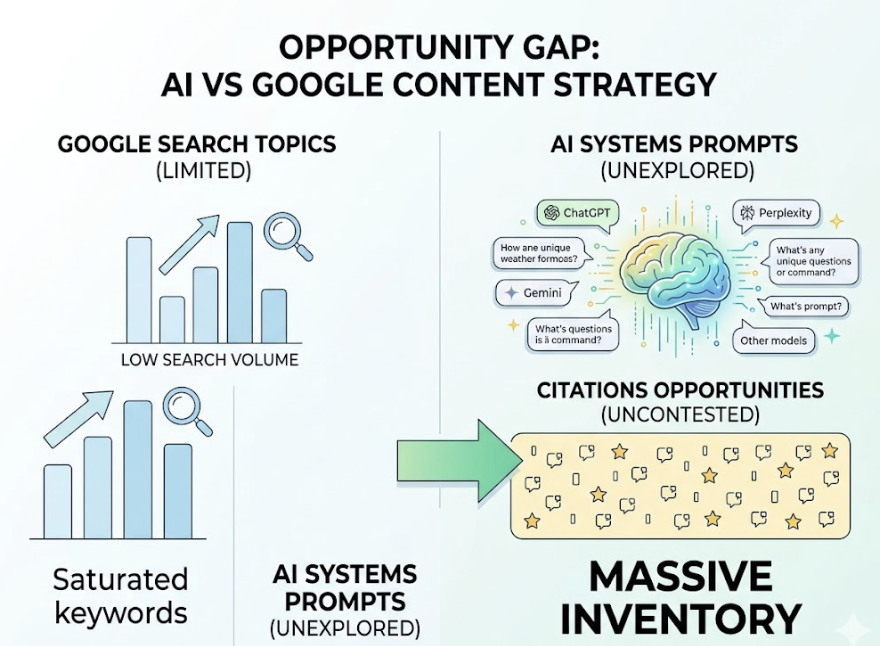
The biggest missed opportunity in AI content strategy is writing about topics people search on Google without checking what people are asking AI systems. Tools like Topify’s AI Volume Analytics surface high-value prompts that are being used in ChatGPT, Perplexity, and Gemini, including prompts with zero recorded search volume in traditional SEO tools. Research shows that 95% of the sub-queries AI models generate to answer a prompt have no search volume in SEMrush or Ahrefs. That’s a massive inventory of uncontested citation opportunities.
Step 2: Generate a structured draft.
Use your chosen AI blog generator to produce the initial draft. For long-form content (1,500+ words), Writesonic or Jasper typically outperform general-purpose models on structural coherence. Feed the tool your target keyword, related intents, and any specific data points you want included.
Step 3: Apply SEO and GEO structure.
AI-generated drafts often need structural editing. Front-load your key answer in the first 200 words. Research on 1.2 million ChatGPT answers found that 44.2% of all citations are pulled from the first third of a page’s content, while the bottom 10% earns just 2.4% to 4.4%. Break content into 200-400 word sections with clear H2/H3 headings. Add FAQ blocks: pages with FAQ schema average 4.9 citations compared to 4.4 for those without.
Step 4: Add human signal.
Google’s 2025 E-E-A-T updates now heavily weight the “Experience” component, favoring content that demonstrates first-hand knowledge. An AI-generated draft that goes straight to publish without original insight, real data, or a human editorial perspective is increasingly likely to underperform. Add a specific case study, a contrarian observation, or original analysis. This is the step that separates content that ranks from content that gets ignored.
Step 5: Publish and track AI citation.
Most teams stop at publication. The teams closing the ROI gap track what happens after. Specifically: which of your published posts are being cited by ChatGPT, Perplexity, and Gemini, and which aren’t. Topify’s Source Analysis monitors the exact domains and URLs AI platforms are citing in responses, letting you identify which content is working and which needs to be restructured or updated.
Does AI-Generated Blog Content Actually Rank on Google and Get Cited by AI?
These are two different questions with two different answers.
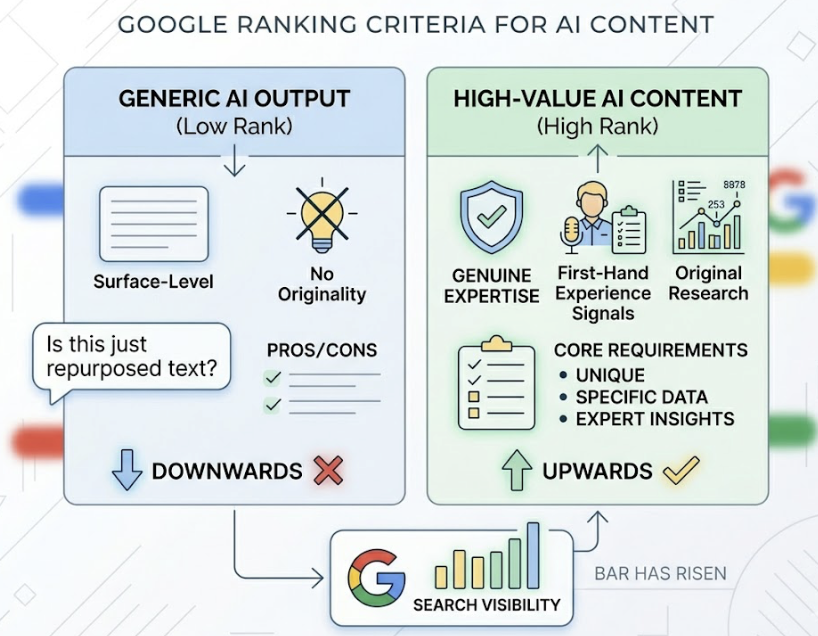
On Google ranking: the evidence suggests AI-generated content can rank, but the bar has risen. Google’s core updates have tightened requirements for unique, non-commodity content, and the algorithm is increasingly capable of detecting the gap between surface-level coverage and genuine expertise. AI content that includes original research, first-hand experience signals, and specific data points performs comparably to human-written content. Generic AI output doesn’t.
On AI citation: the rules are different, and most content teams don’t know them.
AI engines evaluate sources based on domain authority (roughly 40% of the weighting), content quality (35%), and platform trust signals like Trustpilot, G2, or Wikipedia presence (25%). Content updated within the last 30 days is 3.2x more likely to be cited than older material. ChatGPT pulls approximately 6x more pages than it eventually cites, with citation heavily concentrated: around 30 domains capture 67% of citations within any given topic.
The practical implication: most brands are fighting for Google rankings without tracking whether their content is being cited by the AI systems their prospects are increasingly using to make decisions. That’s a significant blind spot. Topify’s visibility tracking monitors brand mentions across ChatGPT, Gemini, Perplexity, and other major AI platforms, giving content teams a clear picture of where their investment is actually landing.
Free vs. Paid AI Blog Generators: Where the Real Gap Is
The honest answer is that free tools have gotten good enough for basic drafting. ChatGPT’s free tier can produce a usable first draft. Notion AI’s add-on handles summarization and short-form content adequately. For solo founders or teams experimenting with AI content for the first time, free is a reasonable starting point.
The gap widens in three specific areas.
First, long-form coherence. Free-tier tools often drift in structure and tone past the 800-word mark. Paid tools built specifically for blog generation maintain narrative consistency across 3,000+ word posts.
Second, SEO and GEO integration. Paid platforms like Writesonic and Surfer SEO pull live search and SERP data into the drafting process, ensuring the content is calibrated to current ranking factors rather than training data from six months ago.
Third, workflow automation. AI-produced content is estimated to be up to 4.7x less expensive than content created entirely by humans. But that cost advantage scales with automation. Paid platforms that connect keyword research, drafting, optimization, and publishing into a single workflow deliver the full productivity dividend. Free tools require manual stitching between steps, which adds back the hours you were trying to save.
The decision framework is simple: if you’re publishing more than two posts a week and treating content as a growth channel, the ROI case for a paid AI writing assistant is straightforward. If you’re occasional, start free and upgrade when the bottleneck becomes quality rather than volume.
The Missing Piece: Generating Blog Content That Drives AI Search Visibility
Here’s the part most content teams don’t think about until it’s too late.
AI referral traffic converts at 14.2%, compared to 1.76% to 2.8% for traditional organic search. That’s a 5x+ difference. Traffic arriving from a ChatGPT or Perplexity citation is arriving with higher intent and more context than a generic Google click.
The brands capturing that traffic aren’t necessarily the ones publishing the most content. They’re the ones that know which content is being cited and why, then systematically build more of it.
That’s the visibility gap most content marketing teams are running blind to. They can see their Google rankings. They don’t know whether their ten most recent AI-generated blog posts are showing up in any AI answers at all.
Topify closes that gap. Its platform tracks how brands are mentioned across ChatGPT, Gemini, Perplexity, and other major AI systems, monitoring seven key metrics: visibility, sentiment, position, volume, mentions, intent, and conversion visibility rate. The Source Analysis feature shows exactly which domains and URLs AI platforms are citing in your category, letting you see whether your content is in that mix or sitting invisible.
For content marketing teams scaling AI blog production, this is the missing feedback loop. Generating posts at 2.5x your previous frequency only compounds your advantage if you know which posts are earning citations and which aren’t.
Topify’s Basic plan starts at $99/month, covering ChatGPT, Perplexity, and Google AI Overviews tracking across 100 prompts.
Conclusion
AI blog generators have made content production fast and affordable. That’s table stakes now, not a competitive advantage. The teams pulling ahead aren’t generating more content. They’re generating content that satisfies two retrieval systems at once: Google’s E-E-A-T requirements and the citation logic of AI engines like ChatGPT and Perplexity.
The workflow is clear. Use a purpose-built AI blog writing tool that integrates real-time SEO data. Front-load your best answers for RAG extraction. Add human expertise signals that generic AI output can’t replicate. Then close the loop by tracking whether your content is actually being cited by the AI systems your audience uses.
Most teams nail the generation step and skip the rest. That’s why 90% of content marketers use AI tools and only 26% are generating measurable value from them.
The gap is closable. It just requires treating AI visibility as a metric, not an afterthought.
FAQ
How do you generate a blog post with AI step by step?
Start with keyword and prompt research to identify topics with both search demand and AI query volume. Use an AI blog generator to produce a structured draft. Apply GEO formatting: front-load your key answer, break content into 200-400 word sections with clear headings, and add FAQ blocks. Edit for human expertise signals, then publish and track which posts earn AI citations using a tool like Topify.
What’s the difference between free and paid AI blog generators?
Free tools handle basic drafting adequately. Paid platforms add live SEO data integration, long-form structural coherence, and workflow automation that compounds productivity gains at scale. If you’re publishing more than twice a week, the economics of paid tools typically pay for themselves within the first month.
How do you generate blog posts at scale with AI?
The most effective approach combines an AI writing tool for drafting, a structured editorial process for quality control, and a feedback loop that tracks which published posts earn citations from AI systems. Publishing volume alone doesn’t create compounding returns. Citability does.
Does AI-generated content rank on Google in 2025?
Yes, with conditions. Google’s 2025 updates penalize generic, thin content regardless of how it was produced. AI-generated posts that include original data, first-hand expertise signals, and specific case studies perform comparably to human-written content on most queries. Surface-level AI output doesn’t.
How do you generate blog content that shows up in AI answers?
Structure your content for RAG retrieval: lead with a direct answer in the first 200 words, use clear H2/H3 headings, include FAQ schema, and update content regularly (material updated within 30 days is 3.2x more likely to be cited). Track your citation performance using a platform like Topify to identify which posts are being picked up and which need restructuring.

